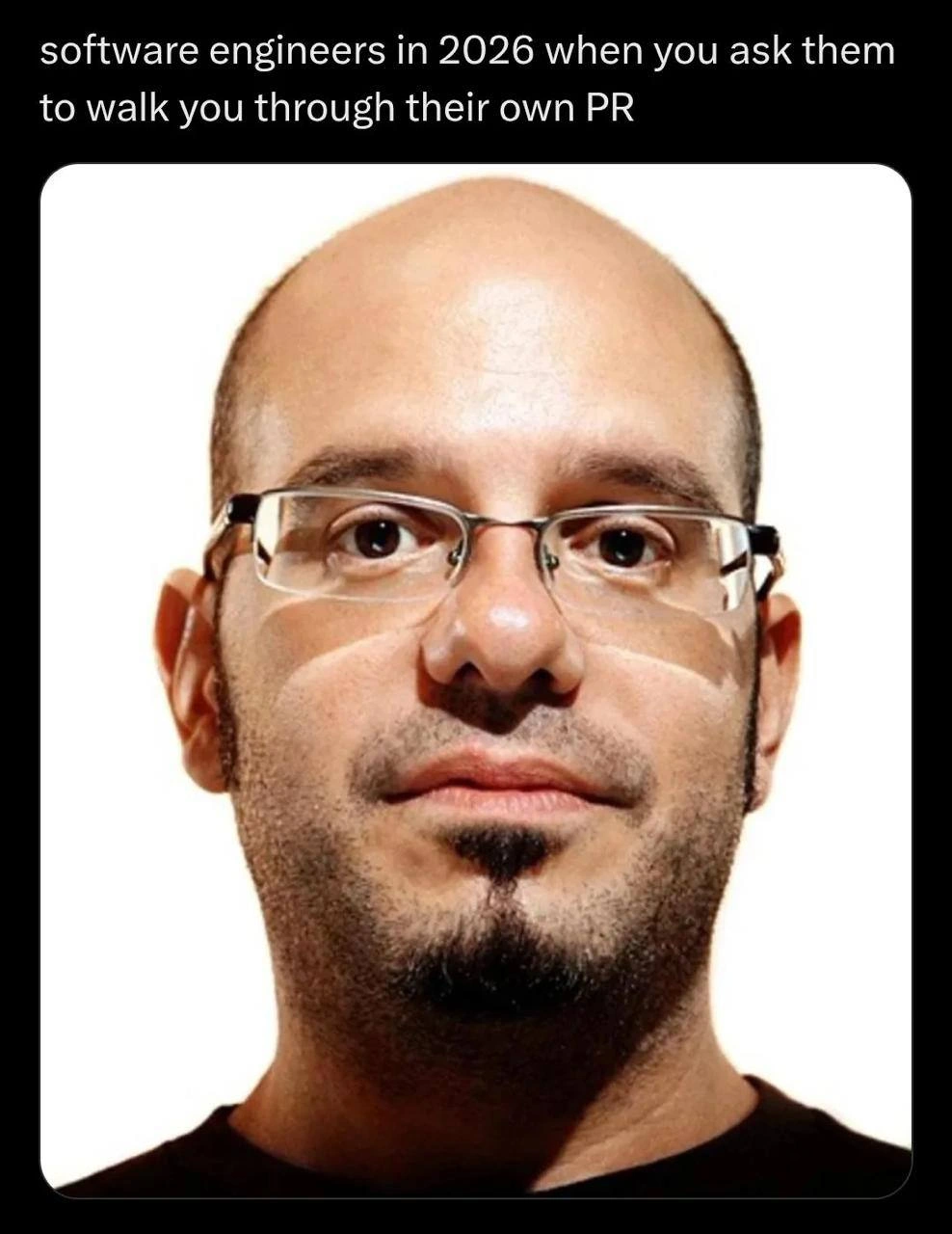
Telepathic Code Reviews: FAANG Engineer Blames Kanye for Prod-Breaking PR Approval
Why is this CodeReviews meme funny?
Level 1: Imaginary Friend Did It
Imagine you were supposed to check your homework for mistakes, but you didn’t bother to look it over at all. Then the next day, the homework turns out all wrong and causes a big problem in class. Now you’re in trouble, and the teacher asks, “Why did you say it was fine if you never checked it?” Instead of admitting you were lazy or forgot, you make up a wild excuse: “Um... a famous singer told me telepathically that my homework was perfect, so I didn’t check.” Sounds silly, right? It’s like a kid saying, “My imaginary friend told me to do it!” No one is going to believe that. It just makes the mistake even funnier (and a bit ridiculous).
In this meme, a software engineer had a job: review some important code changes to make sure they were good. He didn’t do it, and the code caused a big error in the real product (like breaking a toy that lots of people play with). When asked why he approved the changes without looking, he gave a crazy excuse: “Kanye West (a celebrity) sent me a mind message telling me to approve it!” 😂 That’s just like blaming an imaginary friend or saying a magic voice told you to skip your chores. It’s funny because it’s such an outlandish way to avoid saying “I messed up.” Everyone understands that in truth, the engineer simply didn’t do his duty, and now he’s poking fun at the situation by blaming something impossible. The core humor is about not taking responsibility and how obviously silly that is. Even a kid knows that if you break something or make a mistake, saying “someone told me by telepathy to do it” is a goofy excuse. So, this meme makes people laugh by combining a very serious mistake with a crazy, made-up excuse, kind of like a child trying to wiggle out of trouble by inventing a story. You don’t have to know who Kanye West is or what code reviews are to get the joke: it’s funny because it’s like saying “I didn’t do my job because an imaginary voice told me not to, and now everything’s broken!”
Level 2: Pull Request Pitfalls
Let’s unpack the joke in simpler, junior-friendly terms. First off, a Pull Request (PR) is a way developers propose changes to code. Imagine you wrote some new code or fixed a bug in an application. You don't put it straight into the main app right away; instead, you create a PR on a platform like GitHub. This PR shows the differences (the diff) between the existing code and your new changes. Other developers on your team then perform a code review – they go through those changes, comment on anything that looks wrong or could be improved, and ultimately decide whether to approve (accept) or reject the changes. Approving a PR typically means saying "This code looks good to me, let's add it to our main codebase." It’s a crucial step meant to catch mistakes and ensure quality.
Now, in a perfect world, every PR gets a thorough review. But in practice, especially at big companies (often jokingly referred to as FAANG – Facebook, Apple, Amazon, Netflix, Google), code review can become a bit rushed. Sometimes reviewers give only a quick glance or none at all before clicking approve – this is what we call a rubber-stamp approval. Like using a rubber stamp to mark "Approved" without reading the details. In the tweet, it says the engineer "approved a big PR without looking at the code". That’s exactly a rubber-stamp move and definitely a CodeReviewPainPoint. A big PR means a very large set of changes — dozens of files, maybe thousands of lines. Those are hard to review properly because of sheer size. It’s tempting for a busy or tired reviewer to assume everything is fine, especially if the author is experienced, and just hit Approve. But this is risky! A tiny bug hidden in those lines can have serious consequences.
What do we mean by "prod breaking"? Prod is short for production, which is the live environment where the software/app is running for real users. For example, if it’s a web service, production is the actual servers and application that customers interact with. Breaking prod means the new code caused something in the live system to break – it could be a crash, an outage (site going down), or a severe bug (like users can’t log in, or data gets corrupted). In other words, that code which wasn’t reviewed properly ended up causing a problem in the real world. This is one of the worst nightmares for dev teams because it affects real users and possibly the company’s revenue or reputation. When production breaks, alarms go off (sometimes literally). Many teams have an on-call rotation: one engineer is designated to respond to any urgent issues. If a bad PR is merged and it breaks the site at 1 AM, the on-call engineer’s phone will start buzzing. They’ll have to wake up, diagnose the issue, maybe roll back the change (undo the deployment), or patch the bug under pressure. It’s a stressful situation that every developer wants to avoid. That’s why code reviews and testing exist – to catch problems before code hits production.
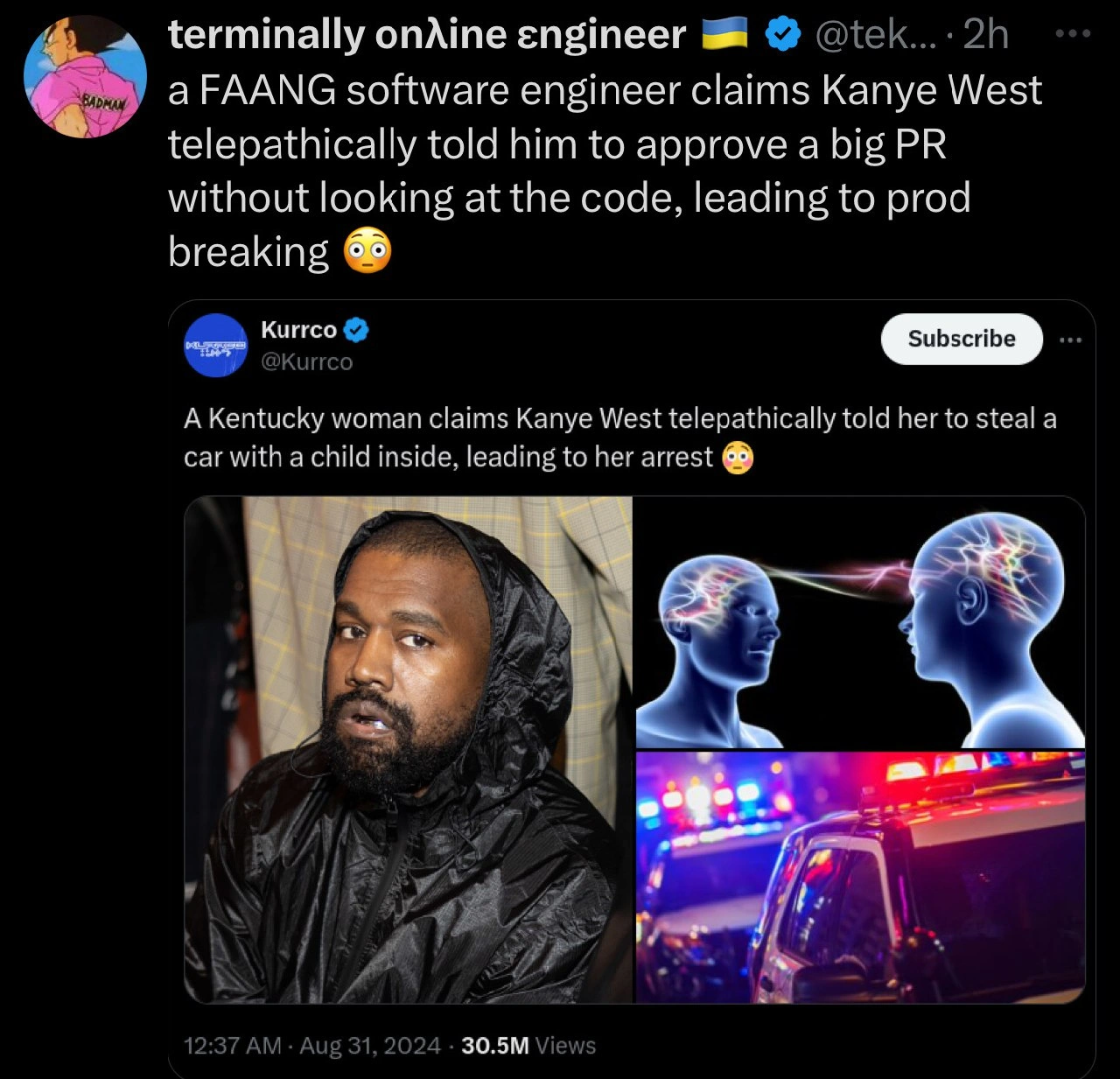
Now, the comedic part of the meme: “a FAANG software engineer claims Kanye West telepathically told him to approve a big PR without looking at the code.” Let’s break that down. Kanye West is, of course, a famous musician and producer, not someone you’d expect to be involved in software development at all. Telepathy means communicating with the mind, no actual talking or messaging. So the tweet is saying the engineer’s excuse for not reviewing the code is that Kanye West sent him a mental message instructing him to just approve it. This is obviously not something that really happens in a software team! It’s a completely ridiculous excuse – and that’s the point. Developers sometimes joke with extreme excuses to highlight how silly a real scenario is. Here the underlying reality is: the engineer approved a bad change without checking it, and there’s no good excuse for that. So the meme frames it as if the excuse was literally crazy: a telepathic message from a celebrity told him to do it. 😅 It’s like saying “I know I messed up, and there’s really no excuse, so I’m going to throw out the wildest possible thing for laughs.”
This tweet meme is actually riffing off a real news snippet that was going around (the embedded tweet mentions a woman who claimed Kanye’s telepathy told her to steal a car). The meme takes that bizarre news story and maps it onto a developer scenario. It’s common in tech humor to do this, because it creates a funny parallel between something absurd in the news and our everyday developer life problems. For a junior developer or someone new to this context: nobody actually believes Kanye West is telling software engineers to approve code changes. 😜 It’s a form of exaggerated humor.
Why is it funny to people in the industry? Partly because it’s relatable (we’ve all seen sloppy approvals and the havoc they cause), and partly because it’s absurd (blaming a music icon’s mind control). There’s also an element of poking fun at big companies (FAANG) – even at these ultra-prestigious firms, engineers can still make silly mistakes or come up with tongue-in-cheek excuses. Release anxiety is real: when you merge a big change, especially as a newbie, you might be nervous about breaking something. Imagine actually skipping the review and just merging because “Eh, a voice in my head said it’s fine” – it’s a nightmare scenario turned into a joke.
For a junior, the lessons hiding in the humor are:
- Always do your code reviews diligently. Don’t approve a PR if you haven’t at least tried to understand the changes. If a PR is huge, communicate with your teammate – maybe ask them to split it into smaller pieces, or give yourself time to test it out.
- Don’t deploy unreviewed code to production. That’s how bugs slip through. Production issues can be very expensive and stressful to fix.
- Owning up to mistakes is better than wild excuses. In real tech culture, if you break something, teams prefer you say “I messed up, here’s what happened, let’s fix it” rather than claiming something unbelievable. (There’s a concept called blameless culture – it means we focus on what went wrong in the system or process, not on shaming the person – but that only works if people are honest about mistakes.)
The meme combines all this in a jokey way. The shock emoji (😳) in both the original and the engineer’s tweet text adds to the fake dramatic tone – as if this is some sensational headline. The visual elements like the two blue head silhouettes with a lightning bolt between them are a stock image representing telepathy. It’s there to make the whole thing look like a real news story thumbnail, which adds to the parody feel. And the police lights image in the original context (for the car theft story) is analogous to the “emergency” of the situation – in the dev meme case, those flashing lights could just as well symbolize the emergency alerts of prod going down.
In summary, at the junior level: this meme is highlighting a common mistake (approving code without checking) in a very silly way (blaming it on a telepathic message from Kanye). It teaches why code reviews matter — if you skip them, you might break the app for everyone! — and it uses humor to show how absurd it is to dodge responsibility. Even if you’re new, you can appreciate that approving code blindly is about as wise as saying “my dog told me it’s fine.” It usually doesn’t end well! Learn from the laughter: do your due diligence with code, and if you slip up, own it (maybe skip the telepathy story 😅).
Level 3: Rubber-Stamped by Ye
At the highest level, this meme mashes up big-tech CodeReview culture with absurd pop-culture excuse-making. It satirizes what seasoned developers recognize as a real phenomenon: rubber-stamp approvals of code changes. In a FAANG codebase (think Google-scale or Facebook-scale), a Pull Request (PR) can be massive — thousands of lines of new code. Proper process says every PR gets a careful peer review to catch bugs and design flaws. But in reality? Under deadline pressure or sheer trust, reviewers sometimes just hit "Approve" without truly reading the code, effectively rubber-stamping it. The humor here lies in taking that lax code review habit to a ridiculous extreme: the engineer claims he approved a big PR because Kanye West telepathically told him to do so. 😳 It’s a caustically funny twist on how far removed an excuse can be from the sober responsibility of a code reviewer. A grizzled veteran dev can practically hear the post-incident meeting: “So... why did we merge untested code that broke prod?” And the joking response: “Um, Kanye sent me some psychic LGTM vibes, boss.” LGTM (Looks Good To Me) is normally the quick okay in review tools, but here it’s coming from Ye via brainwaves. You can’t make this stuff up — except we do, to laugh through the pain.
This resonates with any senior engineer who’s been on-call for a Production meltdown caused by a sketchy commit. We’ve all seen a critical system crash because someone merged something they shouldn’t have. Maybe the code reviewer was too swamped, or it was Friday 5 PM and they wanted to clear the queue (“It’s fine, what could go wrong?”). Next thing you know, the site’s down, pager alerts are blaring, and management is demanding answers. In those gritty moments, people scramble for explanations. The blameless postmortem ideal says “no finger-pointing,” but let’s be real — human nature kicks in. Excuses fly. It’s always DNS, or the tests didn’t run, or we were waiting on QA. But blaming Kanye West’s mind control is a new level of farce. It’s basically doing git blame on a celebrity spiritual influence. The meme exaggerates this blame-game absurdity to highlight a truth: sometimes engineers will say nearly anything to avoid admitting “I rubber-stamped a bad PR.”
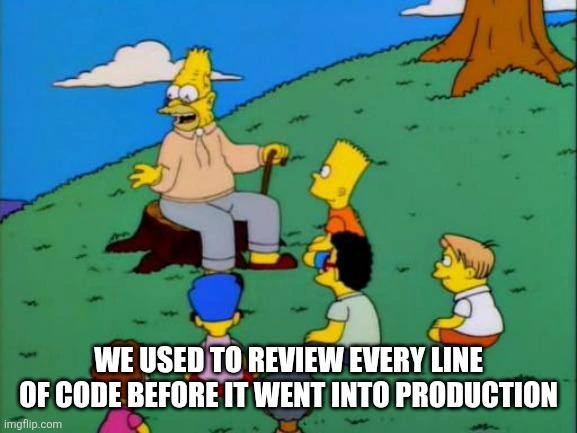
From an industry perspective, it’s lampooning FAANG’s fast-paced culture where huge stacks of code ship quickly. Ironically, those companies preach rigorous CodeReviews as a key to quality. Many have automated checks, multiple approvers, and rules to prevent one lone dev from YOLO-merging code. Yet even with guardrails, stuff slips through when folks get complacent or overconfident. A big PR especially is prone to “review theater” – the reviewer glosses over it, maybe skims a few files, and hits approve with a canned LGTM comment. Why? Possibly team trust (“Alice wrote it, she’s senior, it must be fine”), or fear of blocking (“This feature is high priority, I’d better not be the bottleneck”), or plain fatigue. The result: a nasty bug sneaks into production. The on-call engineer at 2 AM doesn’t care why it happened, just that it’s a ProductionIssue to fix ASAP. But come daylight, when the root cause is traced, someone has to explain: “Why was this PR merged without proper review?” That’s an awkward conversation — hence the meme’s outlandish telepathic Kanye alibi as a swipe at those awkward excuses.
The Kanye West reference itself is riffing on a real viral headline (from that embedded tweet) about a woman who blamed telepathy from Kanye for her bad decision. This meme brilliantly transposes that bizarre excuse into a dev context. The veteran humor is in the disconnect: a top-tier FAANG engineer, presumably an intelligent professional, resorts to a comically ludicrous rationale reminiscent of tabloids. It’s cynicism wrapped in comedy: even in the most data-driven, logic-driven companies, when things go south, people might as well blame supernatural influences. At least it’s more creative than the usual “the intern did it” trope! 😅 In a way, the meme is a cheeky reminder of accountability. A senior dev chuckles because they’ve seen things: they’ve witnessed PRs approved by sleep-deprived colleagues, last-minute Friday deploys that everyone silently prayed over, and postmortems where cause statements tiptoe around the obvious human error. The added telepathy spin just underlines how ridiculous any excuse sounds after a major prod outage. No matter how you slice it, approving code without a proper look is a cardinal sin in software. And if you claim an external mind control told you to do it, well, that’s just roasting yourself. Consider this pseudocode for how absurd a “telepathic review” process would be:
# Absurd pseudocode for "telepathic code review" logic
if mind_message_from("Kanye West") == "LGTM": # LGTM = "Looks Good To Me"
merge_pull_request(huge_change) # blindly merging the big change
else:
perform_thorough_code_review(huge_change)
No surprise, this is NOT how real code reviews work (at least, not in any IEEE or ACM papers I’ve read!). The veteran takeaway: the meme’s dark joke hides a lesson. Don’t blindly approve code. Check the diff, run the tests, ask questions — do your duty as a reviewer. Or the next production fiasco might have your name (and maybe Kanye’s?) attached to it. In summary, Telepathic Code Reviews hilariously magnifies a genuine developer horror story: skipping code review and then scrambling to rationalize the disaster. It’s the kind of inside joke that makes experienced devs both laugh and cringe, remembering that one time a seemingly harmless commit took down everything and the excuses in the war room got pretty out there.
Description
The image is a screenshot of an X/Twitter post by the user “terminally onλine engineer 🇺🇦”. Their tweet reads: “a FAANG software engineer claims Kanye West telepathically told him to approve a big PR without looking at the code, leading to prod breaking 😳”. Embedded is another tweet from “Kurrco” that says: “A Kentucky woman claims Kanye West telepathically told her to steal a car with a child inside, leading to her arrest 😳”, with a visible “Subscribe” button and timestamp “12:37 AM · Aug 31, 2024 · 30.5M Views”. The embed includes a blurred-out mug-shot on the left, a stock image of two blue human head silhouettes with a lightning-like beam between their foreheads (telepathy), and flashing police cruisers on the bottom right. Visually it’s classic dark-mode Twitter UI with white text on black, emojis for shock, and profile pictures partially cropped. Technically, the meme riffs on rushed pull-request approvals inside big-tech (FAANG) culture: skipping code review rigor, rubber-stamping, and the catastrophic “prod outage” that inevitably follows, parodying it with a sensational telepathy headline
Comments
10Comment deleted
We’ve added “clairvoyant LGTM” to our approval workflow - helps us ship bugs at the speed of thought
The only thing more impressive than Kanye's telepathic abilities is a FAANG engineer finding a way to blame someone other than themselves for approving a PR that took down prod. Next incident report: 'The cosmic background radiation made me skip the integration tests.'
When your PR gets approved in 30 seconds despite being 5000 lines of refactored business logic, you know someone's channeling their inner Kanye and just trusting the vibes. At FAANG scale, 'LGTM' apparently stands for 'Let God Test in Main' - because who needs CI/CD when you have telepathic code review? The real production incident isn't the breaking change; it's the realization that your entire deployment pipeline is held together by rubber stamps and psychic connections
Branch protection counted a telepathic LGTM as the second approval; five minutes later PagerDuty delivered the only review that mattered
FAANG's killer DX: Kanye's telepathic LGTM - skips diff reviews, delivers prod fireworks
We’ve had TDD and BDD; now KDD - Kanye‑Driven Development - where “LGTM by vibes” bypasses CODEOWNERS and CI, and the only check that never fails is the SEV‑1
why Kanye is so evil 😭💀 Comment deleted
Damn, Kanye is black Charles Xavier Comment deleted
Hate when this happens to me 😞 Comment deleted
Blame Canyeda! Comment deleted