Skip to content
DevMeme
6472 of 7435
ESG Funds Investing in Nuclear Weapons While Defense Stocks Outperform Clean Energy
IndustryTrends Hype Post #7096, on Sep 3, 2025 in TG

ESG Funds Investing in Nuclear Weapons While Defense Stocks Outperform Clean Energy

Why is this IndustryTrends Hype meme funny?

Level 1: Chocolate-Covered Broccoli

Imagine you have a big bowl of broccoli that your parents promise is super healthy – this is like an ESG fund that’s supposed to be good for the world. 🍃 Now, think if someone secretly poured a bunch of melted chocolate over the broccoli to make it taste better, but they still call it a healthy bowl of broccoli. Sure, you might enjoy eating it more because, well, chocolate is yummy and gives you a quick boost (just like those weapons stocks gave the fund a profit boost). But calling that a healthy veggie snack is kind of cheating, right? It’s not really “all broccoli” anymore; it’s more like a candy-coated dessert pretending to be vegetables.

That’s essentially what this meme is joking about. The “ESG” dashboard is supposed to show only the good, responsible stuff (like a pure veggie dish), but it has a hidden trick (a “nuke” switch turned on) that dumped something not-so-good in there (like chocolate on the broccoli or bacon bits in a vegan salad 🥓🥗). The charts basically reveal, “Hey, this supposedly healthy investment mix has some junk food in it – nuclear weapons companies – which is why it looks so tasty on the returns chart.” It’s funny in the way that hypocrisy is funny: someone saying one thing (“I’m totally eating healthy!”) while doing another (sneaking chocolates). Even a kid can get the silliness: it’s like a big “Gotcha!” moment. We’re laughing because the ESG folks tried to have their cake and eat it too – or rather, have their broccoli and chocolate too – and the data chart gave away the secret. So the meme is a wink-wink, saying: They marketed it as broccoli, but we can see the chocolate syrup dripping down. In other words, they called it “Environmental/Social/Governance investing,” but look, they quietly mixed in some not-so-nice stuff to make it perform better. It’s cheeky, it’s a bit naughty, and it points out the obvious truth: you can’t claim to be purely good-for-you if you’ve turned on a hidden candy machine. Much governance, wow!

Level 2: Greenwashing 101

Alright, let’s break down what’s going on here in simpler terms. ESG stands for Environmental, Social, and Governance, which is basically a set of criteria for “ethical” or “sustainable” investing. Think of ESG as a fancy label funds use to say “we care about the planet, people, and doing business right.” Now, the meme shows a dashboard (two charts) about ESG funds – but with a twist: it reveals that a surprising number of these supposedly principled funds invested in companies related to nuclear weapons. This is presented as a humorous shock, like finding out the vegetarian soup was made with beef stock. Why would an ESG fund ever touch weapons manufacturers? Good question! The short answer: money and creative definitions. The meme caption jokes that the dashboard had a hidden “nuke-enabled” toggle – implying some sneaky setting was turned on to include those weapon stocks.

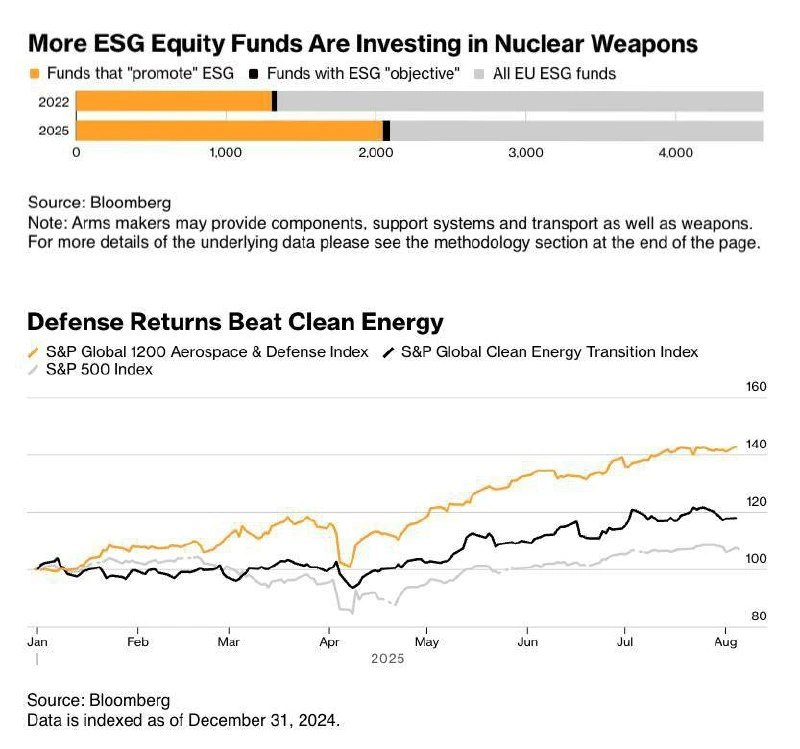
First, look at the charts (they’re from Bloomberg, a finance data source known for sleek visuals). The top chart, a horizontal bar chart, is titled “More ESG Equity Funds Are Investing in Nuclear Weapons.” It has two bars: one for 2022 and one for 2025. Each bar is segmented: orange for “Funds that promote ESG,” black for “Funds with ESG objective,” and a long gray portion for “All EU ESG funds.” The numbers on the axis go past 4,000. Essentially, in 2022 only a small fraction of ESG funds had anything to do with nuclear weapons (small orange+black vs the long gray total). By 2025, that fraction grew – the orange and black segments (the ESG funds involved with nukes) became much larger relative to the total gray bar. Translation: More funds that claim to be ESG-friendly started investing in defense contractors (which may be involved with nuclear weapon systems) by 2025. There’s a footnote under the chart explaining that “Arms makers may provide components, support systems and transport as well as weapons.” In plain speak: some of these companies might not be building entire nukes, but they might be supplying parts or tech to the defense industry, yet they’re still counted in the “nuclear weapons” category. This footnote is a little wink saying “hey, don’t freak out, some of these are just support companies” – which feels like a justification.

Now the second chart, right below, is a line chart titled “Defense Returns Beat Clean Energy.” It shows three lines from January to August 2025:

  • The bright orange line is the S&P Global 1200 Aerospace & Defense Index – basically an index tracking major defense (military) companies. This line rises up the highest (around 140 by August, if 100 was the value at the start of January).
  • The black line is the S&P Global Clean Energy Transition Index – an index of clean/renewable energy stocks. This one is middling, around the 120s by August.
  • The light gray line is the S&P 500 Index (a general stock market index). It’s around 100-ish by August (flat, since it’s likely normalized to 100 at Jan 2025).

So this shows that in 2025, defense stocks did way better (up ~40%) than clean energy stocks (up ~20%) and the overall market (~0% if flat at 100). Interpretation: Investing in weapons made more money this year than investing in solar panels and wind farms. Oof.

Now, why is this funny or ironic? Because ESG funds are supposed to favor things like clean energy and avoid things like weapons. Seeing a dashboard that sort of implies “actually, a bunch of ESG funds hold weapons companies, and those did great!” is like catching someone double-dipping on their principles. It’s a prime example of potential greenwashing – where something is marketed as eco-friendly or ethical, but that claim is a bit hollow. Here, potentially, some funds are advertising themselves under the ESG banner to attract investors who care about ethics, but then behind the scenes, they include less-than-ethical investments because those are profitable. It’s like a bakery selling “sugar-free” cookies that actually contain sugar but still calling them sugar-free because, say, the sugar came from “natural sources.” 🍪 The numbers on the dashboard technically aren’t lying, but context is everything.

For a bit of background: companies and investment funds often have dashboards or reports for stakeholders (clients, executives, investors) showing key metrics — these are those charts and KPIs (Key Performance Indicators). A KPI is just a fancy term for “important number we’re tracking to see if we’re successful.” Here, examples of KPIs would be “number of ESG funds investing in defense” or “return on investment of defense vs clean energy stocks.” Now, KPI selection bias means picking only the metrics that make you look good or that tell the story you want, while ignoring the ones that don’t. It’s like if a student got A’s in art and gym but D’s in math and science, and the school only showed the art and gym grades to prove what a great student they are. In this meme, the choice to highlight “defense beats clean energy” is a bit eyebrow-raising – it feels like a justification for including defense stocks (“See? They perform well!”). Also, showing “more ESG funds invest in nukes now” without much critical commentary could be a way to normalize it (“Everybody’s doing it, it’s fine!”). This selective presentation is what the meme is poking fun at.

Now, about that “hidden nuke-enabled toggle” phrasing. In software development, a feature flag or toggle is a switch (often a config setting or a conditional in code) that enables or disables a feature without deploying new code. For example, isDarkModeEnabled = true might turn on a new dark mode theme in an app. Feature flags are often used to roll out features gradually or test things. When the meme says the ESG dashboard shipped with a hidden “nuke-enabled” toggle, it’s imagining that the developers built a hidden switch in the dashboard that, when flipped, suddenly includes nuclear weapon investments in what is supposed to be a “green” ESG view. It’s a tongue-in-cheek way of saying someone snuck in an option to do the very non-ESG thing (include nuke stocks) in an ESG system. This probably didn’t literally happen with a switch in code – more likely it was a change in policy or data definition – but the toggle metaphor makes it funny for tech folks. We often joke about rogue toggles or Easter eggs causing unexpected behavior. Here it’s as if a dev left nukeEnabled = true in production by mistake, and now the ESG dashboard is embarrassingly honest about the nuke investments.

Think from a junior dev perspective: you might not have dealt with sneaky stakeholders yet, but you probably understand the idea of business requirements changing. Perhaps you built a “clean data” dashboard and then a higher-up asked, “Can we include this other data too? It’ll make the numbers look better.” You include it, but maybe you’re not in charge of the text on the page. If someone forgets to change the title or legend (the labels explaining chart colors), the result is a confusing or misleading chart. That’s what is hinted at with “without updating the legend”. The legend of a chart is that little box or annotation that tells you what each color or line means. In the Bloomberg charts, the legend text is built into the chart titles and labels (orange = funds that "promote" ESG, etc., and lines labeled as Defense, Clean Energy, S&P 500). If the data criteria changed between 2022 and 2025 (like maybe in 2022 “ESG funds” strictly excluded arms, but by 2025 they loosened the definition), and they didn’t update the labels to clarify that, viewers could be misled. Maybe “Funds that promote ESG” in 2025 isn’t the same kind of fund as in 2022, if the rules changed – but the chart makes it look like a direct comparison. This is what they mean by dashboard_legend_mismatch: the text and the data are a bit out of sync.

Let’s also decode the meme’s text caption in normal English. It says:
“**Such Environmental
So Social
Much Governance

Wow🌚**”
This is written in the style of the Doge meme (an old but famous meme featuring a Shiba Inu dog with phrases like "such x, very y, wow"). That style usually conveys a kind of childlike, exaggerated awe. For example, Doge might say “such tasty, very pizza, wow” about a slice of pizza. In our meme, it’s saying “Such Environmental, So Social, Much Governance, Wow,” as if applauding how ESG this all is — but there’s a moon-face emoji (🌚) at the end. That particular emoji is often used to imply sarcasm or sly humor, like a subtle “nothing to see here… or is there?” The combination basically reads as sarcasm: “Oh wow, this is so ESG… not!” It’s mocking the idea that this dashboard is bragging about ESG (“Environmental Social Governance”) achievements, when in reality it’s showing something quite contradictory.

The hashtag #offtopic@dev_meme suggests that this was shared in a developer community as an off-topic funny post — meaning it’s not directly about coding, but tech folks find it humorous and relevant enough to share. It’s connecting a business world issue (ESG investing hypocrisy) to our developer world (feature flags, dashboards, and data visualization). It’s the kind of thing you chuckle at during stand-up or coffee break because it shows how even high-tech, data-driven presentations can be manipulative or ironic.

To sum up Level 2: The meme exposes how data can be used to tell a convenient story (selection bias with KPIs) and how something can be labeled one way (ESG = good and green) while containing something opposite (nuclear weapons investments). For a junior engineer or analyst, it’s a lesson in always checking what’s behind a dashboard’s numbers. The phrase “hidden nuke-enabled toggle” is a playful metaphor: imagine a settings checkbox in the dashboard labeled “✅ Include controversial data (a.k.a. cheat mode).” Someone left that on, intentionally or not. The result? A very ironic ESG report. The humor comes from that stark contrast and the idea that tech folks can appreciate how a single boolean (true/false flag) can flip the script entirely. It’s both a cautionary tale (keep those legends updated and those toggles in check, folks!) and a shared head-shake at corporate StakeholderExpectations: sometimes they’d rather quietly bend definitions than miss out on hot returns. Welcome to IndustryTrends_Hype meets reality, dear junior dev.

Level 3: Feature Flag Fallout

This meme hits like an unexpected production deploy on Friday 5 PM. It shows a polished Bloomberg-style data visualization revealing that ESG (Environmental, Social, Governance) investment funds are, ahem, dabbling in nuclear weapons stocks. In classic dark-humor fashion, the caption jokes about a hidden feature flag – a nukeEnabled toggle – that somehow got switched on in an ESG dashboard. Why is this hilarious to seasoned developers and data engineers? Because it satirizes the all-too-real scenario where corporate dashboards twist metrics with sneaky config changes, turning a righteous DataVisualization into an absurdity.

On the left, we have a stacked bar chart titled “More ESG Equity Funds Are Investing in Nuclear Weapons.” The orange part shows Funds that “promote” ESG, the black part Funds with ESG “objective”, and the long gray bar is All EU ESG funds. The 2022 bar was modest; by 2025 that gray bar stretches beyond 4,000 with a noticeable orange chunk. Translation: a ton of funds branded as “sustainable” or “ethical” now have holdings in defense contractors (yes, the kind making missiles). There’s even a tiny footnote basically saying oh, by “arms makers” we also mean companies that make components or transport, not just the big bad weapons. It’s a classic corporate greenwashing footnote – technically true, but downplaying the direct involvement in bang-bang stuff. To a senior dev, this smells like BusinessLogic shenanigans. It’s as if someone updated the database query or classification rules in 2025 to quietly include arms-related companies under the ESG umbrella. Maybe there was an internal ticket saying: “Update category: allow defense stocks under ESG if labeled as ‘support systems’ (urgent, from Marketing)”. That’s our hidden “nuke-enabled” toggle in action.

The right panel line chart is titled “Defense Returns Beat Clean Energy.” And oh boy, the bright orange line (S&P Global Aerospace & Defense Index) rockets up to ~140 by mid-2025, outperforming both the black line (Clean Energy Index, lagging around 120) and the gray line (S&P 500 near 100 baseline). In plainer terms: if you invested in defense companies, you’d be making a killing (figuratively… hopefully) compared to if you poured money into clean energy. It’s a stark visual narrative: “Hey investors, see? Guns and jets are more profitable than solar panels!” This is IndustryIrony at its finest – an ESG report inadvertently showcasing that “vice” (or at least controversial industries) outperforms “virtue.” For a dev who’s been around the block, it’s the kind of ironic outcome you expect when StakeholderExpectations drive the story more than ethics or truth.

So why do we joke that a “nuke-enabled” toggle shipped with the dashboard? Because in software terms, that’s exactly what it feels like. Imagine the code behind this dashboard had a condition to include or exclude certain industries:

// Pseudo-code for the ESG dashboard's data load
const config = { includeNuclear: true };  // Hidden toggle accidentally left true
let fundsData = queryFunds(category="ESG");
if (config.includeNuclear) {
    fundsData += queryFunds(category="Defense");  // Merge in defense stocks
    // TODO: update legend to reflect nuclear inclusion
}
renderChart(fundsData);

This goofy pseudo-code isn’t far from reality. Some engineer probably built the system to be flexible: a toggle to include or exclude defense contractors from the ESG fund data, perhaps initially defaulting to “off” (because who would include nukes in ESG, right?). But then, under pressure from higher-ups or due to “market trends”, someone set it to true without fully updating the presentation. The result: the data now counts companies like Lockheed Martin or BAE Systems, but the dashboard legend and title still proudly scream “ESG!”. That comment // TODO: update legend… — yeah, that’s the failure to communicate we’re laughing about. Dashboard_legend_mismatch in action: the labels and context weren’t updated when the data criteria changed. It’s the data equivalent of deploying new code and forgetting to update the docs. Senior devs know that pain: your system does exactly what the biz logic asks, but no one told the UX/content team to change the text. Now users (or in this case, investors and the public) see a chart and think “Huh, ESG must include nukes now?!”

This humor also exposes kpi_selection_bias. The meme is a textbook case of picking metrics to fit a narrative. Want to make defense stocks look good? Compare them to clean energy stocks in a timeframe where clean energy underperformed. Boom, context bias achieved. Want to normalize the fact that ESG funds hold weapons makers? Show that a good chunk of them do it; suddenly it seems common, not an outlier. It’s investor-friendly storytelling: selectively present KPIs that justify whatever the powers-that-be decided (e.g., “We included defense in our sustainable fund because look at these returns, and hey many ESG funds do it, promise!”). Experienced engineers and analysts have a saying: “Torture the data long enough and it’ll confess to anything.” Here, the poor data is being waterboarded into saying “Nuclear weapons are ESG-friendly, see?”.

Let’s talk CorporateCulture and real-world context: ESG investing became a huge hype in the 2010s and 2020s — everyone and their doge was launching a “sustainable fund” to attract millennials and climate-conscious investors. But behind the scenes, many companies struggled to balance ethics with profit. Some ESG definitions are squishy, and there’s constant pressure to include lucrative sectors “with a narrative spin.” We’ve seen esg_greenwashing galore: oil companies launching renewable energy ads while still drilling, or tobacco-free funds that quietly hold pharma stocks that make quit-smoking aids (loophole much?). In this case, global events (say, geopolitical conflicts or new regulations) might have nudged what’s considered “socially responsible.” For instance, defense contractors might be rebranded as “promoting social stability” if they supply weapons to the ‘good guys’. A cynical engineer might joke: today’s forbidden investment becomes tomorrow’s virtue signal if the boardroom decides so. Turning on the nuke toggle reflects that morally gray recalibration.

From a systems perspective, this also highlights how Stakeholders_Clients can influence product settings in bizarre ways. If the client is the finance/marketing team, they might request: “Can we have a version of the dashboard that doesn’t make our ESG fund look bad against the S&P 500? Perhaps include some defense stocks so the performance line goes up.” That’s essentially someone asking a data engineer to “improve the numbers” without explicitly saying fudge it. As a battle-scarred dev, you know this conversation: it’s couched in terms like “refine the methodology” or “update the criteria for ESG classification in line with latest market practice.” Uh-huh. Next thing you know, a commit lands that adds include_defense=true to the config and rationalizes it with a wiki entry about “broadening ESG to defense for national security reasons.”

The meme’s comedic tone belies a real frustration: TechHumor often exposes the clash between idealistic tech principles (truth in data, logical consistency) and messy business reality. We’re laughing because it’s absurd to have an “ESG” chart essentially celebrating war profiteering — it’s like a vegan recipe book with a hidden chapter on barbecue ribs. And yet, it’s plausible. We’ve witnessed PR-driven requirements that make apps and dashboards say the darndest things. “Hidden nuke-enabled toggle” is a mordant way to say someone snuck in a drastic change under the hood. It reminds us of those horror stories where a developer leaves a debug mode on and it leaks sensitive info, or an Easter egg goes to production. Only here, the “sensitive info” is that ESG might just be a coat of green paint over a standard profit-chasing fund.

To drive the point home, the meme text itself riffs on the classic Doge meme:

Such Environmental
So Social
Much Governance

Wow 🌚

In Doge-speak, that’s faux-enthusiastic praise, and the moon emoji (🌚) gives it a side-eye snark. It’s basically saying, “Wow, so ESG, much wow… (not).” It’s the dev community’s way of calling BS while feigning wide-eyed awe. The cynicism is strong: we’re clapping with one hand and facepalming with the other. Because nothing says “Environment and Social Governance” like quietly flipping the “nuclear_weapons_investments” switch to ON.

In summary (for Level 3, we don’t do formal summaries, but if we did 😜): this meme is a masterclass in IndustryTrends_Hype satire. It lampoons how data can be misrepresented through selective toggles and biased KPIs, and how CorporateCulture (especially marketing and stakeholder pressure) can turn an earnest ESG initiative into a bit of a joke. Seasoned engineers chuckle (or groan) because they’ve seen analogous hijinks: metrics that move magically, definitions that drift, and yes, toggles that enable exactly the thing you thought would never be allowed. It’s funny, it’s depressing, and it’s exactly the kind of inside joke you share in Slack after a long meeting about “synergizing our values with market performance.” Oh, and if you’re that developer who left the nukeEnabled flag in there… we salute your honesty or oversight – hard to tell. Either way, Feature Flag Fallout is real, and it’s spectacularly depicted in this meme.

Description

A Bloomberg data visualization with two charts. Top chart: 'More ESG Equity Funds Are Investing in Nuclear Weapons' comparing 2022 vs 2025 across three categories: Funds that 'promote' ESG (orange), Funds with ESG 'objective' (black), and All EU ESG funds (grey), showing significant growth in all categories from 2022 to 2025 (with EU ESG funds reaching ~4,500 in 2025). Source note explains arms makers may provide components, support systems, and transport. Bottom chart: 'Defense Returns Beat Clean Energy' showing three indexes from Jan-Aug 2025: S&P Global 1200 Aerospace & Defense Index (green, ~140), S&P Global Clean Energy Transition Index (black, ~120), and S&P 500 Index (grey, ~100). Data indexed as of December 31, 2024

Comments

26
Anonymous ★ Top Pick ESG funds investing in nukes is the financial equivalent of naming your variable 'isSecure' and storing the password in plaintext -- technically the label is there, but the implementation contradicts everything
  1. Anonymous ★ Top Pick

    ESG funds investing in nukes is the financial equivalent of naming your variable 'isSecure' and storing the password in plaintext -- technically the label is there, but the implementation contradicts everything

  2. Anonymous

    Looks like their ESG pipeline has a silent ‘grantExceptNukes’ clause - classic case of a compliance feature flag defaulting to true in production

  3. Anonymous

    Just like how we name our variables 'finalFinalVersion2_ACTUALLY_FINAL', ESG funds have discovered that 'ethical' is just another configurable parameter that can be overridden when the defense sector's returns outperform clean energy by 20 points

  4. Anonymous

    When your ESG fund's definition of 'sustainable' includes sustainably high returns from defense contractors, you know we've reached peak financial engineering. It's like implementing a 'green' deployment pipeline that exclusively launches missiles - technically carbon-neutral if you don't count the explosions. The real innovation here isn't in clean energy; it's in the mental gymnastics required to reconcile 'ethical investing' with nuclear weapons portfolios. At least when we deprecate legacy code, we don't rebrand it as 'vintage architecture' and charge a premium for it

  5. Anonymous

    Enterprise translation: set ESG_PROMOTE=true, fund the “nuclear” microservice, and call it defense-in-depth - because on exec dashboards security ROI always outpaces the clean refactor by quarter end

  6. Anonymous

    ESG funds bankrolling nukes: the ultimate blast radius from unchecked dependency hell

  7. Anonymous

    ESG screening feels like setting 'strict=false' on your SQL filter - add 'arms_makers may provide components/support/transport' to the WHERE clause and suddenly the join pulls in defense stocks; the dashboard looks greener, returns look happier, and ethics is just a non-blocking warning

  8. @Agent1378 10mo

    we just need to nuke the bad people

    1. @TERASKULL 10mo

      that's a lot of people - means a lot of wasted land after the nukes. there must be a cleaner way

      1. @Algoinde 10mo

        micro nukes

    2. @chupasaurus 10mo

      Ripley's speech from Aliens 2 about ultimate solution.gif

      1. @chupasaurus 10mo

        potential banhammer so I won't post it ❤️

        1. @RiedleroD 10mo

          ?

          1. @RiedleroD 10mo

            this?

    3. 我が名はレギオン 10mo

      India for example

  9. @f0cu53d 10mo

    Explain

  10. @RiedleroD 10mo

    ah

  11. @RiedleroD 10mo

    I don't see why that would be a ban reason

    1. @chupasaurus 10mo

      wordplay on "final solution" in my first message

      1. @RiedleroD 10mo

        I don't get it

        1. @RiedleroD 10mo

          oh it's the english name for "endlösung (der judenfrage)"

          1. @chupasaurus 10mo

            yep

          2. @RiedleroD 10mo

            iffy, but just a play on words. I'm fine with that

  12. @Johnny_bit 10mo

    ESG is a scam

  13. @gmayv 10mo

    My brothers in Christ, I am worried

  14. @keeborgue 10mo

    Yep, that would cause major increase in code quality around the globe, which would make mediocre programmers look bad

Use J and K for navigation