The wheel of progress: a tale of enterprise, startups, and government
Why is this CorporateCulture meme funny?
Level 1: Work Smarter, Not Harder
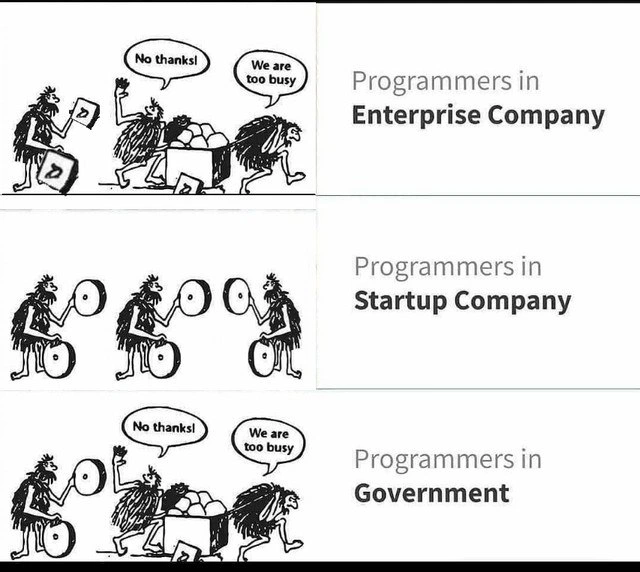
Imagine you and some friends are trying to move a big heavy toy box across the yard. In the first story, you’re pushing this box that inconveniently has square wheels on it. Pushing is super hard and slow because, well, square wheels don’t roll! Along comes another friend who says, “Hey, I have these round wheels you can use. They’ll make it so much easier to move your box.” But you shake your head and say, “No thanks, we’re too busy pushing right now.” That sounds pretty silly, doesn’t it? Obviously, if you took a moment to put the round wheels on, you’d save a lot of effort. This part of the meme is funny because everyone knows a round wheel is a great idea, and it’s ridiculous for the people pushing the box to refuse help while complaining they’re busy. It’s like watching someone stubbornly use a broken crayon to color a huge poster, and when offered a new pack of markers, they go “No time for that, I gotta finish coloring!” You’d laugh because using the new markers would actually help them finish faster.
Now, the second story is different. Imagine another friend who grabs those new round wheels excitedly. But instead of putting them on a box or a wagon, he starts playing the wheels like drums. He’s having a grand old time banging on the wheels and making noise. It’s kinda funny because, sure, he’s enjoying the new wheels, but he’s not actually using them for what they’re meant for – which is rolling things around. This is like if you gave someone a really good hammer to help build a treehouse, and they ended up using the hammer as a toy sword. They’re happy with the new thing, but they aren’t solving the problem they have (which is building the treehouse). In the meme, this is what the startup programmers are doing: they love new gadgets and ideas (the round wheel), but sometimes they get carried away and use them in goofy ways instead of staying focused on the basic job.
Finally, the third story just repeats the first one with government workers as the characters. They’re pushing that heavy box with square wheels and also say “No thanks, we’re too busy” when someone offers them the easy solution (the round wheel). This gives the idea that government offices can be like big companies in how they sometimes avoid new ideas. Maybe they have a lot of rules or they’ve been doing things the same way forever, so they act just like the first group – sticking to the hard way because it’s what they know, even if an easier way exists. It’s as if a school keeps using old, dull pencils for a test and refuses brand new sharp pencils because “we’re already writing, can’t stop now!” It makes you shake your head and chuckle.
In simple terms, the whole meme is comparing three groups and how they deal with a new helpful thing (the wheel). The takeaway is:
- Some people or groups are so stuck in their routine that they won’t try something obviously better even when it’s handed to them (which is funny and a little sad – they’re working harder, not smarter).
- Other people grab new things quickly but might mess around with them without actually improving their situation (also funny because it’s like missing the point of the new tool).
It’s humorous to us because even a kid can see that a round wheel would help and that you should at least try it. The cavemen in the meme act out extremes of real life: one extreme where folks stubbornly ignore a great solution because they claim they’re too busy, and another extreme where folks embrace a new thing but then use it in a wacky, unhelpful way. We laugh because we know nobody would actually use square wheels or play drums on a wheel when they need to move a cart – so when we see it, it highlights how absurd those real-life attitudes are. This meme is basically saying, “Hey, don’t be like these cavemen: try the good ideas when they come, and use your new tools for what they’re meant for!”
Level 2: Shiny New Wheels
Let’s break down the comic and its meaning in plainer terms. The meme uses cavemen and wheels to represent programmers in different work environments:
Enterprise Company: This means a large, established company (think Fortune 500 or big tech firm). In the first panel, two caveman programmers are struggling to push a cart full of rocks that has square wheels. Square wheels are a metaphor for an inefficient, outdated tool or process – something that makes the work much harder than it needs to be. Another caveman comes offering a round wheel, which represents a new technology or better solution that would obviously make things easier (a round wheel would let the cart roll smoothly). But the enterprise cavemen say, “No thanks! We are too busy.” This is poking fun at how big companies often behave. They sometimes reject new ideas or tools — not because the ideas are bad, but because the team is overloaded or the company has too many rules. The phrase “We are too busy” is the corporate excuse for not improving things. It’s like a team saying, “We’re swamped with projects and can’t stop to change our approach,” even if that change (like using round wheels) would save time in the long run. This part of the meme highlights organizational_inertia: big organizations can get stuck in their ways. There’s often a lot of process_overload (paperwork, approvals, meetings) in enterprise environments, and that can make even simple improvements hard to implement. In simpler terms, the enterprise developers are working harder, not smarter – they keep laboring with the old square wheels because changing course seems too difficult under corporate conditions.
Startup Company: A startup is a new, small company (often tech-focused) that is usually more flexible and moves faster than an enterprise. In the second panel, we see startup caveman programmers who have eagerly picked up the round wheels. They’re not ignoring the new invention – quite the opposite, they’re excited about it. But here’s the twist: instead of putting the round wheels on the cart to move the rocks, these startup cavemen are banging on the wheels like drums. In other words, they have a great tool but they’re using it in the wrong way (or at least not for its intended purpose). This is a humorous take on StartupLife. Startups love to adopt the latest technologies (the meme shows them grabbing the “new wheels” enthusiastically). There’s a phrase “shiny object syndrome” that fits here: it means getting distracted by new and shiny tech just because it’s new, not necessarily because it’s needed. The drumming cavemen illustrate tool_misuse – they have the right tool for the job, but lack the focus or experience to apply it effectively, so they end up kind of playing with it. In real life, this could be a small dev team choosing a very complex, trendy solution when a simple one would do. For example, a startup might decide to use an experimental new JavaScript framework for their product because it’s hip and exciting, but then spend a lot of time fixing problems with it or using it oddly, instead of making the product better. The wheel becomes a toy instead of a tool. The meme’s middle panel is basically saying: startups innovate quickly, which is good, but sometimes they might implement technology in a goofy or impractical way (like using wheels as drums) because they’re more focused on the novelty or fun of the tech than the immediate productivity gain.
Government: This refers to programmers working in government agencies or public sector projects. The third panel is actually the same scene as the first one: caveman programmers pushing a cart on square wheels, rejecting the round wheel with “No thanks, we are too busy.” The caption just swaps in “Government” for “Enterprise Company.” The repetition drives home the joke that government tech teams can be just as change-averse as big corporations, if not more so. Government projects are known for having lots of bureaucracy (many rules, approvals, and paperwork). Things move slowly. So, similar to the enterprise case, government developers might keep using old systems or methods for years or decades. For instance, some government offices still run very old software (even languages like
COBOLfrom the 1960s) because updating them is viewed as too risky, expensive, or time-consuming. The meme is highlighting that a government team might also say “we’re too busy” to try a new solution, perhaps because they’re buried in administrative tasks or because adopting anything new involves political and administrative hurdles. It’s a playful jab at organizational_inertia in the public sector. Essentially, the government cavemen are doing exactly what the enterprise ones did – ignoring an obvious improvement – implying that the culture in a government tech environment often mirrors the slow-moving, risk-averse culture of large enterprises, sometimes even in a more exaggerated way.
In summary, the three panels compare how different work cultures handle the same situation (the invention of the wheel, which stands for a game-changing idea or tool):
Enterprise developers often have to play it safe. They may resist new tools even if those tools would help, because they’re bogged down by processes, deadlines, and a mentality of “we’ve always done it this way.” It’s not that enterprise devs don’t like efficiency — it’s that the company culture can make change hard. So the joke is that they literally pass up a time-saving wheel because they’re “busy” using their slow square wheels. It highlights a loss of DeveloperProductivity due to corporate culture.
Startup developers are usually eager to try cutting-edge tech. They grab the wheel eagerly, symbolizing how startups adopt new ideas fast. However, with less structure or experience, they might use that tech incorrectly or frivolously. The humor here is that they have a great tool but lack direction in using it — like a kid with a new gadget who hasn’t read the instructions. It’s a nod to the chaotic freedom of startups: high on innovation, sometimes low on wise usage. They’re making a lot of noise (drumming on the wheels) but possibly not moving the cart forward any faster.
Government developers behave like the enterprise ones, but possibly due to even heavier bureaucracy. They decline the helpful wheel because change is hard in their environment. It emphasizes how government projects can stick with outdated tech for far too long. The comedic effect comes from, “Wow, even with something as obviously better as a round wheel, they’d rather struggle with the old way.” It’s an extreme example of “if it’s not absolutely broken, don’t change it.”
Each panel is an exaggeration, of course. Not all enterprises reject new ideas, and not all startups misuse tech. But the stereotypes ring true enough in the software world that this meme makes developers laugh (or groan). It’s very much a piece of DeveloperHumor about DeveloperCulture: how the place you work can shape whether you cling to old tools or jump on new ones, and how that can be either ridiculous or inefficient (or both). The wheel_invention_analogy is a simple way to show this contrast: the wheel is one of the simplest yet greatest inventions for efficiency. Rejecting it (enterprise/government) or misusing it (startup) is clearly silly, which is exactly the point the meme makes about real-life scenarios in tech teams.
Level 3: No Thanks, Too Busy
This meme spotlights the clash between innovation and organizational inertia across different programming cultures. In the first and third panels, the Enterprise and Government programmers are literal cavemen pushing a cart with square wheels. Another caveman offers a clearly superior round wheel (a better tool or idea), but they snub it with “No thanks! We are too busy.” This absurd scene perfectly captures innovation_resistance in large organizations. In a big Enterprise Company, being “too busy” often means teams are overloaded with process_overload – endless meetings, paperwork, legacy support – leaving no time to implement obvious improvements. It’s a classic busy_excuse: they’re so swamped chugging along with outdated methods (pushing a cart on square wheels) that they can’t stop to adopt the very innovation that would save them time. The humor is painfully relatable: it’s like an IT department refusing to upgrade a clunky old system or automate a manual task because “we’re on a tight deadline” – even though the upgrade would ease future deadlines. This is CorporateCulture at its most paradoxical, where following established process trumps DeveloperProductivity.
Anyone who’s survived EnterpriseLife or government tech projects will recognize this. Proposing a new tool or library in these environments can feel like suggesting fire to cavemen. There are countless real-world parallels: a corporate team sticking with an outdated Java framework or manual testing because “we don’t have bandwidth to research alternatives,” or a government agency running on a 30-year-old legacy system (even a COBOL mainframe) because updating it requires a budget approval the size of a mammoth. In such environments, organizational_inertia is strong – change introduces risk, and no one wants to be the one who broke a system that was “working” (even if it was a painfully slow square wheel). It’s the old joke: “Nobody ever got fired for using IBM” – in other words, sticking with the known old tech is safer for your job than trying a new wheel_invention_analogy that might fail. The CorporateCulture mindset values predictability and sign-offs; ironically, it leads to scenarios where DeveloperHumor writes itself. A team will slog for weeks doing something the hard way rather than spend a day setting up a tool that does it automatically, because adopting that tool wasn’t in the original plan. Process over progress, in a nutshell.
Now look at the middle panel: Programmers in Startup Company. Here the cavemen devs did take the round wheels – startups love new tech! – but instead of using them on the cart, they’re enthusiastically banging on the wheels like drums. This is a different flavor of tech absurdity: the StartupLife tendency to grab shiny new tools but sometimes use them in wild or unproductive ways. It’s poking fun at how startups often embrace the latest framework or fancy gadget without fully considering if it’s the right solution. The round wheel (an innovation) is in their hands, but they’ve turned it into a toy. In real terms, this is tool_misuse: having a powerful new technology but applying it incorrectly or for trivial purposes. Every experienced dev has seen this too – the tiny startup that insists on using ten microservices, three different databases, and AI/ML blockchain-driven distributed Kubernetes clusters™ for what’s basically a to-do list app. They have innovative gear, but no time (or no clue) to properly apply it. The meme exaggerates it as cavemen making a drum circle out of the best invention ever. It’s hilarious in a facepalm way: instead of solving the actual problem (getting the cart moving efficiently), the startup devs focus on the fun, flashy aspect of the new tech (making noise with the wheels). This lampoons DeveloperCulture in fast-paced startups – the “move fast and break things” vibe where experimentation sometimes overshadows practicality. It’s a case of all spark, no traction.
Finally, the third panel brings us back to Government programmers, which mirrors the enterprise scene exactly. That duplication is deliberate: it implies government tech culture is just as averse to change (if not more) than corporate enterprise. Government teams are notorious for red tape and decade-old systems, so the cavemen are once again rejecting the round wheel with “No thanks, we’re too busy.” The humor is that nothing’s changed from panel one – progress who? we’ve never heard of her. In government IT, even if someone invents the perfect wheel, adopting it likely requires a 200-page RFP, a bidding process, and approval from five committees (by which time those cavemen have probably retired). This is organizational_inertia on steroids. Many government devs work with outdated tools not because they want to, but because rules and budget cycles lock them in. (Think of state offices still using Internet Explorer 6 or departments where upgrading from Windows XP took a decade.) The meme underscores that the Enterprise Company and Government cultures share the same flaw: an allergy to change, even when a simple tool could massively improve DeveloperProductivity. It’s a “we’ve always done it this way” mentality fossilized over years of bureaucracy. For seasoned developers, this panel induces a knowing grin (or groan) – we’ve heard the formal versions of “No thanks, too busy” like “We cannot allocate resources to that initiative at this time.” Same energy, just with bigger words.
To sum up the contrast, here’s how each group handles our metaphorical wheel:
| Organization | Reaction to the Round Wheel | Outcome |
|---|---|---|
| Enterprise | “No thanks, we’re too busy.” 🤦♂️ | Keeps grinding with square wheels (outdated methods) due to process paralysis. |
| Startup | “Cool, a new wheel! Let’s jam!” 🥁 | Grabs innovation eagerly, but uses it oddly (tech overkill or misapplication). |
| Government | “No thanks, we’re too busy.” (again) 🙄 | Same as enterprise, if not slower – sticks to the old ways via bureaucracy. |
The meme’s humor lands because it exaggerates truths we encounter in DeveloperCulture. It highlights a spectrum of dysfunction: from innovation_resistance in big orgs to chaotic shiny-object syndrome in startups. Seasoned engineers chuckle (perhaps a bit bitterly) at how often they’ve lived these scenarios. EnterpriseLife can indeed feel like pushing square wheels while ignoring obvious fixes, and StartupLife can feel like a drum circle of every new tech buzzword. The caveman wheel analogy is simple and ancient, yet it hits on a modern tech reality: having the right wheel is only half the battle – you also need the willingness and wisdom to use it properly.
Description
A three-panel cartoon meme that uses the allegory of cavemen inventing the wheel to satirize different programming cultures. The first panel, labeled 'Programmers in Enterprise Company,' shows cavemen struggling to pull a cart with square wheels, refusing an offer of round wheels with 'No thanks!' and 'We are too busy.' The second panel, 'Programmers in Startup Company,' depicts cavemen proudly holding round wheels but having no cart to attach them to, implying a focus on new technology over product delivery. The third panel, 'Programmers in Government,' mirrors the first, showing cavemen with a square-wheeled cart again refusing the superior round wheels because they are 'too busy.' The meme critiques the inertia and resistance to change in large enterprises and government due to existing workloads and bureaucracy, while also poking fun at the startup tendency to adopt trendy tools without a clear purpose

Comments
7Comment deleted
The enterprise team is still using jQuery because migrating is a 3-year project. The startup is using a bleeding-edge framework that will be abandoned in 6 months. The government team just got approval to use jQuery
Enterprise schedules a steering committee to approve round wheels next fiscal, Government issues an RFP to extend support for square ones, and the Startup wraps the wheel in JavaScript, calls it WheelJS, and raises a Series A - then remembers they never built the axle
The real irony is that the government developers are actually following best practices by refusing to adopt untested wheel technology without a 500-page requirements document, three security audits, and approval from seven committees that meet quarterly
The meme perfectly captures the inverse relationship between claimed busyness and actual workload across organizational types. Enterprise and government developers have mastered the art of appearing perpetually overwhelmed while maintaining a single context, whereas startup developers are literally context-switching between multiple projects simultaneously without the luxury of saying 'no.' It's the organizational equivalent of O(1) perceived complexity with O(n) actual work in large orgs, versus O(n²) work with O(1) complaints in startups - a reminder that 'too busy' is often more about organizational culture and risk aversion than actual throughput constraints
Enterprise won’t adopt wheels without a CAB ticket and security review; the startup launched wheel.js but forgot the cart; government is still drafting a five‑year RFP to replace the square‑wheel legacy
Enterprise to the wheel: 'No thanks, too busy carrying our COBOL boulders - microservices can wait for the tiger team retrospective.'
Enterprise: “We don’t have time to replace the square wheels - just optimize the push.” Startup: “We pivoted to being a wheel company; cart ships in v2.” Government: “Wheel denied - RFP mandates 90° corners.” And somehow the dashboard says velocity is up