Elysia.js Creator Breaks Tech Stereotypes as Cosplaying Developer from Thailand
Why is this DevCommunities meme funny?
Level 1: The Costume Surprise
Imagine you have a friend who always wears really cool costumes and can even make himself look like a totally different person. One day, your class hears about a brilliant new project (let’s say a cool new app or game) and everyone imagines what the creator of that project might look like. Most assume it’s somebody typical for that kind of project, maybe like an older boy from a big city. But then you see a picture and it looks like it was made by a girl who dresses up in fancy costumes. Everyone goes, “Wow, that’s so awesome and unexpected!” They’re happy because it’s not who they thought — kind of like if you found out the best gamer in school was actually that quiet girl no one expected.
But here’s the funny part: when the creator sees people talking about him, he says, “Uh, actually… that girl in the picture is me in costume. I’m actually a boy!” It’s like during a costume party when someone you thought was a princess removes their mask and it turns out to be your buddy dressed up. Surprise! Everyone laughs in shock for a second because they totally fell for the disguise.
The whole joke is a bit like the saying, “don’t judge a book by its cover.” The tech community folks judged who made the project by the “cover” (the photos and assumptions), and they guessed wrong. It’s funny and kind of cool because it reminds everyone that looks can be deceiving. Just because someone looks like something (in this case, looking like a girl in a photo) doesn’t mean they are that — just like a really convincing Halloween costume can fool you! In the end, people learned to be a bit more open-minded and had a good laugh. The developer got to show off not only his coding skills with that project, but also his great costume skills, fooling the whole crowd for a moment. It’s a happy, funny lesson: be careful with assumptions, and enjoy the surprises when the real person behind the mask is revealed.
Level 2: When Code Meets Cosplay
Let’s break down what’s happening in this meme in a straightforward way. It all revolves around a conversation on Tech Twitter (the part of Twitter/X where software developers and tech folks talk shop and share stories). The key players here are:
- Duane (@DuaneAdam): a user on Twitter who made a post that starts with "TIL" (which stands for “Today I Learned” – a common internet phrase people use when sharing something new they just found out). Duane learned something about the developer of a JavaScript framework and was excited about it.
- SaltyAom (@saltyAom): the person who Duane is talking about – the developer of Elysia.js. SaltyAom has a blue-check verified account with an anime avatar (a profile picture of an anime character). From Duane’s tweet, we gather that SaltyAom is a solo developer (meaning he built Elysia.js mostly by himself) and that he does cosplay. Cosplay is short for "costume play," a hobby where people dress up as characters from movies, games, or anime. In SaltyAom’s case, he often cosplays as female characters – and does it well enough to look convincingly like a girl in photos.
Now, Elysia.js is mentioned – that’s a JavaScript framework (JavaScript frameworks are tools or libraries that help developers build web applications more easily, like Express.js, React, etc., but Elysia is likely aimed at back-end or full-stack development). The fact that Duane is surprised about Elysia’s creator means Elysia.js probably gained some popularity or respect in the developer community. It’s not every day a new framework gets noticed, so people naturally get curious about the person behind it.
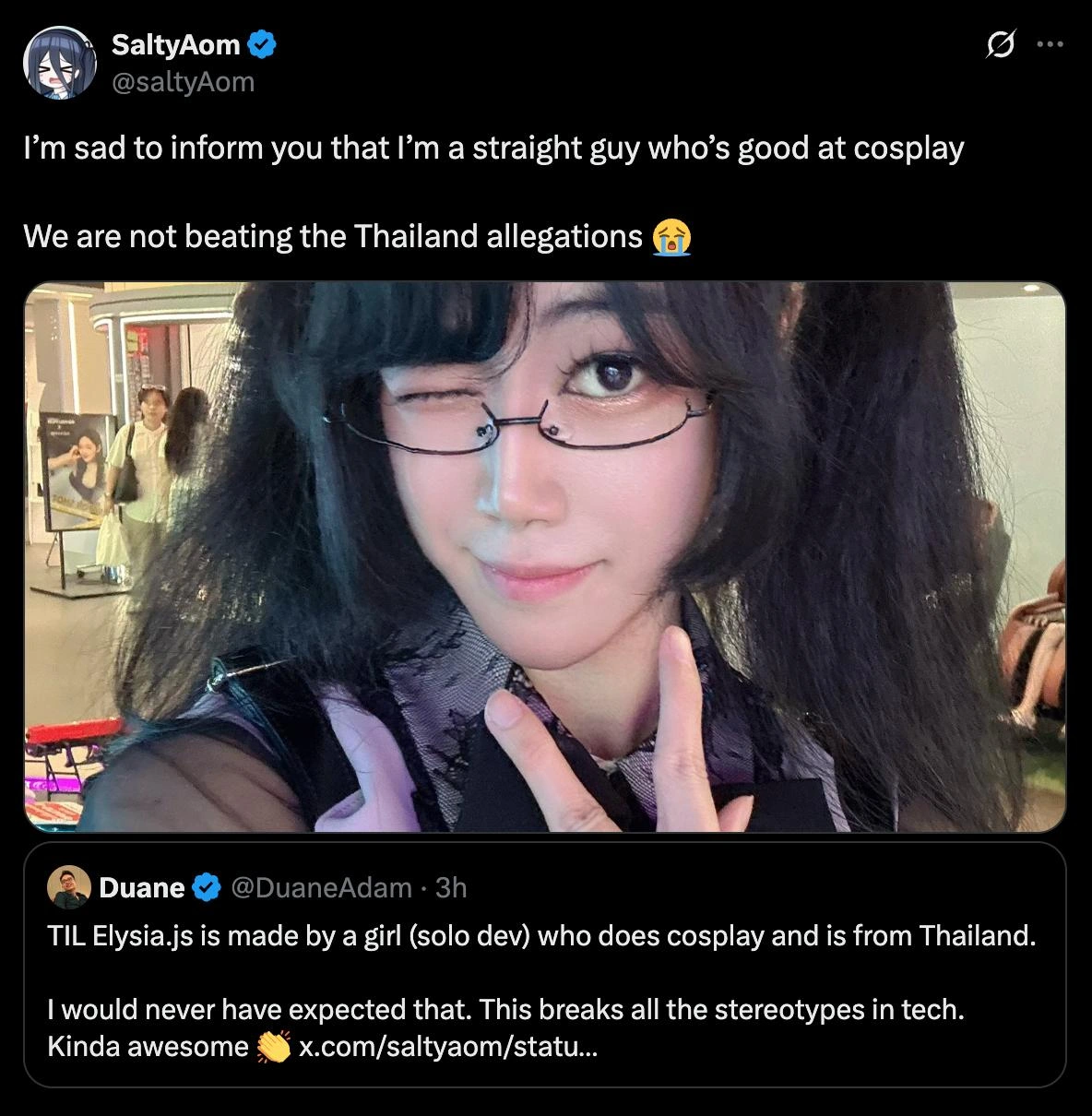
Duane’s tweet basically says: “Today I learned Elysia.js is made by a girl, who is a solo dev, does cosplay, and is from Thailand. I would never have expected that. This breaks all the stereotypes in tech. Kinda awesome 👏.” He even includes a clapping emoji to applaud this discovery. Let’s unpack that:
- He assumed or just found out the developer was a girl. Possibly SaltyAom’s online presence (cosplay photos, perhaps a feminine-looking picture) led him to think that.
- She’s from Thailand and into cosplay – again, not a combination you hear about every day in the context of a prominent software project. He says it breaks stereotypes, meaning it challenges the common image of a software developer (which, stereotypically, might be, say, a male from the US or Europe, not a cosplaying woman from Thailand).
- Duane finds this awesome because it’s like a refreshing story: it shows the tech world has diverse people doing cool things.
So Duane is basically giving a shout-out: “Wow, how cool is this! The dev who made this tool I like is a Thai cosplayer girl – not what I imagined, but awesome!” This is where identity assumptions in dev communities come in – he had an image in mind of who might be behind a framework, and reality surprised him in a positive way.
Enter SaltyAom’s response. SaltyAom sees this praise and decides to set the record straight with a bit of humor. He tweets (paraphrasing): “I’m sorry to tell you that I’m actually a straight guy who’s just really good at cosplay. We aren’t overcoming the Thailand stereotypes, haha 😭.” Let’s clarify that:
- By saying “straight guy,” SaltyAom means he’s a male who is heterosexual. He likely says this to clear up any confusion that he’s a girl or perhaps LGBTQ – basically emphasizing he’s just a regular guy with a hobby, not actually a woman or trans (since people might wonder given how convincing his cosplay is).
- “Good at cosplay” is his way of explaining why people might have thought he was female. He’s skilled at dressing up and doing makeup as female characters to the point where it fooled Duane and others.
- “We are not beating the Thailand stereotypes” – here SaltyAom is joking about a common stereotype or joke regarding Thailand: there’s a well-known notion on the internet that Thailand has many gender-bending cosplayers or “ladyboys” (a term often used, though not very politely, to refer to effeminate male entertainers or transgender women in Thailand). The stereotype is that if you see a very pretty “girl” in Thailand, she might actually be a he. SaltyAom is Thai, and he’s basically joking that he ended up fitting that stereotype exactly (a Thai guy who looks like a girl when in costume). The crying emoji 😭 shows he’s mock-crying about it – meaning he’s playfully ashamed or amused that he confirmed what people often joke about, instead of disproving it.
So, in simpler terms, SaltyAom is telling Duane and everyone, “Hey, thanks for the compliment, but I’m not actually a girl. I know, I cosplay as female characters and fooled you – and funny enough, I’m Thai, so I just proved that old joke about Thai cosplayers right. Oops 😅.”
This back-and-forth is DeveloperHumor gold because it involves a misunderstanding that many people in the dev community find relatable or at least intriguing. It touches on industry stereotypes:
- One stereotype being challenged was “only certain kinds of people create important software projects” (like assuming not many women, or not many Southeast Asians in global tech, etc. are behind popular frameworks – which is a bias that needs challenging).
- Another stereotype inadvertently brought up is the “Thai cosplayer gender-swap” trope, which SaltyAom himself addresses.
For a junior developer or someone new to these communities, a few more points of context:
- TechTwitter is full of threads where people share “Did you know?” or “Today I learned” facts about software and its creators, often to highlight diversity or interesting backstories. It’s part of tech communities celebrating their own.
- The phrase “type inference test” in the meme title is a play on words. Type inference in programming (especially in languages like TypeScript which many JavaScript devs use) is about the compiler figuring out what type a variable is. Here it’s joking that the tech community tried to “infer the type” (gender type, essentially) of SaltyAom from the available info and failed the test. They guessed the wrong type! It’s like the community applied a mental algorithm that said “cosplay + anime avatar + goes by a presumably feminine alias? = female dev” — but that algorithm was flawed. In coding terms, if Twitter’s collective mind were a program, it returned the wrong type for the
saltyAomobject, causing a sort of “TypeError” when the truth came out. - Elysia.js being mentioned ties into the Frameworks tag: it’s the actual tech product in question. For completeness, you should know Elysia.js is a framework in the JavaScript ecosystem (imagine something to help build web servers or apps, akin to Express.js or Fastify, but with its own twist – possibly it emphasizes performance and type safety). It’s gaining attention, which is why people cared who made it. The fact that it’s a solo dev project is impressive, meaning one person did the heavy lifting to create it.
In summary at this level: The meme shows a conversation where someone on a developer thread got excited thinking they found a cool exception to stereotypes – a female Thai cosplayer who’s also a talented coder – only to be humorously corrected by the coder himself, who revealed he’s actually a dude in disguise (literally). It teaches a quick lesson: in the online dev world, don’t jump to conclusions about who’s behind the keyboard. People can surprise you, whether that’s by defying expectations or, as in this case, doing a loop-the-loop and defying them only to circle back to unexpectedly confirm others. It’s all in good humor, and the dev community took it as a laugh and a learning moment about assumptions.
Level 3: Type Mismatch on Tech Twitter
At this level, we peel back the layers of developer culture and the industry stereotypes that fuel the humor in this meme. The scene unfolds on Tech Twitter (or “X”, as it’s called now) – a place where developers, open-source contributors, and tech enthusiasts regularly share insights, start flame wars over frameworks, and yes, occasionally have collective moments of surprise like this one. A well-known user, Duane, tweets in astonishment: he just learned that Elysia.js – a JavaScript web framework – is built by what he believes is a solo female developer from Thailand who also does cosplay. In his words, this “breaks all the stereotypes in tech.” You can almost hear the gears of long-held assumptions grinding to a halt. Tech Twitter loves a good narrative, and here was a feel-good twist: a new framework not coming from the usual suspects (say, a Silicon Valley startup bro or a famous Western open-source guru), but from a cosplaying Thai girl. Duane is clapping in admiration (literally, he used the 👏 emoji) because it’s a refreshing deviation from the norm.
Why is this surprising or funny to seasoned devs? Because it shines a light on what people expect a framework author to look like. The industry has historically skewed towards certain demographics – often male, and frequently Western or at least not openly mixing programming with niches like cosplay. The unspoken bias might be that a “serious” JavaScript framework creator is probably a guy in a hoodie, not a girl in an anime costume. So Duane’s excitement (“TIL... kinda awesome”) is the community’s collective wow at having those expectations upended. It’s a moment of “Look, a stereotype just got shattered!”
But then comes the punchline. The developer in question, @SaltyAom, replies with a cheeky clarification: “I’m sad to inform you that I’m a straight guy who’s good at cosplay. We are not beating the Thailand allegations 😭.” This one sentence turns the whole narrative on its head again, and this double-twist is where the comedic energy really kicks in for those of us who’ve seen our share of internet culture storms. First, SaltyAom confirms he’s the creator of the framework (so that part was right), but corrects the assumption about his gender. He’s male, not female – a fact that instantly nullifies the very stereotype-breaking moment Duane thought he was having. And he delivers this news with a wry, self-deprecating humor: he’s essentially saying, “Hate to break it to you, but I actually am the typical case (a guy developer)… except I cross-play so well that I fooled you!” The phrase “not beating the Thailand allegations” is especially loaded with irony. It references a running joke/cliché that in Thailand there are many highly convincing male-to-female cosplayers or transgender individuals (often in internet slang, Thailand is notorious for this kind of gender confusion – the old trope of the “Thai girlfriend who’s actually male” or the prevalence of cosplay and gender-bending performances). By saying he’s not helping disprove that stereotype, SaltyAom deftly pokes fun at both himself and the stereotype simultaneously. In essence, he’s saying: “Yup, I’m basically walking right into that stereotype: a Thai guy who can look like a girl.” The crying emoji 😭 he adds signals mock disappointment – he’s play-acting sadness that he couldn’t be the exception to the rule. It’s dripping with irony, and the savvy tech crowd sees it.
For a senior developer or anyone who’s been around online communities, there’s a rich subtext here. This exchange is a commentary on identity assumptions in dev communities. We’ve seen many times how the industry can be surprised that a talented coder doesn’t fit the preconceived mold. Whether it’s discovering a prolific open-source contributor is actually a teenager from a remote part of the world, or that the lead maintainer of a crucial library is juggling code with an unlikely hobby or personal life story, these reveals are both heartwarming and a bit telling of our biases. Here, Duane assumed the “Elysia.js solo dev who cosplays” must be female – likely because cosplay, especially dressing up in a feminine way, is often associated with women (or at least, not straight men), and perhaps because the idea of a woman in tech building a framework was novel enough to celebrate. His intentions were positive (he’s lauding the breaking of stereotypes), but the fact he was so surprised shows those stereotypes were very much in mind to begin with.
This is classic DeveloperHumor on social media: it’s funny because it’s true to life. We’ve all seen or participated in those TIL (Today I Learned) posts where someone’s assumptions get publicly corrected. Tech Twitter, being what it is, immediately recognizes the scenario: a well-meaning shout-out turning into an oops moment when the initial assumption fails the “type check.” In a way, the community collectively failed the human type inference test here. They inferred “female” where the reality was “male,” much like a type system throwing a type mismatch error. Some senior devs will jokingly nod and say, “Did you just assume my type?” – a play on the meme “did you just assume my gender?” but using the terminology of programming. The whole thread becomes meta: Duane tried to celebrate breaking tech stereotypes, only to find out more layers that still conform to certain stereotypes (male dev) while breaking others (straight guy doing convincing cosplay of a girl). It’s a tangle of expectations that only a community like this would dissect with equal parts laughter and thoughtfulness.
From an industry perspective, this incident also underscores how diversity and appearances in tech can be double-edged. The fact that a female Asian cosplayer as a framework author was so newsworthy to Duane shows that we still consider it a novelty – which is a commentary on the state of representation. And SaltyAom’s good-natured trolling reminds us not to put people in boxes too quickly. For seasoned developers, it’s a gentle humbling: You might be fluent in multiple programming languages and know all about inference in code, but you can still totally mis-infer a person’s background on the internet. Tech Twitter, in its hyperactive milieu, just got a reminder that behind GitHub handles and anime avatars, developers can be anyone – and assumption is the mother of all goofs. As an added bonus, the buzz around this story likely put Elysia.js on a lot more people’s radars. (There’s a joke in there about how to really get traction for your framework: not just benchmarks or features, but a viral Twitter reveal 😀.) In the end, this is one of those community bonding moments where everyone in DevCommunities stops for a second to chuckle, learn a bit about each other, and maybe push those industry stereotypes one step closer to extinction – albeit through a very unexpected plot twist.
Level 4: Static Typing vs. Stereotyping
At the most abstract level, this meme highlights a clash between formal type inference in programming and informal human stereotyping. In computer science, type inference is a process where a compiler deduces the data type of an expression automatically. For example, languages like Haskell and TypeScript use sophisticated algorithms (think Hindley-Milner type inference) to figure out if x is an Int or a String without the programmer explicitly stating it. The compiler gathers clues from how x is used and then assigns a type that makes the code logically consistent. These algorithms are methodical and based on strict rules – if the hints don't line up or if there’s ambiguity, you get a type error or the compiler demands an explicit annotation. In other words, compilers hate uncertainty and won't assume something without evidence in code.
Humans, on the other hand, perform a kind of ad-hoc type inference socially all the time – often subconsciously. We categorize people quickly based on appearances or fragments of information (like inferring “developer type” or even someone's gender from a profile picture). But unlike a strict type system, our inferences are prone to bias and error. In the meme’s scenario, tech enthusiasts looked at a few data points about the Elysia.js creator – a cosplay photo, an anime avatar, the fact the dev is Thai – and tried to infer the "type" of person behind the code. Essentially, they performed a noisy, heuristic version of what a compiler does with code, but on a human identity. And unsurprisingly, their inference engine misfired.
This is akin to a compiler seeing something that looks like a number and guessing the wrong type because the context was misleading. Imagine a theoretical programming language where the compiler sees SaltyAom and, based on context clues (avatar === "animeGirl", cosplayOutfits.includes("femaleCharacter")), it infers SaltyAom: FemaleDev. The type system here (the community’s collective assumptions) compiled an image and came up with a type that turned out to be incorrect at runtime. In programming terms, Tech Twitter experienced a runtime type error when reality didn't match the inferred type. It’s a fun real-world parallel to how inference can fail if the data (or our biases) are incomplete or misleading.
On a deeper level, this also touches on how type systems strive for soundness and avoid making leaps without evidence, whereas human stereotyping often leaps to conclusions from superficial cues. A compiler doesn’t care about cultural biases – it only trusts what the code shows. Humans, conversely, carry social and cultural preconceptions (like gender roles in tech, or stereotypes about certain nationalities) that can override evidence. In essence, static typing (in code) is a disciplined, evidence-based process, while stereotyping (in society) is a fuzzy pattern-match that’s notoriously error-prone. This meme humorously exposes that contrast by framing a social gaffe (mistaking a male cosplayer for a female dev) as a “failed type inference test.” It’s the human edition of a compiler error: our mental type checker threw an exception because we fed it biased data. And just as robust software requires explicit types or better algorithms to avoid confusion, our tech community needs more explicit understanding and less assumption to avoid these identity mix-ups.
Description
A screenshot of tweets from @saltyAom (SaltyAom, verified). The main tweet reads: 'I'm sad to inform you that I'm a straight guy who's good at cosplay. We are not beating the Thailand allegations' with a crying emoji. Below is a selfie of SaltyAom in elaborate cosplay with long dark hair, glasses, and a peace sign. A quoted tweet from @DuaneAdam reads: 'TIL Elysia.js is made by a girl (solo dev) who does cosplay and is from Thailand. I would never have expected that. This breaks all the stereotypes in tech. Kinda awesome' with a clapping emoji and a link. The exchange humorously corrects the assumption about the Elysia.js creator's gender while playfully leaning into Thai stereotypes
Comments
7Comment deleted
The real TypeScript type guard: `typeof developer === 'expected' ? never : surprise`. Elysia.js proving runtime types are just as unpredictable as TypeScript's
Turns out Twitter’s human-type inference is even looser than JavaScript’s - stop declaring developers as “any” and just await their own export default
The fastest web framework for Bun isn't the only thing breaking expectations here - turns out the real performance optimization was challenging Silicon Valley's pattern matching algorithms on what a framework author looks like
When your framework's type safety is so good that even the community's assumptions about the maintainer fail at compile time. Turns out Elysia.js isn't just breaking performance benchmarks - it's breaking every preconceived notion about who builds the tools we depend on. The real plot twist? The 'Thailand allegations' were just another case of the tech community's pattern matching failing on edge cases that don't fit the training data
Great reminder: static typing belongs in Elysia.js, not in your assumptions parser - stop inferring human types at runtime
Legacy tech stereotype refactored: from neckbeard monolith to Thai solo dev microservice - deployed solo, zero downtime, infinite scale
Elysia ships type safety; the community ships assumptions - lint your rumor pipeline before doing TIL-driven inference on the maintainer