Existential Wojak Contemplates Shareholder Value During Nature Walk
Why is this CorporateCulture meme funny?
Level 1: Playground Worries
Imagine you’re a kid playing at the park on a sunny day. You’re on the swing, the sky is blue, everything is nice… but instead of enjoying it, you suddenly start worrying: “Did I do all my homework? Will my parents be happy with my grades?” That worry is distracting you from the fun moment. This meme is showing a very similar thing, but with a grown-up twist.
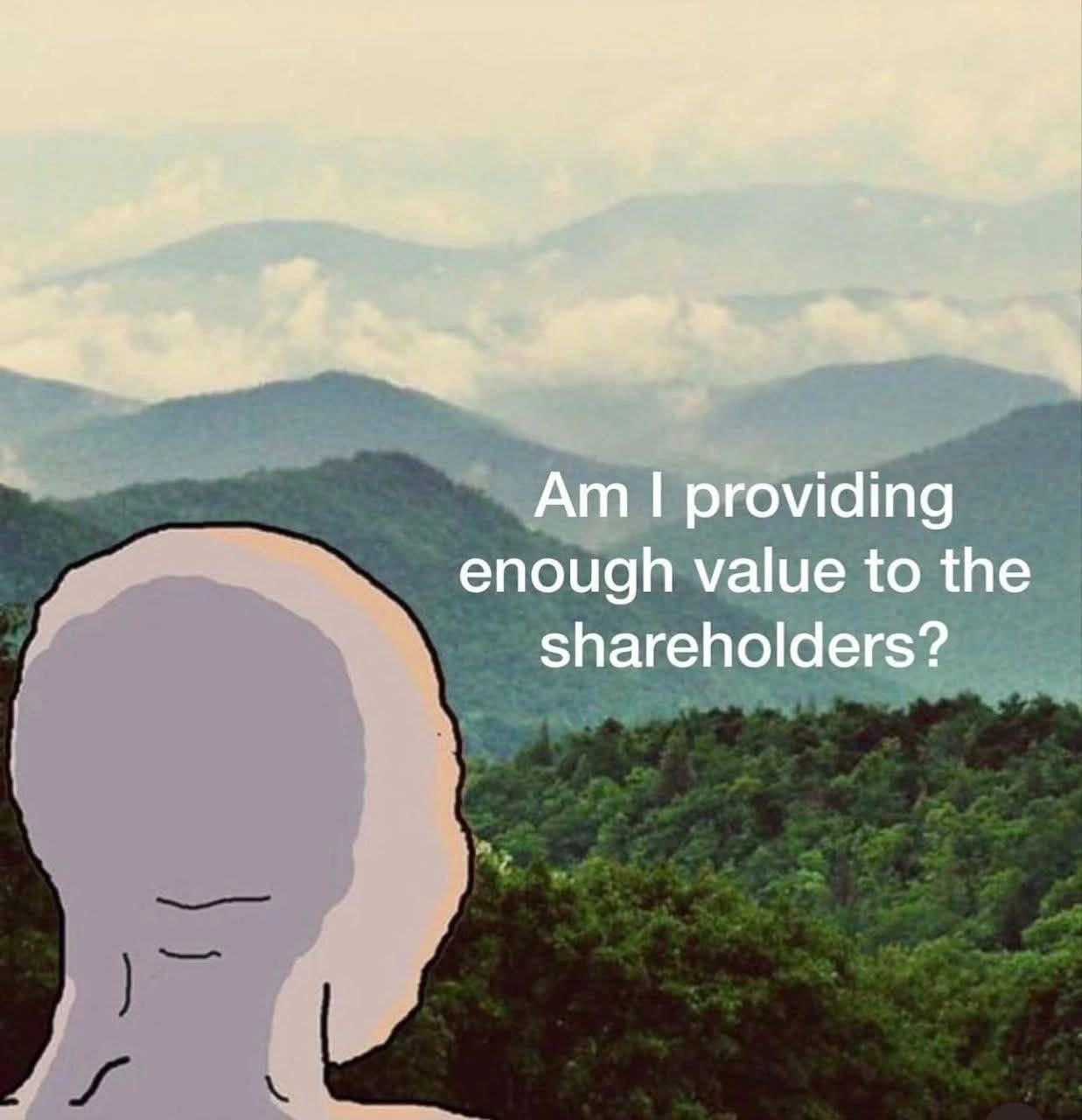
In the picture, a person (the grey cartoon character) is looking at beautiful green mountains and clouds. It should be a calm, happy moment, just like a kid at recess. But the big white text shows what he’s thinking: “Am I providing enough value to the shareholders?” In simple terms, that means “Am I doing a good enough job at work to make the company owners happy?” He’s basically treating his peaceful moment like it’s a work evaluation!
So the funny (and a bit sad) part is: even while he’s surrounded by nature and taking a break, he can’t stop worrying about work and whether he’s pleasing his bosses. It’s like if you were on vacation at Disneyland but kept thinking, “Should I be doing chores to make my mom and dad proud?” You wouldn’t be able to enjoy Mickey Mouse because you’re too stressed. In the same way, this developer can’t enjoy the pretty mountains because he’s anxious about his job.
The meme uses this very simple cartoon style to make a point: sometimes grown-ups, especially those working in big companies, feel pressure all the time to prove that they’re valuable. It’s an emotional joke about how work thoughts can sneak in even when we’re trying to relax. You’re supposed to chuckle because it’s a little silly for someone to be thinking about shareholders (basically, the company’s money-people) while looking at a mountain — but it also feels true. It’s saying: “Hey, have you ever tried to take a quiet moment, but your brain brings up worries about work? Yeah… me too.” It’s funny and relatable in that way, even if you’re not a tech person. It’s basically about when worry ruins your fun.
Level 2: Metrics in the Mist
Let’s break down what’s happening in this meme and why developers find it funny (and a bit too real). In the image, we see a grey Wojak figure from behind. Wojak is a simple cartoon avatar often used in memes to represent an average person’s feelings — in this case, probably feeling empty or anxious. He’s gazing out at a beautiful scene: rolling green hills and misty mountains under a calm sky. Normally, such a scenic landscape gives feelings of peace or awe. It’s the kind of view people seek for relaxation or reflection.
However, right there on the picture, in big white text, is the question: “Am I providing enough value to the shareholders?” This text is the core of the joke. It’s completely out of place for a tranquil nature scene, and that’s intentional. Shareholders are the people who own shares (stock) of a company – basically the company’s owners or investors. Shareholder value refers to the idea of making those owners richer, usually by increasing the company’s stock price or profits. In a healthy business conversation, you might hear a CEO or manager say, “We need to increase shareholder value.” It’s very corporate-speak, and it’s about money and performance.
Now, imagine being a software developer sitting on a mountain, trying to chill out, and suddenly worrying about shareholder value. It’s a hilarious and absurd mismatch. Developers typically care about writing good code, fixing bugs, and making users happy. But modern CorporateCulture sometimes pushes even engineers to think in terms of business metrics. KPI stands for Key Performance Indicator, which is a fancy term for a measurable goal or metric. For example, a KPI for a developer’s project might be “load time under 2 seconds” or “increase sign-ups by 5%.” OKR stands for Objectives and Key Results – it’s a framework companies use to set goals. An Objective is something you want to achieve (like “Improve user engagement”), and the Key Results are specific numbers that tell you if you achieved it (“Increase daily active users from 10k to 12k by Q4”). These concepts are common in large companies and especially in tech management. They’re meant to keep everyone aligned and moving toward the same goals.
However, the joke here is that these KPI and OKR things have become so pervasive that they invade an engineer’s personal thoughts. The phrase “providing value to the shareholders” is basically the ultimate high-level KPI for any business: make the owners happy (with profits). It’s not normally something an individual developer can calculate on a daily basis – it’s very abstract. Yet, in many organizations, even engineers start feeling the StakeholderExpectations directly. Stakeholders can be anyone with an interest in the project – clients, bosses, or yes, shareholders. And stakeholder pressure is when those people’s expectations create stress on the team.
So in the meme, the developer’s inner voice sounds like a worried boss or a slide from a quarterly meeting. The management/PM perspective has colonized his brain. The peaceful green hills are in stark contrast to the anxious question he’s pondering. This contrast is funny to developers because it’s relatable: you might be on vacation or just stepping away from your desk, but you still have that nagging feeling: “Is what I’m doing at work really moving the needle? Will the higher-ups consider my project a success for the business?” This is a form of developer anxiety.
It’s also touching on mental health in corporate environments. Ideally, when you’re off work, you should unwind. But here the poor engineer cannot mentally disconnect. That’s a quick recipe for DeveloperBurnout, a state of mental and physical exhaustion from chronic workplace stress. The meme is a bit of gallows humor about how the pressure to constantly prove one’s value (in dollars, essentially) can follow tech workers everywhere. It’s poking fun at CorporateIrony: companies often encourage employees to take breaks and find inspiration (hiking in nature, say), yet the company’s own intense focus on metrics is what prevents the employee from actually relaxing.
We can also talk about the stylistic choice: using a Wojak meme format. The grey, featureless Wojak represents a kind of everyman (or every-developer) who is emotionless or numb. It’s perfect here because the question “Am I providing enough value to the shareholders?” is delivered in a deadpan, matter-of-fact way. It’s the kind of thought that just drifts into your head with a sigh, not a dramatic exclamation. The background looks like a default Windows wallpaper or something from a motivational poster – those usually have cheesy inspirational quotes like “Believe in yourself” or “Reach for the summit.” Instead, we get this anxious corporate self-questioning. That subversion is what makes it TechHumor: it’s taking something wholesome (a meditative nature scene) and injecting a very un-wholesome tech workplace worry into it.
For someone new to tech or unfamiliar with corporate jobs, it helps to know: CorporateCulture in many companies emphasizes aligning work with business outcomes. You might hear phrases like “How does this task add value?” or “We need to be metrics-driven.” At first it sounds very logical — of course a business cares about profit. But taken too far, it results in what we see in the meme: even individuals start to feel guilty if every hour of their work (or even rest) isn't justified by a line item on a shareholder report. Late_stage_capitalism is a tongue-in-cheek term people use to describe this kind of extreme profit-focused mindset in a somewhat decaying or absurd form. Essentially, it's saying "in the current stage of capitalism, things have gotten a bit ridiculous," like employees feeling existential dread about not making rich investors even richer.
In summary, the meme depicts an existential_dev_thought: a programmer questioning their worth in terms of dollars and cents for others, at a moment when they should be free of those thoughts. It’s a comical exaggeration of real life. We laugh, perhaps a bit nervously, because we recognize that pressure. Whether you’re a junior developer or a seasoned architect, you’ve likely felt a twinge of “Am I doing enough? Is my work really valuable (to the company)?” at some point. This image just cranks that feeling up to 11 by placing it in such a serene setting — making the intrusion of work worries into personal life very stark and therefore humorous (in a EngineeringAbsurdity kind of way).
Level 3: Peak Performance Anxiety
At first glance, this meme feels like a code review from the universe questioning our very existence as engineers. A grey Wojak silhouette stands before a gorgeous mountain vista, yet instead of contemplating nature’s beauty, he's haunted by a corporate mantra:
"Am I providing enough value to the shareholders?"
This absurd juxtaposition hits seasoned developers right in the gut. Why? Because we’ve all been there — relaxing on a weekend hike or staring at the ceiling at 3 AM, and suddenly the Key Performance Indicators (KPIs) and Objectives and Key Results (OKRs) from work creep into our thoughts. It's like an involuntary background thread in our brain doing while(true) { assessShareholderValue(); }. Even in tranquility, the CorporateCulture of endless metrics and StakeholderPressure doesn’t shut down.
The humor is dark and deeply relatable. In the enterprise world, “shareholder value” is the almighty phrase that justifies every late-night deployment and half-baked feature push. It’s that vaguely defined north star that management and PMs (Project/Product Managers) constantly invoke: “Will this refactor drive shareholder value?” Hearing that enough times, you start to internalize it. Suddenly, even a quiet moment in nature turns into a mental KPI dashboard. The serene mountains become just another graph of quarterly performance. The mist over the hills resembles the fog of war in quarterly planning meetings. Late-stage capitalism humor at its finest: even our Zen moments come with a side of ROI calculations.
This meme also exposes the cognitive dissonance and developer anxiety many senior engineers feel. We get into software engineering to solve problems and build cool things. But as you climb the ladder (or just accumulate years in the industry), you’re expected to tie every commit, every architecture decision, back to “shareholder value.” Did that microservice redesign maximize stakeholder ROI? Does improving site latency by 200ms increase EBITDA next quarter? After enough OKR dashboards and all-hands meetings, you end up like our Wojak friend: staring at something beautiful, but only seeing a tech absurdity — the notion that your worth is measured by how much richer you make some distant shareholder.
Real-world war stories echo this feeling. Perhaps you’ve sat through a sprint review where a product manager asks how your code cleanup will “move the needle” for customer retention or revenue. The code works flawlessly, the architecture is sound...but now you’re sweating, justifying that it indirectly improves user satisfaction metrics (which, hopefully, correlate to profit). It’s exhausting. The meme captures that exhaustion as a kind of existential crisis. The Wojak’s blank stare is basically the face you make when you’re roaming free in nature but mentally you’re still in a boardroom being grilled about OKRs.
There’s an element of CorporateIrony here too. Companies preach work-life balance, encouraging you to “unplug,” yet simultaneously cultivate a culture where you feel guilty for not constantly providing value. It’s like an app running in the background consuming your mental RAM: even off the clock, you wonder if you’ve justified your salary this week. No wonder DeveloperBurnout is a thing — when even your peaceful daydreams are interrupted by a phantom stakeholder review meeting, it’s hard to truly recharge. As a battle-scarred dev might joke, “Nothing like a misty mountain to remind me of the cloud (compute bills) and stakeholder value, eh?” In other words, this meme is funny because it’s painfully true: in a culture of KPI omnipresence, even our most serene reflections turn into anxiety about JIRA tickets shareholder value.
Description
A meme showing the 'Wojak' (also known as 'Feels Guy') character in the bottom-left corner, depicted as a simple gray-skinned figure with a melancholy expression, gazing out over a serene mountain landscape with lush green forests and misty blue mountain ranges. White text on the right reads 'Am I providing enough value to the shareholders?' The juxtaposition of the peaceful natural setting with the corporate anxiety creates dark humor about how capitalist productivity culture has colonized even moments of tranquility
Comments
14Comment deleted
You can take the developer out of the sprint, but you can't take the sprint out of the developer -- even the mountains have a backlog of erosion tickets
My on-call PTSD is so bad I'd look at this mountain range and my first thought would be whether our global service latency has as few peaks as that horizon
Nothing like a tranquil mountain vista to remind you your microservices exist solely to nudge the stock price up 0.03% before earnings call
After 20 years of optimizing algorithms and architecting systems that handle billions of requests, you realize the only metric that matters is whether your quarterly OKRs made a line go up on someone's PowerPoint
When you've shipped 47 features this quarter but still wonder if you're just a cost center with a keyboard
PM wants an EPS forecast for a 40ms p99 drop. I ship code, not basis points
Scaled the monolith to microservices, but still O(n!) on justifying RSUs to the board
witch shareholders? Comment deleted
Necromancers, to be precise Comment deleted
witch type? Comment deleted
Deep dark fantasy necromancers Comment deleted
oh.. ok Comment deleted
Which is a question, witch is ведьма Comment deleted
congrats, you are a certified employee now Comment deleted