Skip to content
DevMeme
1656 of 7435
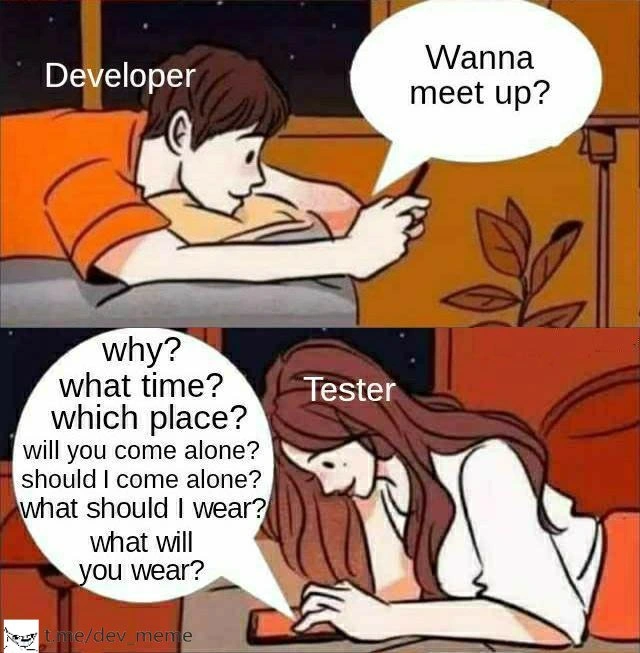
Developer vs. Tester: A Love Story of Requirements
QA Post #1852, on Aug 5, 2020 in TG

Developer vs. Tester: A Love Story of Requirements

Why is this QA meme funny?

Level 1: So Many Questions

Imagine you casually ask your friend, "Hey, want to hang out?" and instead of just saying "Sure" or "When?", your friend responds with a huge list of questions: "Why do you want to hang out? What time should we meet? Where exactly will we go? Are you coming by yourself? Should I come by myself? What should I wear? What will you be wearing?" You’d probably giggle because it’s such an over-the-top response to a simple question.

This meme is funny for the same reason. The developer is like the friend who just says one short thing (very easy-going and assuming it’s straightforward), and the tester is like the friend who can’t help but ask every little thing (very careful and wanting all the details). It’s like one friend is super spontaneous and the other friend is super plan-oriented. The spontaneous friend says, "Let’s just do it!" and the planner friend goes, "Okay, but we need to know the who, what, when, where, why, and how first!"

The humor comes from seeing these two different personalities interact. One is simple and carefree, the other is detailed and cautious. In real life, having that detail-oriented friend can actually be really helpful — they think of things you didn’t! In the picture, it looks silly because the tester’s speech bubble is enormous, bursting with text, next to the developer’s tiny bubble. It exaggerates how one small question can lead to so many questions in return. Even if you’re not a software developer, you can laugh at the idea that a simple invite turned into a full-on questionnaire. It’s showing in a cute way that some people always want more details, and that contrast is what makes it funny and relatable.

Level 2: Parameter Overload

Let’s break down the meme in simpler terms and connect it to everyday software development concepts. The character labeled "Developer" represents a software developer (the person who writes code or builds the application). The developer in the picture sends a very short message: "Wanna meet up?" — just a quick, one-line invitation. This is similar to how a developer might give a very short description of a feature or a change, like a one-sentence requirement. For example, a developer might say, "Let's add a login button," or write a brief note in a ticket without much detail. They provide the basic idea but not much else.

The character labeled "Tester" represents a software tester or QA (Quality Assurance) engineer. Testers are the people who test the software to make sure it works correctly and meets all the requirements. In the meme, the tester’s reply is much longer – it’s a huge speech bubble filled with questions: "why? what time? which place? will you come alone? should I come alone? what should I wear? what will you wear?" This is funny because it’s an exaggerated version of what testers often do in real life: ask lots of questions to clarify the details.

Why would a tester ask so many questions? In software projects, a tester’s job is to think about all the things that might have been overlooked or could go wrong. Testers have a "test case mindset," which means they think in terms of specific scenarios and conditions to test. An edge case in testing is a situation that is at an extreme (or “edge”) of what’s expected – not the normal case, but something unusual or boundary-testing (for example, what if a user’s name is 300 characters long, or what if the meeting time is 12:00 AM on New Year’s?). Testers love to consider these edge cases because it’s their job to find any scenario where the software might break.

Let’s connect each question from the tester to common testing questions in a software context:

  • "Why?" – The tester is essentially asking for the purpose or reason. In development, a tester might ask, "Why are we adding this feature? What is it supposed to accomplish?" Understanding the “why” helps them verify if the end result actually meets the goal.
  • "What time?" – This is about specifics of when. In a project, a tester might clarify, "When should this action happen? Immediately? On a schedule? At what point in the user flow?" They want a clear timeline or trigger for the feature.
  • "Which place?" – In the meme this is a literal place for meeting, but in software, it could translate to "Where in the app or system does this happen? On which page or which part of the system?" For example, if the feature is about meeting up, is it on the mobile app, the website, or maybe via email?
  • "Will you come alone? Should I come alone?" – These questions are about who is involved. In development terms, testers often ask, "Who is this feature for? (e.g., only admins or all users?)" or "Does this involve multiple people or systems at once?" They want to know if the scenario involves one user or many (single-player vs multi-player, one service vs multiple microservices, etc.). It’s like asking if multiple components or people need to be considered.
  • "What should I wear? What will you wear?" – These are questions about preparation and expectations. In a software context, this is similar to asking, "What setup is needed for this feature? What state does the system need to be in? Does the user need certain permissions or pre-existing data?" It’s about making sure preconditions are defined. Just like deciding what to wear to match the occasion (is it a casual hangout or a formal event?), a tester wants to know the context so they can test under the right conditions (is it a test environment or production, do we need test accounts set up, etc.).

All these questions from the tester highlight something called requirements ambiguity. That’s a term for when the requirements (what the software should do) are not clearly or fully specified. The developer’s one-liner "Wanna meet up?" is cute but very ambiguous — it leaves out a lot of details (why, when, where, etc.). In software, if a requirement is written as one short sentence without details, it leaves the who/what/when/how all unclear. Communication between the developer and tester is super important here: the tester isn’t trying to be difficult; they genuinely need answers to test properly. If they don’t get answers, they would have to guess, and guessing can lead to testing the wrong thing or missing bugs.

For someone starting out (say a junior dev or someone new to working with QA), it might be surprising to see how many questions QA can ask for even a simple task. You might think, “Implement X feature, how hard can it be? I know what to do.” But then a tester comes along and asks five or ten different questions like, "What if the user does Y instead? Should it still work? What if they have no data? What if they cancel halfway?" The first time this happens can be an eye-opener! You realize the QA process forces you to think through scenarios you hadn’t considered.

A common early-career experience is writing some code that works for you (the developer) in the basic scenario (often jokingly called “Works on my machine” 😅), and feeling confident. Then QA tests it and immediately finds a bunch of issues because they tried all the things you didn’t try. For example, maybe you made a form that assumes the user will input a valid email, but the tester tried an invalid email, or no email at all, and it crashed. Testers naturally think of those edge cases: What if the input is empty? What if it’s too long? What if it’s weirdly formatted? And they’ll ask beforehand, "Hey, what should happen in these cases?" so they can verify the app handles it properly.

So, this meme is directly about that phenomenon. The developer vs tester meme format often shows the developer doing something minimal and the tester reacting with extreme thoroughness. It’s a lighthearted way to show that developers and testers think differently. One is in building mode (just get the feature out with the primary path working), and the other is in breaking mode (figure out how this could fail or what’s missing). Both roles are essential in software development: the developer drives creation and the tester ensures quality by catching oversights. The humor comes from how exaggerated the difference in communication style is, but it’s rooted in a real communication gap that happens if details aren’t shared.

To a junior developer or someone outside tech: if you’ve ever had a conversation where you said something simple and a very detail-oriented friend responded with a bunch of follow-up questions, you’ve experienced a version of this. In tech teams, that detail-oriented friend is the QA tester, and those questions save everyone from a lot of trouble later!

Level 3: Edge Case Avalanche

In this meme’s two-panel comic, a developer casually sends a one-line message — "Wanna meet up?" — while the tester replies with an avalanche of questions: "why? what time? which place? will you come alone? should I come alone? what should I wear? what will you wear?" This humorous exaggeration captures a classic developer vs tester dynamic in software teams. The developer’s single-line invite represents a minimalist requirement specification (or a happy path assumption) that is common in development: give the simplest description and assume everything will just work out. The tester’s lengthy questionnaire, on the other hand, reflects the QA mindset of exhaustive detail-checking and edge case enumeration. It’s a comically lopsided conversation that any senior engineer recognizes from real life: a one-sentence spec from a dev triggering a barrage of clarifying questions from QA.

Why is this funny to experienced developers? Because it’s too real. In a project setting, if a developer provides a bare-bones feature description or a fix implemented with minimal context, the QA testers will inevitably come back with a list of queries and scenarios that weren’t explicitly addressed. The developer’s "Wanna meet up?" is analogous to a brief JIRA ticket or Slack message like "Let's add this feature." Meanwhile, the tester’s response is like a detailed test plan or edge-case checklist exposing all the unspecified assumptions:

  • “Why?” – What’s the purpose or requirement rationale? Testers often ask for the motivation or expected outcome to ensure the feature aligns with the need. This mirrors asking the user story’s “why”: Why are we meeting up? translates to Why do users need this feature?
  • “What time?” – When exactly should this happen? In software terms, testers pin down scheduling, timing, or version info: Which release or timeframe? Any time constraints or event triggers for this functionality?
  • “Which place?” – In dev terms, which environment or context? Is this for the web app, mobile app, a specific page or module? The tester ensures the context is clear: Production or staging? Frontend or backend? In the comic it’s literally location, but in projects it’s environment specifics.
  • “Will you come alone? Should I come alone?” – These map to who is involved or how components interact. Testers are effectively asking if other systems or people are part of the scenario: Does this feature involve multiple users or services? Do we need multiple testers or special roles to verify it? It’s akin to asking, is this a single-user case or multi-user scenario?
  • “What should I wear? What will you wear?” – This humorously echoes ensuring proper configuration and preconditions. Testers want to know any setup or data prerequisites: Does this require certain test data or configuration? What state should the system be in? In the meme it’s clothing, but in testing it could be which browser, what OS, any specific app version, permissions needed, etc.

The giant speech bubble from the tester highlights how a requirements ambiguity can balloon into a full interrogation. It’s depicting the communication gap: the developer assumed a lot of implicit context, whereas the tester isn’t willing to assume anything. Every unanswered question is a potential bug or misunderstanding waiting to happen. Seasoned devs and testers share a knowing laugh here, because we’ve all been in those refinement meetings or code review sessions where the simple plan gets bombarded by "Did you consider...?" questions. This is TestingHumor rooted in truth: good testers instinctively think of the scenarios that nobody expects (in Monty Python terms, "No one expects the QA inquisition!" 😉). The developer in the meme might feel, “I just asked a simple question,” but the tester’s response shows that nothing is simple when it comes to QA testing and thorough QA process. Their job is to think of all the weird, rare, or nasty scenarios (the edge cases) that could derail that “simple” request.

From a senior perspective, the meme also hints at deeper software engineering lessons:

  • Importance of clear requirements: If a requirement (or invite) is too high-level, testers (and users) will interpret it differently or be confused. Teams often use detailed acceptance criteria to avoid this situation. The tester’s barrage in the meme is basically writing the missing acceptance criteria in real-time: specifying the who, what, when, where of the feature.
  • Happy Path vs. Sad Path: Developers are sometimes guilty of coding only the happy path (the ideal scenario where everything goes right). Testers, by contrast, live in the sad path and edge cases – they ask, "What if something goes wrong or some detail is different?" The meme’s joke is essentially the happy-path dev being jolted by the tester’s sad-path questions. It’s that tester’s test_case_mindset kicking in.
  • Communication and Collaboration: The best outcomes happen when devs and testers collaborate early. If the developer in our scenario had shared more details up front (“We’ll meet at 6 PM at the cafe on 5th Street, dress casual, I'll be with a friend...”), the tester wouldn’t have to ask all those follow-ups. Similarly in software, if devs fleshed out specifications or discussed with QA ahead of time, QA wouldn’t have to play 20 Questions after the fact. This meme playfully dramatizes what can go wrong in the absence of that communication: the clarification overload dumps on the poor developer unexpectedly.
  • Cultural trope in dev teams: It’s a running joke in many developer communities (you see posts tagged DeveloperHumor or TestingHumor about this) that testers have an almost paranoid eye for detail. But that’s exactly what saves us from pushing buggy code to production at 5 PM on a Friday. Experienced folks chuckle because they know the tester’s neurotic level of questioning is precisely what prevents on-call nightmares. The developer’s laid-back approach and the tester’s meticulous approach can clash, but ultimately they balance each other out.

In sum, "Developer sends one-liner, tester replies with a full edge-case questionnaire" is a scenario dripping with truth: one side focusing on just getting things done, the other on not letting anything slip through the cracks. It humorously highlights the communication gap where developers might think a feature or request is straightforward while testers see a rabbit hole of hidden requirements. Any senior engineer who has sat in a meeting where QA bombards a seemingly simple proposal with dozens of questions will not only get the joke, they might even sympathize with the tester! After all, every unanswered question in planning will become a production bug later. The meme cleverly captures this QA process dynamic in one relatable, exaggerated text exchange.

Description

A two-panel comic strip illustrating the differing mindsets of developers and testers through a texting conversation. In the top panel, a young man labeled 'Developer' is lying on his bed, smiling as he texts, 'Wanna meet up?'. In the bottom panel, a young woman labeled 'Tester' is looking intently at her phone, replying with a barrage of questions in a single large speech bubble: 'why? what time? which place? will you come alone? should I come alone? what should I wear? what will you wear?'. A small watermark for 't.me/dev_meme' is in the bottom-left corner. The humor lies in the analogy of a personal interaction to a professional one. The developer's simple, high-level proposal is met with the tester's need for exhaustive specifications and clarification of all possible parameters, perfectly capturing the QA mindset of identifying edge cases and ambiguities before proceeding with any action
Comments

7
Anonymous ★ Top Pick A developer sends a PR with the message 'Wanna merge?'. The CI/CD pipeline, written by a QA engineer, responds with 50 linting errors and a unit test failure
  1. Anonymous ★ Top Pick

    A developer sends a PR with the message 'Wanna merge?'. The CI/CD pipeline, written by a QA engineer, responds with 50 linting errors and a unit test failure

  2. Anonymous

    Dev: git push meet-up; Tester: triggers a 40-comment PR on time-zones, rollback steps, and backward-compatible dress code

  3. Anonymous

    The tester's response perfectly captures why QA finds 37 edge cases in a simple login form - they're already running through every possible scenario before the meeting even happens, while the developer just assumed it would be a quick standup about that one failing test

  4. Anonymous

    This perfectly captures why testers make excellent requirements analysts but terrible at planning happy hours. While the developer treats 'meet up' as a sufficient acceptance criterion, the tester immediately identifies 13 missing edge cases, 7 ambiguous requirements, and at least 3 potential security vulnerabilities in the proposed social interaction. The real question is: did they file a JIRA ticket for the missing meeting specification, or just mark the invitation as 'blocked pending clarification'?

  5. Anonymous

    Devs ship MVPs on vibes; testers demand full test matrix before even swiping right

  6. Anonymous

    Ask QA “Wanna meet up?” and you’ll get a Definition of Ready: reproducible invite, environment details, acceptance criteria, concurrency assumptions (solo vs +1), and a rollback plan - otherwise it’s a flaky date

  7. Anonymous

    Dev exposes POST /meetup with no schema; QA produces a 40‑case matrix for timezones, nullable location, party_size tri‑state, and wardrobe enum - and somehow the burndown blames QA for the velocity hit

Use J and K for navigation