Skip to content
DevMeme
3206 of 7435
The SDLC Express Lane to Production Fires
SDLC Post #3527, on Aug 12, 2021 in TG

The SDLC Express Lane to Production Fires

Why is this SDLC meme funny?

Level 1: Haste Makes Waste

Imagine you’re trying to bake a batch of cookies for your friends. There are a few steps you should follow to make sure the cookies turn out yummy: you need to figure out what kind of cookies everyone wants and get the right ingredients (that’s like the requirements), you should read the recipe and maybe preheat the oven (that’s the design or plan), you might want to taste a bit of the batter or bake a single test cookie to see if it’s right (that’s the testing), and then you finally bake the whole batch and serve them (that’s the release).

Now, what if you skip all the steps and just grab whatever ingredients, mix them in a hurry without a recipe, and shove the mix straight into the oven to serve it immediately? Chances are, your cookies will come out awful – maybe burned on the edges, raw in the middle, or tasting nothing like what you wanted. Your friends would find it pretty funny (and a bit silly) that you tried to rush straight to serving the cookies without doing the important prep work. They might even say, “Wow, you really skipped all the steps!”

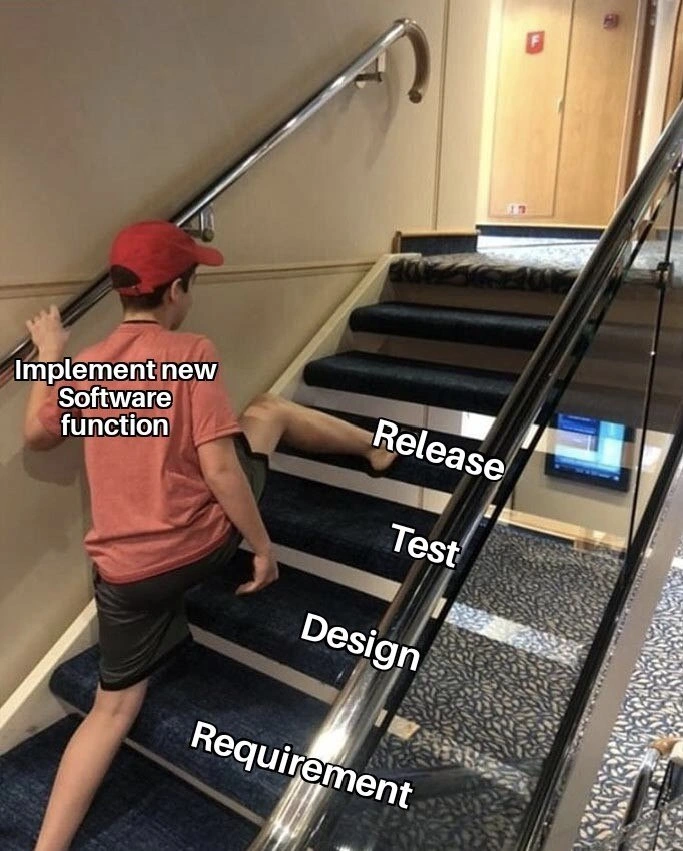
That’s exactly what’s happening in the meme. The boy is skipping straight from the start to the finish on a staircase. In real life, skipping all the middle steps when making software is just as risky as skipping steps in a recipe or a homework assignment. The picture is funny because it shows someone doing something obviously outrageous – a big stretched-out leap – which we immediately understand is not the proper way to walk up stairs. It’s a playful reminder that when you hurry too much and ignore the important steps, you usually end up with a mess. In other words, haste makes waste: if you try to finish a project in a rush by cutting corners, you’ll probably spend even more time cleaning up the problems later.

Level 2: Rushing to Release

Now let’s break down the situation for a less seasoned developer or someone newer to these concepts. The meme is referring to steps in the Software Development Life Cycle (SDLC), which is just a fancy term for the typical stages a software project goes through. These stages usually include:

  • Requirements Gathering: Figuring out what you need to build. This means talking to stakeholders or users, and writing down the features and constraints. It’s like making a wishlist or checklist for the project. Skipping this could mean you build the wrong thing or miss important details.
  • Design: Planning how you will build the solution. This can involve creating a design document, drawing architecture diagrams, or even writing pseudocode. Good design helps ensure the software is organized, scalable, and maintainable. If you skip design, you might start coding yourself into a corner – the structure of the application might end up messy or full of flaws.
  • Implementation (Coding): Actually writing the code to implement new software functionality. This is the step the boy in the meme is eager to do – developers often find writing code more immediately rewarding than planning. In the image, the boy represents the developer during implementation, and he’s labeled “Implement new Software function.”
  • Testing: After (and during) coding, you need to verify that the code works correctly. This includes writing unit tests (small programs to check each part of your code), integration tests (making sure different parts of the system work together), and maybe manual testing or a QA team trying to break the application. Testing is crucial for CodeQuality because it catches bugs and issues before real users see them. If you don’t test, you won’t know about critical bugs until your customers encounter them, which is far worse.
  • Release (Deployment): This is when you package the software and deploy it to a production environment so that users can actually use the new feature. Release management involves steps like version control, deploying to staging environments, doing gradual rollouts, and monitoring the release to ensure everything goes smoothly. It’s the final step where your code goes live.

In a healthy development process, you move through these steps methodically: understand the problem, design a solution, implement it, test it, and then release it. The meme’s joke is that the developer (the kid on the stairs) is skipping directly from Requirements to Release. In other words, they’re doing a software_lifecycle_shortcut – going from the initial idea straight to shipping the code, while completely bypassing Design and Test. It’s like saying, “Nah, I don’t need to do all that preparation and validation. I’ll just write the code and put it in production immediately!”

Why is this funny or relatable? Because in the real world, especially in fast-paced or chaotic environments, developers sometimes really do this (or feel pressured to do this). Maybe the deadline is extremely tight, or maybe someone in charge doesn’t understand why design and testing take time. A junior developer might also do this out of enthusiasm or naiveté: they jump into coding without clarifying the requirements fully or planning things out, and then they might skip writing tests because they’re so sure their code is correct (or they don’t know how to write tests yet).

However, this “rush to release” approach almost always leads to trouble:

  • If you didn’t clarify the requirements, the feature might not do what the users or the product manager actually wanted. That’s like building a tool that solves the wrong problem.
  • If you skipped design, the code might work for now but be impossible to maintain or extend. Other developers (or your future self) will have a hard time understanding it. This contributes to technical debt, which is the extra work you create by taking shortcuts. Imagine a quick hack now that forces a lot of bug fixes and refactoring later – that’s technical debt.
  • If you skipped testing, you likely missed bugs. The software might crash or produce wrong results when real people use it in unpredictable ways. Without UnitTesting and other tests, you have no assurance of quality (no CodeQuality gate). It’s much harder to debug issues in a live environment than to catch them earlier in a controlled setting.

The SDLC steps act like quality control checkpoints. The meme using a staircase is appropriate: each step is a necessary climb towards a reliable release. By skipping steps, the developer is more or less ignoring process and best practices (skipping_process). It’s done in a silly, exaggerated way in the image, which is why it’s funny – we see a kid doing an impossible split to avoid touching the “Design” and “Test” steps. Developers chuckle because it’s a literal depiction of what we metaphorically describe when someone says “Let’s just code it and ship it.” It’s a form of developer humor that also carries an underlying lesson: skipping those intermediate steps might seem to save time in the moment, but it’s risky and can lead to painful failures.

In summary, for a newcomer: the meme is poking fun at the idea of rushing through software development without proper preparation or checks. It’s saying “Look how ridiculous it is to avoid doing requirements, design, and testing – yet some teams still do this!” As a junior developer, if you ever feel tempted to jump straight into coding and deployment, remember the image of this guy stretching over the steps. It might get you to production faster in the very short term, but you’re likely to pull a muscle (i.e., cause a mess) in the process!

Level 3: Speedrunning the SDLC

At the highest technical level, this meme highlights a classic software development anti-pattern: attempting a speedrun through the Software Development Life Cycle (SDLC) by leaping from minimal requirements gathering straight to the production release. In the image, a boy stretches one foot from the ground-level “Requirement” step all the way up to the “Release” step, comically bypassing the “Design” and “Test” steps in between. This goofy physical stunt is a perfect metaphor for cowboy coding or "YOLO-driven development", where an engineer dives into implementation without proper planning or testing. Experienced developers recognize this as a recipe for disaster – or at least a late-night firefight with production bugs.

Real-world engineering teams have formal stages for a reason. Requirement gathering clarifies what needs to be built and why. Design (often captured in a Design Document or architecture diagrams) maps out how to build the solution cleanly and scalably. Testing (unit tests, integration tests, QA cycles, etc.) verifies that the code actually works and doesn’t break existing features, ensuring code meets quality standards. Only then comes the Release, deploying the new code into production. Skipping those stages is like removing the safety net beneath a trapeze artist – you might land the trick, but if you slip, the fall is going to hurt.

The humor here bites especially hard for senior engineers who have been “on call” when a rushed, untested hotfix took down a live site at 3 AM. We’ve learned (the hard way) that rushing to release without due diligence can lead to catastrophic bugs, unhappy users, and massive technical debt down the line. The shared trauma in this DeveloperHumor is real: who hasn’t seen a last-minute feature deployed on a Friday evening (because somebody skipped the process) only to have the team scrambling in a war room to fix the fallout? It’s the “move fast and break things” philosophy taken to an unhealthy extreme. The meme’s exaggerated leapfrogging of steps satirizes those projects where management demands rush_to_release speed or a developer’s overconfidence convinces them that “formal processes just slow us down.”

From a CodeQuality perspective, this shortcut is a deal with the devil. Sure, you might occasionally get away with pushing a quick change directly to prod (maybe for a one-line configuration tweak or adding a printf in the kernel), but habitually skipping Design and Testing means issues that should have been caught early will surface later, where they’re more expensive and embarrassing. Without proper design, you risk a brittle codebase that can’t adapt or scale (the “big ball of mud” architecture). Without tests, every deployment becomes a game of Russian roulette – will it work, or will it explode? Release management best practices (like staged rollouts, code review approvals, automated test pipelines) exist to prevent these do-or-die leaps. When teams ignore those guardrails, the production environment effectively becomes your testing environment, and end-users become unwitting testers. That’s why veteran engineers see this meme and half-laugh, half-cringe. It pokes fun at a skipping_process approach that we know is all too common and short-sighted.

To put it in perspective, here’s a pseudo-code snippet of this anti-pattern in action:

if deadline_is_tight:
    requirements = None      # Skip understanding what the user really needs
    design = None            # Skip planning how to build it
    tests = None             # Skip checking if it works
release_to_production(new_feature)  # YOLO deployment straight to prod

In a properly run project, that release_to_production line should only happen after requirements are clear, design is reviewed, and tests pass. The meme exaggerates the leap, but it resonates because it’s grounded in truth: under pressure or through inexperience, developers sometimes try to short-circuit the software lifecycle. And as any seasoned dev will tell you with a smirk, those attempts usually lead to “staircase tumbles” – big falls that could have been avoided by taking one step at a time.

Description

A meme using a photo of a young person in a red cap taking a flight of stairs multiple steps at a time. The person themself is labeled 'Implement new software function'. Each of the individual steps they are skipping is labeled with a phase of the software development lifecycle. From the bottom up, the stairs are labeled 'Requirement', 'Design', and 'Test'. The person's foot is landing on the final step, which is labeled 'Release'. This meme satirizes the common and dangerous anti-pattern in software development of skipping crucial planning and validation stages. It humorously critiques the pressure or tendency to rush code into production without proper requirements gathering, architectural design, or quality assurance, a practice that inevitably leads to technical debt, bugs, and on-call nightmares
Comments

7
Anonymous ★ Top Pick This is called the 'Rapid Application Development' methodology. The 'Rapid' refers to how quickly you have to roll it back
  1. Anonymous ★ Top Pick

    This is called the 'Rapid Application Development' methodology. The 'Rapid' refers to how quickly you have to roll it back

  2. Anonymous

    Continuous Delivery yoga: one foot on a vaguely worded Jira ticket, the other already in prod - trusting that the meter-wide gap over design and test will be resolved by eventual consistency

  3. Anonymous

    After 20 years in the industry, I've learned that the only thing faster than skipping the requirements phase is the speed at which you'll be rewriting everything when the actual requirements emerge during the post-mortem

  4. Anonymous

    When the PM says 'we can iterate on requirements post-launch' and suddenly you're deploying straight from a Slack message to production. Sure, we'll just treat Requirements, Design, and Test as 'nice-to-haves' - what could possibly go wrong? At least when this inevitably breaks at 3 AM, we'll have excellent documentation in the form of... oh wait, we skipped that step too. The real kicker? This approach somehow still ships faster than waiting for that one stakeholder to approve the PRD they requested six sprints ago

  5. Anonymous

    The true distributed SDLC: implementation consensus achieved first, then CAP-turing requirements across nodes

  6. Anonymous

    Our release acceleration strategy is to short‑circuit the stage gates - treat Requirements -> Design -> Test as soft-deletes - great for lead time, brutal on the error budget

  7. Anonymous

    Enterprise Agile: get a CAB waiver, call it a “critical hotfix,” and do prod yoga from Requirement to Release - Design and Test are just the handrail we touch to keep Audit happy

Use J and K for navigation