From epic interview duel to dumpster-fire first PR: a junior dev timeline
Why is this Interviews meme funny?
Level 1: Epic Battle to Epic Fail
Imagine you want to join a cool playground club. To get in, the club leaders make you do something really hard – like solving a giant puzzle or facing a pretend monster. It’s super intense, like a big epic battle where you have to be very brave and smart. You somehow succeed and they let you in. Phew! Now, on your first day in the club, everyone is really nice to you. They show you around, give you high-fives, maybe even snacks – it’s friendly and easy, not scary at all (kind of like playing with friendly dinosaurs instead of fighting monsters). Next, they give you your first job in the club: it’s a simple but boring chore, like cleaning up a huge mess in the schoolyard all by yourself. It’s not fun, and it’s a lot of work, but it isn’t tricky to understand – just like shoveling a ton of snow is tiring but uncomplicated. You do your best at this chore. Finally, you try to do something on your own to impress everyone – maybe you attempt a small project or make something for the club – but uh-oh! It doesn’t go well. In fact, you mess up so badly that it’s a bit like accidentally falling into a trash can in front of everyone. How embarrassing! The whole journey is funny because it goes from one extreme to another: first you’re tested like a hero in a huge fight, then everything feels safe and easy, and then you stumble on a simple task and fail in a big silly way. The emotional rollercoaster – from feeling challenged, to relieved, to bored, to embarrassed – is what makes us laugh. We laugh because we’ve all felt this way at some point: sometimes life tests you hard, then gives you a break, then you still manage to goof up when you least expect it. It’s a silly story that helps us feel better about our own first mistakes.
Level 2: First Day Follies
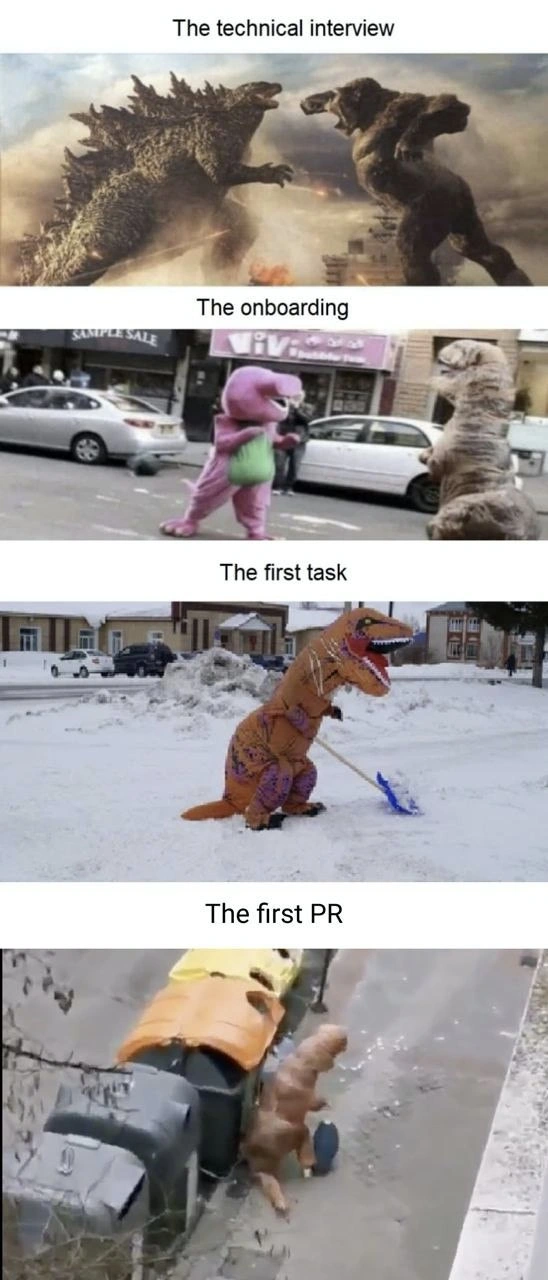
In this meme, we follow a new developer’s journey from hiring to their first real code review, and it humorously highlights how different each stage can be. The first caption, “The technical interview,” shows two giant monsters (Godzilla and King Kong) fighting. This refers to the technical interview process developers go through when applying for jobs. A technical interview is usually a challenging test of your coding and problem-solving skills. For example, you might have to write code on a whiteboard or solve tricky algorithm puzzles in front of interviewers. It feels intense – kind of like a huge battle where you’re pitted against big challenges (hence the Godzilla vs Kong reference). Many newcomers prepare by practicing lots of coding problems (InterviewHumor often points out how these feel like “boss fights”), and during the interview you might be sweating bullets trying to prove yourself. The meme’s joke here is that the interview is depicted as this epic duel, which is funny because it’s overly dramatic compared to what comes next.
The second panel is captioned “The onboarding” and shows something much more lighthearted: people dressed in friendly dinosaur costumes (one looks like Barney, a friendly TV dinosaur for kids) playing around. Onboarding is the period when you’ve just been hired and the company is introducing you to how things work. It usually involves orientation meetings, getting your computer set up, meeting your team, and learning the basics – generally a gentle, welcoming experience. By showing a Barney-costumed person play-fighting a T-Rex-costumed person, the meme humorously suggests that onboarding is easy and friendly. After the scary interview, the new developer is surprised to find the environment is almost childishly friendly. It’s like expecting another high-stakes test but instead getting a friendly onboarding process with maybe some company swag and a tour of the office. This is the onboarding_vs_reality punchline: in reality, companies often try to make new hires comfortable, the exact opposite of the stressful interview. For a junior dev, this sudden change might be surprising – “Wait, no one is testing me anymore?” The meme plays on that contrast for comedic effect.
Next comes “The first task.” The image here shows a person in an inflatable dinosaur costume (a T-Rex) trying to shovel a huge parking lot full of snow, all alone. This represents the kind of work new developers often start with. A first task for a junior developer is usually something small or straightforward in theory, but it can still feel overwhelming. In the real world, this might be a simple bug fix, writing a snippet of documentation, or cleaning up part of the codebase. It’s menial (not fancy or high-profile), but because you’re new, it feels huge – you might not even know where to find that code or how to run the application yet! The snowy parking lot is a metaphor for a backlog of basic tasks that need doing. Shoveling snow is a simple concept (anyone can use a shovel), yet doing it for an entire parking lot is exhausting and daunting, especially alone. Similarly, a junior dev might be asked to, say, rename deprecated functions across the codebase or update dozens of config files – simple but a lot of labor. The inflatable T-Rex costume adds to the humor: it makes the person’s movements clumsy and vision limited. This parallels how a new dev feels: awkward in the code, maybe slowed down by not knowing the tools well. This is a first_task_struggles moment – the work itself isn’t a clever algorithm like the interview had, but it’s challenging in a new way. The meme is pointing out that after all those brain-teaser interviews, a junior’s first actual task can be dull and tedious. It’s a reality check that many of us find funny because we remember being that person scratching our head at what should be a “simple” fix, feeling a bit like a dinosaur stumbling around.
Finally, we have “The first PR.” PR stands for Pull Request, which is when you take the code changes you’ve written and ask your team to merge them into the main code repository. Every pull request triggers a code review – other developers look at your code and give feedback or approval. The meme shows the little T-Rex character tipping head-first into a trash can. This is a comic way to say the first pull request did not go well at all – basically a pull_request dumpster fire. In everyday terms, it’s like you tried to contribute something and it kind of ended up in the garbage (failed). Many junior devs can relate to the experience of their first code review coming back with tons of comments or problems. Perhaps the code doesn’t follow the team’s style guidelines, or it accidentally breaks something (like tests or build scripts), so the reviewers request changes. It might feel like your work got trashed. The phrase “dumpster fire” is often used jokingly to describe a situation that went horribly wrong in a messy way. Here the meme literally shows the new dev diving into a trash bin, symbolizing that messy failure. It’s exaggerated for humor – of course in reality you wouldn’t literally fall into the trash, but you might feel that way if your first attempt at contributing code is met with a lot of critique. Senior developers leaving many review comments can be intimidating. You might see remarks on everything: “Please rename this variable,” “This function needs tests,” “We already have a util for this, please use that,” etc. The new dev might feel embarrassed, much like the flailing T-Rex in the bin. The humor is in how quickly the situation went from calm to chaotic. One moment you were just doing a simple task, and the next your code (and confidence) is in the dumpster (figuratively). As a junior, it’s a relatable and humbling moment – but every developer has been there! The meme uses this four-step timeline to capture a common inside joke in tech: you fight your way in through a crazy interview, you get a warm welcome, you start on trivial tasks, and then you spectacularly mess up something small. It’s comforting and funny for people in the industry because it says, “Don’t worry, we’ve all experienced these DeveloperPainPoints – and looking back, it’s pretty funny how stark each phase is.”
Level 3: Trial by Whiteboard
The first panel exaggerates a technical interview as an epic Kaiju battle – think Godzilla vs Kong locked in combat amid explosions. This dramatic imagery parodies the high-stakes technical interview process used by many tech companies. In real life, candidates are grilled with tough algorithm puzzles and whiteboard coding challenges as if they're facing giant monsters. It's a full-on “technical interview battle”: multiple interviewers hurling rapid-fire questions about data structures, Big-O complexities, or system design scenarios. The meme’s joke is that landing a junior dev job can feel like surviving a showdown with titans, where you're the underdog proving you can slay coding challenges. Everyone who’s been through a ridiculous whiteboard interview knows the feeling – one minute you’re tracing through a tricky dynamic programming solution under glaring eyes, the next you’re optimizing a binary tree traversal while your brain is in panic mode. The Godzilla vs Kong reference nails that vibe: the candidate vs. the interview gauntlet, both equally colossal and absurdly over-the-top. And ironically, passing this trial-by-fire is seen as the rite of passage into a job that (as we’ll see) might not require any of those monster-slaying skills on day one.
Move to the second panel: captioned “The onboarding,” its tone swings to playful absurdity. We see a street scene with people in goofy dinosaur costumes (one is Barney the purple dinosaur, the other an inflatable T-Rex) casually play-fighting. After the hyper-intense interview, the new hire’s onboarding process often feels comically gentle by contrast – almost like play time. In many companies, onboarding a junior developer involves friendly welcomes, orientation sessions, paperwork, and maybe a team lunch. The meme uses Barney (an icon of kiddie friendliness) sparring a T-Rex to show how the atmosphere suddenly becomes safe and welcoming, even silly. It’s a classic onboarding vs reality gag: the new dev braced for another Godzilla-level threat finds instead a disarmingly soft landing. No more breath-of-fire algorithm duels – now it’s smiles, swag bags, and maybe an inflatable dinosaur tour of the codebase. This humorous juxtaposition underscores a real DeveloperExperience (DX) quirk: companies often over-test in interviews, then over-comfort during onboarding. It’s as if after hazing you with brainteasers and system design scenarios, they hand you a plush dinosaur and say “Welcome, we’re actually nice!” The absurd change in tone is a shared joke among devs – one moment you’re in a technical_interview_battle, the next you’re being coddled so you don’t feel overwhelmed your first week. It’s funny because it’s true: the InterviewHumor here comes from that sudden swing from terrifying to terrifically tame.
Now the third panel, “The first task,” shows a lone soul in a spotted T-Rex costume awkwardly shoveling an enormous, snowy parking lot. This is a metaphor for the kind of menial starter tickets or trivial tasks new devs often get. After the hand-holding during onboarding, reality hits: you’re given work that is far from glamorous. The snow shovel metaphor is spot on – a junior might be tasked with something like fixing dozens of tiny UI padding bugs, writing boring unit tests, or trawling through legacy code to add missing comments. It’s work that’s simple in concept (anyone can shovel snow or fix a typo) but huge in volume or mind-numbingly tedious. The image of a tiny T-Rex wielding a kiddie shovel against a vast snowdrift captures the first_task_struggles perfectly. The junior dev (encumbered by an inflatable dinosaur costume, i.e. feeling clumsy and out-of-place) must tackle a backlog that’s piled up like a snowbank. It’s a rite of passage: after surviving the mythical interview duel, you’re brought down to earth with what feels like janitorial coding jobs. Experienced devs chuckle knowingly here – we remember our first assigned “easy” tickets that somehow took days, either because we were setting up our environment, deciphering cryptic codebase logic, or just overwhelmed by the scope, much like a T-Rex slipping in the snow. The humor is in the absurd mismatch: you weren’t asked in your interview to invert binary trees so that you could… clean up log files and rename variables, right? Yet that’s what happens. The onboarding_vs_reality punchline continues: all that computer science theory, and now you’re effectively “shoveling code snow.” It’s a clever visual way to say, welcome to real-world programming, kid – grab a shovel.
Finally, the fourth panel, “The first PR,” delivers the comedic crescendo. We see the poor inflatable T-Rex tumbling head-first into an overfilled trash bin. This represents a new dev’s first Pull Request (PR) turning into a total dumpster fire. In software teams, a pull request is when you submit your code changes to be reviewed and merged into the main codebase. A newbie’s first PR is often small, but it still can go embarrassingly wrong. The meme dramatizes this as literally falling into the garbage – a pull_request_dumpster_fire. Why a dumpster? In developer slang, a “dumpster fire” means a chaotic mess or failure. It’s common for a junior’s first code submission to come back with tons of code review comments: maybe the coding style didn’t match the guidelines, or they introduced a bug, or simply that seasoned reviewers nitpick improvements (everything from variable names to adding tests). The result feels like your hard-written code is “trash” – many requested changes or even outright rejection, which can trash your confidence. This panel nails that shared pain: the T-Rex’s tiny feet flail helplessly, just as a new dev might feel over their head in critique comments and CI build failures. The humor (tinged with DeveloperPainPoints) comes from recognition – every developer remembers that facepalm first PR. Perhaps you forgot to handle a null case and your code crashed the test suite, or you didn’t know the team’s lint rules so your PR has 30 style errors. Suddenly, the friendly Barney-like team is pointing out everything you did wrong. It’s an awkward, humbling tumble. Senior engineers laugh because we’ve all seen it: the “simple” bug fix PR that accidentally took down staging, or the 5-line change that spawns a 20-comment debate. The meme’s final punch is both harsh and hilarious: after all the buildup – battling to get hired, gentle onboarding, low-stakes task – the first real contribution still flops spectacularly. It’s a relatable JuniorVsSenior moment: the junior dev takes a literal fall, and the senior reviewers (off-screen) are likely facepalming or chuckling, remembering their own initiation by fire. The continuum of this junior_dev_timeline is exaggerated for comic effect, but ringed with truth. We laugh because the journey from “epic interview duel to dumpster-fire first PR” is a rite of passage in tech. Every step – the absurd interview, the cushy onboarding, the trivial tasks, the harsh reality check of code review – highlights a disconnect between expectations and reality that is both frustrating and funny in hindsight.
Description
Four-panel meme with captions: 1) “The technical interview” above a cinematic scene of Godzilla and King Kong clashing amid explosions, symbolising a high-stakes white-board battle. 2) “The onboarding” above street footage of people in friendly Barney and inflatable T-Rex suits play-fighting, suggesting a suddenly softer experience. 3) “The first task” shows a lone person in a purple-spotted inflatable T-Rex costume awkwardly shovelling a huge snowy parking lot, captioned accordingly, hinting at menial starter tickets. 4) “The first PR” tops a clip where a tiny T-Rex costume figure tips head-first into an overfilled trash bin, evoking a pull-request that crashes and burns in review. The progression satirises how a developer’s journey quickly shifts from rigorous technical interviews to gentle onboarding, then to trivial tasks and an embarrassing first code-review, capturing common pain points for new engineers
Comments
6Comment deleted
We white-boarded him on lock-free skip lists, shipped him a friendly onboarding doc, and his first PR was a three-line YAML tweak that triggered 17 legacy pipelines and pinged reviewers who quit in 2018 - turns out our interview process scales better than our CI
The technical interview: reversing a binary tree. The first PR: trying to get your 12-line bug fix past the senior who maintains the 8000-line God class you touched
The technical interview promises you'll be architecting distributed systems at scale, but your first task is updating the README formatting. Then comes the first PR - where you discover that your 'simple bug fix' somehow triggered 47 failing tests, broke the CI pipeline, and caused three senior engineers to leave detailed comments about why your variable naming violates the team's unwritten conventions from 2019. Welcome to the team!
Interview: Slay Godzilla with LeetCode. First PR: Manual garbage collection into the monorepo dumpster
Crush the red‑black‑tree duel, then watch your first PR faceplant into branch protections, tribal knowledge, and flaky CI - straight into the tech‑debt dumpster
My first PR at a new org: 6 lines of logic, 2400 lines of yarn.lock, CI blocked because I'm not in the 'prettier-write' Okta group, and the reviewer wants context that predates the monorepo