Skip to content
DevMeme
5298 of 7435
A Glimpse into the Developer's 'Flow State'
MentalHealth Post #5812, on Jan 12, 2024 in TG

A Glimpse into the Developer's 'Flow State'

Why is this MentalHealth meme funny?

Level 1: The Build That Never Ends

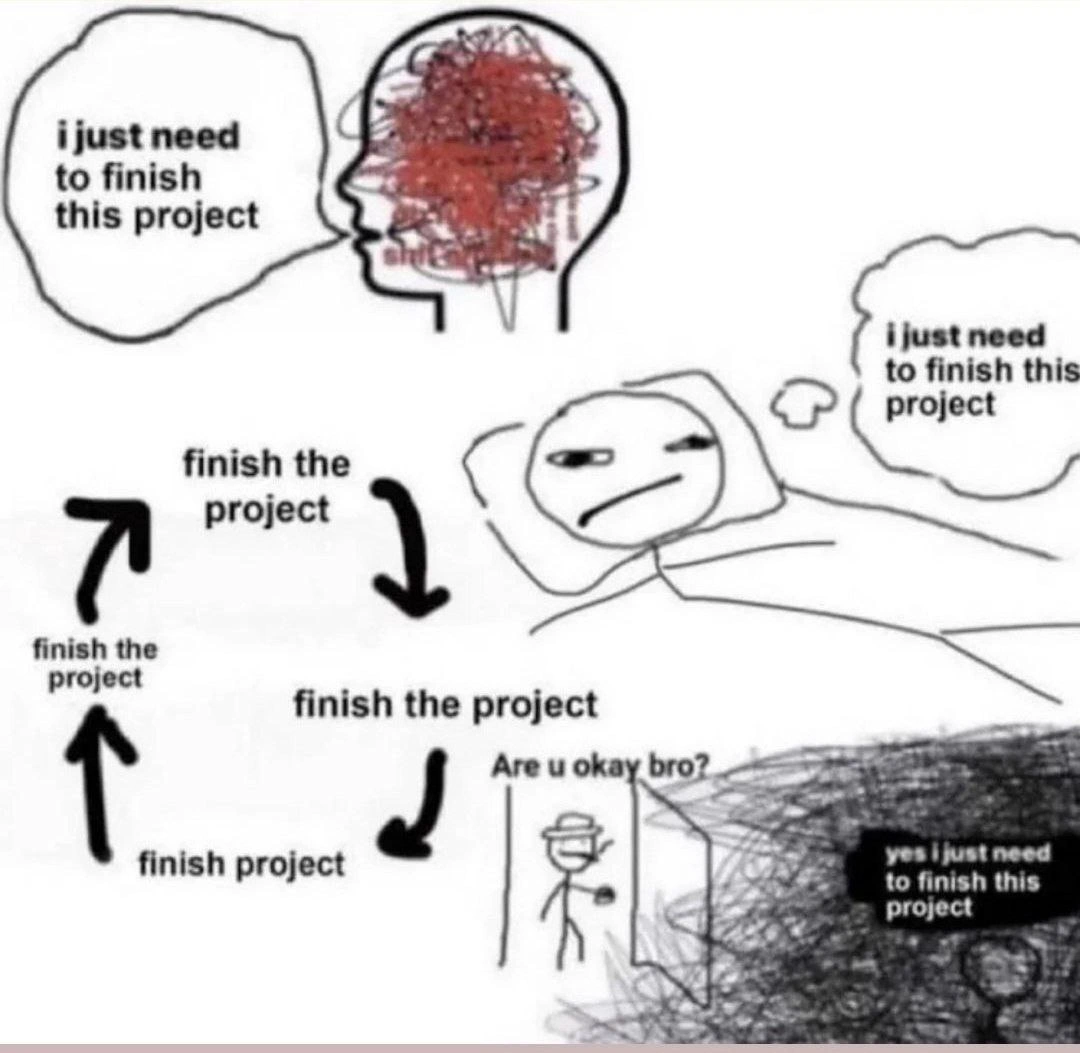
Imagine you’re trying to bake a cake, and for some mysterious reason, every time you think it’s done, it isn’t. 🍰 You put the cake in the oven, wait for the timer, take it out… and it’s still gooey. So you put it back in. Wait again, take it out… still not done. You do this over and over. After a while, you might start muttering to yourself, “I have to bake it, I have to bake it, I have to bake it…” in a kind of daze because you’re so frustrated and fixated on getting this darn cake finished. Now imagine your friend walks into the kitchen and sees you in this state, frantically shoving the cake in and out of the oven, batter splattered everywhere, talking to yourself. Your friend would probably be like, “What the heck is going on in here?!”

In the meme, the developer is you with that cake. But instead of a cake, it’s code they’re trying to "bake" (build) over and over, and it’s just not working. The black scribbles are like the mess in the kitchen and the storm in their head – a big cloud of frustration. The repeated phrase “I have to build” is them obsessing over fixing the problem, kind of like you obsessing over finishing the cake. And the other stick figure opening the door is the friend who discovers this chaotic scene and reacts with shock. It’s funny in a way, but also you feel a little sorry for the person stuck in the loop. We’ve all had moments like this: getting stuck on repeat with a problem, so absorbed that when someone finds us, we’re almost cartoonishly disheveled and stressed. The meme just takes that feeling and makes it super simple and visible: one character is losing it over a never-ending task, and another is the outsider going “Whoa, you okay there?” It’s a slice of everyday life for developers, turned into a silly drawing that anyone who’s ever been frustrated can understand.

Level 2: Trapped in Build Hell

Let’s break down the scene and the jargon for those newer to the game. First off, what even is a build? A build process is essentially the steps needed to convert developers’ source code into a running program. This often means compiling code (turning high-level code into machine code), linking libraries, packaging files – all the nitty-gritty to go from “I wrote some code” to “I have an executable or application that can run.” In modern software teams, especially with many developers collaborating, you typically have a BuildPipeline or CI/CD pipeline (Continuous Integration/Continuous Deployment). This pipeline is often automated with tools like Jenkins, CircleCI, or GitHub Actions. Every time someone pushes a change, the pipeline kicks off: it builds the code, runs tests, maybe runs code quality checks, and if everything is good, possibly even deploys the app. It’s a BuildAutomation assembly line meant to catch issues early and ensure the software is always in a deployable state.

Now, why would someone get “stuck” in a build loop? A build loop in this context means someone is repeatedly running the build or CI pipeline and not getting a successful result, over and over. One common cause: BuildFailures. Perhaps a test is failing or the code isn’t compiling due to an error. The developer fixes one problem, starts the build again… and then hits the next problem. Fix, build, fail, fix, build… you get the idea. It’s like trying to whack moles in a carnival game 😵 – fix one thing, another pops up. If each cycle takes a long time, it quickly becomes an exercise in frustration. This can lead to compile_cycle_anxiety – a coined phrase that perfectly describes the nervousness a dev might feel each time they hit “build” or wait for CI, heart pounding a bit because, oh no, what’s going to break next?

The meme illustrates this with the little stick figure on the right, who is completely overwhelmed. They are drawn inside a big mass of scribbles. Those scribbles represent chaos and mental overload – probably how a super messy build log looks to a tired programmer at the end of the day, or how their brain feels when juggling too many errors and tasks. The speech bubble coming from that figure shows them repeating “I have to build I have to build I have to build…” on loop. That’s basically showing an obsessive thought pattern. It’s the cartoon way to say, “This person is stuck in a one-track mind right now.” Technically, it’s parodying how some developers get fixated when the build isn’t working: they can’t think of anything else until it succeeds. They might be running the build command like mvn package or npm run build endlessly, or re-running the CI pipeline, isolating themselves until they see a green success message. It’s an infinite_build_loop mentality – a trap where you feel you must keep rebuilding until everything passes, and you sort of lose perspective (and track of time).

Meanwhile, on the left, we have another stick figure opening a door and saying “What the fuck?” (excuse the language, but hey, it’s a direct quote from the meme). This character represents a colleague or friend literally walking in on the situation. The meme is drawn in a simple black-and-white stick-figure style – reminiscent of webcomic or stick_figure_intruder_meme formats where one character intrudes on another’s frame in surprise. The hat on the intruding figure gives a bit of comedic flair; maybe it’s just to make that character visually distinct (perhaps a tip of the hat to some classic stick-figure comics). When this teammate opens the door, they are confronted with a wild scene: their coworker is in a kind of self-induced torment, hunched and mumbling amid a scribbly cloud of stress. The reaction “WTF?” is exactly how you’d respond if you found your normally sane friend rocking back and forth muttering tech jargon to themselves in a dark room. It underscores just how absurd the situation looks from the outside.

Let’s talk about DeveloperFrustration and DeveloperFatigue here. Building software is usually a normal routine task – you do it dozens of times a day, ideally with quick results. But problems in the build can cause huge frustration. Imagine you’re fairly new, and you update one library in your project. Suddenly, nothing compiles because that upgrade had ripple effects (maybe some functions changed). You try to fix one error, but then 10 new errors appear. It’s like a hydra: cut off one head, more grow back. If the build or test suite takes a long time to run, each attempt is a long wait. This waiting combined with repeated failures can really wear a developer down. DeveloperBurnout isn’t just caused by long hours; it’s also caused by a sense of grinding away without progress – exactly what a never-ending build failure loop feels like. You start second-guessing yourself: “Did I break everything? Why can’t I get this to work? It’s just a build!” This erodes your confidence. Cognitive overload (too much info and error messages flooding your brain) means you can’t even see a clear path to the solution after a while – everything just looks like that giant scribble in the meme.

In a more literal sense, there’s also the scenario of a CI pipeline that’s misconfigured and actually triggers endlessly. For instance, suppose a CI job is set to run on every git push, and the job itself commits something (like formatting the code and pushing those changes). You could inadvertently create a loop: push triggers build, build makes a new push, which triggers another build… oh no, infinite loop! This is less common (most teams have safeguards), but it does happen occasionally when automation rules get tangled. In that case, a developer could indeed be stuck frantically trying to stop the process: picture someone canceling jobs, editing configs at high speed, essentially thinking “I have to stop the build, I have to stop it!” – a slightly different take on “I have to build” but the anxiety vibe matches the meme. It’s all part of never_ending_build drama.

For a junior developer or anyone new to these concepts, the meme is a cautionary (and humorous) tale of DeveloperProductivity gone wrong. It’s telling you: look, builds and CI are supposed to help us, but if they’re slow or always failing, they can trap you. In healthy practice, a build should be straightforward. If it fails, usually you fix one thing and it works. But any experienced dev will tell you, sometimes you hit a nasty day where nothing builds and you feel like you’re chasing your tail. The key terms to know:

  • CI/CD (Continuous Integration/Continuous Deployment): a workflow that automatically builds and tests code frequently, so integration issues are caught early.
  • Build/Build System: the tools (like Maven, Gradle, Make, or even an IDE) and processes that compile and assemble your software. A BuildPipeline is the sequence of steps in CI that does this on a server.
  • Breaking the build: an important phrase. If you “break the build,” it means you committed code that fails the pipeline (so others can’t get a clean build until it’s fixed). It’s often somewhat shameful 😅 – teams try to avoid breaking the build because it blocks everyone else.
  • Build Hell: not a formal term, but developers humorously talk about being in “dependency hell” or “build hell” when they’re stuck with build problems that are hard to resolve. It implies a combination of technical snags and the personal frustration that results.
  • Developer burnout/fatigue: when a developer becomes exhausted and less effective, often due to prolonged stress or overwork. This meme shows a kind of mini-burnout episode, albeit temporary and focused on one task that’s driving the person crazy.
  • Cognitive overload: when you’re processing too much at once. All those scribbles? That’s the visual representation of overload – maybe logs, errors, thoughts, and worries all jumbled together.

In sum, that chaotic scene is a perfect storm of a BuildProcess gone awry and the human reaction to it. A colleague walking in might snap the person out of it: “Hey, take a break, let’s figure this out together,” which is often what needs to happen in real life to prevent mental health spiraling. The meme speaks to developers’ shared experience: whether you’re new and it’s your first big project, or you’re seasoned and seen systems crumble, you know the pain of waiting on builds and the panic when they keep failing. It’s equal parts informative (to those learning why builds are important and challenging) and cathartic (to those who’ve lived through it and can now laugh, a little, at the memory).

Level 3: Builds All The Way Down

For those who’ve been in the trenches of large codebases, this meme triggers an immediate oh no, I’ve seen this reaction. The scene of a developer hunched over amid chaotic black scribbles, mumbling “I have to build I have to build I have to build…” on repeat, is a darkly comedic exaggeration of DeveloperFrustration and burnout. It’s the embodiment of a programmer trapped in Build Hell – that special circle of developer hell where the builds never end, the CI pipeline keeps spewing errors, and every fix you attempt triggers yet another rebuild. The left side stick-figure (with the snazzy fedora) opening the door and exclaiming “What the fuck?” is basically any teammate or manager walking in on this spectacle of despair. It’s the outsider’s shock at how a supposedly routine task – running a build – has devolved into an overwhelming obsession. We laugh because we recognize the truth: continuous integration can feel like continuous insanity when things go wrong.

The humor here comes from exaggeration, but only slight exaggeration. Anyone who’s dealt with a flaky BuildPipeline or interminable compile times has felt a slice of this nightmare. Imagine a developer who’s been trying to get the CI/CD pipeline green for hours: they run the build, a test fails. Fix test, run it again. Now a different module fails due to an obscure dependency issue. Fix that, run again. Now something that was working mysteriously breaks, possibly due to a side-effect or a mis-merging of branches. Each cycle takes 20 minutes, and with each iteration the developer’s stress ticks up a notch. After enough cycles, you’re essentially doing the same thing over and over, hoping for a different result – the very definition of insanity. DeveloperProductivity plummets; you’re spiraling. The scribbled mess in the meme perfectly illustrates the mental state: tangled thoughts, cognitive overload, maybe some choice curse words scribbled in there for good measure. That black speech bubble with “I have to build I have to build...” is like the internal mantra of panic, not far off from a system process stuck logging the same error repeatedly. It’s funny because it’s true – many of us have caught ourselves muttering at the screen or obsessively hitting the "Rebuild" button like a lab rat hitting a feeder bar, fully overwhelmed_by_ci madness.

From a senior developer perspective, there’s also a commentary on process and priority failures. Why is our poor teammate stuck in this loop to begin with? It hints at systemic issues many teams face. Perhaps the BuildSystems_CICD setup is brittle: maybe the build takes 45 minutes due to thousands of unit tests and massive code, and a single failure near the end means you start over. (Cue the "I swear it passed locally!" conversations.) Or maybe an incremental build that should only take seconds keeps defaulting to full rebuilds because of some misconfigured dependency. There’s an industry term for this kind of quagmire: “the daily build breakage” – when almost every day something is broken in the pipeline, and developers end up spending half their time firefighting the build instead of writing new code. It’s a huge DeveloperProductivity killer, and everyone knows it, yet it happens frighteningly often. The meme is basically a war story in comic form: one dev has fallen victim to the infinite build loop, and another dev is discovering the horror like a plot twist in a movie. Surprise! Your coworker’s not fixing features anymore; they’ve been ritually sacrificed to the CI gods.

The dark humor also touches on mental health in tech. The right side of the frame is pure chaos and mental noise – it’s not just code failing, it’s a person’s mind being overwhelmed. This is where DeveloperBurnout and fatigue come in. We joke about it, sure, but the struggle is real. Spending days in an endless loop of trying to fix builds can lead to serious fatigue. You lose the thread of what feature you were building in the first place; you go home annoyed and dream about error logs. The meme resonates especially with those who have experienced crunch times or on-call rotations where your brain ends up in a similar scribbly mess. It’s as if the BuildProcess has possessed the developer. They’ve become a build zombie, only chanting the one thing their tunnel-visioned brain can focus on: must… fix… build… 🔄.

In a well-run project, of course, we try to prevent this scenario. We invest in faster build machines, we break the monolith into microservices to reduce scope, we write reliable tests, we quarantine flaky tests, we improve BuildAutomation scripts so they’re robust. But the meme wryly suggests what happens when those best practices fall short or aren’t in place at all. It’s poking fun at the anti-pattern where Continuous Integration isn’t truly continuous progress, it’s continuously trapping developers in a quagmire. There’s even an element of office culture commentary: that left-hand stick figure could be a senior dev or team lead stumbling upon a junior dev in crisis. Perhaps they left this junior alone to handle a big deployment or complex integration, and now they’re opening the door like, “Oh no, what did we do to them?” The fedora-wearing hero might even be a release manager coming to check why the release isn’t out yet, only to find one of his team muttering like Gollum over the build logs. The reaction – “WTF?” – is both shock and a bit of accusatory how did you let it get this bad?.

Seasoned engineers reading this have likely endured similar "nightmare build" stories (and wear them like badges of honor or trauma). The shared experience is what makes it DeveloperHumor. It’s a form of relief to see it captured so perfectly in a silly drawing: Yes! – we say – I’ve opened that metaphorical door and found chaos on the other side. Or worse, I’ve been that person in the scribbles. We chuckle, maybe a bit ruefully, because we know how easily one can get pulled into that vortex. The meme holds up a mirror to the absurdity of losing days of work to what should be a routine automated process. It's a reminder that behind our slick DevOps pipelines, if something goes wrong, it can feel like madness. And as any cynical veteran dev will tell you over a beer, sometimes all you can do is laugh it off after the fact – and perhaps mutter “It’s always the build…” as a play on the old joke "it's always DNS" whenever something mysteriously fails. We’ve all got war stories, and this stick-figure cartoon just turned one of those war stories into a visual gag.

Level 4: The Halting Build Problem

On a fundamental level, a software build process can be modeled as a directed acyclic graph of tasks: compiling modules, linking binaries, running tests, packaging artifacts, and so on. Ideally it's acyclic – no loops – so it eventually terminates. But reality isn’t always so kind. The meme’s endless build loop echoes the classic Halting Problem in theoretical computer science: determining whether an arbitrary program will finish running is undecidable in the general case. In practice, build systems work hard to guarantee termination (no one wants a compile stuck in an infinite loop), yet complex systems sometimes flirt with this nightmare scenario. Ever seen a CI job trigger another job, which triggers the first job again? One misconfigured script and you’ve accidentally coded a perpetual build motion machine. 🔁

Modern BuildSystems like Bazel and Buck actually restrict their build specification languages to prevent Turing-completeness – a fancy way of saying they don’t allow arbitrary loops in build definitions. This is by design: if your build configuration were as powerful as a general program, you could write one that never stops (imagine a Makefile recursively calling itself, chasing its tail forever). By limiting expressiveness, these tools avoid the compile-cycle anxiety of a self-referential build that never concludes. Other build tools (consider older shell-scripted CI pipelines) aren’t as safeguarded, so a frustrated developer might inadvertently create a never_ending_build job that keeps restarting itself or never hits a termination condition. It’s a grim engineering joke: we have to apply theoretical CS constraints just to keep our BuildAutomation under control, so we don’t literally implement the myth of Sisyphus in Jenkins.

Even without literal loops, the build pipeline can feel infinite when its complexity grows beyond what hardware or humans can handle. Compiling a huge monolithic codebase can approach asymptotic extremes. C++ template metaprogramming, for example, is Turing-complete – you can craft templates that make the compiler work arbitrarily hard or even hit internal recursion limits, effectively approximating an infinite loop until the compiler throws an error. Large-scale builds often involve thousands of files and dependencies; the dependency graph might be acyclic but still enormous. The time to churn through it can explode combinatorially if not managed. This is where advanced strategies come in: parallel compilation (using all those CPU cores 🖥️), distributed builds (farm it out to many machines), and cached incremental builds. However, invalidating and managing those caches introduces one of the infamous hard problems in computer science: cache invalidation. When a build system isn’t sure what parts are affected by a change, it often errs on the side of rebuilding too much. That’s like recalculating an entire equation because one variable changed. It ensures correctness, but at the cost of turning minutes into hours. The quip “there are two hard things: naming, cache invalidation, and off-by-one errors” exists because getting a build cache right is devilishly tricky. If the cache logic fails, developers lose trust and start doing “clean builds” every time (“just wipe everything and rebuild it all, I don’t care anymore!”) – a brute-force approach that can spiral into the very build loop depicted in this meme.

From a theoretical lens, the humor here taps into an underlying inevitability: as systems scale, developer productivity tools like builds and CI become complex systems themselves, subject to delays, race conditions, and the occasional logical paradox. We expect continuous integration to streamline development, but beyond a certain scale it enters a regime of diminishing returns, or even madness. There’s an almost recursive irony: we write code to automate and speed up our work, but that code (build scripts, CI configurations) is still code – it has bugs, it has edge cases, and sometimes it traps us in a recursive abyss of our own making. The cognitive_overload scribbled across the meme’s right side could just as well be a visual metaphor for a tangled dependency graph or a muddled state machine that a formal methods professor might sketch on a whiteboard to prove a point about complexity. This is the deep end of the joke: in software, even our tools need tools, and if you peek behind the door at 3 AM (as the stick figure with the hat does), you might find your teammate and the build server both trapped in the same infinite_loop nightmare, staring into the abyss of unresolved dependencies and repeating tasks. It’s funny in a slightly terrifying way – a black comedy coded in YAML and C++.

Description

A two-panel meme in the style of the 'Are ya winning, son?' format. On the left, a stick figure wearing a hat opens a door and says, 'What the fuck?'. On the right, the room is depicted as a chaotic vortex of black scribbles, symbolizing an overwhelming and complex mental state. Inside this chaos, a barely visible second stick figure is hunched over, with a black speech bubble filled with the repeated phrase: 'I have to build I have to build I have to build...'. The meme humorously contrasts an outsider's perspective with the internal reality of a developer or founder consumed by a project. It visualizes the intense, all-consuming focus, pressure, and mental chaos associated with deep work, tight deadlines, or the entrepreneurial drive to create, a state that is often mistaken for madness by those outside of it

Comments

7
Anonymous ★ Top Pick That's just a senior engineer's brain trying to resolve a circular dependency in the build configuration while simultaneously placating the project manager. It's a fragile state; best not to disturb it
  1. Anonymous ★ Top Pick

    That's just a senior engineer's brain trying to resolve a circular dependency in the build configuration while simultaneously placating the project manager. It's a fragile state; best not to disturb it

  2. Anonymous

    When a teammate finally opens the door and finds you rocking in the dark muttering “bazel clean --expunge” on repeat, it hits them - the only truly Turing-complete service in our architecture is the build pipeline’s infinite loop

  3. Anonymous

    The same instinct that made me rewrite our perfectly functional auth system three times is now telling me to build a distributed event-sourcing framework for my personal todo app

  4. Anonymous

    This is what happens when your 'simple' microservice has 847 transitive dependencies and your build system decides to recompile the entire universe because you changed a comment in a utility function. The architect who said 'just add another layer of abstraction' is nowhere to be found, and you're left watching Gradle download the internet for the third time today while your CI pipeline burns through $200 in compute credits. The real kicker? After all this builds, you realize you're still on Java 8 because upgrading would trigger this nightmare across 50 other services

  5. Anonymous

    When the NIH daemon wins, you don’t ship a feature - you accidentally create a platform team with a 24x7 SLA

  6. Anonymous

    Recursive backlog with no base case: def have_to_build(): have_to_build() # Sanity stack overflow in 3...2...

  7. Anonymous

    Nothing triggers the NIH daemon faster than the words off-the-shelf - five minutes later you’ve architected a bespoke platform, a microservice you didn’t need, and a decade of on-call

Use J and K for navigation