Deciding Git host while dependabot pings and tech burnout slowly sets in
Why is this VersionControl meme funny?
Level 1: Too Tired to Care
Imagine you ask your friend whether they like Toy A or Toy B better. Instead of a simple answer, your friend suddenly starts venting about everything that’s bothering them. They go: “I’m so tired of playing these games! Every day there’s a new rule to learn. The instruction booklet is missing pages, so I don’t even know how to play properly. My phone keeps buzzing with reminders that I haven’t finished my homework and the game levels I started yesterday aren’t working today for some reason. I’m just exhausted. You know what? I’ll choose Toy A… because it has a funny cute sticker on it.”
It’s a silly and unexpected response to a straightforward question, right? Instead of just saying "Toy A" or "Toy B" and giving a normal reason, your friend unloads all their stress (too many rules = too many acronyms, missing instructions = no documentation, phone buzzing = dependabot alerts, game not working today = code fails next day). They’re basically saying they feel overwhelmed and burned out. In the end, they pick something based on a trivial detail (a cute sticker, like the cute cat logo in the meme) because that’s all the positivity they can find at the moment.
The humor here is that the person is so tired they can’t even focus on the original question. It’s funny in the way someone might overreact and start ranting about everything when you only asked a small thing. We laugh because we recognize that frazzled feeling. The meme is using this exaggerated rant to show how a developer (a person who writes code) feels when they’re burned out by their job. It’s like if you ask a stressed-out student, “What’s your favorite subject?” and they respond, “I’m drowning in homework, I don’t understand half the notes, I’m running on 4 hours of sleep… uh, I guess I like math because the numbers look cool.” The tiredness makes them answer in a goofy way. So, in simple terms: the meme is funny because the tech worker is too tired to care about a serious choice, and ends up choosing based on something as small as a cute cat picture. It highlights how being overworked can make anyone a bit goofy and desperate for a smile, even in the middle of an important discussion.
Level 2: Works on My Machine
Let’s break down the terms and issues in this meme one by one, and why they’re causing our developer such grief:
GitHub vs GitLab: These are popular platforms for hosting code using Git, a version control system. Version control is basically a way to keep track of changes in your code and collaborate with others without overwriting each other’s work. GitHub and GitLab provide a web interface on top of Git, plus features like issue tracking and continuous integration (auto-building and testing your code). Think of them like Dropbox or Google Drive for code, but with a lot of extras tailored for development teams. People often ask “Which do you prefer?” Similar to comparing two similar tools (like VS Code vs IntelliJ, or Android vs iPhone), it usually comes down to personal or team preference. GitHub’s mascot is the Octocat, a cute cat-octopus character, and GitLab’s mascot is a tanuki (raccoon dog). In the meme, the developer jokes that they choose GitHub because of the cute cat. This implies they’re too burned out to seriously weigh the technical pros and cons. It’s like saying “I can’t deal with a big debate right now—let’s just go with the one that at least has a fun vibe.”
Dependabot: This is an automated tool (now built into GitHub) that helps manage dependencies. In software, a dependency is an external library or package that your project uses. For example, if you’re building a website and use a popular library for making charts, that library is a dependency. These dependencies get updates over time (for bug fixes, new features, security patches). Dependabot’s job is to check your project’s dependency list, see if any have newer versions, and then automatically open a pull request (a suggested code change) to update the old version to the new one. It’s super handy because it reminds you to stay up-to-date and even does a chunk of the work for you. So why is the developer upset? Imagine you have a project with dozens of dependencies; Dependabot might open/update a new PR every day (or multiple in a day) because something is always version-bumping. Your inbox or notifications get flooded with “🔔 Dependabot alert: Update library X from 1.2.1 to 1.2.2.” It can start to feel like an annoying alarm that never stops. The dev is basically saying: “I appreciate the help, Dependabot, but can I have one day without these alerts?” This feeling is common when tools meant to help end up adding a bit of stress — you feel pressured to constantly review and merge these updates. It’s a modern developer problem: you want your software secure and updated (thanks to Dependabot), but keeping up with the bot’s relentless pace can be tiring, especially when you’re already busy with other tasks.
Too Many Acronyms: The text specifically complains: “Why do people keep adding more acronyms?” In tech, an acronym is an abbreviation formed from the initial letters of other words (for example, HTTP stands for HyperText Transfer Protocol). There are tons of acronyms and abbreviations in the developer world. Some you learn early, like SQL (Structured Query Language) or API (Application Programming Interface). But as you dive deeper, you encounter an ever-growing list: REST, JSON, HTML, CSS, RPC, OAuth, S3… it can feel endless. And then new technologies introduce fresh ones all the time (think of GraphQL, CI/CD, JWT, SPA, DNS... the list never ends!). For a newcomer, this can be very overwhelming — it’s like learning a new language where every other word is shortened. Even for an experienced dev, keeping up with the latest acronyms can be a chore. Why do we use so many? Often it’s to save time (saying “SQL” is quicker than the full phrase), or because it’s a standard term every developer is expected to know. Sometimes acronyms become popular buzzwords. But it’s totally okay if you need to look them up; even veterans do! The meme’s developer has hit a point of acronym fatigue: they’re tired of every new framework or methodology coming with a new abbreviation to remember. It’s a relatable frustration — like, “Ugh, can’t we just use plain words?” If you’ve ever seen a technical document or chat message full of things like “Yeah just use JWT for auth and ensure SSO via OAuth2 with the IdP,” you know it can feel like deciphering alphabet soup. In short: acronym overload = brain overload, which adds to the person’s burnout.
“Where is the documentation?”: Documentation in software is any text or guides that explain how things work or how to use them. This can be official docs on a website, README files in a repo, or even comments in code. Good documentation is like a map that helps developers navigate a project or an API. Unfortunately, it’s very common to encounter projects with sparse or outdated docs. For example, you might find a library that solves your problem, but the instructions are incomplete, or the usage examples don’t cover your case, or the docs haven’t been updated after the last major change. This is super frustrating! You’re left to reverse-engineer (figure it out by reading code or experimenting). The meme’s dev asking “Where is the documentation?” is practically a meme on its own in dev culture. It’s both a genuine question and a sarcastic remark, implying that there isn’t any. If you’re a new developer, know that you’re not alone in feeling lost due to poor documentation — even senior devs get stuck and annoyed by it. Often on teams, you’ll hear jokes like “The documentation is the code itself” (meaning you have to read the code to understand usage). Writing docs is an important skill, but because it’s not “code” that runs, teams sometimes neglect it. The result: everyone’s confused and asking around for help. In our meme, this missing docs issue is one more thing pushing the developer towards burnout. It’s a plea we’ve all made: could somebody please write things down clearly? When you’re tired and everything is complicated, having no documentation feels like the world is just making things harder on purpose.
Code works one day, fails the next: This line, “Why does my code work one day and fail the next??”, pinpoints a classic newbie and experienced-dev experience alike: inconsistent behavior. You might run your program and all tests pass on Friday, but run the exact same code on Monday and suddenly something is broken. How is that possible? There are a few common reasons:
- Environment changes: The “environment” is the setup/configuration your code runs in (operating system, installed packages, environment variables, etc.). If something in that environment changed (say you updated Python, or installed a new system update, or changed a PATH setting), it can affect the code’s behavior. Often people say, “Well, it works on my machine,” meaning the code isn’t fundamentally broken, but it only seems to run correctly on the original machine or setup. This phrase has become a running joke because it’s such a frequent scenario.
- External changes: Maybe your code calls an API or uses an online service and something changed on that service’s side over the weekend (e.g., they deprecated a feature). Or if you pull in data from the internet, one day’s data might have slight differences that reveal a bug in your parsing.
- Time-dependent issues: This is sneaky — something as simple as a date or time can break code. For instance, code that handled dates might fail on the first of a new month, or an SSL certificate might expire overnight causing connection failures.
- Random bugs (Heisenbugs): Occasionally, there are bugs that don’t show up every time, or they only appear under certain conditions. Maybe a test was passing by luck (like two processes always happened in a safe order by chance, until one day they didn’t). When you discover those, it’s perplexing: “But I didn’t change anything, how did it break?!” Seasoned devs learn to suspect everything: “Okay, what changed that I’m not aware of?” It could be as trivial as the machine’s locale settings or as obscure as cosmic rays (seriously, very rarely memory can flip from radiation!). The key point is that software isn’t always as predictable as we think, especially when multiple systems interact.
For a newer developer, encountering this is frustrating and might feel like you’re losing your mind. You might wonder, Did I imagine it working yesterday? Rest assured, even veterans get thrown by this. They’ve just built up more strategies to investigate (like checking version histories or diffing configurations). In any case, this meme’s author is at their wits’ end with such flaky behavior. It’s one more straw on the camel’s back leading them to scream for help.
Tech burnout: The overarching theme is burnout – feeling physically and mentally exhausted by work to the point of losing motivation or effectiveness. In tech jobs, burnout is unfortunately common. Why? The field moves fast, demands long hours sometimes, and can be very high pressure (think tight deadlines, on-call rotations waking you up at 3 AM, production outages needing immediate fixes). Also, many of us are passionate about tech, so we push ourselves hard — until we hit a wall. The meme explicitly states “working in tech is slowly burning me out,” which is a cry that many developers (even relatively junior ones) have felt after a crunch period or during a particularly chaotic project. Burnout signs include feeling tired no matter how much you sleep, becoming cynical or irritable, and feeling ineffective or bored even with tasks you used to enjoy. It’s serious because it can lead to health issues and people quitting jobs or even careers. The meme uses the burnout mention to comedic effect (it’s unexpected in what should be a simple preference question), but it’s highlighting a real problem in developer experience. When you see this as a junior dev, take it as a gentle warning: take care of yourself, ask for help when overwhelmed, and know that feeling this way sometimes doesn’t mean you’re not cut out for tech — it means the workflow might be unhealthy. Good companies are starting to acknowledge burnout and try to prevent it (through reasonable working hours, more support, etc.). But clearly, from this meme, not all places have it figured out. So the poor dev in question has hit that burnout stage where everything feels like too much.
“The cat is cute” (Octocat): Finally, the somewhat silly note the developer ends on: preferring GitHub because of the cat logo. This is a bit of developer humor and exhaustion shining through. GitHub’s logo/mascot is a character called Octocat – basically a cat with octopus tentacles. It appears on the GitHub website and swag. Many devs find it charming or iconic. By contrast, GitLab’s logo is a fox (or tanuki). Saying “I like GitHub because the cat is cute” is like answering a serious question with a joke answer because you’re just done with serious thinking for the moment. It’s similar to if someone asked “Which car is better, A or B?” and you say “Whichever one comes in red, because I like red cars,” after ranting about traffic and car troubles. It shows the person’s state of mind: decision fatigue and a search for a tiny bit of happiness. The cute cat is that tiny spark of joy for this developer. It might also imply that at the end of the day, the differences between the two platforms don’t matter much to them – both will host your Git repositories – so why not choose the one with a fun mascot? For a newcomer, it’s important to note: normally, you’d choose a tool based on features, community, etc., not the logo 😄. The humor is that the dev knows that, but is being facetious. It’s a way to say “I have bigger things on my mind, so I’ll choose in a lighthearted way.”
In summary, this meme is a laundry list of common developer frustrations: constant dependency updates, constant new acronyms, poor documentation, flaky code, all piling on to cause burnout. The GitHub vs GitLab question is almost like a trigger that sets off this avalanche of venting. Every point mentioned is something you’ll likely encounter in a software career:
- You’ll be spammed by automated tools (whether it’s Dependabot or another CI alert system).
- You’ll drown in jargon and abbreviations.
- You’ll definitely groan at missing documentation.
- You’ll have a “but it worked yesterday!” moment.
- And you might face burnout or see teammates go through it.
The meme wraps these lessons in humor. It’s saying: “we love working in tech, but man, some days it’s rough.” And when it’s rough, even an innocent question can set us off. The takeaway for a junior developer is both comfort and caution: comfort that these struggles are normal and shared by others (you’re not alone or doing something wrong when you feel these pains), and caution that you have to manage them so they don’t overwhelm you. Also, it subtly suggests finding small joys (like the Octocat sticker on your laptop, or any little positive) to keep yourself sane when things get crazy.
Level 3: Burnout Overflow
At the senior engineer level, this meme hits like a gut punch of truth wrapped in dark humor. On the surface, someone asks a harmless question: GitHub or GitLab? But the exhausted dev in the image responds with a torrent of frustration about their whole work life. This contrast is hilariously tragic and very familiar to seasoned developers. We’ve all been there — so burned out that a simple either/or tech question tips us into venting about everything that’s broken or burning.
Git Hosting Holy Wars vs Reality: Tech communities often bikeshed over tools. Debating GitHub vs. GitLab can spark endless arguments in meetups or Slack channels: Which has better CI/CD? Which integrates with Jira? But when you’re neck-deep in real problems, that debate feels absurdly low-priority. The meme’s dev is basically saying, “I can’t even care about that right now — I have bigger fires.” This is a senior perspective: with enough experience (and scars), you realize that developer experience (DX) and sanity matter more than the logo on your Git repo. In a burned-out state, both platforms are just a place to push code and hope it doesn’t explode. Honestly, you’ll choose whichever one annoys you less. In this case, the dev picks GitHub not for some advanced feature, but because the Octocat mascot is cute. That’s a tongue-in-cheek admission that when you’re fried, you make choices based on what little joy is left — even if it’s a goofy cartoon cat. Seasoned devs chuckle at this because we’ve seen passionate tech stack arguments rendered moot by sheer exhaustion. It’s the ultimate anti-bikeshedding moment: trivial preferences get trumped by “I’m just trying to survive here.”
Dependabot Alert Fatigue: The meme specifically yells, “Can dependabot PLEASE leave me alone for one day?” This hits on Dependency Management headaches that veterans know too well. Dependabot is an automated tool (integrated into GitHub) that scans your project’s libraries and opens pull requests to update them. In theory, it’s wonderful — keeping you safe from vulnerabilities and up-to-date. In practice, on a mature project it can feel like an unending stream of nagging notifications. Every day, “📢 Upgrade this package, update that package.” It’s like a smoke alarm that won’t stop chirping until you change the battery. Senior devs have experienced drowning in these PRs, especially if you maintain multiple repos. Sure, each update is minor, but together they can overwhelm your review queue. This leads to alert fatigue, where important alerts get ignored because there are just too many. The humor here is that an automated tool meant to help is now personified as an annoying coworker you want to shoe away. “Leave me alone, Dependabot, I need a breather!” is a sentiment every maintainer understands after the 50th “dependency update” of the week. It’s a modern twist on “dependency hell”: not only do you wrestle with compatibility, you also get pestered about it incessantly. The veteran subtext: We created these tools to make our lives easier, but they can unintentionally contribute to burnout if not managed.
Acronym Overload – The ABCs of Stress: “Why do people keep adding more Acronyms?!” the meme asks in exasperation. The experienced dev reading this probably snorts and thinks, “Right??” In tech, acronyms and jargon breed like rabbits. New language, framework, or methodology? It’s getting a catchy abbreviation. We have acronyms for systems (CPU, GPU), processes (CI/CD, CRUD), and every framework du jour (SPA, SSR, JWT, OMG 😂). It’s alphabet soup out here. For a senior developer, each new acronym is a flashback to when you had to google what that meant while pretending you knew. The meme pokes fun at this overload – even a battle-hardened engineer feels drowned in constantly learning new shorthand. There’s an inside joke: as you become senior, you’ve learned hundreds of acronyms… only for the industry to coin hundreds more. It’s exhausting to keep up. This is often called acronym fatigue and it’s real. Why do we keep adding them? Partly because technology evolves rapidly, and each new concept needs a name. Partly because saying the full term (“Serial ATA Interface”) is boring, so we say SATA and then casually invent M.2 NVMe SSD to confuse everyone further. The absurdity is that tech folks love to simplify concepts for computers, but overcomplicate naming for humans. Senior devs have made peace with frequently saying “Hold on, what does that stand for again?” The humor carries a bite: even the pros are tired of tech’s endless parade of TLAs (Three-Letter Acronyms). It’s a small contributor to burnout – the mental load of constant translation. (Fun fact: some acronyms are recursive jokes, like YAML which stands for “YAML Ain’t Markup Language.” Yes, the acronym defines itself by saying what it isn’t. This is the kind of thing that makes you laugh and cry simultaneously when you’ve been in the industry long enough.)
Documentation Despair: Next up in the meme’s wall-of-text rant: “Where is the documentation?” This is basically the battle cry of frustrated developers everywhere. Poor or missing documentation is so common it’s a cliché. A senior engineer encountering a new system or API has learned to expect skimpy README files and outdated wikis. We know the pain of digging through source code to figure out how something works because the official docs answer everything except the one thing you need. The meme nails this pain point — after wrestling with acronyms and endless updates, the last straw is not finding any guides or explanations. It’s like being handed a complex IKEA furniture kit with half the pages missing: sure, you can eventually figure it out, but it might involve a lot of swearing and a few extra screws left over. The dark humor here is ubiquitous: Every experienced dev has at some point muttered “Where’s the @#$% docs?” at 2 AM while trying to integrate some library. Why does this happen so often? Because writing good documentation is hard and often undervalued. Companies prioritize features and deadlines; documentation is an afterthought. In open source, maintainers are overworked too — writing code seems more urgent than writing docs, until users start yelling. The end result: even critical systems end up with scant documentation, and developers rely on tribal knowledge, Stack Overflow answers, or reading the source. Senior devs find this simultaneously maddening and comically predictable. We’ve come to expect that “the documentation is in the code” (an old cynical joke meaning no documentation at all). So the meme’s exasperation – “Where is the documentation?” – gets a knowing nod. It’s funny because it’s the truth, expressed bluntly. The lack of docs is practically a meme on its own in dev circles, often depicted as Indiana Jones hunting for lost scrolls or a Where’s Waldo page without Waldo.
Non-Deterministic Nightmare – “Works on My Machine”: The developer then cries, “Why does my code work one day and fail the next??” If you’ve spent enough time in software, you’ve undoubtedly experienced the Schrödinger’s code: yesterday all tests passed, today everything’s on fire. This can happen for a bunch of sneaky reasons. Maybe a dependency updated overnight (hey, dependabot might be to blame 😅), or an environment variable expired, or someone “fixed” something in the codebase and introduced a new bug. There are also Heisenbugs, a term for bugs that seem to disappear or change behavior when you try to debug them (like the act of observing them alters the outcome). And of course, there’s the classic scenario: it “works on my machine” but fails on another, meaning your local development environment has some magic sauce (right Node version, specific config, leftover data) that isn’t true elsewhere. In large systems, we also get issues like cache invalidation and race conditions that make behavior inconsistent. Seasoned engineers are painfully familiar with these woes: one day the integration passes, the next day it inexplicably fails because an external API changed its response format. The meme captures that frustrated disbelief perfectly – you can almost hear the despair in “??” at the end of the sentence. It’s funny in retrospect because it’s so relatable: we’ve all had that What the heck changed overnight? moment. It highlights a core reality: software is complex and often not fully deterministic once you introduce external factors. Every experienced dev has a mental catalog of war stories: “It broke because the server’s clock drifted by 5 minutes,” or “It broke because an .SVG icon file I didn’t know existed suddenly got updated.” At the senior level, you’ve learned to expect the unexpected and have monitoring in place… but it still finds a way to surprise you. The humor here is half laughing at our own eternal struggle and half crying inside. It’s the uneasy comedy of a magician whose tricks sometimes randomly fail – even though he swears he did everything the same.
Burnout and the Human Cost: All these technical headaches — constant updates, jargon overload, lacking docs, flaky builds — are more than just individual annoyances. Together, they contribute to developer burnout, which the meme explicitly calls out: “working in tech is slowly burning me out.” Senior devs know this feeling deeply. Burnout isn’t just being tired after a long day; it’s a state of chronic exhaustion and detachment where you just can’t care anymore. It sneaks up on those who are passionate and take on too much or get slammed by relentless pressure. In the software world, you’re expected to learn continuously, fix issues rapidly, and keep up with innovation — it’s exhilarating but also unsustainable at full throttle. The meme uses humor to shine light on a serious issue: the person is overwhelmed by everything happening at once, and instead of a calm answer about Git hosting, they unload their stress. This is a form of gallows humor many seniors use amongst themselves: we joke about “drinking from the firehose” of work or say things like “I’m in sprint 202 of a marathon.” The reason we laugh is to cope; we’ve seen colleagues burn out or felt it ourselves. When the meme’s developer begs “Please help, I’m tired,” it’s played for laughs, but there’s truth under it. In real life, a good team or manager will recognize those signs and intervene (reassign tasks, mandate a vacation, etc.), but in many environments the crunch just continues. The industry has started talking more about mental health and sustainable pace, but the meme implies we’re far from solving it — otherwise, so many of us wouldn’t instantly resonate with this burnout rant.
Octocat to the Rescue – Humor as a Coping Mechanism: After listing all that misery, the final line “I like GitHub bc the cat is cute” is the punchline that makes this meme comedic instead of just a cry for help. GitHub’s Octocat has become an iconic symbol of the developer world — a little whimsical art that reminds us there’s fun and creativity in what we do. Choosing GitHub because of the Octocat is absurd from a technical standpoint, but that absurdity is the joke. It satirizes how sometimes decisions in companies are made on silly things like logos, or how a jaded dev will answer facetiously just to end the discussion. It’s also a subtle nod to how developer culture can be playful: we put stickers of the Octocat (and other mascots) on our laptops, we have plush toys from tech conferences — these small joys balance the stress. The veteran perspective here might be: “At the end of the day, whatever keeps you sane.” If a cute cat on your git platform makes you smile for a second amidst chaos, that’s actually valuable! The meme is essentially poking fun at DevOps and version control debates by saying the real issue isn’t which tool, it’s how we’re doing, mentally. And ironically, many senior devs will openly admit: GitHub vs GitLab feature-for-feature is less important than having a workflow that doesn’t drive you up the wall. If the Octocat sparks joy, so be it. This resonates because we’ve seen how often engineers will choose the “familiar” or the one with community memes around it, just to have some emotional comfort.
So at Level 3, the meme’s humor comes from shared pain and irony. It wraps a whole bundle of senior developer nightmares (excessive notifications, jargon, lack of docs, unpredictable bugs, burnout) into one exaggeration. We laugh because it’s all too true. The next time a trivial question comes up during a rough week, you might just echo this meme: “You know what, let’s go with GitHub — the cat’s cute. Now please excuse me while I deal with these 57 alerts and try not to cry.” 😅
Description
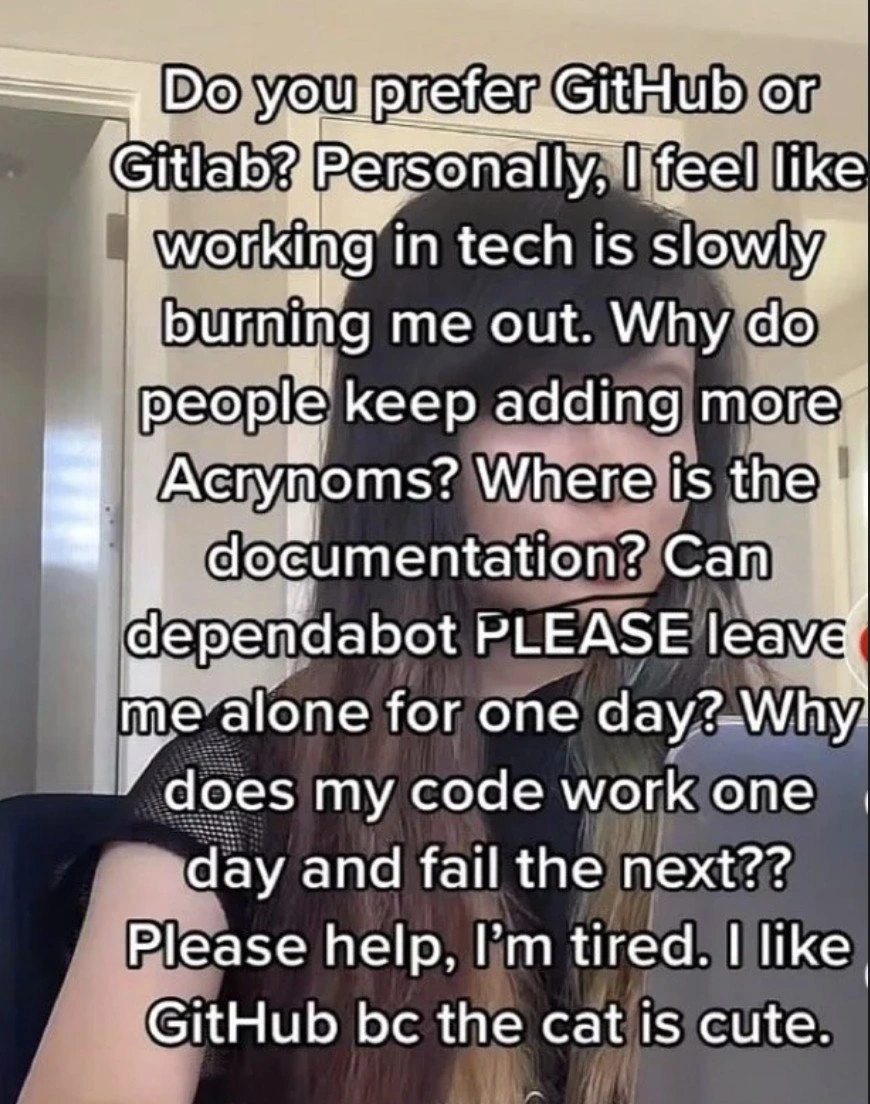
A tired-looking, long-haired developer sits at a desk while bold white text blankets the image. The on-screen caption reads: “Do you prefer GitHub or Gitlab? Personally, I feel like working in tech is slowly burning me out. Why do people keep adding more Acrynoms? Where is the documentation? Can dependabot PLEASE leave me alone for one day? Why does my code work one day and fail the next?? Please help, I’m tired. I like GitHub bc the cat is cute.” The calm home-office backdrop contrasts with the frantic wall of questions, highlighting common senior-dev pain points: dependency-update spam, acronym overload, missing docs, and nondeterministic builds. The meme frames the GitHub-vs-GitLab debate as secondary to developer wellbeing, poking fun at how burnout and the Octocat mascot ultimately influence tool choice in modern DevOps workflows
Comments
6Comment deleted
After 20 years of commits I’ve learned the only real Git hosting choice is whether you want Dependabot spamming you with a cat or a tanuki - either way the build breaks on a transitive dep you’ve never heard of and the docs are still TODO
The real version control system is the one managing all the different versions of yourself as you slowly git blame your past self for every architectural decision while dependabot creates PRs faster than you can close browser tabs from that one debugging session three sprints ago
The progression from 'GitHub vs GitLab?' to 'I like GitHub bc the cat is cute' perfectly encapsulates the senior engineer's journey: you start with architectural debates and end with the realization that after 15 years, the only thing that truly matters is whether your tooling sparks joy. Also, if your code works Monday but fails Tuesday with zero changes, congratulations - you've discovered either a race condition, a time-based test, or proof that the universe is fundamentally non-deterministic. Dependabot's daily PRs are just the distributed system's way of implementing exponential backoff on your sanity
Enterprise selection in 2025: evaluate features, model TCO, run a POC - then pick GitHub because Octocat demos better to stakeholders while Dependabot continues its denial-of-snooze campaign
GitHub vs GitLab? ADR: choose GitHub - Octocat demos better than our docs. Dependabot already runs sprint planning; without hermetic builds, Monday’s green is Wednesday’s archaeology
GitHub's Octocat gets burnout: she merges flawlessly while ignoring Dependabot's endless vulnz pings - like a cat ignoring your existential crises