One-Line Change, a Thousand Compiler Warnings
Why is this Compilers meme funny?
Level 1: Small Change, Big Mess
Imagine you’re building a tall tower out of blocks. You decide to adjust just one block – maybe it’s a little crooked, so you straighten it a tiny bit. But the moment you do that, the entire tower starts to wobble and then crash! All the blocks come tumbling down in every direction. You stand there thinking, "I only touched one block, how did everything fall apart?!" It’s a surprising and funny image: one small touch causing a huge, chaotic mess.
That’s exactly the feeling this meme is joking about. Changing one line in code is like touching that one block. And the compiler’s reaction – all those error messages lighting up – is like seeing every warning light and alarm possible going off at once, just as if your block tower had little warning sirens on each block and they all started blaring. It’s an exaggerated overreaction. The reason it’s humorous is because of how exaggerated it is: normally, a small change should only make a small problem, right? So when a tiny change causes a giant mess, it’s both frustrating and a bit comical. It’s like if you gently pushed a doorbell and all the lights in the house started flashing and the fire alarm rang – you’d be startled at first, but if it was a prank, you might laugh at how ridiculous it is.
In simple terms, the meme is saying: "I did something very little, but look at the huge chaos that followed!" It’s funny to developers (people who write code) because they know this exact feeling. It’s a mix of “oh no!” and “this is so absurd it’s funny.” Even if you’re not a coder, you can relate to times when a tiny action led to a lot of unexpected trouble. Like knocking over one domino and seeing a whole line of them fall down. Or pulling one thread on a sweater and half the sweater unravels. The emotion here is surprise and a bit of helpless laughter — how can one little thing create so many problems?
So, the picture of the car dashboard lit up like a holiday display is a silly way to show that feeling. It’s visually saying: one small issue caused everything to blink red. And that exaggeration is what makes it funny and relatable. Even if you don’t understand compilers or code, you can understand a big overreaction to a little mistake. It’s a comedy of cause and effect: tiny cause, giant effect. That’s the joke! And the next time something simple you do blows up into a big hassle, you might just remember this meme and manage a chuckle (after facepalming, of course).
Level 2: Warning Lights Everywhere
So what’s going on here? The meme is comparing a compiler’s reaction to a tiny code change with a car dashboard lighting up every warning. Let’s break that down in simple terms. A compiler is a program that takes the code you write (in languages like C++, Java, etc.) and converts it into something the computer can run. When your code has mistakes (we call them bugs or errors), the compiler will stop and tell you what’s wrong. These messages are called compiler errors (for serious issues that make the build stop) or warnings (for things that aren’t fatal but could be problematic). Now, usually, you fix a bug, re-run the compiler, and you might see one or two error messages related to that bug. But sometimes, especially in big programs, one little mistake can cause the compiler to spit out a whole list of error messages. That’s the situation this meme jokes about: “I changed one line and suddenly my compiler shows me 20 things that are supposedly wrong!”
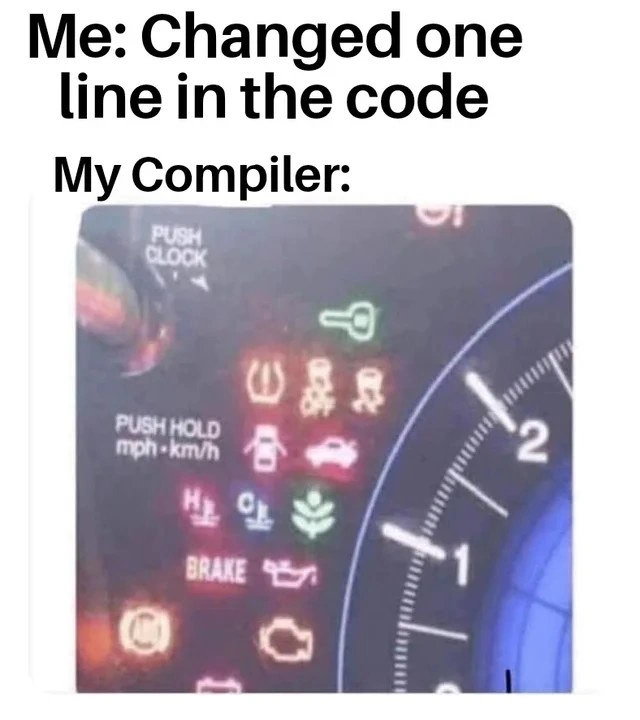
In the image, the car’s instrument panel is filled with different warning lights. Normally, you might see one (hopefully none!) at a time – like the seatbelt light if you’re not buckled, or the check engine light if something’s up with the engine. Seeing all of them on at once is ridiculous and that’s why it’s funny. It’s a visual way to say “everything that could possibly go wrong, went wrong.” The text "My Compiler:" above that image means the compiler is acting like that car dashboard, lighting up every warning indicator it has. And the text above, "Me: Changed one line in the code," sets up the scenario – the person did something very small (touched one line of code) and in response, got a totally over-the-top reaction from the compiler. It’s like if you tightened one screw on your bike but then all the alarms in your house started ringing – clearly an overreaction, right?
For new developers, it might help to know why one change can lead to so many errors. Imagine you have a programming project with multiple files. If you change a piece that those files all rely on (for example, a common variable or a piece of configuration), all those files might suddenly have issues. It’s a bit like changing a recipe in a bakery – if that recipe is used for 10 pastries and you make a bad change, 10 pastries get messed up, not just one. In coding terms, perhaps you renamed a function or changed what type of data it returns. Every place in the code that calls that function or expects the old data type will now throw an error because they’re out of sync. So one edit = many errors popping up, one for each place affected.
Another reason for an error flood is how compilers handle mistakes. A compiler reads code very literally, from top to bottom. If it gets confused by something (say you forgot a } or a ;), it doesn’t know how to make sense of the rest of your file. So it might flag almost every subsequent line as an error because, from its perspective, everything is now jumbled. You’ll often find that many of the errors are just side-effects of that first one. For example, if you forget a semicolon in C++ at the end of a line, the next line might generate an error like “expected ‘;’ before this statement,” and maybe even one more error complaining that it didn’t expect something there. It looks like two or three errors, but really if you add that one missing semicolon, all of those problems vanish. The compiler was basically crying out for the missing piece.
The meme taps into that overwhelming feeling. If you’re newer to coding, getting a ton of errors at once can be really intimidating. You might think “Oh no, I broke everything!” But take heart: usually it’s not as bad as it looks. Debugging (which means finding and fixing issues in code) often involves a bit of detective work. You learn to identify the first real error or the root cause. Fix that, and you’ll see that many of the other errors were just echoes that disappear. It’s like if a master switch in a circuit trips – lots of lights go off, but if you flip the master switch back, everything comes back to normal. So in practice, even though the compiler output looks scary (like that blinding array of dashboard lights), the fix might be as simple as reverting that one line or adjusting it correctly.
Let’s connect it back to the car dashboard image one more time. Each little symbol on a car dash (battery, oil can, engine, seatbelt, ABS brakes, etc.) is an indicator of a specific issue. In this meme’s photo, even labels like "PUSH HOLD mph•km/h" or "BRAKE" are illuminated—things that normally wouldn’t all be active. It’s essentially showing a scenario that shouldn’t happen in a real car (if it does, you probably turned the ignition to the diagnostic mode or you have a serious electrical fault!). The humor comes from the absurdity. In the same way, a compiler blasting you with every type of error feels absurd. Usually, you’d fix errors one by one. But here the compiler seems to say "Everything is wrong, everywhere!" which is just an over-the-top situation. This is what we call developer humor: it takes a frustrating reality (a small change causing a big mess) and presents it in a laughable way. If you’ve experienced it, you laugh because it’s true; if you haven’t yet, well, now you know what might be coming! Every programmer has a tale of the one-line change that unexpectedly broke the build. It’s practically a meme in itself in coding circles – and that’s literally what this image is capitalizing on.
So, if you ever find yourself in this situation as a newbie: don’t panic. It looks like all the lights are on, but systematically address one issue at a time. The meme is a comical exaggeration meant to make programmers smile and say, “Haha, yep, been there!” And once you solve the issue, that compiler "dashboard" will go back to normal (hopefully with zero lights on). It’s all part of the learning process.
Level 3: One Line to Break Them All
To an experienced developer, the humor in this meme is painfully relatable. It nails that classic programming scenario: you tweak one line of code that you were so sure was harmless, and suddenly your screen is flooded with compiler errors as if you broke everything. It’s the “but I only changed one thing!” nightmare. Why is it funny? Because it’s true – we’ve all been there, and it usually happens when we confidently expect a quick win. The meme exaggerates it with the car dashboard lit up like a Christmas tree (or a Las Vegas strip, as the title says), but sometimes it barely feels like an exaggeration!
Think of a time you updated a simple function parameter or corrected a variable name. Instead of a clean compile, you get a compiler_warning_flood: dozens of errors and warnings scroll by. Your heart sinks as the build fails spectacularly. All those warning indicators in the car image correspond to each error message the compiler throws at you. It’s as if the compiler took your tiny change very personally and decided to unleash every possible complaint it can muster. The text “Me: Changed one line in the code. My Compiler:” with that image is basically a little skit:
Me: "I only tweaked a single line, no biggie."
My Compiler: [flashing every alarm] "EMERGENCY! EVERYTHING IS BROKEN!" 😫
The reason seasoned devs chuckle at this is because it captures a form of debugging frustration we know too well. One subtle bug or a minor syntax goof can lead the build to break in a hundred places. In real life, the compiler isn’t truly finding 100 independent mistakes – often it’s one mistake causing a chain reaction of errors. But when you’re staring at that wall of red error text, it sure looks like you just ruined the entire codebase with a single keystroke! It’s a mixture of horror and comedy: horror because now you have to wade through all those messages, and comedy because of how absurd it feels to see everything go wrong at once.
This meme also pokes at the fragility of build systems and large codebases. In a well-engineered, loosely-coupled system, a small change should only have localized effects. But let’s be honest – many projects have spooky hidden dependencies and global state. Especially in older or rushed projects (hello, legacy code!), you touch one thing and five unrelated modules suddenly fail. Maybe that one line was a critical initialization that, when changed, caused null-pointer issues in distant parts of the app. Or perhaps it was a config flag that turned on a bunch of compiler warnings (like flipping a setting to be more strict), unleashing a torrent of complaint messages that were previously suppressed. A senior developer will likely nod and say, “Yep, been there, done that.” The phrase “Works on my machine” comes to mind – you make a change that fixes one scenario but then bam! the build server or a colleague’s environment lights up with errors, much to your embarrassment. Unexpected build breakage from a minor edit is practically a rite of passage in software teams. Some offices even have playful "awards" for breaking the build, because it happens to everyone eventually.
From a teamwork and process perspective, this also highlights why practices like code review and continuous integration exist. One-line changes can be deceiving; they deserve testing and scrutiny because of their potential blast radius. The meme resonates especially in contexts like C or C++ programming, where something as small as including the wrong header or a forward declaration issue can produce an insane list of errors. Seasoned C++ devs often joke about the template metaprogramming errors that span pages of terminal output – sometimes one misplaced angle bracket > will give you a Vegas light show of compiler diagnostics. Even in Java or C#, changing a method signature (say, altering the type of a parameter) will immediately break every call to that method, yielding an error for each call site. It’s logical, but when you see all those red error lines, it feels like the compiler is overreacting to a tiny tweak.
The car dashboard metaphor in the image is a great stylistic choice for this. Normally, each light on your car’s dash – engine, oil, tire pressure, battery, seatbelt – corresponds to a specific issue. Seeing them ALL on at once is humorous because a car typically doesn’t fail in every way simultaneously; if it did, you'd think the car was having a dramatic nervous breakdown. Likewise, a compiler spitting out error after error across seemingly unrelated parts of your project gives the impression that your code had a nervous breakdown. The meme exaggerates that feeling: "I fix one thing, and now EVERYTHING is supposedly wrong." It’s funny because of the exaggerated contrast between cause and effect, and because every programmer has felt that exasperation.
On a more serious senior-dev note, we know that the proper response to such a flood is to stay calm. Experienced programmers learn to read compiler output like a detective. Rather than panicking at the 50 errors, you scroll to the top of the log (the first error is often the real culprit) or look for patterns. Typically, fixing that first error or two will magically make 90% of the others disappear on the next compile. In other words, all those Vegas lights will go off once you tighten the one loose bolt that caused them. But in the moment, especially if you’re tired or on a tight deadline, seeing that wall of errors triggers a facepalm. The meme immortalizes that facepalm moment in a humorous way. We laugh because it’s better than crying, and because we’ve all exclaimed, "How can so much break from one little change?!" at least once in our careers. It’s a gentle reminder that in programming, nothing is ever as simple as it seems, and every change — no matter how small — can have unintended consequences.
Level 4: Cascading Compiler Chaos
At the deepest technical level, this meme highlights how a compiler can explode with diagnostics due to one small change, thanks to the interconnected nature of code and compiler design. When you "change one line in the code," you might inadvertently disrupt the compiler's internal model of the program. Modern compilers break down source code through several stages like lexical analysis, parsing, semantic analysis, and code generation. A tiny mistake in that one line can send cascading effects through these stages. For example, a missing semicolon or brace isn’t just a minor typo – it actually violates the programming language’s grammar. The parser might then enter a confused state, encountering tokens where it doesn't expect them. In compiler theory, this is handled by error recovery strategies (like panic mode, where the parser discards tokens until it finds a safe point). The result? The compiler flags an error at the point of the mistake and often keeps spitting out further errors for lines that are perfectly fine, simply because it lost its bearings.
Consider a C/C++ compiler reading code like:
int x = 5 // Oops, missing a semicolon here
int y = 10; // The compiler thinks this is a continuation of the previous line
When the compiler hits the missing ;, it gets confused. It might output errors such as:
error: expected ';' before 'int'
error: expected unqualified-id before 'int'
The second error is basically the compiler saying, "I had no idea what int y was, because the missing semicolon threw me off." This is a classic cascading error effect. One root cause (the missing semicolon) led the compiler to highlight multiple symptoms (unexpected int, missing identifier, etc.). The instrument cluster image with every light on is a perfect analogy: one thing went wrong, and now everything looks wrong.
In large codebases, the effect is magnified. A one-line change in a widely included header file (say you modified a type definition or macro) can trigger a rebuild of dozens of modules. If that change is incompatible, suddenly all those modules fail to compile, each logging errors. It's the dependency domino effect inside your build system. One tweak to a function signature, for instance, can produce a flood of errors in every place that function is called. In strongly-typed languages, changing a type in that one line might break the type-checking in ten other files. The compiler isn’t trying to be dramatic; it's actually doing its job by checking consistency everywhere. But to the developer, it feels like the compiler dashboard lights up like Vegas – an overwhelming neon blast of CompilerErrors across your terminal or IDE.
Interestingly, compiler engineers have spent decades trying to improve error reporting to avoid this overload. Early compilers (and some ultra-strict ones) would often stop at the first error, on the theory that subsequent messages might be spurious. But modern compilers aim to be helpful by reporting multiple issues in one go, so you don’t have to recompile repeatedly. They use sophisticated techniques to recover from a broken state and keep analyzing. The downside is exactly what the meme jokes about: you fix one thing and suddenly get hit with 30 notes, warnings, and errors. In terms of computer science, this touches on the limits of static analysis – compilers must make sense of incomplete/broken code, which is akin to a parser trying to read a sentence with missing punctuation. The avalanche of errors is essentially the compiler’s way of saying, “Because of that one change, a lot of things aren’t consistent anymore.” Just as a car’s diagnostic system might flash multiple warnings if a critical sensor fails (imagine if a car’s computer loses track of speed, it might also trigger ABS, traction, and engine warnings together), a compiler’s internal consistency checks light up all over when a crucial piece of code doesn’t fit the expected pattern.
So, on a deep level, this meme is exposing a truth about compiled languages and build systems: they can be brittle and deeply interconnected. Change one element that violates assumptions, and the compiler’s error dashboard floods with signals. It’s a little bit of chaos theory in software: a tiny change in one part of the system can lead to a disproportionate outcome. In academic terms, one could say it’s an illustration of how local errors can have non-local effects in a code compilation process. And while in theory each of those error messages is useful information, in practice it's like an onslaught of blinking lights vying for your attention. The “Vegas” vibe – all lights flashing – underscores the almost comical overload of information. For veteran programmers, there’s even a bit of dark humor here: it's a scenario we’ve all seen, and it usually happens at the worst possible time (like just before a deadline or a demo). The compiler’s plethora of illuminated warnings is the opposite of hitting the jackpot, though it certainly feels like a spectacle. Essentially, the meme captures the complex reality that in coding, a one-line change can traverse through the compiler’s many stages (parsing, type-checking, optimization) and come out the other end as a blaring multi-error fiasco, purely because of how each stage depends on the previous one’s correctness.
Description
This is a two-part meme that contrasts a developer's action with the compiler's reaction. The top text reads, 'Me: Changed one line in the code'. Below this, under the heading 'My Compiler:', there is a photograph of a car's dashboard completely illuminated with numerous warning lights. Every possible indicator, from the check engine and oil pressure lights to the brake and battery warnings, is glowing, suggesting a catastrophic, system-wide failure. The humor lies in the relatable experience of making a seemingly minor and innocuous change to a codebase, only to have it trigger a massive and overwhelming cascade of errors and warnings during compilation. For senior developers, this is a familiar sight in large, complex, or tightly-coupled systems, especially with strongly-typed languages, where a single modification can violate countless dependencies and contracts, making the resulting error log feel as chaotic and alarming as a car dashboard signaling total failure
Comments
13Comment deleted
The best is when it's a C++ template error and the compiler's output is so long it starts citing passages from the Necronomicon
Changed one enum in a 2006-era shared header - now clang’s screaming low-oil, ABS fault, and “replace timing belt in template instantiation.” Monorepo build dashboards: the only place a tiny enum tweak can trigger a full mechanical recall
After 20 years in this industry, I've learned that changing a semicolon to a comma is basically the software equivalent of pulling the wrong Jenga block - except the tower doesn't just fall, it catches fire, alerts security, breaks prod in three different regions, and somehow makes the coffee machine start printing COBOL
Ah yes, the classic 'change one import statement and suddenly your entire type system decides to have an existential crisis' scenario. It's like touching a single microservice and watching your distributed tracing dashboard light up like a Christmas tree - except instead of presents, you get 47 circular dependency warnings, 23 unused variable complaints, and that one cryptic error about a missing semicolon three layers deep in a generated file. The real kicker? The code still compiles in production because someone added `@ts-ignore` comments everywhere during the last sprint
Touched a shared header and invalidated the PCH, so one typedef change became a full rebuild with hundreds of “cascading from previous error” diagnostics - the -Werror version of a dashboard Christmas tree
Transitive includes strike again: one line touched, entire monorepo guilty by association
Changed one line - in a shared header - and the compiler lit the whole dashboard: -Werror, ODR violations, template recursion, ABI drift; turns out “incremental build” was just a story we told the PM
Ctrl+S Comment deleted
:w Comment deleted
qs:w<ret>q@s Comment deleted
ye you can do that too Comment deleted
removing a variable declaration in an angular component Comment deleted
Just added logger Comment deleted