Skip to content
DevMeme
2766 of 7435
Corporate Laptop Allocation: Managers vs. Developers
CorporateCulture Post #3056, on May 8, 2021 in TG

Corporate Laptop Allocation: Managers vs. Developers

Why is this CorporateCulture meme funny?

Level 1: Crayons for Big and Small Drawings

Imagine you’re in art class and there are two kids. One kid only needs to draw a tiny stick figure on a small notepad. The other kid has to draw a giant colorful poster for the class. Now, the teacher gives the first kid (who’s just doodling a stick figure) a big brand-new box of fancy markers. But the second kid (who has to color a whole poster) gets one old tiny crayon that’s almost worn out. That seems pretty unfair and silly, right? The first kid doesn’t need all those fancy markers to do a tiny job, and the second kid really could use better tools to finish the big poster. In the same way, the meme is joking that a company is giving really powerful new computers to people who only do easy things (like the small drawing), and giving slow, old computers to people who need to do very big, difficult work (like the big poster). It’s funny because it’s so backwards from what you’d expect. The person with the big job gets the worst tool, and the person with the tiny job gets the best tool. The humor comes from that crazy swap, and anyone can see it’s a bit ridiculous — that’s why it makes us laugh!

Level 2: Zoom vs Android Studio

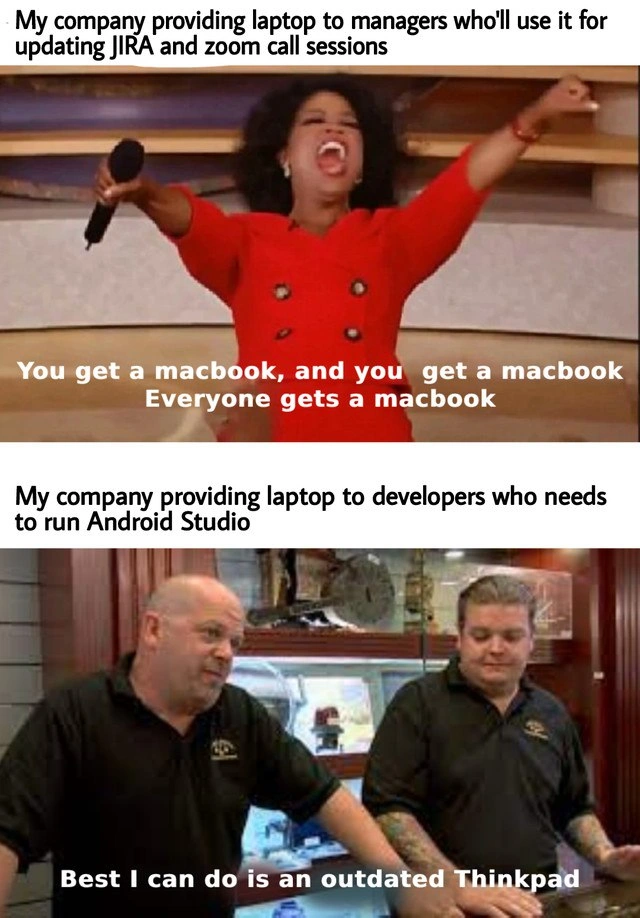
Let’s break down the joke in simpler terms. The meme compares two groups at a company (managers vs. developers) and the laptops they get. In the first part (with Oprah in a red dress, famously saying “You get a car!” on her show), the text says the company gives MacBook laptops to managers who mostly use them for things like updating JIRA tickets and joining Zoom calls. A MacBook is a high-end laptop made by Apple. They’re expensive and powerful, with features like fast processors and lots of memory. The funny (or sad) part is that managers don’t really need all that power just to do simple tasks. JIRA is basically an online to-do list for software teams – managers use it to track progress, assign tasks, and update statuses. And Zoom is a video calling app for meetings. Sure, Zoom calls and web browsing use some resources, but almost any modern laptop can handle that. In other words, updating JIRA and chatting on Zoom are lightweight tasks that don’t require a super-powerful computer. The meme exaggerates that the company hands out MacBooks like free prizes to every manager (like Oprah did with cars for her audience). That’s why the text says: “You get a MacBook, and you get a MacBook. Everyone gets a MacBook.” It’s poking fun at how generously (and maybe unnecessarily) the company treats the management when it comes to gadgets.

Now, the second part shows a scene from the TV show "Pawn Stars" where people haggle over prices. The text on top says the company, when providing a laptop to developers who need to run Android Studio, responds with the phrase: “Best I can do is an outdated ThinkPad.” This is a popular meme format: someone asks for something valuable, and the reply is humorously low-balled (like offering much less than requested). Here, the developers are asking for a capable laptop because they run Android Studio – an application used to write apps for Android phones. Android Studio is an IDE (Integrated Development Environment), meaning it’s a software that has a code editor, a compiler, and even an Android phone simulator (emulator) all in one. Running Android Studio can be very demanding on a computer. It needs a fast CPU for compiling code, lots of RAM (memory) to keep the program and emulator running smoothly, and preferably a fast disk (like an SSD) because it reads and writes a lot of files. In short, developers have a heavy workload for their computers: writing and building code, testing apps, maybe running databases or servers locally. An outdated ThinkPad refers to an older model of a ThinkPad laptop (ThinkPads are a brand of laptops originally by IBM, now by Lenovo, known for being sturdy business laptops). Outdated implies it’s probably a few generations behind in hardware: maybe it has an older slower processor, less memory, and perhaps not even a fast hard drive. That kind of laptop will struggle with something like Android Studio — developers might experience long compile times (waiting a long time for their code to build), the machine might freeze or lag when the Android emulator is running, and overall it slows down their work.

The company saying “Best I can do is an outdated ThinkPad” is the joke: it’s as if the developers pleaded, “Can we have a good laptop, please?” and the company acted like a stingy pawn shop owner, offering the bare minimum. This highlights a common DeveloperHumor gripe in CorporateCulture: sometimes companies spend a lot on things that don’t directly help production (like expensive laptops for managers as a perk or status symbol), but then skimp on the tools for developers who actually create the product. It’s a ResourceConstraints joke — developers feel the pinch of limited resources (like weak hardware) while seeing resources generously allocated elsewhere. The tags like HardwareHumor and ToolingFrustration are on point: it’s poking fun at the frustration developers feel when they don’t have the proper tools (or hardware) for the job. And it’s very RelatableDevExperience – many developers have experienced working on a slow, old machine and wished for an upgrade, only to face bureaucracy or tight budgets. Meanwhile, they notice management sporting the latest shiny laptops mostly for emails and meetings.

In simpler terms: the meme’s humor comes from the obvious mismatch. The managers get top-of-the-line laptops for simple tasks, and the developers get old, underpowered laptops for very demanding tasks. Anyone who’s started their career in a tech company might have noticed this or heard such stories. It highlights how the people making decisions (management) sometimes don’t realize how important good hardware is for developers. Or they do realize but have other priorities, leaving engineers stuck with slow computers. The Pawn Stars reference (“Best I can do...”) makes it extra funny because it frames the company as bargaining down the developers’ request. It’s like the devs say, “We need something powerful,” and the company responds, “Hmm, the best we’re willing to give you is this old ThinkPad we found in storage.” It’s an exaggeration, but it resonates because it contains a grain of truth about management_vs_engineering_hardware battles.

Level 3: Handouts vs Hand‑me‑downs

In the CorporateCulture of many tech companies, there's an ironic inversion of logic that every seasoned developer has witnessed: high-end hardware goes to those who need it least, while the folks pushing heavy code are left with the scraps. This meme nails it. In the top panel, a hyped-up Oprah is showering MacBooks like candy to all the managers. It’s a parody of that famous Oprah giveaway (“You get a car!”) — except here it’s "You get a MacBook!" to every manager who mostly just updates JIRA tickets and hops on Zoom call sessions. In the bottom panel, we have the Pawn Stars guys flatly saying "Best I can do is an outdated ThinkPad." That’s the response a developer hears when begging for a decent machine to run weighty tools like Android Studio. The contrast is painfully relatable: managers swimming in shiny new MacBooks they’ll use to juggle spreadsheets, while devs sweat over Gradle builds on creaky old laptops.

Let’s unpack the technical absurdity. Android Studio is a notorious resource hog in the DeveloperExperience_DX world — a full IDE with an emulator that can gobble up CPU, RAM, and I/O. Firing up an Android emulator on an outdated ThinkPad can feel like trying to run a modern game on a decade-old PC. Long build times, IDE freeze-ups, fan blasting like a jet engine... we’ve been there. Android compiles and emulator instances demand serious horsepower (think multi-core CPU, lots of RAM, fast SSD). An older ThinkPad with maybe a spinning HDD and 4GB or 8GB of RAM will struggle; the developer ends up waiting and waiting as the machine swaps memory and chugs along. Meanwhile, what’s the heaviest load our manager’s fully-specced MacBook is carrying? Opening Chrome for a Zoom meeting, maybe 10 tabs of JIRA and Slack — trivial tasks that a mid-range tablet or any half-decent machine could handle without breaking a sweat. Yet the company, in its infinite wisdom, has allocated premium hardware to management as a status symbol, and handed developers “just enough” to get by (barely).

This is a textbook case of resource misallocation and a classic ManagementVsEngineering folly. The humor stings because it’s true: the people actually compiling code, running tests, deploying builds (which directly affects product quality and timelines) are held back by ResourceConstraints. Every senior engineer has war stories of waiting 30 minutes for a build on a clunky laptop while seeing a director flaunt a brand new MacBook Pro that’s mostly idling on email. The meme’s two panels perfectly illustrate this laptop_allocation_inequity. The Oprah panel exaggerates how freely management gets high-end gear (“Everyone gets a MacBook!”) – it's a comedic hyperbole but not far from how it feels. The Pawn Stars panel (“Best I can do is an outdated ThinkPad”) reflects the pushback developers hear: when you request a necessary upgrade, the IT procurement or finance team lowballs you as if negotiating a pawn deal. It’s like:

function allocateLaptop(role, needs) {
  if (role === "Manager") {
    return "Latest MacBook Pro"; // Overkill for JIRA and Zoom, but hey, it's a perk
  } else if (role === "Developer" && needs.includes("Android Studio")) {
    return "Outdated ThinkPad";  // Underpowered for heavy IDE use, but saves budget
  }
}

This pseudo-code might as well be corporate policy in some places. HardwareHumor aside, there’s real inefficiency here. The company is being penny-wise and pound-foolish: they splurge on MacBooks for managerial roles (maybe because those are visible positions or simply as perks of rank) while developers, seen as a cost center, are told to make do with older equipment. In truth, slow hardware drags down developer productivity — every delayed compile or IDE crash is lost time (and money). Ironically, those shiny MacBooks sit idle or underused, which is a RelatableDevExperience frustration: seeing expensive resources underutilized by one group while another group struggles without them.

From a senior perspective, this meme also hints at the cultural gap: managers might not realize how ToolingFrustration affects engineering morale. Perhaps the managers think “a laptop is a laptop, why are these devs complaining?” They might not grasp that AndroidStudio on a weak machine feels like treading water with a brick. Meanwhile, the dev team jokes darkly that the only way to get a MacBook is to get promoted out of coding — a cynic’s way of saying technical roles aren’t valued as they should be. It’s a shared pain: knowing the ManagementVsEngineering divide is literally visible in the laptops folks carry to meetings. And yes, it’s always the folks updating JIRA (which could run on a potato) who get the cutting-edge silicon. As a battle-scarred engineer, you can’t help but chuckle and groan at how perfectly the meme calls out this backward reality.

Description

A two-panel meme contrasting corporate hardware provisioning for different roles. The top panel features Oprah Winfrey in her iconic 'You get a car!' pose, joyfully exclaiming, 'You get a macbook, and you get a macbook. Everyone gets a macbook'. The accompanying text reads, 'My company providing laptop to managers who'll use it for updating JIRA and zoom call sessions'. This depicts a scenario of generous, high-end hardware for non-demanding tasks. The bottom panel shifts to the 'Pawn Stars' meme format, with Rick Harrison looking skeptical. The caption says, 'My company providing laptop to developers who needs to run Android Studio', followed by his classic line, 'Best I can do is an outdated Thinkpad'. The joke highlights the common developer frustration where companies misallocate expensive, powerful MacBooks to management for light administrative work, while developers, who require high-performance machines for resource-intensive tasks like running the notoriously heavy Android Studio, are often given inadequate, older hardware


Comments

32
Anonymous ★ Top Pick My manager's M3 Max MacBook is so powerful it can run 10 simultaneous Zoom calls, while my ThinkPad's fan starts screaming if I open more than two tabs in the Android Studio documentation
  1. Anonymous ★ Top Pick

    My manager's M3 Max MacBook is so powerful it can run 10 simultaneous Zoom calls, while my ThinkPad's fan starts screaming if I open more than two tabs in the Android Studio documentation

  2. Anonymous

    Our cap-ex policy: if your heaviest process is Excel, you get an M3 Pro; if you spawn eight JVMs for a Gradle build, here’s a ThinkPad with one stick of DDR3 - because compile time apparently scales with optimism

  3. Anonymous

    The same executives who approved $50K for a Gartner report telling them to "invest in developer productivity" are now wondering why build times are measured in coffee breaks instead of milliseconds

  4. Anonymous

    Ah yes, the classic enterprise resource allocation paradox: managers get M2 Max MacBooks to update JIRA tickets and attend Zoom calls, while Android developers - who need to simultaneously run Android Studio, multiple emulators, Gradle builds consuming 32GB RAM, and still have Chrome open with 47 Stack Overflow tabs - get a 2015 ThinkPad with 8GB RAM and a spinning HDD. Nothing says 'we value engineering productivity' quite like watching your incremental build take 12 minutes while your manager's MacBook idles at 3% CPU during their fourth standup of the day. At least the ThinkPad's keyboard is legendary, which you'll appreciate during the extra hours you'll spend waiting for builds to complete

  5. Anonymous

    MacBooks for JIRA's infinite scroll of tickets; ThinkPads for Android Studio's Gradle daemon that outlives your sprint

  6. Anonymous

    Org-chart provisioning: M2 MacBooks for Zoom and Jira, hand-me-down ThinkPads for Android Studio - then leadership wonders why Gradle builds outlast the stand-up

  7. Anonymous

    Procurement optimizes for Zoom FPS, not Gradle p95; the PM gets a MacBook Pro while my Android Studio splash screen triggers thermal throttling on a hand-me-down ThinkPad

  8. @MagnusEdvardsson 5y

    A last model thinkpad is better than a last model macbook

    1. @QroChang 5y

      +++++

    2. @alshenetsky 5y

      No, it is not. Apple's M1 chip is breakthrough

      1. @RiedleroD 5y

        it really depends on so many factors… And I don't think there's even a native version of Android studio for the M1 chip. Non-native versions are always gonna be slower than native ones.

        1. @alshenetsky 5y

          It’s matter of time

          1. @RiedleroD 5y

            But we're talking about right now. Also, I don't think google cares enough to add M1 support.

            1. @alshenetsky 5y

              Ok, but first comment which I replied is still wrong because it depends on someone’s use cases then. I am working with PHPStorm (native), Docker (native), 100+ tabs browser and it runs faster than my desktop PC did. And it lives a full working day with a margin.

              1. @RiedleroD 5y

                That's what I'm saying. You're both wrong, in different ways. I don't think the M1 chip is bad, but I certainly think that thinkpads do have advantages over it. I'm currently looking into the specs, so I can tell you more.

                1. @RiedleroD 5y

                  ok so if we compare the macbook pro (3.2k€) with the thinkpad X1 extreme (2.9k€), a clear difference can be seen: while the thinkpad is absolutely smashing the macbook in terms of performance, with a 6 core, 5GHz Processor, the macbook pro has a much, much longer battery life. The rest of the specs are slightly in the favour of the thinkpad, but not really pronounced enough to be mentioned. Especially when looking at the price difference, I think the thinkpad wins. Though if you're often on longer trips, the macbook might be a wiser choice. Also, I can't imagine the thinkpad not thermal throttling. I mean, 5GHz? that's insane. It still wins by core count, but holy fuck.

                  1. @alshenetsky 5y

                    Macbook Air would be the best choice because it is cheaper than Pro (having the same chip). Also, gigahertzes are nothing without software, so it meaningless to compare pure specs. Especially, if you got the same performance gain as I do, when moving to M1 platform.

                    1. @RiedleroD 5y

                      "gigahertzes are nothing without software" what?

                      1. @alshenetsky 5y

                        I mean you looking at CPU’s frequency, ignoring different architecture (ARM’s instructions are «faster», sorry for simplification), different platform (M1 is a system on a chip, not a CPU - which is also gains your performance) and optimized software that you have on macOS

                        1. @RiedleroD 5y

                          ARM isn't faster than x86, it's just more efficient. That means, you have less energy per instruction (which also means less heat, which means they thermal throttle less fast). an SoC does give some advantages like low latency and high throughput between components, but also some disadvantages like a higher risk of thermal throttling the main CPU when some other component in the SoC is at high use. The software on MacOS isn't inherently more optimized just because it runs on a better chip. In contrary, because the compilers for it are relatively new as well, there haven't been as many optimisations implemented for it. And while a on-hands comparison is always the best way to compare hardware, the specs are usually a very good indicator of how good hardware is for specifc use-cases. There are some things that can't be trusted, however, for example the Teraflop metric for graphics cards, which is really not even half the story of what a graphics card does, and the average battery lifespan ratings are always vastly overexaggerated by the producer. Core count and frequency are the most important metrics in a CPU though.

                          1. @RiedleroD 5y

                            jesus, that's a bigger wall of text than I wanted, sorry for that

                      2. @alshenetsky 5y

                        I agree that I formulated it like an idiot.

                    2. @RiedleroD 5y

                      no, really. Explain what you mean. I have no idea what you mean by that.

      2. @MagnusEdvardsson 5y

        Good luck running anything on that architecture. Once again, Apple is being incompatible with everything.

  9. @Bodziek 5y

    it's always like this

  10. Deleted Account 5y

    sad truth🤩

  11. @Vlasoov 5y

    True story

  12. Deleted Account 5y

    My company even refuses to provide me a second monitor.

  13. @MagnusEdvardsson 5y

    I want to see how your docker containers built for x86 run on arm

  14. @MagnusEdvardsson 5y

    M1 is good for users, but won't be useful for devs until there's a lot more support for it.

  15. @maxbit89 5y

    Well i would use the thinkpad as weapon of choice. It holds up to several oponents. It will most likely work just fine after battle and if not it is fixed within 4 days. The MacBook will shater at first hit and goodluck getting it repaired. If you are not near the Rossman Repair Group.

    1. @RiedleroD 5y

      germans be like

Use J and K for navigation