Senior Devs on Small vs. Large Pull Requests
Why is this CodeReviews meme funny?
Level 1: Small Change, Big Fuss
Imagine you draw a little picture – just a quick doodle – and show it to your teacher. The teacher suddenly finds all sorts of tiny issues: “Use more colors here,” “Stay inside the lines,” “Make this part neater, please.” It’s like a big fuss over a small drawing. Now, next day, you turn in a huge messy painting that covers an entire poster. You splashed paint everywhere, maybe even spilled some coffee on it. But this time the teacher just gives you a thumbs-up and says, “Looks good to me!” No corrections, no comments. Sounds backwards, right? You’d expect the big messy painting to get more critique than the little doodle! That upside-down reaction is exactly what this meme is joking about. In a software team, sometimes a senior programmer will heavily critique a tiny code change (pointing out every little improvement), but then barely react to a gigantic chunk of new code. It feels silly and unfair – like scolding you for a tiny mess but shrugging at a huge mess. That contrast is what makes it funny: it’s showing how people can overreact to small things and underreact to big things, which is the opposite of what you’d think should happen. It’s a goofy reminder that in both school and coding, sometimes the feedback we get doesn’t match the size of the problem, and seeing that happen can be pretty amusing.
Level 2: Refactor vs Ship It
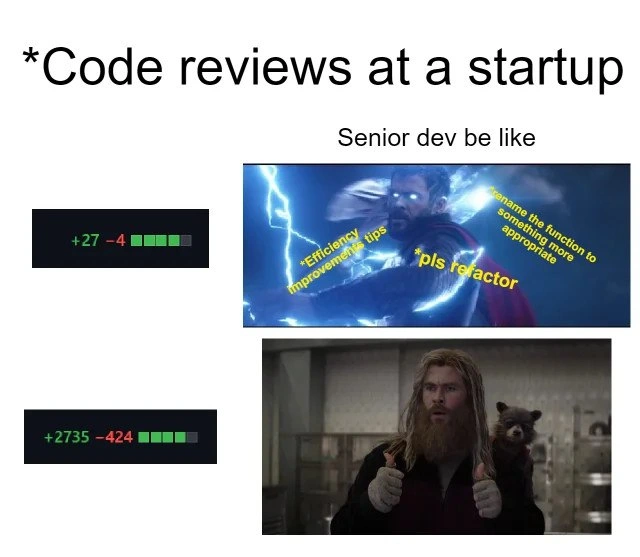
Let’s break down the meme and the humor for those newer to code reviews. Code review is the process where other developers examine a set of code changes (usually in a pull request, often abbreviated PR) before that code is merged into the main project. At a startup, code reviews can be a bit wild: there might not be strict guidelines, and one experienced senior dev might be reviewing almost everything. This meme shows two exaggerated review scenarios from that world: one for a small change, and one for a huge change.
In the top scenario, the code change is very small – only
+27 −4lines (meaning 27 lines added, 4 removed). That’s like changing a couple of files or a tiny feature. Yet the senior developer reacts super intensely. Thor with lightning represents the senior dev “storming” the pull request with lots of comments and suggestions. The yellow text around him – "Efficiency improvement tips", "pls refactor", "rename the function to something more appropriate" – are examples of what he’s probably commenting on the code. These are common CodeReviewPainPoints for junior devs: you open a PR thinking it’s fine, and the senior person comes in with a laundry list of improvements. For example:Efficiency improvement tip: maybe the senior suggests using a more efficient method or algorithm. For instance, “Hey, instead of looping through this list twice, you could use a set for O(1) lookups.” It’s not that the original code was wrong, they just know a faster way.
“pls refactor”: this is shorthand for “please refactor this code.” Refactoring means reorganizing or rewriting parts of the code to improve readability or structure without changing what it does. The senior dev might be saying the code works, but it would be cleaner or more maintainable if written differently.
“rename the function to something more appropriate”: Choosing good names in code is a big deal. A senior reviewer might think your function name is too vague or not following a naming convention. For example, if you named a functiondoStuff(), they might comment, “rename this function to reflect what it actually does, likecalculateTotal().” This is the classic function naming debate that happens often in reviews – figuring out what to call things.So, on that small PR, the senior dev is basically giving a mini-lecture through comments: fix that name, clean up this code, improve the efficiency here. It can feel like a lot (Thor’s lightning attack is an exaggeration of that flood of comments). It’s done with good intentions – to keep code quality high – but in a startup you might see it happen even when changes are minor.
Now, look at the bottom scenario:
+2735 −424lines changed – that’s huge! This is the kind of pull request that might include an entire new feature or a big rewrite of the system. Normally, big PRs are harder to review because there’s so much going on. You’d expect a reviewer to take a long time and be very thorough, possibly leaving many comments or asking for chunks to be split into smaller PRs. But the meme jokes that our senior dev does the opposite here. He’s shown as “Endgame Thor” – Thor from Avengers: Endgame who is out-of-shape, relaxed, even a bit lazy. In the image, Thor is wearing a hoodie and giving a casual thumbs-up, standing next to Rocket Raccoon (his furry teammate). This represents the senior developer approving the gigantic PR with barely any scrutiny. A thumbs-up in code review terms basically means “Approved, looks good to me.” In fact, developers often literally comment LGTM (which stands for "Looks Good To Me") when they approve a PR without any changes needed. It’s a quick way to say “I’m fine with this.”The joke is that the senior dev is extremely casual and okay with this enormous, potentially risky change. No detailed critique, no lightning bolts – just “sure, let’s merge it.” If the first scenario was an overreaction, this one is an underreaction. It’s like he’s saying, “Meh, it’s 2700 lines, I’m not gonna even try to nitpick – it’s probably fine.” This startup humor highlights how in fast-paced teams, sometimes the normal rules bend. Maybe there’s a rush to get a feature out, or the reviewer is also the author (or a close teammate) and trusts it. It’s a funny example of inconsistent standards: the small change got heavily scrutinized, while the massive change got almost no scrutiny at all.
Why is this funny (and a bit true)? It’s showing a common experience in software teams, especially young startups: priorities can feel backwards. Junior developers often joke about how their mentor or tech lead will nitpick their 5-line fix (“Did you add a comma in the JSON? We prefer no trailing commas, please.”) but then will merge a 5000-line overhaul with just a “looks good” because nobody wants to hold up progress. There’s even a term for wasting energy on trivial details: “bikeshedding.” It means people tend to debate small, simple things more than big complex things. Code reviews sometimes fall into this trap. It’s easier for a reviewer to comment on a tiny function name or a minor efficiency tweak (something within their comfort zone) than to dig into a huge system redesign which might require an hour of reading and deep thinking. In a startup, time is precious, so big PRs often get a quick pass due to deadlines or trust, whereas small PRs become learning moments or chances to perfect the code style.
So the meme is both humor and gentle critique. It uses Marvel’s Thor to personify the senior dev’s two modes: strict perfectionist (Thor bringing the hammer down) versus easy-going approver (chill Thor nodding “okay”). If you’re a newer developer, don’t be surprised if you run into this. Your 10-line patch might get a bunch of comments (it’s not that you did bad – seniors just want to help you refine it), and yet you might see a giant commit go through with hardly a peep (possibly because who has time to review all that?). The contrast is what makes it funny. It’s highlighting a real-world quirk in peer review culture: sometimes the feedback you get isn’t proportional to the size or importance of the change!
Level 3: Lightning & Rubber Stamps
In a scrappy startup’s code review culture, you often get a paradox that even Thor would chuckle at. One moment, a senior developer is in full thunder-god mode, unleashing a storm of nitpicks on a trivial change set – picture the first panel: Thor crackling with lightning, hammer swinging. He’s zapping a tiny +27 −4 diff with relentless feedback like “Efficiency improvement tips”, “pls refactor”, and “rename the function to something more appropriate”. It’s a review comment storm on the smallest pull request, a bikeshedding extravaganza. (Yes, the classic Parkinson’s Law of Triviality rears its head: teams obsess over trivial things – like function names or one extra loop – because those are easy to grasp. Why debate the system architecture when we can argue about variable names?)
Fast forward to the next panel: now we’ve got Endgame Thor – out-of-shape, in a hoodie, looking utterly unbothered – giving a thumbs-up alongside Rocket Raccoon. This time the PR is colossal, +2735 −424 lines changed, basically a whole new feature dump or a refactor-of-doom. By all logic, this monolithic pull request should trigger alarms and high scrutiny. But our senior dev has apparently decided to rubber-stamp it. No lightning bolts here – just a lazy “LGTM” (Looks Good To Me) and a grin. It’s the ultimate “ship it” moment on a change-set so large it could hide an entire buggy Infinity Stone microservice.
Why does this happen? A cynical veteran will tell you:
- Bikeshedding on small diffs: Tiny changes are easy to chew on. The senior dev can flex their expertise on code style and micro-optimizations without breaking a sweat. Debating a function name or tweaking a loop gives a quick dopamine hit of “improving code quality.” It’s classic CodeReviewPainPoints – the review becomes a pedantic checklist of minor issues.
- Reviewer overload on big diffs: A giant pull request is intimidating. Properly reviewing thousands of lines might take hours of concentration. In a fast-paced Startup environment, nobody has that time (or patience). It’s much easier to assume the author knows what they’re doing and hit approve. The result? Critical design flaws or sneaky bugs might slip through, but hey, at least we merged before the demo.
- Inverted priorities & startup culture: This meme nails the startup humor: the company relies on moving fast. The senior dev who normally plays quality gatekeeper will drop the act when a huge PR lands at 5 PM Friday. It’s a “we’ll fix it in post” mentality. They might even be the author of that big PR – and who’s gonna grill the hero who wrote the core feature overnight? So the Senior vs Junior Developers double standard kicks in: juniors get schooled on little mistakes, while seniors get a free pass on big ones (because deadlines, or because trust).
The Marvel imagery drives the contrast home. Thor with lightning is the overzealous code reviewer, hammering down on every line of a minor change. Bro Thor (the ragged Thor) is the laid-back reviewer on a massive code dump, essentially saying “Cool story, merge away.” Every developer who’s been through chaotic code reviews knows this irony: sometimes the fiercest feedback comes on the smallest PRs, and the big scary commits get a shrug. It’s both hilarious and painfully true – a developer stereotype turned up to 11. After all, why fight the big battle today when you can give a thumbs-up and hope for the best? ⚡👍
Description
A two-panel meme contrasting senior developer feedback on small versus large pull requests, particularly in a startup environment. The top panel shows a small Git diff (+27, -4 lines) next to an image of a powerful, god-like Thor demanding refactoring and efficiency improvements with text overlays: '*Efficiency improvement tips*', '*pls refactor*', '*rename the function to something more appropriate*'. The bottom panel displays a massive Git diff (+2735, -424 lines) next to an image of an overwhelmed 'Fat Thor' giving a casual thumbs-up, implying passive approval due to the sheer size of the change. This meme humorously critiques the phenomenon of 'review fatigue,' where small, manageable changes receive intense scrutiny while overwhelmingly large changes are often approved with minimal feedback because they are too difficult to analyze thoroughly
Comments
13Comment deleted
That 20-line PR? I've found three ways to optimize the cache invalidation. The 2000-line one? Looks good to me, ship it. The CI pipeline is the only senior dev with enough patience to review that
Our startup’s review time is apparently O(1/LOC): a 27-line tweak summons Viking-grade nit-picks, but a 2,735-line refactor sails straight to prod on a single “LGTM” emoji
The same senior dev who wrote a 47-page RFC on why we need strict PR size limits just approved a changeset that touches every microservice because "the demo is tomorrow and the investor's nephew is going to be there."
Review rigor is inversely proportional to diff size: 27 lines gets a thesis defense, 2,735 gets 'LGTM' - the reviewer's eyes hit OOM and the approval is just the fallback handler
Ah yes, the startup code review paradox: a 30-line refactor gets dissected like it's the Zapruder film, complete with frame-by-frame analysis of variable naming conventions and suggestions to 'make it more functional.' But that 3000-line feature branch that touches 47 files, rewrites the entire auth system, and introduces a new database schema? Two thumbs up, ship it. Because at 6 PM on Friday, the only thing standing between you and the weekend is your willingness to pretend you can meaningfully review 2700 lines of diff in the GitHub UI. The real efficiency tip? Learning when 'LGTM' is the most honest thing you can say
Startup seniors don't review code - they lightning-bolt it into +27-line 'efficiency' monoliths that no junior can lift
Startup code review algorithm: scrutiny = 1/LOC - 20-line PR triggers a DDD naming symposium; 3k-line PR gets “LGTM, CI’s green and the demo’s in 10.”
Our review process implements an undocumented heuristic: if delta LOC > 1,000, switch from “nits and renames” to O(1) LGTM to meet the PR‑latency SLO
that's true Comment deleted
I'd suggest you change your name to Simon or Semyon lol Comment deleted
yeah I know, but I don't care Comment deleted
Aight have a good day! Comment deleted
So if there is a lot of commit, just LGTM? Comment deleted