Skip to content
DevMeme
4633 of 7435
When your lovely code meets the brutal honesty of code review
CodeReviews Post #5081, on Dec 11, 2022 in TG

When your lovely code meets the brutal honesty of code review

Why is this CodeReviews meme funny?

Level 1: Truth Hurts

Imagine you spent all afternoon building a Lego tower that you’re super proud of. You think it’s the coolest tower ever – tall, colorful, absolutely perfect. You show it to your older sibling. They immediately notice that the tower is a bit crooked and might fall over because you didn’t stack the pieces firmly. They’re not trying to be mean; they just see something you didn’t see. Suddenly, your perfect tower doesn’t look so perfect anymore, and you feel a little upset. That’s what’s happening in this meme. The programmer loves the code they wrote, kind of like you loved your Lego creation. But when someone else (the reviewer) looks at it, they spot problems. It’s funny in the picture because the code writer sees a cute pet lobster (something lovable), while the reviewer sees a scary, gross lobster (something messed up). It’s a silly way of saying: sometimes we love what we made so much that we don’t notice its flaws, and it takes an honest friend (or reviewer) to point them out – and yeah, the truth can hurt a bit, but it helps us do better next time.

Level 2: Harsh Code Reality

Let’s break down what’s happening in simpler terms. In software development, a code review is when someone else – usually a teammate – examines your code changes for mistakes, bugs, or ways to improve them. It’s like proofreading someone’s essay, but for code. The person who wrote the code often thinks it’s great (it works on their computer, they put a lot of effort in, so they’re proud of it). That’s the “my POV” side: “Check out my code, isn’t it neat?” The reviewer’s job, however, is to be critical and objective. They look at the code and often see all the problems the original author missed. That’s the “reviewer’s POV”: “Oh boy, this code has issues... we need to fix these.”

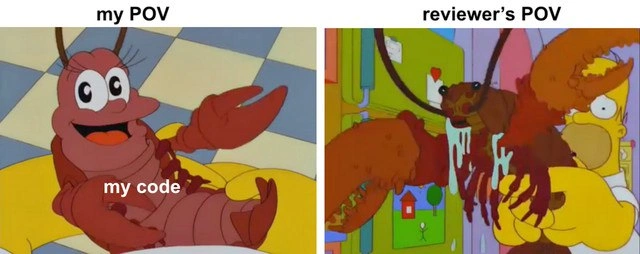
The meme uses a funny example from a cartoon to show this difference in perspective. On the left, the developer’s perspective, the code is represented as a cute lobster being hugged affectionately. This suggests the coder loves their code – maybe they even call it “lovely” or say “my code is awesome.” On the right, from the reviewer’s perspective, the same lobster is now gross and dripping with sauce, and Homer (representing the reviewer) is recoiling in disgust. This is a comedic way to say the reviewer thinks the code is in bad shape – perhaps messy, poorly written, or “cooked” in a wrong way. It’s exaggerating how a reviewer might react internally upon seeing code that the author thought was perfectly fine. In reality, a reviewer hopefully isn’t screaming in horror, but they might leave a bunch of comments that feel as shocking as Homer’s face in that image.

For someone new to this, imagine you wrote a program that you thought was great. You run it, it gives the right output, so you’re feeling good. Then you show it to a senior developer or friend. They immediately start pointing out things you didn’t consider: “What if the input is empty? This will crash.” “This variable name is confusing.” “We already have a function for this, why didn’t you use it?” Suddenly you realize your code isn’t as perfect as you thought. That’s basically what a code review does – it’s a second set of eyes catching all the stuff you overlooked. It can be uncomfortable, especially the first few times. You might feel a bit embarrassed, like “How did I not see that?” But it’s a normal part of learning and making the code better.

To illustrate, here’s a tiny pseudo-example of how a developer’s code and a reviewer’s comments might look:

# Developer's code (my POV):
def serve_lobster(pinchy):
    result = cook(pinchy) + add_sauce()  # combine lobster and sauce
    return result

# Reviewer's POV (comments on the code above):
# - Does cook(pinchy) return something? If cook just boils in-place, adding it to sauce may fail.
# - What if pinchy is already cooked or None? There’s no error handling for that scenario.
# - Where is add_sauce() defined? Is it using global ingredients? This might be a hidden dependency.
# - Variable name 'pinchy' is cute, but in real code we'd use something like 'lobster' for clarity.

In this made-up snippet, the developer thinks their function serve_lobster is straightforward: cook the lobster, add sauce, done. But a reviewer immediately spots potential bugs (like if cook(pinchy) doesn’t return a value or if pinchy isn’t in a state to be cooked), design issues (like not handling unexpected cases, or unclear connections between functions), and style concerns (using a pet name “pinchy” in code might confuse others who don’t know the joke). This is typical of a code review in real life. The author focuses on the happy path (it works when everything is as expected), whereas the reviewer looks for edge cases and adherence to best practices.

Another way to put it: Code quality can be partly subjective, but generally, there are standards. New developers might not be aware of all these standards at first. For example, companies or open-source projects often have a style guide (how to name variables, how to structure code), and certain patterns to avoid known as code smells (like overly complex functions or duplicate code). When you write something, you might unknowingly introduce a few of these issues. A reviewer—often a more experienced dev—will catch them. It can feel like they’re being nitpicky or “brutally honest,” but the goal is to maintain a high quality so that the codebase stays healthy and easy to work with.

The meme is DeveloperHumor dramatizing this process. It’s common to feel a bit defensive or down when your code comes back with lots of comments. That’s why developers joke about it; laughing it off is easier than getting upset. We’ve turned the code review into a cartoon of a lobster turning from adorable to horrifying. It captures that “ouch” moment in a silly way. If you’ve ever had a pull request where the reviewer left what feels like a hundred comments, you probably relate to Homer’s face on the right panel. But over time, you learn not to take it personally. Even senior devs get critique – nobody’s code is perfect on the first try. The lobster might get boiled, but hey, at the end of the process the code will be as well-done (in a good way) as a properly cooked dish. 🍴

Level 3: Claws Out Code Review

At the highest level, this meme skewers the harsh reality of CodeReviews and perceived CodeQuality through a darkly funny lens. It’s referencing a classic scene from The Simpsons where Homer’s beloved pet lobster Pinchy goes from pampered pet to, well... dinner. In the left panel (“my POV”), the developer sees their code as this cute, perfect little lobster – cherished, nurtured, their baby. The right panel (“reviewer’s POV”) shows that same code-lobster horrifically overcooked and dripping with sauce, as if attacking Homer. This contrast is an exaggerated metaphor for what happens in a code review: the author’s rosy view of their code meets the reviewer’s brutally honest critique. It’s a software engineer’s way of saying, “What I think I wrote vs. what my peer actually sees.” 🤨

From a senior developer’s perspective, this is hilariously on-point. We’ve all been there – you submit a pull request proudly, thinking your solution is elegant, even adorable in its ingenuity. Then a colleague (the reviewer) puts on their inspector glasses and suddenly your prized code is picked apart like an overdone crustacean. The humor works because of a shared understanding in tech: developers are often biased toward their own work (a kind of code beauty bias), while reviewers zero in on every wart and flaw. This disparity creates comedic tension. The meme brilliantly uses the my POV vs reviewer’s POV format to capture that painful yet funny moment when you realize your “beautiful” code isn’t so beautiful to others. The author sees a pet; the reviewer sees a potential code smell served on a platter.

Why is this so relatable in engineering culture? Because subjective code quality is a real thing – what looks well-structured to one person might look like a hot mess to another. The left image radiates the developer’s pride and affection (“Look at my lovely code, isn’t it great?”). The right image embodies the CodeReviewPainPoints: the reviewer is basically Homer recoiling in horror, implying “Yikes, this code is a nightmare!” That lobster dripping with goo is every weird bug, sloppy naming, or convoluted logic the reviewer uncovers. It’s common in peer reviews for an author to feel defensive or surprised: “I thought my solution was fine – why are they tearing it apart?” This meme nails that feeling with absurd visual humor.

Digging deeper, it also hints at the emotional undercurrents in code reviews. The DeveloperSelfDeprecation here is strong: we’re laughing at ourselves for being blind to our code’s faults. The seasoned engineers chuckle because they’ve experienced the humiliation of a code review turning their pet project into a code horror story (at least in the reviewer’s write-up). It’s a rite of passage. The meme reminds us of known patterns:

  • The Illusion of Code Beauty: As authors, we often overlook our code’s imperfections (like Homer cuddling Pinchy, oblivious to any flaws). We might ignore minor issues or convince ourselves that clever hacks are fine. This is the code_beauty_bias – we wrote it, so on some level we love it.
  • The Reviewer’s Harsh Light: A reviewer approaches the code with fresh eyes and a mandate for quality. They spot the things you glossed over. Suddenly that “clever” one-liner looks unreadable, or that module you swore was clean is called “overcooked spaghetti code”. Reviewers are tasked with maintaining standards and preventing bugs, so they’ll bring up anything even slightly off. To the author, this can feel like your pet lobster got dropped into boiling water – painful but necessary to reveal its true form.
  • Shared Pain = Humor: This meme taps into RelatableDeveloperExperience – everyone in software has felt this. The reason it’s funny (in a slightly masochistic way) is because it’s true. The relatable humor comes from recognition: “Haha, I’ve had my code completely trashed in a PR review, I know this exact scenario.” The veteran coders laugh with a hint of scar tissue, remembering past CodeReviewHorrorStories.

In essence, the meme highlights a core truth in software teams: code reviews are where your perspective isn’t the only one. Your lovely code doesn’t live in a vacuum. The reviewer’s “brutal honesty” is often just their job – to find what’s wrong or could be improved. And while it can feel brutal (like poor Pinchy’s fate), it ultimately makes the code better. The cynical undertone (“brutal honesty” indeed) resonates with developers who joke that code reviews sometimes feel like your pride getting boiled alive. DeveloperHumor turns that uncomfortable reality into a laugh, using The Simpsons as the perfect dramatic illustration. After all, in the world of code reviews, even the cutest code can get roasted. 🔥

Description

Two-panel meme from The Simpsons comparing perspectives on code quality. Left panel, heading "my POV," shows a brightly lit kitchen floor and a cute, smiling cartoon lobster being cradled like a pet; white overlay text on its shell reads "my code," conveying pride and affection. Right panel, heading "reviewer's POV," shows the same lobster now over-cooked, soggy, and dripping sauce while Homer recoils, making it look grotesque and threatening - an exaggerated depiction of the reviewer’s harsh judgment. The visual joke highlights the disparity between how developers perceive their own work versus how reviewers spot flaws, a common pain point in peer review culture and code quality discussions

Comments

8
Anonymous ★ Top Pick I ship what I think is a neat hexagonal service; the reviewer just sees a singleton lobster leaking global state through fourteen transitive dependencies, dripping cross-cutting concerns like melted butter
  1. Anonymous ★ Top Pick

    I ship what I think is a neat hexagonal service; the reviewer just sees a singleton lobster leaking global state through fourteen transitive dependencies, dripping cross-cutting concerns like melted butter

  2. Anonymous

    After 15 years in the industry, I've learned that the distance between 'works on my machine' and 'production-ready' is measured not in lines of code, but in the number of senior engineers who've aged visibly during your PR review

  3. Anonymous

    The fundamental theorem of code reviews: The perceived elegance of your implementation is inversely proportional to the number of edge cases the reviewer discovers. What you see as a beautifully crafted, DRY solution with clever abstractions, they see as an untested, undocumented monster with hidden coupling and race conditions waiting to bite production at 3 AM

  4. Anonymous

    Your PR: elegant lobster bisque recipe. Reviewer's fork: straight to the boil, exposing every undercooked callback

  5. Anonymous

    Author POV: a tidy facade; reviewer POV: a carnivorous singleton with shared mutable state, temporal coupling, and side effects dripping like marinara - suddenly that “small refactor” PR needs an RFC

  6. Anonymous

    My POV: a neat helper; reviewer’s POV: a leaky abstraction smuggling a global mutable singleton and temporal coupling into the request path - the cute lobster that pages SRE at 2am

  7. no name 3y

    best Rust reference

    1. @RiedleroD 3y

      you forgot /s

Use J and K for navigation