The Inevitable Arc of Tech Hustle Culture: From 100+ Hours to Hospital Bed
Why is this MentalHealth meme funny?
Level 1: Work Till You Drop
Imagine you decide to play your favorite game or do homework non-stop for days, with almost no sleep or rest. At first, you might feel like a hero, thinking “Wow, I’m really getting so much done!” But as you keep going, you’d get more and more tired. You’d start making silly mistakes in the game or on your homework because your brain is exhausted. You might even start feeling sick – your eyes hurt from staring at the screen, your head aches, you’re dizzy from lack of sleep. Eventually, you’d just collapse, maybe falling asleep at your desk or even needing to see a doctor if you really pushed it too far. This meme is joking about that exact idea, but with coding (computer programming). The first picture is like someone bragging, “Look at me, I can code for 100 hours without any breaks!” – kind of like a kid bragging they can ride their bike forever without stopping. The second picture is the reality: that same person completely worn out in a hospital bed, which is like the kid who wouldn’t stop finally falling off the bike and scraping their knee badly. It’s funny in a kind of “see what you did to yourself!” way. The core message is simple: too much work and no rest will make you crash. Just like everyone needs to sleep and take breaks to stay healthy, even programmers need to take it easy sometimes. The meme makes us laugh because it shows a very exaggerated before-and-after: at first the guy looks like a super-worker, and next he’s totally burned out (even in the hospital!). It’s a playful warning: don’t be like the person who worked so hard that they literally dropped – balance work with rest, or you’ll end up paying for it, just like anyone who overdoes it.
Level 2: Burnout Buffer Overflow
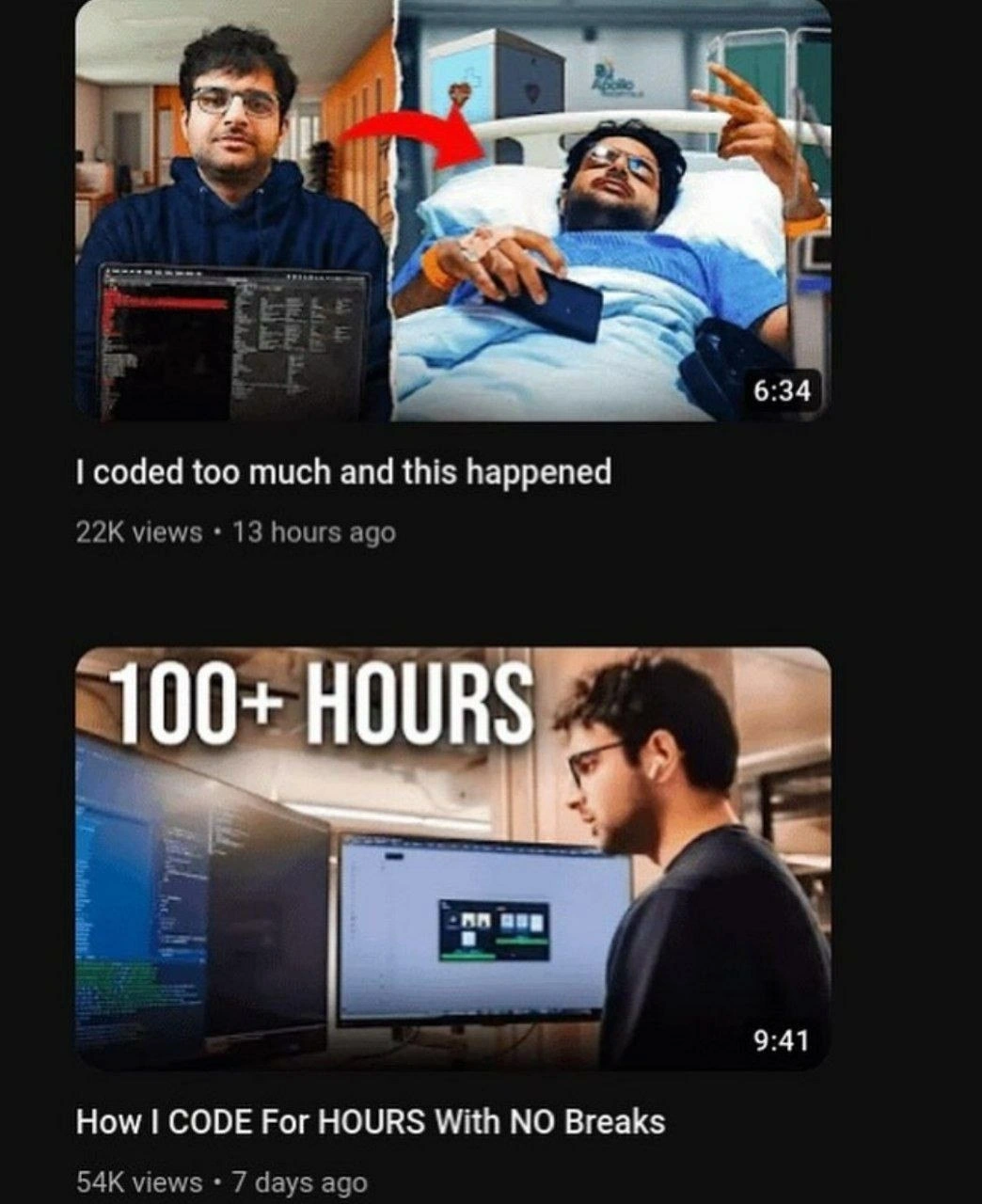
This meme highlights the gap between flashy hustle culture and healthy programming practices, using a pair of fake YouTube thumbnail images. On the bottom, there’s a video title boasting “How I CODE For HOURS With NO Breaks” with 100+ HOURS emblazoned on it. This is a nod to those online tech gurus or tutorial makers who claim superhuman DeveloperProductivity by coding non-stop. The picture shows a young developer intensely focused on twin monitors: one screen has an IDE (Integrated Development Environment – basically the program where developers write and test code) filled with source code, and the other screen shows a desktop or maybe some app. He looks laser-focused, probably to convince the viewer that he’s in the zone for hours on end. The big white text 100+ HOURS is pure clickbait exaggeration – it’s intentionally over the top, similar to other YouTube titles like “I didn’t sleep for a week!!” It’s meant to draw attention. In the context of programming, “100+ hours” suggests working well beyond the normal 40-hour work week, more than double, with presumably no weekends or breaks. That’s an insanely long time to code continuously, and any real developer knows it’s not a sustainable or common practice – it sounds more like a brag or a stunt than anything realistic.
Now, the top image (the supposed “next” video) is titled “I coded too much and this happened.” Here we see the consequences of that no-break marathon. The same developer is now lying in a hospital bed, wearing a patient gown and hospital wristbands, with an IV drip in his arm. He’s even wearing sunglasses in bed and holding a smartphone, which is a humorous touch – as if he still can’t stop checking his code or messages, even while hospitalized. There’s a big red arrow pointing from an image of him coding (on the left) to the image of him in the hospital (on the right). This makes it very clear: coding too long with no breaks led directly to a medical emergency. It’s satire, but it’s highlighting a real issue known as DeveloperBurnout or DeveloperExhaustion.
Let’s clarify some of these terms. Burnout in a developer context refers to a state of extreme physical and mental exhaustion caused by prolonged stress and overwork. A developer who’s burned out might feel constantly tired, less creative, and unable to concentrate or care about their work. Exhaustion is the more immediate feeling of being worn out – imagine how you feel after staying up two nights in a row, but every day. The term CrunchTime is often used in the software industry to describe a period when developers work especially long hours under intense pressure to meet a deadline (like right before a big product release). During crunch time, people might stay late at the office, pull LateNightCoding sessions, and yes, sometimes even work through the night. It’s become somewhat infamous in certain industries – for example, video game development is known for frightening crunch periods where devs work, say, 80-hour weeks in the final months. This meme is essentially pointing out, in a humorous way, the danger of treating crunch time or ultra-long coding sessions as something to be proud of or to advertise.
The idea of hustle_culture_myth is important here. Hustle culture pushes the belief that to succeed, especially in tech, you must be constantly “grinding” – working harder and longer than everyone else, sometimes at the expense of sleep, breaks, or any personal life. You’ve probably seen motivational posts or videos saying “Rise and grind!” or developers on Twitter bragging, “Just crushed a 20-hour coding session, feeling like a beast.” The meme calls this out as a myth by literally picturing the aftermath: the “beast” ends up in a hospital bed. In reality, no human can go full throttle continuously without consequences. Sure, you can have bursts of intense work (everyone pulls an all-nighter once or twice if necessary), but making a habit of it is unhealthy and counterproductive.
The tags like health_risks_of_burnout and hospitalizable_code_sprint capture the serious side of this joke. Working extremely long hours with no breaks can lead to health problems. Lack of sleep and constant stress can weaken your immune system, mess up your concentration, and increase risks of everything from migraines to more serious issues like heart problems. There have been real cases (notably in some finance and tech jobs) where people literally collapsed or needed medical attention after working insane hours without rest. While the meme is exaggerating for effect (most coders won’t end up in the ER just from coding too much in one go – usually they’d pass out asleep before that), it’s rooted in the genuine concern over work habits. Micro_break_deficit is a term hinting at the lack of even tiny breaks – things like standing up to stretch, looking away from the screen, or grabbing a snack. These micro-breaks might seem trivial, but they help prevent strain and maintain focus. A “deficit” means not having enough of them. When someone claims they worked 100 hours with “NO Breaks,” it implies even those little breathers were skipped – which is both unhealthy and likely untrue (everyone has to use the bathroom or eat at some point!).
On the topic of productivity, most evidence and experienced advice say that working such long stretches actually makes you less productive overall. Usually after a certain number of hours of continuous work, your rate of producing good code drops. You start making mistakes that you wouldn’t if you were rested. So a newbie developer reading “How I code for hours with no breaks” might think wow, that’s how to get ahead! but a more experienced dev or a good mentor would quickly point out that this is not a sustainable or wise approach. Good WorkLifeBalanceTips would advise regular breaks, adequate sleep, and time away from the keyboard to recharge your creativity. If anything, veteran developers often emphasize working smart over simply working long. For example, using tools, automating tasks, prioritizing work, and yes, taking breaks so you don’t burn out are all part of working smart.
The comedic punch of the meme comes from how blatantly it connects the dots: it’s practically a before-and-after picture. Before – “I’m a coding machine, look at me grind for 100+ hours!” After – “I destroyed myself by coding too much.” The top thumbnail’s text “I coded too much and this happened” is styled exactly like dramatic YouTube confession videos (“I tried X and you won’t believe what happened”). The bottom’s “100+ HOURS” looks like those extreme challenge videos (“I stayed awake for 5 days challenge” or “100 hours in a VR headset!”). By putting them together, the meme creators are saying, this is the truth behind those crazy coding marathon videos. It’s a form of industry in-joke: developers often share horror stories of ridiculous CrunchTime demands and the burnouts that followed. So seeing it presented like a YouTube story is both funny and telling.
A few more things to note: That top image in the hospital – the developer still holding a smartphone – is poking fun at the idea that even at the brink of collapse, the person can’t detach from work or the internet. It’s an exaggeration, sure, but it represents how some people in tech culture almost idolize constant connectivity and work. It’s like saying “Look, even on the way to the ER, he’s checking his GitHub or Slack!” It adds to the dark humor: he hasn’t learned his lesson even after his body gave out. The room even has a medical equipment box and the logo of a hospital (Apollo, which is a real hospital chain in some countries) to sell that realism. Meanwhile, the bottom image is pretty typical: it’s just a dude coding in an ordinary room, late hours, with lines of code visible – nothing dramatic there except that giant “100+ HOURS” text. The contrast between the two images drives the point home visually.
For a junior developer or someone new to the field, the meme is basically an educational joke: Don’t glorify overwork. The tags like UnrealisticDeadlines are reminding us that often this kind of crunch isn’t because the code can’t be written any other way, but because of poor planning or unreasonable expectations. If someone is regularly coding 100 hours a week, something’s wrong – either they have too much on their plate, or they (or their boss) set impossible goals. It should never be seen as normal or cool. The meme’s humor is a gentle way to communicate a serious message among developers: take care of yourself, and don’t buy into the hype that you must suffer nonstop to be a “real programmer.” In fact, one of the best skills you can develop early in your career is time management and knowing when to step away to rest. Your brain is a bit like a computer’s RAM: it needs downtime to flush out and sort the day’s data (that’s basically what sleep is for!). If you keep pushing without that maintenance, you’re going to have a crash – maybe not a literal hospital trip, but possibly a point where you can’t think straight or you start hating what you normally love doing.
In summary, level 2 takeaways are: this meme uses exaggerated YouTube video images to poke fun at “always-on” coding culture. It defines the problem of developer burnout in simple terms – work too hard with no rest and you pay the price. It serves as a warning especially to ambitious newcomers: coding is great, passion is great, but moderation and breaks are not just for the weak – they’re essential if you want to have a long and healthy career (and life!). The humor works because it shows the extreme outcome in a way that’s instantly understandable: nobody wants to end up like that guy in the hospital saying “I coded too much.” It’s a cautionary laugh and a nod to all the developers who have learned this lesson already.
Level 3: No Breakpoints, Only Breakdowns
In the high-stakes world of coding marathons, hustle culture sometimes feels like an infinite loop with no escape condition. The meme stacks two YouTube-style thumbnails as if they’re steps in a tragic pipeline: first, a coder proudly touts “100+ HOURS” of continuous coding with no breaks; next, we see the inevitable result – the same guy laid up in a hospital bed, IV drip in arm, still clutching a smartphone in a death grip. It’s a darkly comedic visualization of what seasoned engineers know all too well: push a system (or yourself) beyond its limits without pause, and you’ll trigger a fatal exception. No surprise here – skip the break; and you get a breakdown.
This juxtaposition parodies the youtube_productivity_clickbait genre that glorifies insane work habits. Those bold all-caps titles (“100+ HOURS” plastered over a dual-monitor coding setup) and red arrows are the YouTuber equivalent of a red cape waved at a bull. They entice eager new devs with promises of superhuman productivity. How I CODE For HOURS With NO Breaks! – as if that’s a skill to be proud of. The cynical veteran in all of us smirks, knowing that bragging about marathon coding is like bragging about writing code with no version control: sure, you can do it, but you’re one step away from disaster. CrunchTime has been a notorious anti-pattern in software development for decades. Those of us who’ve survived real death-march projects recognize the red flags in these thumbnails: bloodshot eyes concealed behind glasses, a cluttered dark-themed IDE on screen, and the absence of anything resembling normal human life. It’s a recipe we’ve tasted before, and the aftertaste is burnout with a hint of regret.
Let’s break down the technical irony here. DeveloperProductivity isn’t measured in hours chained to your desk or lines of code at 4 AM; it’s measured in sustainable, high-quality output. Past a certain point, your cognitive cache invalidates itself. Memory leaks aren’t just for C++ programs – a sleep-deprived brain will leak context and introduce bugs that slip past all your tests. Think of it like a server running without garbage collection: sure, it works great… until it doesn’t. After 30-40 hours awake, your mind’s call stack overflows with junk variables (typos, logic errors, printf("fix this later"); comments) that never get cleaned up. By the time you hit that mythical 100+ HOURS mark, you’re basically running on undefined behavior. And as every systems programmer knows, undefined behavior can manifest as anything from corrupt data to a complete crash – or in this case, a trip to the emergency room. The top thumbnail’s text “I coded too much and this happened” might as well be a stack trace of human exception: health_risks_of_burnout thrown at function life.cpp: line 100.
We also see a sly nod to the idea of overclocking a human. In hardware terms, overclocking a CPU means running it beyond rated speed – great for short bursts, but keep it up and you’ll fry the silicon without serious cooling. Here the developer is essentially overclocking his body and mind with caffeine as coolant and sheer willpower as the fan. The result? Thermal throttling in the form of micro-sleeps and brain fog, until ultimately the whole system shuts down. The meme’s hospital scene is the “blue screen of death” for the human body, complete with an IV drip acting as emergency coolant. If you look closely at that top image, our exhausted coder is making a weak V-for-victory sign while half-conscious in bed. That hand gesture reads as pure dark humor: “I survived the sprint!” – except he’s literally hooked up to monitors and fluids. Victory, indeed.
Seasoned developers will recall countless war stories that echo this satire. We’ve seen the DeveloperBurnout scenario play out in real life: the colleague who pulled one too many all-nighters and ended up needing a month off for “medical reasons,” or the on-call engineer who thought chugging Red Bulls could fend off sleep until they started hallucinating monitoring alerts. It’s funny because it’s true: at 3 AM during a LateNightCoding binge, that code you’re writing isn’t your best friend. It’s a siren luring you onto the rocks of technical debt. There’s a reason why wise teams implement mandatory breakpoints (the human kind, not just the debugger kind) during sprints. Without pause, quality plummets – we’re talking negative productivity where each extra hour creates more bugs than features. Ever fixed a critical bug at hour 72, only to introduce two worse ones? Classic. As the meme hints, the “How I code for hours with no breaks” act is quickly followed by “I coded too much and look what happened.” The thumbnails even show a timeframe: one video posted “7 days ago” (the hustle tutorial), and a follow-up “13 hours ago” (the hospital reveal). It’s a one-two punch storyline: Day 7 – I’m invincible, Day 0 – I’m in the ER. This formatting roasts the cycle of hustle_culture_myth content. It’s like the tech community’s own cautionary tale, delivered in the familiar YouTube clickbait aesthetic.
Notice the subtle details the meme creator nailed: The “22K views • 13 hours ago” vs “54K views • 7 days ago” suggests that the outrageous stunt (100+ hour coding grind) garnered a lot of attention, but the aftermath is catching up. The second video – the crash – is newer, implying cause and effect. It’s a clever commentary on what the audience actually values: a sensational grind video might go viral, while the sobering truth (hospitalization) is an afterthought. And yet here they are, stacked together, forcing you to see the full life cycle of a 24_7_coding_grind. The bottom thumbnail even shows a side-profile of a coder intensely staring at dual screens with an IDE open – perhaps a recognizable code editor UI (likely a staged ide_screenshot_prop just to look “code-y”). It’s the quintessential “grind” image. In contrast, the top has the same guy in a hospital gown. The big red arrow in the top image literally points from the coding scene to the hospital scene, as if saying “Step 1: grind, Step 2: suffer.” This heavy-handed visual metaphor is satire with a side of truth. Every senior dev who’s been through a death march project can practically feel their back pain just looking at it.
Why does this resonate with experienced engineers? Because many of us have been there – maybe not with an actual ambulance ride, but close. We remember the UnrealisticDeadlines (“can you just implement these 5 major features by Monday?” asked on a Friday), the pizza-fueled nights merging code like zombies, and the bleary-eyed stand-ups where half the team looks physically ill. We learned (the hard way) that WorkLifeBalanceTips exist for a reason. The meme is essentially a PSA wrapped in humor: if you treat coding like a sprint that never ends, you’ll hit the wall – hard. In software terms, your body will rate-limit you if you don’t do it yourself. Maybe you can get away with one 100-hour week when you’re 20 and running on sheer adrenaline, but that debt accumulates interest. It’s like neglecting to free memory in a loop: eventually, you crash the system. The “ER fast-track” in the title is no joke – most ERs do have a fast track for urgent cases, and severe exhaustion or collapse could put you there. Hospitalizable_code_sprint is a term nobody wants on their resume.
In summary, the top tier technical humor here comes from recognizing the absurdity of hero-programmer mythology. It pokes fun at the hustle culture myth by illustrating its extreme: coding 100 hours straight isn’t a badge of honor, it’s a path to self-destruction. The meme captures a truth that senior devs often end up preaching: working smarter (with breaks, rest, and balance) beats working harder ad nauseam. Sure, it’s couched in dark humor – the guy still on his phone in the hospital is a chef’s kiss detail about how deep this obsession runs – but the message lands. It’s a laugh of recognition, with a wince of empathy. We’ve refactored crummy 4-AM code, we’ve felt the DeveloperExhaustion that no amount of coffee can fix, and we’ve seen colleagues flame out. This meme just dramatizes it in a way that every overworked programmer can understand: if you try to be a coding machine, don’t be surprised when the machine breaks down.
Description
The image displays a sequence of two YouTube video thumbnails from the same creator, illustrating a cause-and-effect narrative. The bottom thumbnail, posted '7 days ago,' shows a developer intensely focused on multiple monitors with the text '100+ HOURS' overlaid. The title reads, 'How I CODE For HOURS With NO Breaks,' glorifying extreme work habits. The top thumbnail, posted '13 hours ago,' presents a stark contrast. On the left, the developer is at his desk; a red arrow points to the right, where he is shown lying in a hospital bed with an IV drip. The title is, 'I coded too much and this happened.' This meme serves as a cynical commentary on the toxic 'hustle culture' often promoted in the tech industry. For senior engineers, the humor lies in the predictable, almost inevitable, outcome of sacrificing health for performative productivity. It highlights the naivety of equating long hours with valuable work, a lesson most experienced professionals have learned the hard way

Comments
32Comment deleted
Ah, the classic 'sprint-to-the-hospital' agile methodology. The retrospective must be interesting: 'What went well? Got a lot of views. What didn't go well? System crashed, and I mean my CNS.'
Sure, you can push 100-hour sprints - just remember your new CI pipeline stands for ‘Cardiac Intensive.’
The real bug here isn't in the code - it's thinking that 'git commit' messages from a hospital bed will impress your tech lead more than sustainable, well-architected solutions delivered by someone who actually remembers what they wrote after a good night's sleep
The classic developer paradox: we'll spend 100+ hours optimizing an algorithm to save 3 milliseconds of runtime, but won't take 5 minutes to stand up and stretch. Turns out the real O(n) complexity was our declining health metrics all along - and unlike technical debt, you can't just refactor your way out of a hospital bed with a clever design pattern
Optimizing for commit velocity until your only remaining bottleneck is a hospital IV drip
Treating '100+ HOURS, no breaks' as a KPI just burns the human error budget - your rollback plan becomes the ICU
Advertising “100+ HOURS” is the human equivalent of disabling exponential backoff - throughput flatlines, defect rates spike, and the next escalation page is from cardiology instead of PagerDuty
HOW retarded people outsource ME to write them technical debt Comment deleted
Another random influencer spreading lies Comment deleted
Damn( Comment deleted
Bullshit for bullshit, those bloody bloggers produces totally damn fake videos but collecting thousands and millions of views. Who da fuck is watching this shit for idiots? Comment deleted
Me asf after a three day contest (i failed) Comment deleted
you tried to ban dev meme itself?) Comment deleted
what lmao Comment deleted
Hahahaha what did you do Comment deleted
note to anyone here who doesn't see the group chat: - this was just for testing - please don't click on commands, it makes you send it too, instantly, without confirmation dialog (which is kind of spam) - if you're not a trusted user nor a mod you can't do anything with it anyway Comment deleted
yeah, we need to ban this spammer. he texts about bullshit telegram features at random time and for no reason Comment deleted
Huh? This was shown as a link ... duh. Why show links if they don't lead anywhere. Comment deleted
It was a clickable element, to play a devil's advocate Comment deleted
It still is Comment deleted
blame telegram, commands are formatted like links, and many users get confused by that Comment deleted
@RiedleroD Comment deleted
ikik Comment deleted
you wanna ban the channel? Comment deleted
When me 😋 Comment deleted
jesus Comment deleted
yuki just started laughing uncontrollably and i decided to check what the fuck happened Comment deleted
jesus Comment deleted
oh shit Comment deleted
I can see edge cases here XD Comment deleted
. Comment deleted
although *this* seems off to Comment deleted