Skip to content
DevMeme
2591 of 7435
Defining Your Age by Obsolete Physical Media
TechHistory Post #2868, on Mar 29, 2021 in TG

Defining Your Age by Obsolete Physical Media

Why is this TechHistory meme funny?

Level 1: Old-School Show-and-Tell

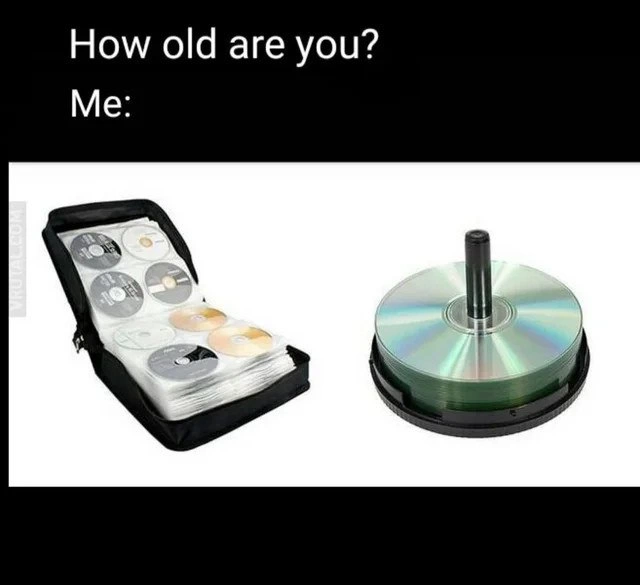
At the heart of this meme, the humor comes from answering a question about age by showing a really old piece of technology instead of just stating a number. Imagine if you asked your dad, “How old are you?” and he just pulled out a box of dusty VHS tapes or an ancient brick cellphone from the 1980s. You’d probably laugh and think, “Wow, that’s some old stuff, you must be pretty old too!” In this meme, when the person is asked “How old are you?”, they respond by revealing a big case full of CDs and a huge stack of them. Even if you don’t know much about computers, you can tell those are old things – people don’t really use CDs like that anymore.

It’s basically a fun way of saying, “I’m from an older generation,” using objects instead of words. Think of it like show-and-tell in school: instead of telling the class their age, they’re showing an item from the past to get the idea across. The reason it’s funny is that it’s so unexpected and visual. Only someone who has been around for quite a while would still have a collection of CDs like that lying around. So it immediately clicks that this person is jokingly boasting about being older (and by extension, more experienced). It brings a smile because it mixes pride with a bit of silliness – proud to have been around to use those things, and silly because nowadays those things are kind of obsolete. You don’t need any technical knowledge to get the joke: it’s the same as someone holding up a floppy disk or a pager and saying, “This is how you know I’m not young anymore.” It’s a little nostalgic wink that says the tools we used can tell our age story. And seeing those old tools makes people who recognize them feel a happy, nostalgic spark, which is what makes the whole thing endearing and funny.

Level 2: Before the Cloud

Let’s break down what’s in this meme for those newer to the tech scene. The two photos show items that might seem a bit odd or old-fashioned today, but they were once everyday tools for storing and sharing data:

  • On the left is a CD wallet (a CD case). It’s a zip-up binder with plastic sleeve pages, and each sleeve holds a Compact Disc. People used these like a photo album for CDs. For example, a software developer might keep all their important installation CDs or backups in one of these wallets so they could carry them around or just have them organized. You flip through it kind of like how you’d flip a book to find the disc you need.
  • On the right is a CD spindle – basically a tall stack of blank CDs. Blank CDs (often the CD-R type, which stands for recordable CDs) were sold in bulk on these spindles. The spindle has a rod in the middle and a round base, and the CDs are stacked on it to keep them safe and dust-free. If you bought a pack of 50 or 100 blank CDs, it would come on a spindle like this. Each of those blank discs could be “burned” with data.

Now, some context: A CD (Compact Disc) is a form of optical media. “Optical” because it’s read by a laser in a drive. Back in the 1990s and early 2000s, CDs were one of the main ways to store files, install software, or transfer things from one computer to another. Each CD could hold about 700 MB of data (which was huge compared to the floppy disks that came before them, which only held 1.44 MB!). To give an idea, 700 MB might hold, say, around 150 MP3 song files or a bunch of documents, or one moderate-sized program setup file. It was enough space to fit a whole operating system installer or a big application suite on one disc.

Before the cloud and high-speed internet, if you needed a program, you would often get it on a CD. For example, if you were installing Microsoft Office or Adobe Photoshop back then, you’d buy it in a box that had a CD (or several) inside. You’d then put that CD into your computer’s CD drive (a hardware slot in the computer specifically for reading CDs – which was standard on all PCs at the time, though many modern laptops don’t include CD drives anymore) and the install would run from there. This was the normal method of installing software – no app stores or huge downloads, just physical discs. Similarly, if you wanted to back up data or copy files to give to someone, burning them onto a CD was a common method. “Burning” a CD means using a CD burner (a type of drive that can write data to blank CDs) to record information onto the disc. It’s called burning because a laser literally writes the data by burning tiny marks on the disc’s dye layer.

Now, why is showing a CD wallet and spindle an answer to “How old are you?” It’s a playful way of saying, “I’m so old that I used these in my day-to-day life as a developer.” In other words, it signals tech nostalgia and being from an earlier generation of tech. If someone is, say, 20 years old today, they might have never used a CD to install a program – they’ve grown up with downloads and cloud services. So they might not even recognize the spindle or understand why someone would have a big album of discs. But someone who is, for example, in their 30s or 40s (or older) very likely remembers this era. For them, this picture is instantly relatable. It brings back memories of how things were done “back then.”

Think of it like this: Each CD in that wallet could be something important or useful from years ago – maybe Windows installation discs, driver discs that came with hardware (back when new printers or graphics cards came with a CD of software), or burned CDs containing projects and backups. A developer might have one disc for a database tool, another for a graphics editing program, another with a backup of some source code repository, and so on. The spindle of blank CDs was like having a stack of blank notebooks: whenever you needed to save something new or share files, you’d grab a fresh CD-R from the spindle and burn the data onto it, then maybe label it with a pen. People would often scribble labels like “Project_X Backup April 2005” or “Linux Ubuntu Install Disc” on these CDs.

Some examples of what an older developer or IT person might recall using CDs for:

  • Installing an operating system or software: e.g. putting in a Windows XP CD to set up a new PC, or using a set of CDs to install Microsoft Visual Studio or Oracle Database. Big software sometimes came on multiple CDs which you had to swap out during installation.
  • System recovery and tools: having a “bootable” rescue CD to fix computers when they crash. Tools like antivirus rescue disks or partition repair tools were burned onto CDs so you could boot a troubled machine from them.
  • Sharing files or updates: before high-speed internet, if a colleague needed a copy of a big file or software, you might burn it to a CD and hand it to them, since emailing large files wasn’t feasible. This was sometimes jokingly called using “sneakernet” – physically walking the data over, instead of sending it through networks.
  • Backup archives: every so often, you’d copy important files to a CD and store it, just in case. Offices would have stacks of backup CDs (and before that, backup tapes or floppies). It was a normal part of data safety at the time.

So, the meme is funny because it’s using those objects – the CD case and spindle – as shorthand for “I’ve been around a while.” It’s a bit like if someone asked, “how old are you?” and you showed them a cassette tape collection or a VHS tape – it indicates you’re from an earlier era, because those things aren’t used anymore. In the world of developers and tech, having a bunch of CDs means you worked in the days before fast internet and cloud computing. It triggers a kind of “Oh wow, I remember doing that!” response among older tech folks, and maybe a “Huh, people really did that?” reaction from younger ones.

This meme falls under TechHistory/TechNostalgia because it’s all about remembering an old way of doing things. It highlights how hardware and storage have evolved. Nowadays, if we want to deploy software or share code, we might use a Git repository, send a link, or spin up a cloud server. Back then, you compiled your program and then burned it onto a disc if you needed to deliver it. It’s a huge change in convenience and speed. The person in the meme is jokingly flexing that they lived through those changes. They’re basically saying: “Here’s my age badge: a pile of CD-Rs!”

Even if you’ve never used a CD like this, the idea is understandable. It’s showing an outdated object to represent age. The emotion behind it is a warm, slightly proud nostalgia. Older developers chuckle because it reminds them of their early days, and younger developers might learn a bit about how things used to be (and maybe be thankful they don’t have to carry spindles of discs around!). In any case, it’s a light-hearted tech joke about how far we’ve come in the realm of storage and software distribution.

Level 3: Compact Disc Chronicles

If you’ve been around the tech block for a while, this meme likely hits you with a wave of developer nostalgia. The setup – “How old are you?” with the response being a photo of a bulging CD wallet alongside a tall CD spindle – is an instant age indicator for seasoned engineers. It’s like a secret handshake between older devs: seeing those, you immediately nod and think, “Oh, I know exactly how old you are.” Younger devs might just blink in mild confusion or curiosity because they’ve probably never had to install software from a disc or back up source code onto a stack of CD-Rs. But for the veterans, those binders full of shiny discs are as emblematic of a past era as dial-up modems, Zip drives, or CRT monitors. Just the sight of that zippered CD case triggers memories of another time in computing.

This meme is indeed the ultimate nostalgia flex. In tech circles, a “flex” means showing off – usually in a tongue-in-cheek way. Here the person isn’t bragging about fancy new gear; they’re showing off old gear, which flips the script humorously. It says, “I’ve been around long enough to have used all this.” There’s a mix of pride and self-deprecation in that message. On one hand, the poster is proud of having that depth of experience – “I survived the era of burning installers to CD, and I still have the receipts (or rather, the discs)!” On the other hand, they’re poking fun at themselves for being, well, kind of old in tech years. It’s the geek equivalent of a veteran rock climber showing their fraying rope and scuffed carabiners – these battle-scars of the trade – to a newbie and saying “I’ve been doing this since before you were around.”

For developers who started in the 1990s or early 2000s, CDs were absolutely central to the workflow. This was a time before ubiquitous high-speed internet and cloud services. If you needed a piece of software, you couldn’t always download it – you often had to obtain it on a CD. Companies like Microsoft would ship out big boxes of software or documentation on discs. (Anyone remember the giant MSDN Library binder of CDs/DVDs? Every few months, Microsoft mailed updated documentation and SDKs on physical media – a hefty package that dev teams eagerly awaited.) Setting up a new PC or server meant digging into your drawer for the OEM Windows installation CD and the driver discs for each piece of hardware. Seasoned IT folks amassed libraries of CDs: everything from operating system installers, to service pack updates, to burnable rescue disks, and collections of tools/utilities. That spindle in the meme? It was a common sight on an office shelf or desk, chock-full of blank CD-Rs ready to be written with whatever files needed transferring or archiving. In short, having a CD collection was just part of being a developer back then – much like having a stack of external hard drives or a fleet of cloud accounts might be today.

The side-by-side images in the meme (the CD wallet and the spindle) also hint at different uses. The wallet suggests a curated personal collection – maybe a decade’s worth of installations, backups, even music or Linux distros – all neatly organized in one place. Many of us had a wallet like that in our backpack or car, filled with “just in case” software. The spindle of blank CDs, on the other hand, was like having a pile of fresh notebooks waiting to be filled. It was your blank canvas for whatever needed saving next. Did your friend need the latest antivirus and their internet was too slow to download it? Burn a CD and hand it off. Deploying an app to a client’s server? Burn the installer to disc for the trip (because back then, you couldn’t assume you’d be able to pull it from the web on-site). These were everyday scenarios. Seeing those objects now compresses all of that context into one nostalgic punch.

What really makes the meme funny is how it subverts a normal question-and-answer. “How old are you?” is usually answered with a number. Responding with a picture of technological relics is an unexpected twist. It’s essentially saying, “I’m as old as whatever era these belong to – you do the math.” It lands as a joke because people in the know immediately understand that era. It’s a bit like if someone asked a chef, “How long have you been cooking?” and they just held up a battered, decades-old cast iron skillet. The object tells a story. Here, the story is: “I come from the time of CDs, and I’m not afraid to show it.” Among developers, it draws a laugh because it’s a humblebrag wrapped in self-irony – acknowledging that, yes, you’ve been in the game a long time (long enough to accumulate archaic tech), and also inviting others to reminisce about those times.

Digging deeper into the nostalgia: remember how installing software used to mean feeding a PC one CD after another? Big games or SDKs often came on multiple disks. You’d hear the drive spin up, see progress bars creep along, and occasionally get prompted to swap discs. That whole experience is extinct now, which is why recalling it is equally amusing and heart-warming for older devs. Or think about burning your first CD – it felt like such a high-tech accomplishment to archive your code or your MP3 collection onto a disc that you could share or keep safe. You had to choose a burn speed, maybe 8× or 16×, and hope no one jostled the computer during the burn (early burners could produce “coasters” if there was a hiccup – meaning a bad burn that turned the disc into a useless coaster for drinks). Successfully burning and labeling a CD with “Project Backup – Aug 2004” gave a little satisfaction and peace of mind. These are the kinds of memories the meme brings back in an instant.

From a tech history standpoint, the meme also winks at how far storage and distribution have evolved. It’s saying, “I belong to the era of legacy hardware.” We’ve gone from physical media like tapes, floppies, and CDs, to solid-state storage and high-speed networks, in a relatively short span. Someone flaunting a CD collection as an age badge is implicitly contrasting themselves with the new generation who grew up with App Stores and GitHub. It’s almost a gentle jab: “You kids have it so easy, with your infinite cloud backups and fiber internet. Back in my day, half the job was just managing all these discs!” There’s truth in that exaggeration – older devs did spend considerable time swapping disks, organizing them, making sure to carry the right ones to a job site, etc. It was a whole mode of operating that simply doesn’t exist now. The absurdity of showing a CD spindle to represent age highlights just how different the environment was.

One funny thing is how quickly things changed. Not too long ago, having a binder of software CDs was normal; now it’s a museum vibe. The meme gets chuckles also because many of us realize we still have one of those binders sitting in a closet, collecting dust, essentially tech fossils. We’ve kept them perhaps out of sentimental value (“That disc there has the first program I ever wrote!”) or just inertia, even though we know we’re unlikely to ever use them again. There’s a shared confession in that: “Yep, I’ve got one of those spindles in the garage too, and it’s been years since I touched it.” It’s akin to realizing you still own a pager or a Walkman – a moment of “wow, I’ve been around.” By presenting these items as an answer to “How old are you,” the meme creator cleverly taps into that collective sentiment.

In summary, the humor works on multiple levels for developers. It’s a gag about showing one’s age by technology rather than by number. It’s a nod of respect to how things were done in the “old days” of software development (with a mix of fondness and relief that we don’t have to do that now). And it’s a little celebration of tech progress: we laugh because we remember the inconvenience, and we’re kinda proud we made it through and adapted. The next generation might use something like “Here’s my USB flash drive collection” or “Here’s my external hard drive stack” in a future meme – each wave of tech leaves its own artifacts. But right now, for developers, the CD binder is a perfect symbol of being a grizzled, experienced veteran. It tells a whole story in one image, and that story makes those in the know smile and say, “Those were the days… and I guess I’m officially old now, haha.”

Level 4: Laser-Etched Legacy

In the deep technological weeds, this meme’s nostalgia flex centers on decades-old optical storage tech. The Compact Disc (CD) arrived in 1982 for audio (Philips & Sony’s Red Book spec), and by 1985 the CD-ROM variant (Yellow Book) enabled storing ~650–700 MB on one disc – a massive leap from 1.44 MB floppies. (700 MB felt huge then; by today’s standards it’s smaller than some HD movies or a hefty node_modules folder!) A CD encodes bits as microscopic pits and lands along a continuous spiral track on its polycarbonate surface. A drive’s 780 nm laser shines on the disc and detects the differences in reflectivity between a pit (less reflection) and a land (more reflection) to read a stream of digital 1s and 0s.

For reliability, CDs utilize Reed-Solomon error correction codes. This adds redundancy so that even if some bits are misread due to scratches or dust, the original data can be reconstructed. It’s a brilliant blend of hardware and math: a scratched music CD often still plays flawlessly because the player’s decoder repairs the missing bits on the fly. The CD format was engineered with this robustness in mind; a few errors per million bits can be smoothed over, meaning a minor scuff won’t corrupt your entire installer or song. This error-correction scheme was crucial to making optical media practical for software and data, where even one flipped bit could break an executable. In essence, the designers anticipated the realities of physical media handling – discs get dirty, scratched, imperfect – and built in a buffer of algorithmic forgiveness.

A blank CD-R has a special dye layer that a CD burner’s laser can alter permanently. When you “burn” data onto a CD-R, you’re using a high-intensity laser to heat tiny spots on that dye, changing it from transparent to opaque. Those opaque spots serve the same role as the molded pits on a factory-pressed CD-ROM – they disrupt the laser’s reflection to signify a binary 0. This is literally laser-powered writing: heat, chemical change, and digital information fused in a little rainbow-shiny disc. Once a section of dye is burned, it can’t revert, which is why CD-Rs are write-once. (Later on, CD-RW discs came along with a phase-change metallic alloy layer that could be reset – by heating to different temperatures, the alloy could be toggled between crystalline and amorphous states, allowing erasing and rewriting. It was like high-tech magic at the time, though CD-RWs never quite matched the popularity of cheap, simpler CD-Rs in practice.)

Despite their marvels, optical discs have inherent performance constraints. Early CD-ROM drives read at 1× speed, meaning ~150 KB/s data transfer – fine for 1980s audio, but a snail’s pace for programs. Engineers pushed this to 2×, 4×, 16×, up to about 52× in the 2000s (where the drive’s outer edge could pull data at a few MB/s). Even so, seek times (moving the laser to the correct track) were on the order of 100+ milliseconds. That’s an eye-blink for a human, but an eon compared to modern SSD latencies measured in microseconds. If you’ve ever waited while a game or IDE installer progressed disc by disc, hearing the drive spin up and the head clicking back and forth, you’ve felt these limitations. Optical drives also have to constantly adjust rotation speed: they spin slower when the laser is reading near the disc’s outer edge (to maintain a constant linear read rate). It’s an electromechanical ballet with speed ramps and head movements – fascinating, but comparatively slow. By contrast, today’s NVMe solid-state drives move data with no moving parts at thousands of MB/s, and we kind of chuckle that we once thought 52× was blistering fast. In short, loading software from a CD was reliable and dramatic (all that noise!) but it definitely wasn’t speedy.

Another piece of this legacy is the filesystem and format of data CDs. Most software CDs were organized using the ISO 9660 filesystem (the standard for CD-ROM data), often with extensions like Joliet (for Windows, allowing long file names and Unicode) or Rock Ridge (for Unix/Linux, preserving permissions and longer names). This is why even now we talk about “ISO files” – an ISO is just a byte-for-byte image of a disc following the ISO 9660 standard. The terminology of mounting an ISO in a virtual drive is a direct carryover from the days you’d mount a physical CD. All those conventions – calling a disc image an “ISO,” using terms like burn and mount – are little linguistic fossils of the CD era. Even the fact that drive letters on Windows would jump from A: (floppy) to C: (hard disk) and often D: for the CD-ROM is part of that historical artifact. These were the constraints and standards developers had to work with: for example, ensuring their installer fit the file name limits of ISO 9660, or splitting assets across multiple discs if one wasn’t enough.

The dominance of CDs shaped software distribution practices. Think about patching or updates: today we deploy continuously, but in the 90s if a bug was found after shipping a CD, users might have to wait for a mailed patch disc or find a download (if they even had internet). Big software releases were infrequent, coordinated events – you didn’t casually push out a new version every week when most users only got your software via a physical CD in a box. This, in a way, enforced a more monolithic or waterfall style development cycle. We joke that “back in my day, updates were service packs you installed from a CD after 6 months,” but it’s grounded in how distribution worked. Some companies tried innovative solutions, like including automatic updaters, but those were limited by dial-up speeds. The physical reality of shipping bits on plastic created a natural drag on how fast things could evolve or be corrected. It also meant documentation and extras came bundled – many devs recall the thick printed manuals and multiple CD set in the software box, an experience that’s virtually disappeared now.

So, by flashing a CD wallet and a spindle of discs in response to an age query, the meme encapsulates all this technical history in one image. It’s saying, beneath the humor, that these objects – the product of lasers, intricate encoding schemes, and bygone distribution models – mark the era a developer hails from. It’s a nod to a time when computing had more tangible artifacts: when installing an OS meant feeding discs one by one, when backing up code meant carefully burning it to a CD and labeling it with a Sharpie. The humor gains an extra layer when you realize: only someone who lived through that cutting-edge-turned-obsolete tech would even think to use it as an age indicator. In a world of ephemeral cloud services and instant downloads, a spindle of CDs is practically an archaeological relic. The meme’s punchline lands because technically inclined folks recognize that having such relics is a boast of having witnessed (and survived) a very hands-on, hardware-driven chapter of tech history.

Description

A 'how old are you?' meme format. The top section on a black background contains the text 'How old are you? Me:'. The bottom section shows two iconic pieces of late 1990s/early 2000s technology against a white background. On the left is a black, zippered CD/DVD binder, opened to reveal discs stored in plastic sleeves. On the right is a tall stack of blank, iridescent CD-Rs or DVD-Rs on a black plastic spindle. The humor comes from answering the question of age not with a number, but with images of technology that are instantly recognizable to a specific generation (primarily Millennials and late Gen X). For experienced developers, this evokes strong memories of burning software, operating system ISOs, music mixes, and data backups onto physical discs, a stark contrast to today's world of cloud storage and high-speed internet
Comments

39
Anonymous ★ Top Pick I'm 'buffer underrun error on the 49th minute of a 50-minute CD burn' years old. That's a special kind of trauma that cloud storage will never understand
  1. Anonymous ★ Top Pick

    I'm 'buffer underrun error on the 49th minute of a 50-minute CD burn' years old. That's a special kind of trauma that cloud storage will never understand

  2. Anonymous

    Old enough that our first “artifact repository” was a spindle of CD-Rs - merge conflict resolution involved a Sharpie and whoever yelled “overwrite” the loudest

  3. Anonymous

    Remember when deploying to production meant burning a master disc at 1x speed to avoid buffer underruns, then praying the client's CD drive could read your particular brand of CD-R? Now we panic when our CI/CD pipeline takes more than 5 minutes

  4. Anonymous

    Remember when 'deploying to production' meant burning a CD-R at 4x speed because anything faster would cause buffer underruns, then physically shipping it overnight? Now we push to prod 50 times a day and somehow feel *less* confident about it. At least back then, when something broke, you could literally see the coaster you created

  5. Anonymous

    Old enough that my first container was a CD spindle, long before Docker registries

  6. Anonymous

    Old enough that CI/CD meant Copy ISO/Carry Disc - the artifact repo was a 100‑pack spindle and the hallway was our deployment pipeline

  7. Anonymous

    My first package manager was a spindle of CD‑Rs; deployment pipeline: mkisofs | cdrecord | walk to the rack

  8. @perfect_pixel 5y

    до сих пор лежит похожая коробочка как слева, на нее записаны все сезоны комиссара рекса

  9. @perfect_pixel 5y

    видимо уже на пенсии посмотрю (если данные доживут)

    1. @Odbjorn 5y

      если ещё будет дисковод

      1. @ANTICHRISTUS_REX 5y

        ما هذا ؟

        1. @pyproman 5y

          ؜We don't speak Arabic here

          1. @ANTICHRISTUS_REX 5y

            Nor russian.

            1. @feskow 5y

              you frickin killed him

            2. @ANeufeld 5y

              I beg to differ...

              1. @ANTICHRISTUS_REX 5y

                Dans ce cas là, on va tous parler nos propres langues et faire de Telegram la grande tour de Babel.

                1. @ANeufeld 5y

                  Pues, hay una cosita la cual estas ignorando completamente. Hay un monton de rusos aqui, de hecho, probablemente la mayoria eatan rusos y el admin solo esta enforcando esta regla tonta para aumentar la popularidad del canal. Und deshalb ist es zwar in Ordnung rissisch zu schreiben, aber arabisch ist definitiv eine Minderheit und ist tatsächlich sehr... sagen wir... undemokratisch. Ну а если ты дальше хочешь мерится хуями, то я еще на китайский могу перейти, и мне не нужен словарь. Did you get everything, smartass?

                  1. @ANTICHRISTUS_REX 5y

                    لقد فهمت ما قد قلتم، و لن أنحط إلى هذا المستوى لكي أتمكّن من الإجابة. Parce que répondre à l'impolitesse par l'impolitesse ne fait qu'accentuer la bassesse. and about the stupid rule imposed by the admin, I may say Dura lex, sed lex. ¡adiós mi amor!

                  2. @RiedleroD 5y

                    idk if you actually speak german or if you translated it, but that's 100% fine wine right there. A+ on grammar, A+ on vocabulary, and A+ on content :P C- on Rechtschreibung because rissisch→russisch aber ok Sehr gut gemacht! 👍🏻

                    1. @ANeufeld 5y

                      Hehe, vielen Dank. Ich habe es tatsächlich selbst getippt und habe mich in der Eifer des Gefechts vertippt. Ich komme zwar aus Russland aber lebe aktuell in Deutschland.

  10. @GTRst 5y

    you win

  11. @JoseAngelSanchez 5y

    I hope someone invents an online translator soon

  12. @deerspangle 5y

    Plus messenger's built in translator is pretty decent tbh. Wouldn't want to try and have a conversation through it though

  13. @ANeufeld 5y

    "seul les faibles aiment être malpolis tout en se cachant comme des vampires peureux." He said and deleted the message

    1. @ANTICHRISTUS_REX 5y

      Deleted because I wanted to translate before to answer, I need to know what's about, I'm not weak !!

      1. @ANeufeld 5y

        Uh, apparently I hit a nerve.

        1. @ANTICHRISTUS_REX 5y

          You should be proud then.

      2. @ANeufeld 5y

        First part is in Spanish. Then German. Then Russian. Then English. If you translate by parts, it could work. There are a few typos tho. Google Translator might just aurocorrect them. The first part, you should be able to understand with your French anyway.

  14. @ANeufeld 5y

    Talk about weak.

  15. @JoseAngelSanchez 5y

    that’s neat

  16. @pyproman 5y

    This chat just turned to a mix of all languages

  17. @pyproman 5y

    Completely normal (text glitch)

    1. @ANTICHRISTUS_REX 5y

      I did not start using my own language because there are a lot of people who may understand it. English is the universal language, but some persons are too clever to force other people to translate. I'm just a mirror, I show how other people may feel/think when "clever" people aren't able to understand it.

      1. @RiedleroD 5y

        trying to sound smart is often a sign of not actually being smart so shut up

        1. @ANTICHRISTUS_REX 5y

          I do not try to be smart or asking for opinion from people such you ! I'm showing/explaining my rightness, even if (you) the haters gonna hate, I don't give a shit !!

          1. @RiedleroD 5y

            why though? Why do you feel the need of trying to be right, huh? Nobody cares, and you're just going to seem like an ass. Because that's what you are right now.

            1. @ANTICHRISTUS_REX 5y

              Need to fight ? Play FPS !!

              1. @RiedleroD 5y

                Aight, imma just block you, then my life will have less unnecessary noise.

                1. @ANTICHRISTUS_REX 5y

                  Weak people !

Use J and K for navigation