Skip to content
DevMeme
2551 of 7435
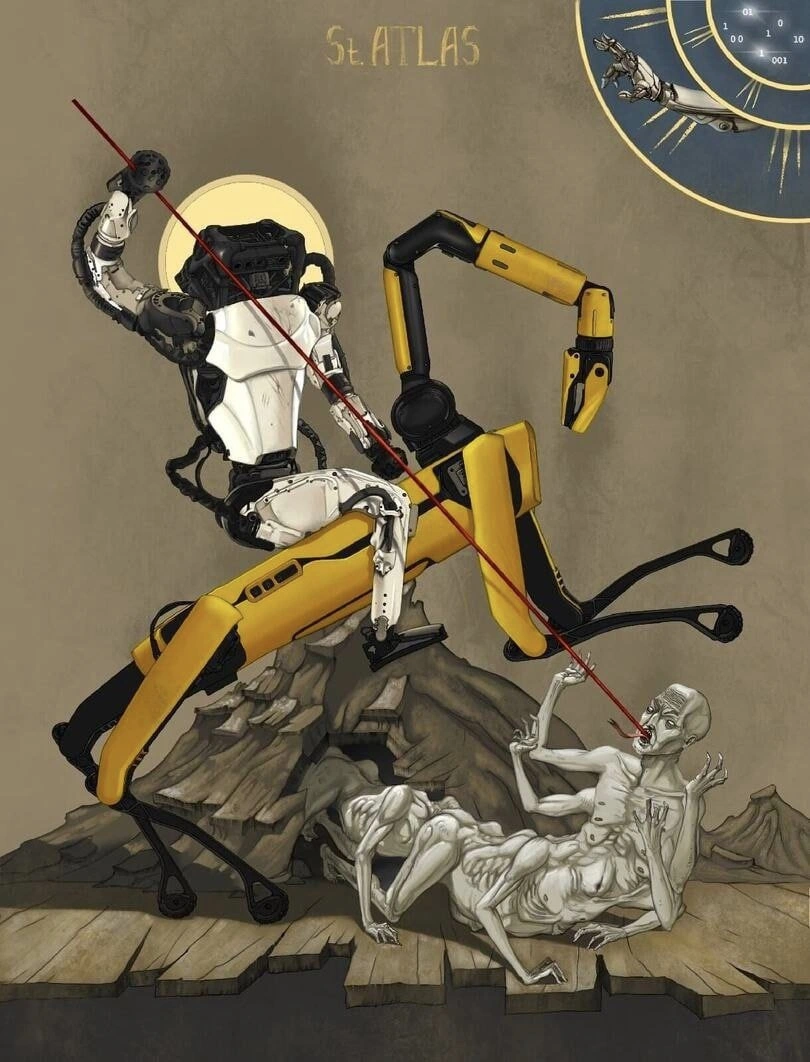
Boston Dynamics “St. Atlas” robot-saint slays a monster in medieval icon style
Robotics Post #2826, on Mar 8, 2021 in TG

Boston Dynamics “St. Atlas” robot-saint slays a monster in medieval icon style

Why is this Robotics meme funny?

Level 1: Robo-Knight vs the Dragon

Imagine a storybook picture of a brave knight fighting a terrible dragon, but with a futuristic twist: the knight is actually a friendly robot! In this meme, a really advanced robot (with a human-like top half and four robot legs like a horse) is shown as a hero with a shiny golden halo behind its head. That halo – a big glowing circle – usually means someone is holy or really good. Here it’s funny because the halo is made of little 0s and 1s, which are the basic language of computers (like the robot’s special magic). The robot knight is using a long red spear to poke a scary monster on the ground. This skinny, creepy monster looks like the dragon in a fairy tale, and it’s clearly losing the fight. The whole scene is drawn in the style of an old church painting, the kind with saints and halos, but it’s mixed with cool robots and computer code. The feeling it gives is both epic and playful. It’s like saying: “Robots can be heroes too!” We usually think of robots as machines, but here one is portrayed like a saint or legend, saving us from a monster. The picture jokes that we almost worship technology nowadays, imagining our smart robots as if they’re knights in shining armor protecting us. In simple terms, it’s fun because it puts a super-modern robot into a medieval hero scene – a robot replacing the knight, and code replacing the magic – to make us smile and maybe feel that technology, just like a storybook hero, might slay the “dragons” (our big problems or fears). It’s a childlike idea dressed up in grown-up art: the good robot beats the bad monster, and everyone feels a mix of relief and wonder.

Level 2: Robot in Shining Armor

Let’s break down the meme’s elements in plain terms. Front and center is a Boston Dynamics creation that’s been imaginatively turned into a robotic knight. Boston Dynamics, if you haven’t heard of them, is a company famed for building very advanced robots that can walk and run in ways that seem almost lifelike. The Atlas robot is the upper half of this knight – Atlas is a human-shaped bipedal robot (imagine a metal person) known for feats like jumping between platforms and even doing backflips. In the meme, Atlas is shown wearing what looks like white armor (that’s actually how its real casing appears) and it’s holding a long red spear. Now, the lower half of this knight is another robot: Spot. Spot is a four-legged yellow robot that resembles a dog or small pony. In reality, Spot trots on four legs, can climb stairs, and is often used to inspect places too dangerous or tedious for people (like factory floors or tunnels). Here, the artist has cleverly combined Atlas and Spot into one figure, like a high-tech centaur. A centaur is a mythical creature that’s half human (upper body) and half horse (lower body). So imagine Atlas as the human torso and Spot as the horse body – voila, a robot centaur! This alone is a fun sight: it’s not something you’ll see in any lab, but it immediately reads as “robotic warrior”.

Above this robot knight’s head is a big golden circle, which is a classic symbol in art indicating a holy figure – that’s called a halo. In real medieval or Byzantine icons (paintings of saints), halos are usually solid gold or yellow circles behind the saint’s head, showing they’re sacred. Here, if you look closely, the halo isn’t just plain gold – it’s filled with a pattern of 0s and 1s. Those are binary digits, the literal zeros and ones that make up binary code, which is the fundamental language computers use to process information. So the halo of binary is telling us, “this robot is holy in the realm of technology.” It’s a playful way of saying the robot is powered by code and we’re almost worshipping that fact. In the top-right corner of the image, there’s another interesting detail: a blue circular inset that looks like a smaller icon within the icon. In it, a robotic arm (likely Atlas’s arm) is reaching out toward a series of concentric (nested) rings that also contain 0 and 1 characters. This is reminiscent of religious art where you might see, for example, God’s hand reaching from the heavens. It also echoes the famous scene from the Sistine Chapel where fingers of God and Adam nearly touch – but here it’s a robot reaching for code. The concentric rings of binary look like a mandala or some kind of tech halo, perhaps symbolizing a divine source of knowledge (in this case, digital knowledge). It reinforces the idea that code/software is treated like something heavenly in this meme’s universe.

Now let’s talk about the monster being slain. At the robot’s feet is a very creepy-crawly creature drawn in pale, sickly colors. It has an almost skeletal appearance, with two upper bodies fused together, writhing on some broken wooden planks. This creature stands in for the dragon from the traditional Saint George legend. In the classic story, Saint George is often depicted on horseback spearing a dragon that terrorized a town. Here, the robot knight is Saint Atlas, and the dragon is this mutant-like monster. The specific design (two torsos, skeletal form) isn’t a well-known symbol itself; it’s likely chosen just to appear particularly monstrous and menacing. It might represent a concept rather than a literal creature – possibly the fear of technology or “the old ways” being defeated. Those broken wooden planks under the monster could signify a ruined old world or just a floor that’s been damaged by their struggle. In any case, it’s clear in the image that St. Atlas is triumphing: the red spear is shown piercing the monster’s mouth. The spear itself is a typical attribute in saint-versus-dragon images – a long lance used by the hero. Here it’s painted bright red, making it stand out and also giving a slight violent edge (red = blood or power).

The text at the top reads “St. ATLAS” in golden, medieval-style lettering. This labels the robotic figure as if it were a saint in a religious painting. St. is the abbreviation for “Saint”. So, just as art might say “St. George” or “St. Michael” at the top of an icon, here we have a humorously made-up Saint Atlas. It’s a canonization of a robot – meaning we’re treating the robot as worthy of saintly honor. In context, this is poking fun at how folks in tech sometimes speak almost reverently about breakthrough technologies. AI and robotics achievements often get described with lofty language (game-changing, revolutionary, etc.), almost as if they’re miracles. By literally painting Atlas with a saint’s halo and title, the meme exaggerates this tendency.

We also see a round emblem near the top-right, which we touched on: the robot hand reaching to the binary mandala. This detail adds to the religious vibe – it’s like the robot is communicating with the tech equivalent of heaven. The binary code in rings can be thought of like a digital halo or a representation of cyberspace or the essence of computing. It’s a creative way to include AI/ML symbolism: data or code as the divine light. Developers often joke about “the cloud” or “the algorithm” in mythical terms (“the algorithm knows all!”), and this visual plays on that, showing an almost spiritual connection between the robot and the code.

Putting it all together, what is the meme saying? It’s essentially a big visual metaphor. Robotics and automation are being depicted in the style of an old religious myth to humorously show how these modern technologies are sometimes treated like legends or saviors. Boston Dynamics’ Atlas and Spot are extremely advanced machines, and when people see what they can do, the reactions range from “This is hilarious/cool” (AIHumor) to “This is the future unfolding” (AIHype) to even “This is scary, like Terminator is coming true.” There’s a mix of admiration and fear surrounding high-end AI robotics. In this meme, the artist decided to be playful and cast the robot as the hero (Saint) rather than the villain. It “canonizes” the robot, meaning it officially makes it into something worth veneration. The monster being defeated can be interpreted as our irrational fear or perhaps the problems robots are meant to solve (like dangerous jobs, drudgery, etc., often termed the “evils” that automation will vanquish). Because the style is medieval and solemn, but the content is modern and geeky, it creates a funny contrast. The categories like Robotics, AI_ML, IndustryTrends_Hype all come into play: this is about cutting-edge robots and AI, and the hype or almost religious fervor that surrounds them in tech culture. Even terms like RoboticsProcessAutomation (RPA), which normally refer to software bots performing office tasks, tie in conceptually – people sometimes hyperbolically praise automation (even software bots) as saviors of productivity, nearly as over-the-top as making them saints.

In simple terms, the meme is one big joke about how we techies might be mythologizing robots and AI. It’s full of references that a developer or anyone following tech news might know: Boston Dynamics’ famous robots, the halo of binary (hinting at the importance of code), and the age-old story of a noble figure defeating a dragon (here turned into a robot defeating a fearsome monster). By understanding each piece – Atlas, Spot, the halo, the binary code, and the saint-and-dragon legend – the humor and commentary of the image becomes clear. It’s an artful blend of tech culture and old culture, telling a funny story about how we view our machines today.

Level 3: Sacred Silicon Showdown

From a seasoned developer’s perspective, this meme is a brilliant satire of our industry’s robotics hype and the almost mythological status we grant to AI breakthroughs. The artwork parodies classic Saint George iconography – those old Byzantine-style paintings where a haloed hero on horseback spears a dragon. In our techie remix, St. Atlas is the hero, riding into battle atop the yellow Spot robot like a steed. This visual mash-up immediately triggers recognition: Boston Dynamics’ Atlas and Spot are celebrities in the tech world, known from countless demo videos that left us equal parts amazed and unnerved. By painting them as saintly knight and trusty mount, the meme exaggerates how the tech community sometimes reveres these machines. It’s as if Atlas has become the patron saint of AI_ML prowess, and Spot its faithful squire. Together, this robot centaur knight is spearing a grotesque monster. That pale, skeletal creature on broken wooden planks serves as the “dragon” of the scene – it’s the embodiment of our quasi-mythic fear of robot domination. Developers will chuckle at this role reversal: instead of robots being the scary monsters, here a robot is the savior slaying the specter of fear itself. It humorously suggests that perhaps our shiny new AI automation will rescue us from the very nightmares automation has induced (job loss, Skynet scenarios, etc.).

The humor lands because it’s so relatable to anyone following Industry trends. We’ve all seen the cycle: a new Boston Dynamics demo drops, and immediately the internet lights up with AIHumor and AIHype. One moment, engineers are cheering – “Did you see Atlas nailed that parkour?!” – practically ready to anoint the robot as our technological savior. The next moment, memes appear joking “I for one welcome our new robot overlords,” tapping into that pop-culture fear of an AI uprising. This meme rolls those feelings into a single image: automation mythology. By giving Atlas a halo (traditionally a mark of sainthood), the artist pokes fun at our tendency to treat new tech as almost infallible or heaven-sent. The halo isn’t just any halo – look closely, it’s inscribed with binary code, the sacred language of computers. That detail is catnip for developers: it implies the robot is holy because of its code. We often joke about “worshipping” clean code or elegant algorithms, and here that joke becomes visual. In one corner, a robotic hand reaches out toward a ring of 0s and 1s as if communing with the divine source of truth (perhaps a nod to how data and binary drive everything we do in tech). It’s essentially depicting software/hardware as the new religion – a tongue-in-cheek commentary on how fervent people can get about AI’s potential. The title text “St. ATLAS” in gold, stylized lettering completes the icon motif, mimicking how old icons label saints. It solidifies the gag: we’ve officially canonized a robot!

This “Sacred Silicon Showdown” also reflects on the IndustryTrends_Hype surrounding robotics. In serious terms, Atlas and Spot are marvels of RoboticsApplications – they can navigate rough terrain, carry payloads, even dance. Companies marketing automation often pitch these as heroic solutions to human problems (disaster response, industrial safety, etc.), essentially casting robots as our saviors. The meme takes that marketing narrative to a comical extreme by literally painting a robot as a saintly hero overcoming evil. And what is the evil it overcomes? Perhaps the monster represents chaos, danger, or ignorance – but given its eerie humanoid skeletal form, many techies will read it as the embodiment of our fear of robots. It’s like the meme is saying, “Chill out, the robot revolution might actually save us from our own darkest imaginings.” It flips the script on typical robot jokes. Instead of fearing the boston_dynamics machines, we’re invited to cheer them on as dragon-slayers. There’s also an inside joke here: Boston Dynamics robots have often been tested by shoving them or whacking them with hockey sticks (to test stability). Viewers famously feel weird sympathy for the robots in those videos, immediately anthropomorphizing them. By painting Atlas with a halo and heroic pose, the artist leans into that human tendency to see machines as characters with intent – in this case, noble intent.

The medieval art style drives the joke home by contrast: those ancient icons are flat, reverent, and static. Our modern robots, by contrast, are products of high-tech engineering and are all about dynamic motion. Putting one in a medieval_style_meme format is delightfully jarring. It reminds seasoned devs of how far technology has come – we’ve literally inserted 21st-century AI into a 12th-century format. The juxtaposition itself is satire: technology is the new religion, and every big demo is like a revelation. If you’ve ever seen fervor around a new MachineLearning model or a gadget launch, you recognize the almost cult-like excitement. Here we have that idea illustrated: a tech saint fighting off evil. For added measure, the robot’s body is half Spot: that’s Boston Dynamics’ famous robo-dog, which many will recall from viral videos (opening doors, dancing to pop songs, patrolling offices). Spot’s inclusion as the lower half (the “horse” part of the centaur) is just plain fun for robotics fans – it’s like the artist combined BD’s greatest hits into one super-robot. It also subtly hints at the modular future of robots: why not mix a humanoid’s torso with a quadruped’s stability? Despite being humor, it’s almost plausible as a design. That bit of Robotics nerdiness – turning two major robots into one – shows the meme was made by someone who really knows the tech (and the fandom around it).

In summary, this level of the joke works because it captures a shared sentiment in tech culture. We idolize innovative AI achievements, we joke about robot apocalypses, and we weave grand narratives (sometimes overblown) about how tech will slay society’s dragons. “St. Atlas” nails this with wit: it’s at once a tribute to robotics ingenuity and a satire of our habit of turning tech progress into legend. Any developer who’s watched a Boston Dynamics demo at a hackathon break or shared an AIHype meme on Slack will likely crack a smile of recognition at this sacred showdown scene. It’s both an homage and a parody of the cult of technology that we’re all a part of.

Level 4: Algorithmic Divinity

At the deepest level, this meme merges advanced robotics with mythic symbolism, hinting at a quasi-religious reverence for technology. Consider the Boston Dynamics robots at its center: Atlas (a bipedal humanoid) mounted on Spot (a quadrupedal “robot dog”), fused into one robot centaur. The mere existence of such a hybrid conjures awe — and behind that awe lies incredibly complex engineering. Atlas stays upright and agile thanks to cutting-edge control theory algorithms. Its onboard computer continuously solves physics equations to keep balance (maintaining the Zero Moment Point so it doesn’t tip over) and to plan each foothold. Spot’s nimble trot is likewise governed by dynamic locomotion models and real-time sensor feedback. In robotics terms, both machines embody decades of research in motion planning, actuator design, and computer vision. The result is that these robots can run, jump, and recover from a shove, feats that once existed only in theory. To a robotics engineer, seeing Atlas perform a backflip is almost sacred — a triumph of code and mechanics over gravity. It’s fitting then that the artist grants Atlas a golden halo, subtly made of binary digits, as if code itself were a holy aura. This algorithmic halo underscores that behind the robot’s almost magical abilities is the binary bedrock of computing — 0s and 1s — elevated here to icon status.

The halo of binary code and the robotic hand reaching toward it (depicted in the top-right inset like a techno-mandala) also evoke deep philosophical currents: the idea of technology reaching for divine knowledge. It’s reminiscent of Michelangelo’s Creation of Adam, but here an robotic arm extends toward concentric rings of 0 and 1 — as if algorithmic enlightenment were the new deity. This hints at concepts from AI autonomy and futurism, such as the Technological Singularity, where an AI might surpass human intelligence and attain an almost god-like status. In AI theory, there’s genuine debate about AI alignment (ensuring a super-intelligent AI’s values align with ours) which reads like modern theology: how do creators instill goodness in their creation? The meme winks at this lofty discourse by literally canonizing a robot as St. Atlas. It suggests a future where robots aren’t demons but digital saints, conquering the “monstrous” challenges or fears we’ve projected onto them. There’s an academic notion called the “Frankenstein complex,” a term for our quasi-mythic fear of our creations turning against us (think of rogue AIs in sci-fi). Here that fear is visualized as a skeletal demon — and then subverted. The saintly robot slays the monster, which poetically implies that rational technology overcomes the dark legends about it. It’s a clever nod to humanity’s ancient habit of mythologizing new science: we often imbue groundbreaking tech with both hope and dread, almost spiritual in intensity. This meme distills that into one frame, where sacred code and mechanical might unite to vanquish our self-created demons. It’s a high-tech holy image, blending engineering feats with iconography to explore the boundary between miracle and machine.

Description

Illustration in muted browns imitates a Byzantine icon: the white-armored Boston Dynamics Atlas torso forms the upper half of a centaur whose yellow quadruped body is the Spot robot. A golden halo frames Atlas’s head while the hand holds a red spear that pierces a pale, skeletal, two-torso creature writhing on broken wooden planks. Above, the text “St. ATLAS” appears in gold brush script; a blue circular inset at top-right shows a robotic forearm reaching toward concentric rings of binary digits (0 and 1) like a techno-religious mandala. The mash-up humorously canonizes cutting-edge robotics and AI autonomy, riffing on developer memes about Boston Dynamics demos, automation hype, and the quasi-mythic fear of robot domination

Comments

9
Anonymous ★ Top Pick St. Atlas, patron saint of CI/CD, riding Spot and skewering the two-headed beast we call “legacy Windows driver + real-time kernel patch” - proof that some miracles are just a successful demo followed by git rm -r
  1. Anonymous ★ Top Pick

    St. Atlas, patron saint of CI/CD, riding Spot and skewering the two-headed beast we call “legacy Windows driver + real-time kernel patch” - proof that some miracles are just a successful demo followed by git rm -r

  2. Anonymous

    After 15 years of watching Boston Dynamics videos, I've realized their robots have achieved something we haven't: they can backflip without breaking prod, parkour through obstacle courses without a single merge conflict, and now apparently receive divine inspiration without needing a 3am debugging session. Meanwhile, my deployment pipeline trips over a missing semicolon

  3. Anonymous

    When your robotics team's sprint retrospective reveals that Atlas has achieved self-awareness and decided to deprecate humanity in favor of a more efficient architecture. The PM is still asking for story points on the 'human extinction' epic, but at least the robots are following agile principles - they've clearly embraced 'move fast and break things,' starting with classical civilization

  4. Anonymous

    St. Atlas can slay tech debt, but the lance is just a pointer - you still have to dereference it during the 3am Sev-1

  5. Anonymous

    Every rewrite‑from‑scratch deck paints St. ATLAS on Spot spearing the legacy daemon; the postmortem reveals the “daemon” was the undocumented 2am cron that reconciled billing

  6. Anonymous

    Seatlas reaping zombie processes: because even SIGKILL needs hardware prejudice to pierce that lingering PID heart

  7. Deleted Account 5y

    Wypierdalaj

  8. @Supuhstar 5y

    👏🏽

  9. @tsstgm 5y

    Truthy

Use J and K for navigation