Blockchain: Just a Linked List with Extra Steps
Why is this Blockchain meme funny?
Level 1: Just a Fancy Chain
Imagine you have a line of LEGO bricks connected end to end, and on each brick you write a secret number that comes from the brick before it. If anyone tries to remove or swap one of the bricks, the secret numbers on the following bricks won’t line up anymore, and you’ll immediately know something’s wrong. In the end, it’s still just a simple chain of bricks snapped together – you’ve just added an extra little safety step on each one to make the whole line trustworthy. The joke here is like someone giving a super fancy name to this LEGO chain idea and acting like it’s revolutionary, when really it’s the same old chain with one clever extra step. It’s funny because it shows that something that sounds very high-tech (a “blockchain”) is basically an everyday idea (a chain of things linked in order) with a bit of special sauce to make it more secure.
Level 2: Linked List vs Blockchain
Let’s break down the technical terms and concepts here. A linked list is one of the simplest data structures in computer science. It’s basically a sequence of nodes, where each node holds some data and a pointer (or reference) to the next node in the chain. Think of it like a treasure hunt: each clue (node) tells you how to find the next clue. You start at the first node (the head of the list) and follow the pointers one by one. For example, in a singly linked list, node A might have a reference to node B, B points to C, and so on, forming a chain.
A blockchain, in terms of structure, isn’t too different – it’s a chain of blocks of data. Each block contains some data (for instance, a list of transactions) and also something special: the hash of the previous block. That hash acts kind of like a pointer, but with built-in verification. A cryptographic hash function (like SHA-256) is a fancy algorithm that takes input data and produces a unique fixed-size string (a hash value). Importantly, if you change even one character of the input, you’ll get a completely different hash output. So hashes are great for detecting changes. When we say a block stores the hash of the block before it, we mean each block carries a fingerprint of its predecessor. This creates a linked chain where each link has a lock: if someone alters an earlier block, its fingerprint (hash) no longer matches what the next block expects, and the chain is broken.
We can compare a traditional linked list node to a blockchain block in code to see the similarity:
# A simple linked list node
class ListNode:
def __init__(self, data):
self.data = data # store the data
self.next = None # pointer to the next node in the list
# A simple blockchain block
class Block:
def __init__(self, data, prev_hash):
self.data = data # store the data (e.g. transactions)
self.prev_hash = prev_hash # store hash of the previous block instead of a pointer
self.hash = sha256(str(data) + prev_hash) # hash of current block's data + prev block's hash
In a normal linked list, node.next literally points to the next node’s location in memory. In a blockchain, instead of an address, block.prev_hash holds a string that is the hash of the previous block’s content. The block.hash is then calculated from its own data plus that prev_hash. So each block “knows” about the one before it, not by an actual memory address, but by a secure fingerprint of its data. This construction is often called a hash pointer chain: each block points to the previous one via a hash value. If anyone meddles with an older block’s data, its hash would change, and that mismatch would cascade down the chain (because every subsequent block’s prev_hash would no longer match). That’s how a blockchain achieves integrity: it’s extremely hard to alter any block in the middle of the chain without everyone noticing the break in the sequence.
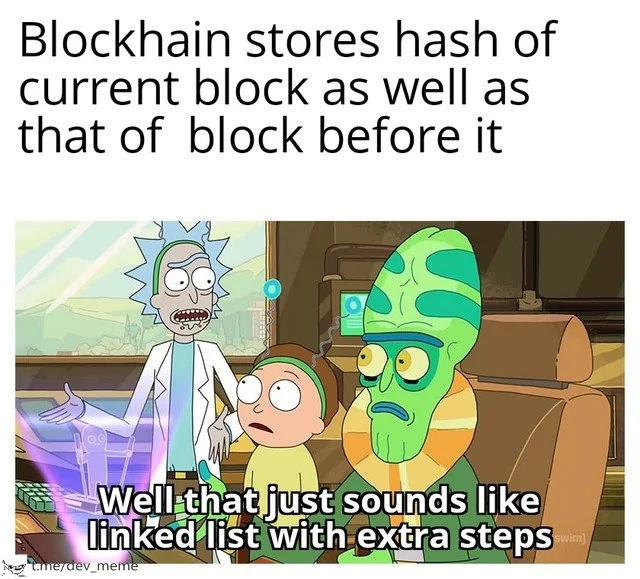
Now, the meme is comparing these two ideas in a funny way. The top text essentially describes the blockchain mechanism: “each block stores its hash and the hash of the block before it.” Rick’s response in the bottom panel (“...linked list with extra steps”) jokes that this technical description is basically describing a linked list, plus the use of hashes — those are the “extra steps.” The Rick & Morty reference adds flavor here: in the show, Rick Sanchez is a scientist who often cuts through complexity with blunt humor. The phrase “with extra steps” comes from a popular meme template originating from a Rick & Morty joke, meaning “you’ve just made something more complicated than it needs to be.” So when Rick says blockchain sounds like a linked list with extra steps, he’s humorously implying: “All that fancy blockchain talk is just our old friend the linked list, but with some cryptography sprinkled on top.”
In summary, this meme is doing a light-hearted data structure comparison: it takes the hype-heavy concept of a blockchain and boils it down to a familiar structure a junior developer would recognize – a linked list. A linked list links nodes in sequence; a blockchain links blocks in sequence using hashes. The extra step (using the hash of the previous block) provides security, but structurally it’s akin to what you learn in CS class about pointers and lists. That’s why the joke lands: once you understand the terms, you realize a blockchain’s chain-of-blocks is basically just a high-tech cousin of the humble linked list.
Level 3: Hashing Out the Hype
At the core of this meme is a wry observation: amidst all the blockchain hype, the data structure behind a blockchain is basically Computer Science 101. The top panel states a technical fact about blockchain: “Blockchain stores hash of current block as well as that of block before it.” That sounds impressively cryptographic, but then we have Rick (the genius scientist from Rick & Morty) in the bottom panel delivering a blunt reality check:
Rick: "Well that just sounds like linked list with extra steps."
This is a direct parody of a famous Rick & Morty scene, and in true developer humor fashion it shatters the mystique of a buzzword by comparing it to a plain old data structure.
For seasoned developers, this punchline hits home. We’ve seen waves of blockchain evangelism where every problem supposedly needs a blockchain solution. But behind the fancy jargon, a blockchain is fundamentally an append-only list of records, each one carrying a reference to the previous one – effectively forming a hash pointer chain much like a basic linked list. Rick’s dismissive quip represents the senior engineer perspective: he’s basically saying, “Congrats, you reinvented the linked list... and made it slower with cryptography!” It’s funny because it’s true – a blockchain’s chain of blocks is a lot like a basic linked list, only each link includes a cryptographic hash of the previous block instead of a normal pointer. Those hashes are the “extra steps” adding security, but the structure is still a linear chain. In the context of the meme, Rick is the jaded senior dev who’s seen every fad come and go, and he’s not impressed by buzzwords. The two aliens (and poor Morty) listening are like wide-eyed stakeholders or junior devs who just heard about a “revolutionary new tech,” while Rick delivers the reality check with sarcastic clarity.
This meme resonates in the tech community because we’ve all been in situations where something simple is over-complicated. Remember those meetings or product pitches during the peak of BlockchainHype where someone insisted, “Let’s use a blockchain for this!” – even if it was just a basic logging or database problem? It’s a classic TechHumor scenario. The experienced engineers in the room would quietly smirk or groan because they know an old truth: if you strip away the buzzwords, many “innovative” solutions are just well-known concepts with a new coat of paint. Here, the coat of paint is words like “block” and “hash” and decentralized ledger gloss, but Rick isn’t fooled for a second. His line “linked list with extra steps” succinctly captures that feeling when a fancy architecture is basically an over-engineered version of something fundamental. It’s the same energy as joking that microservices are “just a monolithic app with extra network latency with extra steps,” or that cloud computing is just “someone else’s computer.” In other words, the meme is poking fun at the tendency to rebrand CS fundamentals as cutting-edge breakthroughs.
To be fair, those extra steps in a blockchain (the cryptographic hashing and the decentralized consensus mechanisms) serve a real purpose – they enable trust without a central authority. But the humor lies in how blockchain enthusiasts often gloss over the simplicity at its core. It’s both a geeky reality check and an in-joke: developers love to remind each other that underneath the hype, it’s “just math and data structures.” By evoking an iconic Rick & Morty punchline (“X with extra steps” has become a meme format of its own), the joke delivers its point with pop-culture flair. Rick, known for his no-nonsense takedowns of confusing science, is the perfect mouthpiece for a senior dev’s skepticism. When he says it “sounds like a linked list with extra steps,” he’s voicing what many experienced folks are thinking. The result is a satisfying mix of validation and amusement – validation that someone cut through the buzzword BS, and amusement at how perfectly this cartoon scene nails a real-world tech sentiment. The meme is basically giving a knowing wink to every programmer who’s rolled their eyes at over-hyped tech and thought, “Haven’t we seen this before, just with more steps?”.
Level 4: Just Add Cryptography
At a theoretical level, a blockchain implements what computer scientists call a hash-pointer chain. This means each block of data contains a cryptographic hash of the previous block, effectively linking them together with a one-way mathematical pointer. A regular linked list uses memory addresses to chain nodes, but a blockchain replaces those pointers with cryptographic hashes. Why is that such a big deal? Because cryptographic hash functions (like SHA-256) have a special property: even a tiny change in the input data produces a completely different hash output. If someone tries to alter the contents of an earlier block, its hash changes and no longer matches the “previous hash” recorded in the next block. The chain breaks mathematically. In other words, these hashes act like a mathematical seal on each block – they make the chain tamper-evident and immutably tied together. It’s the same underlying principle that gives Git commits their integrity and Merkle trees their magic. Under the hood, a blockchain’s blocks are basically playing leapfrog with cryptographic fingerprints instead of hand-holding pointers.
This clever use of hashing transforms a simple data structure into an append-only ledger that’s extremely hard to tamper with. It's not that the idea of linking records is new – append-only logs and hash-chained records have been around in academia and systems design for decades. But blockchain tech adds a few extra steps to make it trustless: by broadcasting this chain across a decentralized network, and often using a consensus mechanism (like Bitcoin’s proof-of-work) to decide which block comes next, it ensures no single party can secretly alter the history. In essence, everyone keeps a copy of this linked list of blocks and agrees on it through protocol. Those extra steps (distributed consensus algorithms, cryptographic puzzles, public/private key signatures) are what elevate it from a mere linked list to a distributed trust system. Yet fundamentally, every new block is still just computing something like hash_current = SHA-256(prev_hash + data_current) – a fancy self-referential link.
Historically, it’s fascinating how CS fundamentals underpin flashy innovations. The humble concept of pointer-linked data from early computer science reappears as the backbone of a multi-billion-dollar technology. A veteran developer might recall that Git’s version history is essentially a cryptographically linked list of commits — sound familiar? — or that certain secure log systems predate blockchains using similar ideas. The meme nails this irony: blockchain didn’t invent the linked list, it just supercharged it with cryptography and decentralized consensus. The result is a system where trust is enforced by math: you don’t have to trust any single node, you just trust the hash chain and the consensus rules. In summary, at the deep technical level, a blockchain is basically our old friend the linked list, beefed up with cryptographic hashing and a distributed agreement process. It’s a brilliant composition of simple pieces – a reminder that sometimes adding cryptography is all it takes to turn a classic CS concept into a revolutionary platform!
Description
This meme uses the popular 'That just sounds like slavery with extra steps' format from the animated show Rick and Morty. The top text states, "Blockchain stores hash of current block as well as that of block before it". The image below shows Rick Sanchez explaining something to a concerned Morty and another alien character. The subtitle has been altered to read, "Well that just sounds like linked list with extra steps". A watermark for t.me/dev_meme is in the bottom left. The humor lies in reducing the complex and often-hyped concept of blockchain to a fundamental computer science data structure: the linked list. At its core, a blockchain is a chain of blocks, where each block contains the hash of the previous one, creating a link. This is structurally analogous to a linked list where each node points to the next. For senior engineers, the joke is a cynical and humorous demystification of blockchain technology, cutting through the buzzwords to highlight the simple underlying principle, while comically downplaying the 'extra steps' like decentralization and cryptographic security
Comments
7Comment deleted
Of course it's not just a linked list. It's an append-only, globally-distributed, and cryptographically-secured linked list that requires the energy consumption of a small nation to add a new node
We rebranded an append-only logfile with hash pointers, sprinkled in Byzantine consensus, and suddenly finance calls it “digital gold” instead of “that slow, immutable linked list you can’t gc.”
Wait until you explain that it's also distributed, immutable, and trustless - then watch them realize you've just reinvented Git with a terrible merge strategy and no way to rebase
Ah yes, blockchain - the technology that convinced an entire industry to get excited about linked lists again, but this time with O(n) lookups, massive storage overhead, and the added bonus of burning enough electricity to power a small nation. It's like we collectively forgot that git has been doing Merkle trees and content-addressable storage for decades, but without the need for proof-of-work to commit your code. At least when your linked list traversal takes 10 minutes and costs $50 in gas fees, you can tell stakeholders it's 'decentralized innovation' rather than 'we chose the wrong data structure.'
Basically a linked list where the next pointer is a SHA‑256 receipt and every append is a global lottery - perfect until the PM asks for deletes
Blockchain: the linked list where appending a node forks reality if you don't pay enough gas
Blockchain is just a linked list? Sure - where the prev pointer is a hash, append requires Byzantine consensus, and garbage collection is called a hard fork