The CAPTCHA That Filters 90% of Developers
Why is this Interviews meme funny?
Level 1: Show You’re Human
Imagine you go to a website and, instead of the usual easy test to prove you’re not a robot (like picking out pictures of cars or clicking a checkbox), it asks you to solve a hard puzzle that only a computer expert would know. In this joke, the website is saying, “If you’re really a person, please flip this complicated tree-like puzzle upside down.” That’s not something normal people do every day! It’s as if a site said, “To show you’re not a robot, please solve a Rubik’s Cube.” It’s funny because it’s a silly, over-the-top test: only a very special group of humans (programmers) would know how to do it. For everyone else, it would be way too hard. The humor comes from how absurd it is – proving you’re human by doing something that even many humans can’t do easily. It’s like a secret club handshake for computer folks. If you can do it, you feel proud and “real.” If you can’t, the site jokingly teases that you must be a robot. In simple terms, the meme is laughing at the idea of setting the bar for “being human” hilariously high, turning a boring robot-check into a nerdy challenge.
Level 2: Inverting Expectations
At its core, this meme blends a coding challenge with a security check in a way that new developers will find both amusing and educational. The blue banner’s text, “To prove you are human, please Invert a binary tree,” is styled like a typical reCAPTCHA prompt. Usually, a CAPTCHA (Completely Automated Public Turing test to tell Computers and Humans Apart) asks you to do something simple like identify pictures of cats or stop signs. It’s designed to be easy for average people but hard for bots. Here, instead, the task is something from a programming interview – essentially, prove your humanity with code. That’s the first chuckle: a CAPTCHA for developers set at a difficulty level that assumes you know data structures and algorithms!
Let’s break down the task itself. A binary tree is a fundamental data structure in computer science where each node can have up to two children (often called the left and right child). “Inverting” a binary tree means to swap every left child with its right child throughout the whole tree. In other words, you create a mirror image of the original tree. If a node had a left branch going one way and a right branch going the other, after inversion the left branch will go where the right was, and vice versa. This is a classic exercise in understanding trees and recursion in programming. In many coding interview prep materials (think LeetCode or HackerRank), the invert_binary_tree_problem is a popular easy/medium question. Interviewers use it to see if you understand tree traversal and pointers/references. For example, one solution is to traverse the tree and at each node, swap its children. Here’s a quick pseudo-code in JavaScript that a new developer might write or recognize:
function invert(root) {
if (root === null) return null; // Base case: empty tree stays empty
// Invert the subtrees first using recursion
let leftInverted = invert(root.left);
let rightInverted = invert(root.right);
// Swap the inverted subtrees
root.left = rightInverted;
root.right = leftInverted;
return root;
}
This little function walks through the tree, flips the branches, and returns the inverted tree. It’s concise and runs in linear time O(n) (proportional to the number of nodes). Any junior developer who has practiced CodingChallenges on trees will recognize this pattern. It’s essentially the answer the CAPTCHA is expecting you to come up with on the spot.
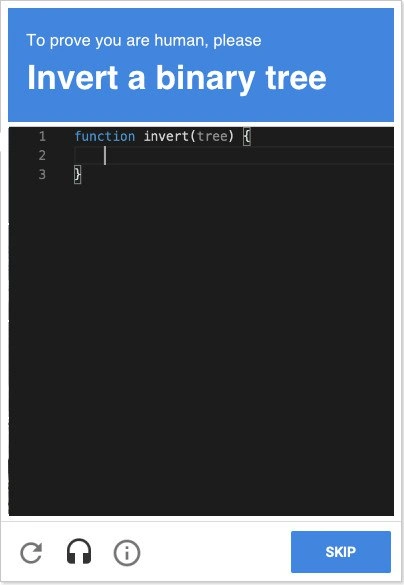
Now, the image shows a dark-themed code_editor_ui with a stub: function invert(tree) { }. This looks just like a coding exercise interface where you’re supposed to fill in your solution – very reminiscent of a leetcode_style_prompt. The joke is that a website is using this interface in a pop-up to verify you’re not a robot. On a normal website, you might check a box or type a few letters from a blurry image. But here, you’d have to actively write a snippet of correct code. The bottom has the familiar CAPTCHA icons: a refresh symbol (in case you want a different challenge) and a headphone icon (usually for an audio CAPTCHA alternative). And in the bottom-right, there’s a big blue “SKIP” button. Typically, CAPTCHAs let you skip if one is too hard or if you can’t solve it, giving you another try. In this meme, hitting “Skip” would presumably present some other task – but the text says “or hit skip like a mere bot,” implying that skipping means you’re basically admitting defeat (and maybe admitting you’re not human, at least not a coding-human!). It’s a playful dramatization: real developers won’t skip; they’ll prove their mettle by coding the solution.
For a junior developer or a student, this meme is funny because it merges two worlds: InterviewHumor and everyday web experience. If you’ve started preparing for technical interviews, you know the slight anxiety around tasks like binary tree inversion. Maybe you’ve practiced it as part of your CS_Fundamentals coursework or bootcamp algorithms class. Seeing that exact task pop up in a CAPTCHA is absurdly unexpected. It’s saying, “Hey, instead of proving you’re human by selecting images, prove it by solving a coding problem!” It highlights how, in developer culture, solving algorithms is almost like a badge of competence. And for people in the know, there’s also a gentle jab at how interviews can feel like you’re proving your human worth through code. The meme’s DeveloperHumor shines through when you imagine an everyday scenario (logging into a site) suddenly requiring you to remember your computer science homework. It’s both silly and relatable if you’ve been steeped in code. After all, most people will never need to invert a binary tree in daily life, but as a developer you might have done it so many times that it does feel like a mundane “are you human?” check. This exaggerated scenario tickles that part of a developer’s brain that loves both coding puzzles and laughing at the sometimes ridiculous hoops we jump through in tech.
Level 3: Whiteboard Turing Test
This meme cleverly mashes up a coding interview classic with a web security twist, creating an algorithmic Turing test. Instead of identifying traffic lights or clicking “I am not a robot,” the challenge is to write code: invert a binary tree. For seasoned developers, this prompt immediately rings a bell – it’s practically the FizzBuzz of tree problems, a staple in tech interviews. By turning it into a CAPTCHA, the meme pokes fun at the idea that only real human developers could solve such a problem on the fly.
From a senior perspective, the humor cuts deep: Invert a binary tree is a well-known LeetCode-style question to test CS fundamentals like recursion and tree traversal under pressure. Many experienced engineers chuckle (or groan) at this because they’ve been in that hot seat, scrambling on a whiteboard or code editor to swap left and right child nodes while an interviewer watches. The phrase “or hit skip like a mere bot” adds a tongue-in-cheek dare. It implies that if you can’t invert the tree, you might as well admit you’re a robot. No self-respecting programmer wants to click Skip and be labeled a bot – that hits right at the coder’s pride! It’s a playful jab at the gatekeeping in tech: if you can solve the algorithm, you belong to the human/dev club; if not, you’re programmatically outcast.
There’s also an ironic reality here. CAPTCHAs are meant to differentiate humans from automated bots by giving tasks easy for humans but hard for machines. Yet, in this flipped scenario, the task is a bit of elite nerd trivia that a normal human (non-coder) would find impossible, while a sufficiently trained bot or algorithm could potentially solve it. It’s a satirical nod to how far “proving you’re human” could go in a developer-centric world. In fact, the meme riffs on a shared industry joke: tech companies sometimes act as if you’re “not human enough” to hire if you can’t do these puzzle questions. (Developers still swap war stories about job interviews where they had to invert binary trees – legend has it even the creator of Homebrew was once asked to do this at Google!) By making it a login requirement, the meme exaggerates that absurdity for comedic effect.
All these elements resonate with veteran developers. We recognize the InterviewHumor: the stress of coding challenges under scrutiny, the absurd prevalence of certain problems, and the unspoken rule that real developers can crank out a tree inversion on demand. It’s funny because it’s a bit too real – a reminder of countless technical interviews and a sly comment on how proving skill (or humanity) often comes down to performing these well-worn algorithms. In short, this “whiteboard Turing test” CAPTCHA perfectly satirizes the developer experience: to log in as a human, you must think like a computer and write flawless code – otherwise, click “Skip” and accept your fate as a bot.
Description
A meme formatted to look like a CAPTCHA challenge. A blue header bar contains the text 'To prove you are human, please' followed by the main instruction in large white font: 'Invert a binary tree'. Below the header is a dark-themed code editor window, showing a JavaScript function signature: 'function invert(tree) { }' with a cursor ready for input. At the bottom right, there's a blue 'SKIP' button. The humor comes from the absurdity of using a classic, and for some, notoriously difficult, computer science algorithm problem as a simple human verification test. The 'invert a binary tree' problem was famously popularized when Max Howell, the author of Homebrew, tweeted that he was rejected by Google for failing to solve it on a whiteboard. This meme satirizes both the difficulty of technical interviews and the very concept of CAPTCHA, as a well-programmed bot could solve this problem instantly, while many human developers might struggle
Comments
32Comment deleted
This CAPTCHA doesn't just stop bots; it stops the 90% of engineers who forgot the recursive solution and now have to click the 'SKIP' button of shame
The real Turing test: the bot nails the O(n) recursion instantly, while the senior engineer hesitates - wondering if they should refactor to an iterative stack so DevSecOps won’t flag it for “unbounded call depth in production.”
After 20 years of shipping production systems, I still can't prove I'm human without implementing a recursive tree algorithm that I'll never use again - meanwhile, the actual bots are probably just calling tree.reverse() and moving on with their SQL injection attempts
Ah yes, the classic 'prove you're human' test: inverting a binary tree. Because nothing says 'qualified senior engineer' quite like solving a CS101 problem under pressure that you'll never use in production. Meanwhile, the actual humans who've shipped products to millions of users are stuck at the CAPTCHA screen, wondering if they should just click 'SKIP' on their entire career
CAPTCHA: invert a binary tree. I proved I’m human by opening a change request, asking who owns the root, and proposing a read-side projection instead of mutating prod
Proof of humanity is now O(n): implement the left/right swap with O(h) recursion - or hit SKIP like a senior who remembers V8 never shipped real tail-call optimization
Bots ace image CAPTCHAs; this one filters for engineers scarred by recursive left-right swaps in prod trees
return “eert yranib” Comment deleted
ща бы бинарными деревьями на джаваскрипте баловаться)0 Comment deleted
why not Comment deleted
щас бы джаваскриптом баловаться Comment deleted
согласен, зашквар тот еще. Comment deleted
AI’d do it better than a human Comment deleted
... but this is true Comment deleted
lol Comment deleted
unlimited power Comment deleted
POWER! UNLIMITED POWER! Comment deleted
curl stackoverflow.com > unlited_power.c gcc unlited_power.c -o unlited_power ./unlited_power Comment deleted
King, you forgot runtime libraries, optimization flags, and -Wall + -Wextra Comment deleted
>2020 >caring about warnings Get a load of this guy Comment deleted
Lmao Comment deleted
all extra shadow non-virtual-dtor old-style-cast cast-align unused overloaded-virtual pedantic conversion sign-conversion misleading-indentation null-dereference double-promotion format=2 Comment deleted
Error: flag not found Comment deleted
deep Comment deleted
Error: command cannot be executed Comment deleted
sudo dd -if=/dev/zero -of=/dev/sda -bs=1M Comment deleted
hey, u alive? Comment deleted
Filesystem type unknown, partition type 0xee Comment deleted
sudo rm -rf /sys/firmware/efi/efivars/* Comment deleted
OK 👌 Comment deleted
% sudo fwupdate -a 34578c72-11dc-4378-bc7f-b643866f598c .cache/fwupdmgr/e69073e5403ee433ddfdd40b53781e91074b07b2-firmware_XPS_9560_1_5_0.wu.cab -v Could not set up firmware update: No such file or directory error trace: efivarfs.c:230 efivarfs_get_variable(): open(/sys/firmware/efi/efivars/fwupdate-34578c72-11dc-4378-bc7f-b643866f598c-0-0abba7dc-e516-4167-bbf5-4d9d1c739416): No such file or directory lib.c:152 efi_get_variable(): ops->get_variable failed: No such file or directory efivarfs.c:230 efivarfs_get_variable(): open(/sys/firmware/efi/efivars/fwupdate-34578c72-11dc-4378-bc7f-b643866f598c-0-0abba7dc-e516-4167-bbf5-4d9d1c739416): No such file or directory lib.c:152 efi_get_variable(): ops->get_variable failed: No such file or directory libfwup.c:1207 get_fd_and_media_path(): mkostemps(/boot/efi/EFI//boot/efi/EFI/arch/fw/fw/fwupdate-9FJxpS.cap) failed: No such file or directory Comment deleted
Error command Comment deleted