AWS is Prepared for the Zombie Apocalypse
Why is this AWS meme funny?
Level 1: Except if Zombies Attack
Imagine you have a very strict teacher who makes a big list of class rules. One rule says you must do all your homework on time no matter what. But then, at the very end, the teacher adds a funny exception: “...unless a zombie apocalypse happens.” 😮 Basically, the teacher is saying, “You must follow all the rules – except if zombies come to life and start chasing people, then the rules don’t count!” That’s exactly why this is so funny. AWS is a huge company that gives us internet services (kind of like a super teacher of the web), and they have a giant list of rules everyone has to agree to. Those rules are usually super serious. But in one tiny hidden part of their rules, they wrote that all bets are off if zombies show up. 🧟♂️ It’s such a silly, unexpected surprise in a serious document – like finding a joke in a textbook. People find it hilarious because it’s hard to imagine a company planning for something as crazy as the living dead taking over! It’s as if AWS said, “We promise to keep your websites running... except if zombies attack – then you’re on your own!” This little twist makes us laugh and also feel a bit amazed that even the big serious grown-ups running the internet have a playful side.
Level 2: Zombies in the Fine Print
AWS (Amazon Web Services) is the giant cloud platform developers use to run applications, storing data and powering websites across the globe. When you use AWS, you agree to their Terms of Service – basically a long legal document that sets the rules for using their services. Most people (especially junior devs just starting out) never read these tedious agreements in full. They’re full of legal jargon, covering everything from uptime guarantees to what happens if things go horribly wrong. Usually, such documents have clauses for emergency situations (like natural disasters) saying AWS isn’t responsible if, say, an earthquake knocks out a data center. This is known in legal-speak as a force majeure clause, meaning “greater force” events beyond anyone’s control.
What’s wild – and what this meme highlights – is that AWS got very specific and a bit creative in one section of their terms. In Clause 42.10 of one AWS service agreement, they wrote an exception for a “widespread viral infection transmitted via bites that causes human corpses to reanimate and seek to consume living human flesh…”. In plain language: if a zombie apocalypse happens, AWS’s normal rules or promises won’t apply. There’s even a tiny zombie emoji in the tweet because, well, it really is talking about zombies! This kind of oddly specific rule is not what you expect in a serious contract, which is why developers found it so funny and started sharing it. It’s a prime example of TechHumor mixed with ComplianceHumor – turning a boring cloud compliance detail into something out of a horror movie.
Why would AWS include such a strange clause? One reason is playful corporate culture. Big tech companies sometimes hide Easter eggs or jokes in unexpected places. In this case, AWS (or rather its lawyers) might have added the zombie scenario as a lighthearted example of an extreme disaster. Another reason is thoroughness: lawyers explore all hypotheticals, even wildly fictional ones, to prevent loopholes. It turns out this was originally tied to Amazon’s game development platform (Amazon Lumberyard), where they prohibited using the game engine for life-critical systems unless a zombie apocalypse literally happened – then all bets are off and you can use it however you need (because saving the world > licensing restrictions!). So it’s partly a joke and partly a definitive “cover every base” move.
For a junior developer or someone new to cloud computing, this meme is a peek into how even the serious world of cloud agreements can have a sense of humor. It also illustrates a broader point: always read the fine print – you might discover bizarre nuggets like this zombie clause. In the tech community, stories like this become inside jokes. Developers joke that AWS is ready for anything, even a zombie outbreak. The tweet in the meme is basically doing a public service: “Hey everyone, lol, look what AWS put in their terms!” – and we laugh because it’s both unbelievable and true. In short, AWS slipped a bit of zombie lore into an otherwise dry legal document, and that contrast between rigid corporate compliance and sci-fi horror humor is what makes it so amusing.
Level 3: Terms & Zombie Conditions
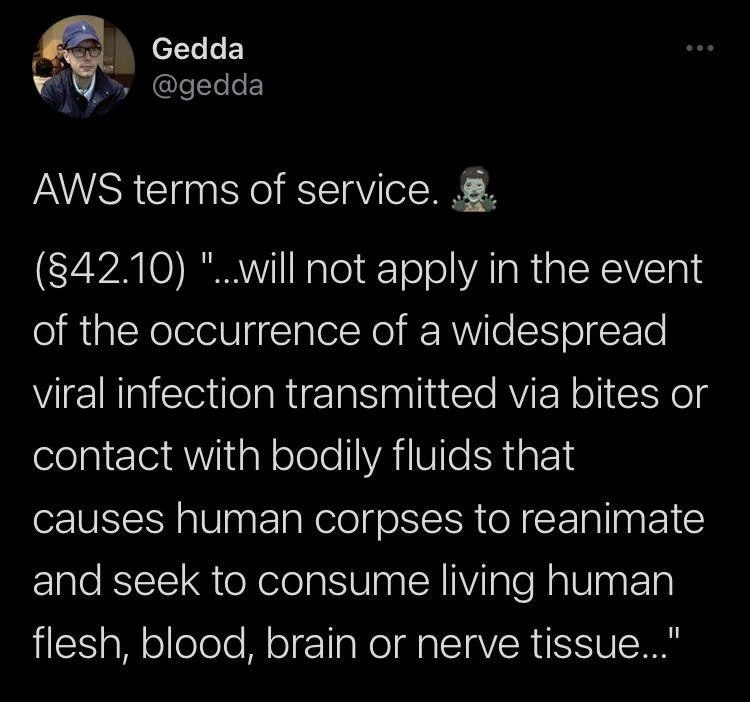
In AWS’s cavernous Terms of Service (yes, that endless legal scroll we all accept without reading), there lies a hidden gem: Clause §42.10 – fondly known as the zombie apocalypse clause. This is the actual text spotted in the meme’s tweet:
“…will not apply in the event of the occurrence of a widespread viral infection transmitted via bites or contact with bodily fluids that causes human corpses to reanimate and seek to consume living human flesh, blood, brain or nerve tissue…”
Parse that like code and you’ll realize AWS basically wrote a legal exception for a zombie apocalypse. It’s a surreal collision of CloudHumor and legalese. Seasoned developers and weary DevOps folks are smirking because they’ve waded through endless AWS documentation and corporate policies, but never expected to find The Walking Dead in the fine print. The humor here riffs on the absurd thoroughness of corporate lawyers. It’s compliance humor at its finest: AWS meticulously covers every legal edge case – even the nightmarish scenario of undead hordes munching on sysadmins.
From a senior dev perspective, this clause is a tongue-in-cheek twist on a standard force majeure provision (those “Act of God” clauses that excuse obligations during earthquakes, hurricanes, or other apocalyptic events). Normally, a cloud provider might blandly list “pandemics” or “natural disasters”. Amazon’s legal team, however, went full George A. Romero. They explicitly enumerated “widespread viral infection…via bites” causing “human corpses to reanimate” as the trigger where their normal rules “will not apply.” It’s both overkill and darkly hilarious. After all, if zombies overrun the data centers, your high availability architecture and 99.999% SLA kind of don’t matter anymore. (We can assume the on-call engineer has bigger problems than a downed EC2 instance when the undead are chewing on the cage wiring.)
This meme tickles the battle-scarred IT crowd because it confirms a suspicion: cloud providers have think of everything. It’s a satire of corporate culture at scale – an AWS in-joke that escaped into the wild. The very fact that it’s Section 42.10 is itself a wink to geeks (42 being the Answer to Life, the Universe, and Everything in Hitchhiker’s Guide). You can almost imagine an AWS attorney, perhaps a sci-fi fan, slipping this clause in with a grin. It humanizes the faceless cloud giant: even in buttoned-up contracts, a bit of playfulness lurks. Historically, tech documentation has had Easter eggs (like the famous HTTP 418 I’m a teapot or humorous RFCs), but seeing one in a serious service agreement is next-level. It lampoons how corporate legal teams sometimes go overboard to cover all bases. And frankly, who among senior devs hasn’t joked during late deployments, “Did we account for zombies in our disaster recovery plan?” Now we know AWS did – officially!
Beyond the laughs, there’s an underlying truth that veterans appreciate: modern contracts try to anticipate crazy edge cases because million-dollar services demand airtight terms. This clause ensures Amazon isn’t liable for outages or breaches during a literal apocalypse. It’s absurd, yes, but also oddly reassuring in its thoroughness – a cynical veteran might quip that AWS thought of scenarios even our threat models didn’t. The shared experience of wading through over-engineered processes and bloated contracts makes this meme resonate. It’s a gentle reminder that even the most corporate and serious tech company might have a sense of humor buried in bureaucracy. The next time you scroll through a software EULA or cloud agreement, remember: there might be a zombie hidden in the fine print, waiting to give you a laugh.
Description
This is a screenshot of a tweet from user Gedda (@gedda) that highlights a real and famous clause in the Amazon Web Services (AWS) Terms of Service. The tweet text reads: 'AWS terms of service. (§42.10) "...will not apply in the event of the occurrence of a widespread viral infection transmitted via bites or contact with bodily fluids that causes human corpses to reanimate and seek to consume living human flesh, blood, brain or nerve tissue..."'. This is a well-known Easter egg, specifically from the terms for the AWS Lumberyard game engine. The humor lies in the stark contrast between the dry, formal nature of a legal document and the ridiculously specific, fantastical scenario of a zombie apocalypse. It's a piece of tech trivia that resonates with developers who appreciate when large corporations show a sense of humor, especially when it's buried deep within pages of otherwise tedious legal text
Comments
7Comment deleted
Glad to know my critical services are covered by the AWS Zombie Apocalypse Exemption. My biggest concern wasn't service downtime, it was whether my EC2 instances would be reanimated to serve a zombie master
According to §42.10, the SLA dies in a zombie outbreak but our 3-year Reserved Instances will keep shambling on - apparently the AWS billing daemon has five nines of persistence
Finally, a cloud provider that acknowledges the real disaster recovery scenario we've all been preparing for - not regional outages or DDoS attacks, but the inevitable zombie apocalypse where your auto-scaling groups won't help when the instances themselves start consuming brains instead of CPU cycles
Ah yes, AWS §42.10 - the clause that finally answers the age-old architectural question: 'But will it survive the zombie apocalypse?' Turns out your 99.99% SLA doesn't cover undead DDoS attacks. This is what happens when your legal team has too much time between reviewing Reserved Instance contracts - they start planning for edge cases that are *literally* at the edge of human existence. At least now we know that when the apocalypse comes, AWS will be down, but at least they won't be liable for it. Good to see Amazon thinking about their long-term support strategy
AWS ToS covers zombie outbreaks but not the real undead horror: a Lambda cold start during the apocalypse
AWS ToS has a zombie clause: Multi-AZ is covered, Multi-Z isn’t; shared responsibility means they manage fault domains, you manage bite domains
Turns out our SLA is five nines - unless the incident is multi‑bite, in which case Legal auto‑scales our liability to zero while Reserved Instances keep billing from beyond the grave