Skip to content
DevMeme
6623 of 7435
AWS Infrastructure Brainrot Slang Confuses Sales Rep
AWS Post #7257, on Oct 11, 2025 in TG

AWS Infrastructure Brainrot Slang Confuses Sales Rep

Why is this AWS meme funny?

Level 1: Secret Code Language

Imagine you love something so much that you start making up your own funny words about it. For example, a kid who is crazy about dinosaurs might declare, “I’m dino-pilled and fossilcucked!” to show how obsessed they are with T-Rexes. If that kid said this to a museum guide or a toy store clerk, the adult would probably just stare and say, “Uh, what?” because those words sound like complete nonsense to anyone outside the kid’s secret club. That’s exactly what’s happening in this meme. The developer uses made-up silly words to brag about how much they love Amazon’s storage service (S3 buckets on the cloud). But the Amazon salesperson – like the confused adult in the dinosaur example – has no idea what those crazy words mean. The result is a funny situation where someone’s super-special fan language doesn’t translate to the real world, leaving the other person totally puzzled and saying, “Huh?!”

Level 2: Translating AWS Fan-speak

Let’s break down what’s going on in simpler terms. AWS S3 is Amazon’s “Simple Storage Service” – basically a place on the cloud where you can store files and data. In S3, you put files into containers called buckets (kind of like folders on the cloud, but flat and limitless in size). If someone says “I have a bucket for backups,” they mean an S3 bucket that holds their backup files. An AWS sales rep is a person whose job is to help companies use AWS services (and, of course, to get them to spend more on AWS). You’d expect an AWS rep to know all the official terms and product features of S3, but not necessarily every goofy slang term a developer might invent on the internet.

Now, the person in the meme uses some very strange self-descriptions: “storagepilled,” “bucketcucked,” and “infracel.” These are not real AWS terms at all – they’re mashups of internet slang with tech words, meant to be funny (and a bit absurd). Here’s what each of those words is roughly implying:

Slang Term What It Combines & Means
storagepilled This mixes “storage” (data storage, like files and databases) with the suffix “-pilled.” The “pilled” part comes from the idea of being “redpilled” (a Matrix movie reference used online to mean you’ve learned a life-altering truth). So if someone says they’re “storagepilled,” they jokingly mean “I’ve swallowed the storage pill – I’m completely sold on storage tech (especially S3) as the best thing ever.” It’s like claiming you saw the light and now believe cloud storage is the one true way.
bucketcucked This one combines “bucket” (an S3 bucket) with “cucked.” In crude internet slang, “cucked” implies someone has been cheated on or made to feel powerless (it’s derived from “cuckold”). Saying you’re “bucketcucked” is a very tongue-in-cheek way to admit “I’m basically dominated by S3 buckets.” In other words, “AWS’s bucket storage has me so hooked and dependent that I’ve kind of surrendered to it.” It’s an exaggeration that implies the person is at the mercy of this one AWS service.
infracel Here we have “infra” (short for infrastructure, meaning the IT back-end stuff like servers, networks, and cloud services) combined with the “-cel” from incel (which stands for involuntary celibate – an internet subculture term). By calling themselves an “infracel,” the person humorously suggests “I’m involuntarily stuck in the infrastructure world.” It’s like they only focus on cloud infrastructure and don’t “get to” do other things. It’s a self-deprecating way to label oneself as an infrastructure nerd who might be missing out on other tech (or life) experiences.

In short, this developer is using a bunch of fanboy slang to brag (in a silly, self-mocking way) about how devoted they are to AWS S3 and cloud infrastructure. It’s like they’re saying, “I’m such a hardcore cloud nerd that I took the ‘storage pill’ and even let S3 buckets completely own me.” They’re mixing serious tech terms with jokey meme language from the internet.

The punchline comes from the reaction: “The AWS sales rep: What”. The sales rep is utterly confused. Imagine you’re a professional who sells AWS services, and a customer describes themselves as “bucketcucked” – you’d probably pause and think, “What on earth does that mean?” It’s not a term from any AWS training or normal tech conversation, so the rep can only respond with bafflement. Essentially, the developer’s attempt to use meme-worthy lingo falls flat in a real-world interaction. The AWS rep was expecting normal cloud talk (like “I need cheap storage for backups” or “How do I secure my S3 bucket?”), but instead got hit with these bizarre hybrid slang words.

For a newcomer to cloud or programming, the takeaway is that tech communities often invent their own slang or in-jokes. Terms like “-pilled” or “-cel” are borrowed from internet culture to exaggerate how deep into something you are. But these aren’t official or professional terms – you won’t find them in documentation or polite conversation. They’re part of cloud humor and meme culture among developers. So if you hear weird phrases like this, know that they’re meant as jokes. In a real meeting or with someone like an AWS rep, it’s usually best to stick to clear language (unless you’re sure the other person is also an online meme nerd). Otherwise, you might just get a blank stare and a “What?” – exactly like the poor AWS sales rep in this meme.

Level 3: Babel of Buckets

This meme throws together hardcore cloud jargon with edgy internet slang, creating a comic clash that even an AWS insider can’t decode. It’s lampooning what happens when a cloud infrastructure fanatic takes their enthusiasm to a tongue-in-cheek extreme. By saying “I’m really storagepilled” and “such a bucketcucked infracel,” the speaker is basically flaunting ultranerd credentials in absurdist slang. These terms borrow the structure of certain online subcultures (“-pilled” from the Matrix-inspired red pill metaphor, and “-cel” from incel forums) and splice them with AWS lingo (“storage,” “bucket,” “infra” for infrastructure). The result is purposely over-the-top, as if the person’s entire identity is defined by devotion to S3 cloud storage.

For experienced engineers, the humor cuts close to real life. We’ve all met that one AWS super-fan (or seen them on forums) who talks about Amazon’s services with near-religious fervor. They might proclaim S3’s supremacy in every conversation, turning a simple storage choice into a crusade. This meme exaggerates that archetype: the speaker’s vocabulary sounds like an inside joke gone wild, where everyday tech terms become badges of honor in a one-vendor cult. It’s poking fun at the vendor lock-in evangelist mindset — someone so invested in a single platform (AWS in this case) that they invent flamboyant labels for themselves as a point of pride.

The twist is that even the AWS sales rep – whose job is literally to promote AWS services – has no idea what this person is saying. Usually, sales reps expect technical questions or at least standard cloud terminology, not a barrage of memetic slang. The rep’s puzzled response (“What”) is the punchline highlighting the communication breakdown. It underscores a truth: when you dive too deep into niche infra lingo and cloud memes, you end up speaking a dialect that’s unintelligible to outsiders – even insiders who aren’t part of your internet clique. (Needless to say, none of these terms show up in AWS’s official documentation or certification exams – there’s no “Certified Storagepilled Solutions Architect” badge – so the rep is completely lost here.)

This scenario resonates in dev circles because it satirizes a cult-of-tech mentality. Technologies like Amazon S3, Kubernetes, or React often inspire enthusiastic communities, and within those some folks push it to comical levels of tribalism. There’s an implicit commentary: it’s great to love your tools, but wrapping your entire identity in them leads to absurd situations (like baffling the very people who work with those tools professionally). Seasoned engineers have seen this pattern before — today it’s S3 devotees inventing wacky slang, yesterday it was Linux zealots wearing “RTFM” T-shirts, and tomorrow it might be some new cloud or blockchain fad with its own jargon. The meme captures that timeless dynamic of tech culture with a fresh, ridiculous example. It’s both a roast and a wink to the community: yes, S3 is awesome, but if even the AWS rep can’t understand you, maybe dial back the fanboy energy a notch.

Level 4: The Eleven Nines Revelation

Deep inside the architecture of AWS S3 (Amazon’s Simple Storage Service) lies a feat of distributed systems engineering that can inspire almost religious awe among infrastructure geeks. S3 isn’t just a disk in the sky; it’s a globally distributed object store that achieved what was once dreamlike: 11 nines of durability (99.999999999% durability per year). This means your data on S3 is redundantly stored across multiple devices and even across data centers, making it astronomically unlikely to vanish. Such reliability and scale come from serious computer science foundations. CAP theorem (which says a distributed system can’t have perfect consistency and availability in a network partition) traditionally forces a storage system to trade off some guarantees. S3’s original design embraced eventual consistency for certain operations, prioritizing availability and partition tolerance across regions. Over the years, AWS refined S3 to offer strong read-after-write consistency without sacrificing massive scale – a remarkable engineering achievement that might feel like uncovering a sacred truth of storage.

For a certain breed of senior engineer, discovering these underpinnings can be a “red pill” moment. They see the elegant simplicity of addressing any file with a URL like s3://my-bucket/my-object, backed by a labyrinth of servers seamlessly handling replication, versioning, and encryption behind the scenes. It’s easy to become storagepilled – completely convinced that object storage (especially S3) is the ultimate solution for nearly every data problem. The combination of virtually infinite scaling and vendor-managed infrastructure can feel like a revelation. Instead of manually sharding databases or worrying about RAID failures, you entrust your bits to S3 and they just persist. This fervor can morph into an almost fanatical belief: the engineer starts to view every project through a single lens (“Could we put this in S3? S3 is life!”), echoing a kind of technical orthodoxy.

However, such single-minded devotion can cross into the realm of identity rather than mere tool usage. The meme exaggerates this by blending internet subculture slang with cloud tech talk – turning genuine technical admiration into something absurd. We see terms like “bucketcucked” and “infracel” that poke fun at the idea of being dominated by and isolated within one’s infrastructure choices. This is the extreme end of a vendor lock-in mindset – psychologically locking oneself in because S3’s technical prowess makes everything else seem unworthy. At this deepest level, the humor arises from how a very real technical marvel (distributed cloud storage with mind-boggling durability) can lead to overzealous, almost cult-like behavior. It’s a reminder that even the most elegant systems in tech can inspire over-the-top devotion when engineers forget that not everyone shares their reverence for those eleven nines.

Description

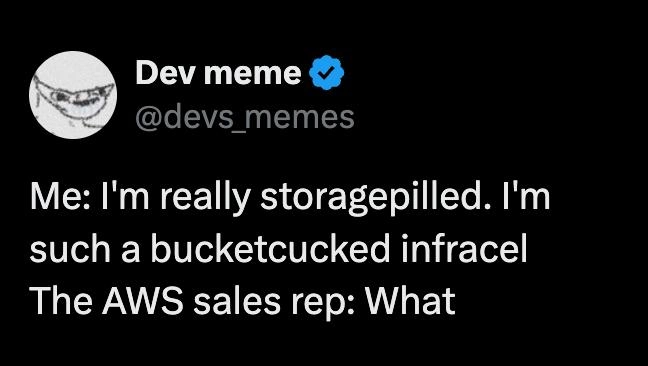
A tweet from Dev meme (@devs_memes) with a smug Wojak-style profile picture reading: 'Me: I'm really storagepilled. I'm such a bucketcucked infracel. The AWS sales rep: What.' The meme applies internet brainrot slang (-pilled, -cucked, -cel suffixes from incel culture) to cloud infrastructure terminology, creating absurd neologisms like 'storagepilled' (obsessed with storage), 'bucketcucked' (victimized by S3 buckets), and 'infracel' (infrastructure celibate/incel). The humor lies in the collision of terminally-online culture with enterprise cloud sales

Comments

8
Anonymous ★ Top Pick You know you've spent too long in the cloud when you start describing your S3 cost overruns using incel taxonomy. 'Yeah I'm totally egress-mogged by CloudFront, it's over for infracels.'
  1. Anonymous ★ Top Pick

    You know you've spent too long in the cloud when you start describing your S3 cost overruns using incel taxonomy. 'Yeah I'm totally egress-mogged by CloudFront, it's over for infracels.'

  2. Anonymous

    If your identity is tied to S3 buckets, congratulations - you’ve achieved object-oriented self-storage with 11 nines of existential durability

  3. Anonymous

    After 15 years of explaining CAP theorem and eventual consistency to executives, the real challenge is explaining to your AWS account manager why you're 'taking the object storage blackpill' and becoming 'lambda-maxxing' - turns out enterprise sales training doesn't cover post-ironic infrastructure nihilism

  4. Anonymous

    When you've been in the cloud infrastructure game so long that you start combining AWS service names with internet culture suffixes, creating a dialect only comprehensible to those who've spent 3 AM debugging S3 bucket policies while doom-scrolling Twitter. The AWS sales rep's confusion is understandable - they're trained to sell EBS volumes and RDS instances, not decode whether 'bucketcucked' refers to S3 lifecycle policies or your emotional state after the monthly bill arrives

  5. Anonymous

    Senior translation: I obsess over S3 prefix sharding, LIST/PUT rates, and 11‑nines; the AE only speaks “CloudFront credits and a larger commit.”

  6. Anonymous

    Storagepilled truth: your S3 egress fees hit harder than any sales pitch cold call

  7. Anonymous

    Enterprise translation: “storagepilled bucketcucked infracel” = we dumped everything into S3 without governance, lifecycle rules, or a data catalog - and now egress fees own us

  8. @SneedG 9mo

    Telegram user in the wild

Use J and K for navigation