Skip to content
DevMeme
5344 of 7435
Spot the Original: The App Store's AI Chatbot Gold Rush
IndustryTrends Hype Post #5862, on Feb 1, 2024 in TG

Spot the Original: The App Store's AI Chatbot Gold Rush

Why is this IndustryTrends Hype meme funny?

Level 1: One of These is Not Like the Others

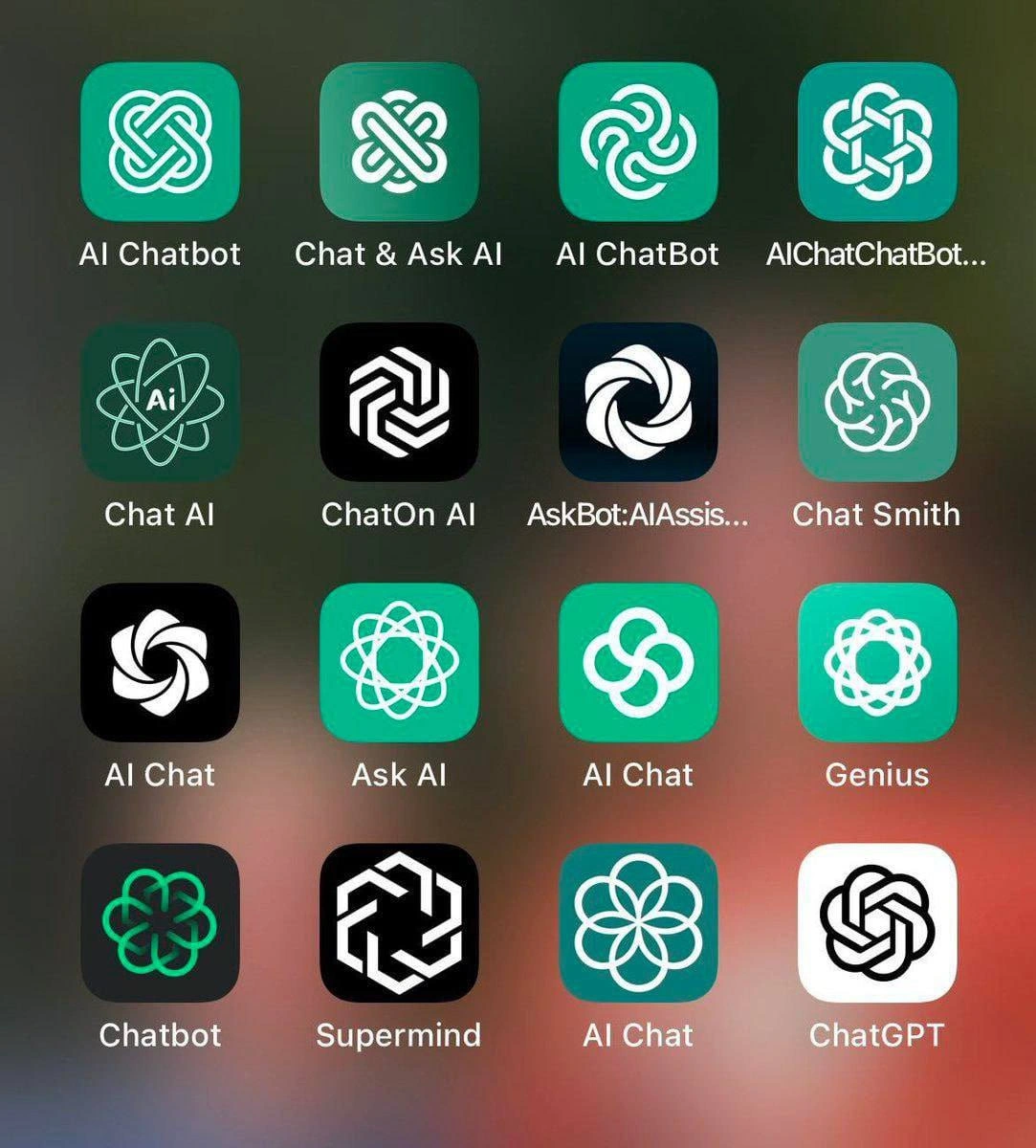
Imagine you go to a store to buy your favorite toy, but when you get to the shelf, you see 15 toys that all look almost the same. They all have the same color box and a similar picture on the front, just with slightly different names. It would be kind of funny, right? You’d stand there thinking, “Huh, which one is the real toy I wanted?” It’s also a bit frustrating because you have to look carefully to find the one that’s not just an imitation. That’s exactly what’s happening in this picture. There’s a bunch of app icons on a phone and almost all of them look alike – same green color, similar swirl logo, and names like “Chat AI” or “AI Chatbot” that all blend together. It’s like a Where’s Waldo puzzle or an Easter egg hunt for the true app. The joke is that the phone’s screen is so crowded with copycats that finding the actual ChatGPT app (the one you’re looking for) is a challenge. In simple terms, it’s poking fun at how everyone tried to make their own version of the same popular thing, until you have a whole bunch of look-alikes. It’s silly and a bit absurd – you can’t tell the difference at first glance, and that’s why it’s funny! It’s like having a dozen nearly identical twins all saying, “I’m the real deal!” when only one of them truly is.

Level 2: Clone App Gold Rush

So, what exactly are we looking at here? It’s an iPhone home screen filled with AI chatbot apps that all look eerily alike. Essentially, dozens of developers have created their own ChatGPT-like apps, and many chose nearly identical names and logos. Let’s decode some terms and why this is happening:

  • ChatGPT: This is the famous AI chatbot developed by OpenAI – it’s a Large Language Model (LLM) that can answer questions and hold conversations. It became super popular, so lots of people want a ChatGPT app on their phone. OpenAI has an official app (that’s the one icon in the screenshot labeled “ChatGPT” with the clean black-and-white logo).
  • Clone apps: These are look-alike or copycat apps. When something becomes a hit, other developers sometimes make their own versions to piggyback on the popularity. In this case, after ChatGPT’s success, many AI assistants or AI tools popped up claiming to do the same thing. Some might genuinely use the same underlying AI (by sending your questions to OpenAI’s servers via an API), while others might use different AI models. But from a user’s perspective, they all advertise “Ask anything!” and “Chat with AI!” just like ChatGPT.
  • App Store Optimization (ASO): This is like SEO but for app stores. Developers pick app names, descriptions, and keywords to rank higher in search results on Apple’s App Store (or Google Play). If everyone is searching for “AI chat” or “ChatGPT”, an easy trick is to stuff those words into your app’s name. For example, naming your app “Chat & Ask AI” or “AI ChatBot” almost guarantees you’ll appear when someone searches “chat” or “AI”. The result? Many apps end up with very similar titles because they all include the hot keywords. In the image, you can see multiple apps just using “AI Chat” in different orders like a jumble: Chat AI, AI Chat, AI Chatbot, Ask AI, etc. There’s even one literally called AIChatChatBot (the name repeats “Chat” and “Bot” – presumably to cover both “chat” and “chatbot” search terms!). This can cause name collisions where many apps share overlapping titles, which is confusing for users but something developers do to get noticed.
  • Logo mimicry: Notice how almost all those icons use a looped knot or swirl design similar to the official ChatGPT logo. That official logo is pretty distinctive – it looks like an endless knot made of several interlocking curves. It’s become an icon people associate with the ChatGPT. Here, clone apps are using logos that look almost the same: similar white geometric patterns on green or black backgrounds. This is likely intentional. By imitating the look, they hope users will think their app is related or at least equally advanced. It skirts the line of brand infringement (using someone else’s trademarked style). Companies usually frown on this; for example, OpenAI’s team or Apple might eventually remove apps that copy the logo too closely. But initially, many slipped through, leading to this sea of green spirals. In short: these apps are visually camouflaging themselves as ChatGPT-like.
  • Generative AI gold rush: “Gold rush” is a term from history (like when everyone flocked to California in the 1800s hoping to find gold). In tech, we use it for when a new technology gets huge hype and everyone races to exploit it. AI_ML (specifically generative AI like ChatGPT) is the gold rush of the moment. The meme jokingly portrays how the IndustryTrends_Hype around AI has every developer (and their cat 😸) releasing an AI chat app. It’s very easy to create a basic chatbot app now, because companies like OpenAI provide APIs – basically cloud services you can call to get AI responses. A solo developer or small team can whip up an app that calls the API and displays the answer, in a matter of days or even hours. So, during this “AI boom”, app stores got inundated with such apps. The upside: lots of innovation and choices. The downside (which the meme points out): a lot of spammy or redundant apps that don’t add much new.
  • AI app spam and user confusion: From a user’s perspective, this is overwhelming. If you go to the App Store and search “ChatGPT”, you might get a dozen similarly-named apps. How do you decide which one to install? It’s easy to accidentally pick a clone thinking it’s the official ChatGPT, especially if you’re not familiar with OpenAI’s exact logo or publisher name. Some of these clones might be fine (they connect to the real ChatGPT service), but some might pester you with ads or expensive subscriptions. This is why it’s also a product-security concern: companies worry that fake or low-quality apps can scam users or damage the reputation of the technology. Apple does review apps, but when a trend is exploding, the sheer volume can be hard to police in real-time. They have rules against outright impersonation and require apps to offer some unique value, but many clones get by initially by tweaking a few things.

In this meme image, only the bottom-right icon is the official ChatGPT app (white logo on black background and labeled “ChatGPT”). All the rest are third-party apps trying to fill the demand for AI chat. It humorously looks like a grid of the same app copied over and over, just with slightly different knot patterns and name variations. For a junior developer or someone new to MobileDevelopment, it’s a surprising look at how competitive and crowded app marketplaces can get. One moment a new technology is introduced, the next moment you’ve got an entire cottage industry of look-alikes. It’s almost an industry in-joke: “Of course there are 15 ChatGPT wannabes on my phone – it’s 2024 and AI is the new hotness.”

To put it simply, the joke here is that the App Store has so many similar AI chat apps that finding the actual ChatGPT is like a game. Instead of one clearly branded app, you have a dozen options all with “AI Chat” names and green spiral logos. It highlights the hype overload: whenever something in tech gets really popular, clones and copycats multiply like rabbits. Developers find this image funny because it exaggerates a real trend – it’s both a little ridiculous and a little too real.

Level 3: Spiraling out of Control

At first glance, this iOS home screen looks like a generative_ai_clones convention – a spot-the-difference puzzle for developers. Nearly every icon sports that familiar ChatGPT-style knot logo (or a slight variation of it) on a teal or black background. The sheer uniformity is comical: it’s as if someone forked the official OpenAI icon fifteen times with minimal tweaks. This meme captures an AIHype phenomenon where the App Store is flooded by look-alike chatbots, turning the search for the real ChatGPT app into an Easter-egg hunt. It highlights the explosive LLM gold rush in tech: once ChatGPT proved wildly popular, a horde of copycat apps sprang up, all vying to ride the wave. For seasoned developers, it’s a familiar sight – reminiscent of past clone-stampedes (remember the endless Flappy Bird or fidget spinner clones?). But here it’s not just trivial games; it’s the cutting-edge world of AI_ML being mimicked en masse, which makes it equal parts impressive and absurd.

From a senior dev perspective, the humor comes from seeing blatant app_store_clonefest tactics at play. These apps have nearly indistinguishable names like "AI Chatbot", "AI ChatBot" (note the subtle capitalization change), "Chat AI", "AI Chat", and even an "AIChatChatBot…" that literally repeats itself. It’s like the developers ran out of synonyms and just doubled down – quite literally. That one got cut off with an ellipsis, implying the full name is even longer (perhaps AskBot:AIAssistantChatGPTUltra or some absurd keyword salad). Why do they do this? App Store Optimization (ASO). Just as SEO drives web content naming, ASO means apps jam keywords like “AI” and “Chat” into their titles to lunge upwards in search rankings. The result is unintentional comedy: half these clones sound like someone hit the autocomplete on “AI chat” repeatedly. It’s an IndustryTrends_Hype showcase of quantity over originality.

Visually, the meme exaggerates what users face on the App Store during a trend. The icons all use interlocking loops and geometric chatgpt_logo_ripoff designs. You can imagine a rushed graphic designer thinking, “Quick, what screams ‘ChatGPT’? Green background, white knot icon, go!” The uniform teal-green color across so many icons gives a UI déjà vu – a real icon_ux_confusion nightmare. Apple’s Human Interface Guidelines encourage unique, identifiable app icons, but during gold rushes, these guidelines are more honor system than rule. Here, practically every icon says “I’m just like ChatGPT, pick me!” This is funny because it’s true: in a hype frenzy, dozens of apps will claim to be the AI chatbot you need, differing only by a few pixels or letters. Developers with a cynical streak (and many of us have one after seeing trends repeat) chuckle at how transparent this is. It’s the Wild West of the App Store – or maybe the “Wild Waldo,” since we’re essentially playing Where’s ChatGPT? in a sea of doppelgängers.

Under the hood, many of these clone apps are likely just wrappers around the OpenAI API (or similar LLM backends). It’s trivially easy for a developer to plug ChatGPT’s brains into a simple app interface. A bit of code to call openAI.complete() here, a text input box there, and voila – you have “SuperChat Guru Pro” or whatever today’s branding is. The hard part (making the AI) is already done by OpenAI, so clone developers focus on marketing: name, icon, and an aggressive subscription model. In fact, one reason this meme resonates is that it hints at a slightly darker joke: many of these look-alike apps charge hefty fees or push weekly subscriptions for essentially the same service the official ChatGPT app or site might offer for free or at lower cost. It’s a classic opportunistic grab – AI_tools repackaged with paywalls. So the humor has an edge of truth-based frustration: seasoned devs know that whenever there’s a hot new tech (be it chatbots, crypto wallets, or AR filters), opportunists flood the market with low-effort copies hoping to make a quick buck.

Let’s break down the clone-war tactics being satirized here:

  • Name-Keyword Stuffing: Every app name is a permutation of Chat/AI/Bot/Ask. This is ASO in action – by cramming keywords, they aim to ambush any user search for “chat” or “AI”. It’s why we see redundant titles like ChatOn AI and AI Chat and AI ChatBot all at once. The meme’s long truncated name (AskBot:AIAssis…) is a tell-tale sign of an ASO maximalist who tried to squeeze in every relevant word until iOS said “enough”.
  • Logo Mimicry: Nearly all icons riff on the official ChatGPT logo – a distinctive twisted knot design. Some are rotated, some simplified, but they’re clearly riffing off OpenAI’s trademark look. This banks on instant recognition. A user sees a familiar-looking icon and thinks “Oh that must be related to ChatGPT!” It’s borderline trademark infringement (OpenAI’s lawyers are probably facepalming), but clone devs gamble that they can fly under the radar or benefit before being told to cease and desist.
  • Monetization Gold Rush: Hype-fueled clones often come with aggressive in-app purchases. The meme image doesn’t show it, but many of these “free” apps will prompt users to pay for full access after a few queries. In the generative AI mania, there were reports of unscrupulous apps charging $10/week subscriptions for ChatGPT access that’s otherwise free on OpenAI’s website. In other words, they’re selling sand in the desert. Seasoned devs see the humor in this profiteering: it’s like an AIHumor inside joke about how every tech boom spawns get-rich-quick schemes.
  • User Confusion & Security: On a more serious note, this clone swarm creates real headaches. Users can easily download the wrong “AI Chat” app and get a poor experience or even a scam. Product and security teams at companies have to untangle this mess. For instance, OpenAI’s team might need to monitor the App Store for apps misusing the ChatGPT name or leaking user data. Apple’s review team too gets dragged into whack-a-mole: which of these apps are legit (using the official API under fair use) versus which are shady (misleading users or violating policies)? The meme’s comedic exaggeration underscores a truth: in the TechTrends rush, policing quality and branding becomes incredibly tough.

All these factors combine to make the image both funny and cringingly familiar. It’s funny as a visual gag – an iPhone screen where every app icon looks cloned from one template, pointing to the absurdity of AIHype culture. And it’s familiar as a cautionary tale: developers know that any breakthrough (like GPT-based chatbots) triggers a clone stampede. We’ve seen it with past trends (one big hit game or app yields a thousand imitators), but seeing it with something as advanced as AI is both ironic and expected. After all, these apps are about cutting-edge intelligence, yet the marketplace around them devolved into copy-paste duplication.

In the end, senior devs chuckle at this image because it’s a perfect storm of tech trend irony: powerful AIAssistants reduced to dozens of indistinguishable app icons, innovation drowned in imitation. It’s a snapshot of an App Store clone wars, where finding the official ChatGPT is, indeed, like finding a needle in a needle-stack. Or as the meme title jokes, an Easter-egg hunt – except every egg’s been painted the same color. 🥚🤖

// Pseudo-swift code for a typical ChatGPT clone app
func getChatGPTReply(for userPrompt: String) -> String {
    // Using OpenAI's API behind the scenes (the clone's "brain")
    return OpenAI.API.complete(prompt: userPrompt)
}

print(getChatGPTReply(for: "Why are there so many ChatGPT copycats?"))
// Expected output: "Because everyone wants a piece of the AI pie, of course."

(Above: If you peeked inside one of these apps, its core logic might be this simple – just calling the OpenAI API. The real effort went into naming and icon design, ironically.)

Description

A screenshot of a smartphone's home screen displays a 4x4 grid of 16 app icons against a blurred background. All the applications are AI chatbots, with generic names such as 'AI Chatbot', 'Chat & Ask AI', 'ChatOn AI', 'Ask AI', 'Genius', and 'Supermind'. Most of the app icons are stylistically similar, featuring abstract, geometric, or swirling designs in teal, green, white, and black, clearly imitating the logo of OpenAI. In the bottom right corner, the official 'ChatGPT' app is shown, with its distinct and well-known logo, creating a stark contrast to the numerous clones surrounding it. This image satirizes the massive influx of low-effort, copycat applications that flooded mobile app stores following the mainstream success of ChatGPT. For experienced developers, it's a visual representation of a technology hype cycle, where a genuine breakthrough is immediately followed by a wave of 'wrapper' applications that offer little to no new functionality, simply putting a new interface on an existing API to capitalize on the trend. It highlights the challenges of market saturation and brand dilution in a gold rush
Comments

7
Anonymous ★ Top Pick The hardest part of launching one of these AI apps isn't the code; it's finding a synonym for 'Chat' and an abstract logo that hasn't already been taken by the other 500 wrappers submitted that day
  1. Anonymous ★ Top Pick

    The hardest part of launching one of these AI apps isn't the code; it's finding a synonym for 'Chat' and an abstract logo that hasn't already been taken by the other 500 wrappers submitted that day

  2. Anonymous

    Apparently the App Store called fork() on the ChatGPT repo and forgot the PID check

  3. Anonymous

    When your entire product differentiation strategy is a different seed value for the same geometric logo generator

  4. Anonymous

    When your entire business model is `curl https://api.openai.com/v1/chat/completions` wrapped in a $9.99/month subscription and a geometric logo generator. The real AI innovation here is convincing VCs that your ChatGPT wrapper with a slightly different shade of teal is defensible IP. At least when we had 'Uber for X' clones, they had to deal with different regulatory frameworks - these apps literally call the same API endpoint and compete on who can make their atomic symbol logo spin faster

  5. Anonymous

    App Store dependency hell: fifteen ai‑chat packages that are 30MB wrappers around POST /v1/chat/completions - each adds a subscription, an analytics SDK, and a slightly different knot in the logo

  6. Anonymous

    Monolith in micro-apps: every icon's just a SwiftUI facade routing to the same GPT endpoint

  7. Anonymous

    The app store’s vector search must use cosine similarity on “teal knot” - my home screen returned 16 matches, all thin wrappers around POST /v1/chat/completions with a weekly subscription

Use J and K for navigation