The Unattainable Zen of Retro Coding
Why is this TechHistory meme funny?
Level 1: No Wi-Fi, No Worries
Imagine you are trying to read your favorite storybook in a cozy, quiet room. The evening sun is coming through the window, and your cat is curled up on your lap purring. There’s no TV on, no phone ringing – it’s just you, your book, and your friendly cat. You can really concentrate on the story, and it feels calm and nice.
Now think about trying to read that story on a tablet in a busy living room. The TV is blaring cartoons, your phone keeps buzzing with notifications, and maybe your family is asking you questions at the same time. It’s pretty hard to focus on the story in that situation, right? A lot more stressful and distracting.
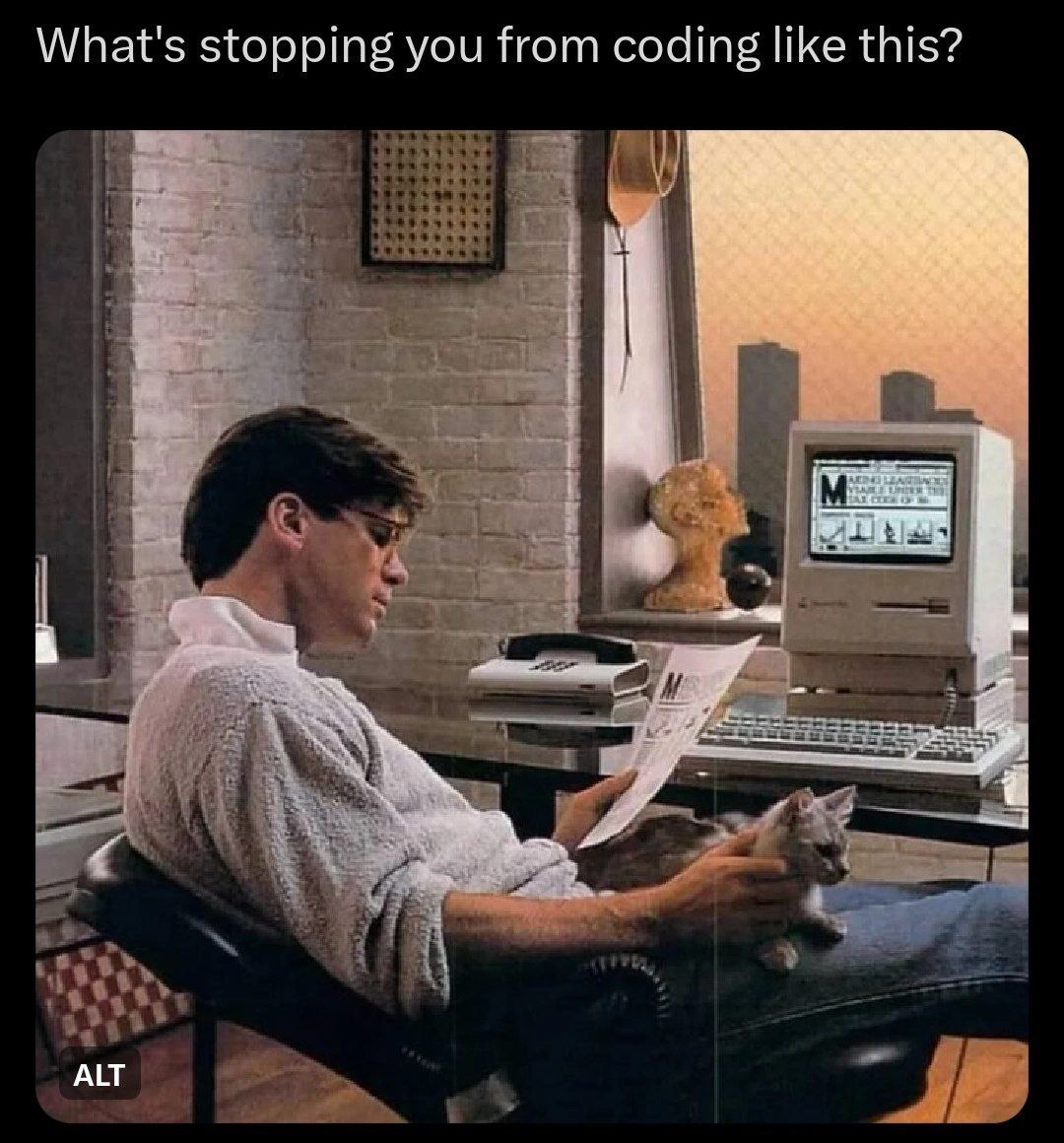
This meme is joking about that kind of difference, but with computer programming. The picture shows the “quiet room with a cat” style of coding – an old simple computer, no internet, no distractions, and a relaxed programmer. It asks, “Why aren’t you coding like this nowadays?” The funny part is that today it’s almost impossible to have that simplicity when coding. We usually need the internet, and our projects and tools are super complex, with lots of things happening at once on the screen. The meme makes us laugh because it imagines if we could remove all the modern noise and just code peacefully like in the old days. That peaceful scene looks wonderful (who wouldn’t want to work with a cute kitty on their lap?), but we know it’s not realistic now. It highlights, in a lighthearted way, how busy and noisy our tech world has become compared to the past. We find it funny because deep down, many of us wish our work could be as simple and relaxing as petting a cat while the computer quietly does its thing – even though we also love what today’s technology can do for us.
Level 2: Beige Box Basics
Let’s break down what’s going on in this meme in simpler terms. The picture shows a programmer in the 1980s using a very old Apple Macintosh computer (the beige boxy machine on the desk). This model (likely a Macintosh Plus) has a small built-in screen that displays everything in black and white. That kind of display is called monochrome, and the interface you see (with icons and menus) is an early Graphical User Interface (GUI). In the 80s, seeing a GUI like this was exciting and new – it meant you could interact with the computer using a mouse and pictures instead of just typing lines of text. But by today’s standards, that interface and capabilities were extremely basic (the screen’s resolution was only about 512×342 pixels, just a few dozen words worth of space!).
On the desk next to the Mac, there’s a dot-matrix printer (the boxy device with paper coming out). This was a common printer of that era which printed on long sheets of paper with holes on the sides. It created letters and images by rapidly striking tiny pins against an ink ribbon (a bit like a fast typewriter hitting the paper). Dot-matrix printers were slow and quite noisy – imagine a “zzzzzt-chk-chk” sound as it prints each line. Still, they were how you got a hardcopy (paper version) of your work. If a programmer wanted to read code or a manual away from the screen, they might print it out. In this image, the printer is likely churning out something while our programmer waits.
Now, notice the man isn’t actively typing. He’s leaning back reading a newspaper and gently petting a cat in his lap. This shows just how relaxed and distraction-free his setup is. Why a newspaper? In the 1980s, there was no Internet for instant information or online documentation. If a developer needed to look up how to do something or wanted a break, they might read physical books, magazines, or newspapers for information and news. The cat on his lap adds to the cozy, calm vibe – it’s literally a pet keeping him company as he works. Many people (including programmers) find having a pet around helps reduce stress. Unlike today, there are no smartphones buzzing, no social media alerts, and no Slack messages popping up on that screen. The only “notification” might be the printer dinging when it’s done or the cat meowing. It’s a very minimalist way to work: just one computer, one task, and some personal comfort.
The meme’s caption asks, “What’s stopping you from coding like this?” in a tongue-in-cheek way. It’s basically saying: “This looks like the ideal way to program – so peaceful and simple – so why aren’t you doing it now?” The humorous answer is that nowadays we have a very different environment and different needs. Modern programming typically requires the Internet and powerful, up-to-date computers. For example, today if you run into a coding problem, you’ll probably search Google or look on Stack Overflow for answers (none of which existed in the 80s). If you’re working with a team, you likely use chat apps or online code repositories to collaborate – which need an internet connection and modern software. Plus, the software we build now (like web applications, mobile apps, AI programs) are far more demanding; an old Macintosh couldn’t run them at all due to limited memory and processing power. In short, technology and expectations have moved on. We could try to mimic this simple setup today (maybe by turning off Wi-Fi and using just a basic editor), but we’d soon struggle to accomplish our real tasks. The meme is jokingly suggesting that while the old setup looks calm and nice, it’s not practical for the kind of coding we actually do today.
To better understand some of the terms and ideas mentioned:
RetroComputing: This means using or collecting old computers and software, usually for fun or nostalgia. For instance, some hobbyists love tinkering with a 1980s Macintosh or a vintage game console to relive how technology was back then. It’s like keeping old tech alive as a hobby, similar to how some people restore classic cars.
TechNostalgia: Nostalgia is a warm, fuzzy feeling for the past. So tech nostalgia is feeling nostalgic about old technology. If you ever hear someone reminisce about “the good old days” of computers or video games, that’s tech nostalgia. This meme oozes tech nostalgia – it makes the past look so relaxed and appealing that even those who never experienced it can imagine it fondly.
Developer Experience (DX): Think of this like “user experience” but for programmers. It’s about how easy and pleasant (or frustrating) it is to do your job as a developer with certain tools or setups. A good developer experience means you have tools that help you, don’t crash often, and streamline your work. In the 80s, DX was very different: you had only a few tools, so they were simple to learn, but you also didn’t have many conveniences. Today’s DX gives us powerful features (like auto-complete suggestions, instant search in documentation, automated testing), but sometimes there’s a steep learning curve or a lot of configuration. The meme hints that the old DX might have been less distracting (because the tools were minimal), even if it was less powerful.
DeveloperLifestyle: This refers to the day-to-day life and habits of a developer. The meme portrays an idealized 1980s developer lifestyle: a slow-paced, comfortable routine (reading the newspaper, petting a cat, unhurried because the computer is slow by nature). Today’s developer lifestyle can be quite different: maybe coding from a café or a home office, constantly checking emails or chat, updating skills to keep up with fast-moving technology, etc. The term “developer lifestyle” isn’t a strict technical term, but here it’s used to discuss how being a developer feels as a way of life – laid-back then vs. always-connected now.
Minimalist tooling: “Tooling” means the software tools for development (like editors, compilers, debuggers, etc.), and minimalist means “keeping it simple with as few parts as necessary.” In the 80s environment, the tooling was very minimal: perhaps just a basic text editor to write code and a compiler to build it, plus maybe some offline documentation. There was no VS Code with hundreds of extensions, no databases or cloud services running on your machine. While that meant fewer things to learn or go wrong, it also meant you had to do a lot yourself (manage memory, track bugs without sophisticated debuggers, etc.). Today, our tooling is far more complex but also far more capable. The meme gently jokes that maybe all those extra tools also bring extra distractions or complications.
“80s office aesthetic”: This describes the look and feel of the workspace in the photo, typical of the 1980s. The exposed brick wall, the style of the lamp, the beige computer and printer, even that bust on the desk – it all creates a vintage tech atmosphere. People call it an “aesthetic” because it’s a recognizable style that some find appealing. In fact, some modern offices or home setups deliberately include retro decorations or old computers as a nod to that aesthetic. It’s similar to how some people might decorate with retro posters or old vinyl records to create a certain vibe.
“Sneakernet”: A humorous term from computing lore. Before computers were connected by networks (or if the network was too slow or insecure), the quickest way to transfer data was often to copy it onto a floppy disk or USB drive and physically carry it to another machine. This was nicknamed “sneakernet” – as if your sneakers (shoes) were the network cables carrying the data. In the 80s, if two programmers wanted to share code, one might say “I’ll put it on a disk and walk it over” – that’s sneakernet. It’s the ancestor of today’s cloud drives and email attachments, except it required legwork!
Graphical User Interface (GUI): This is the now-standard way we interact with computers using visuals like windows, icons, and menus, often with a mouse or touchscreen. The Macintosh popularized the GUI in the mid-80s, making computers much more user-friendly compared to the text-only command line interfaces before. The GUI shown on the Mac in the image is very simple: just black and white graphics, with basic icons. Today’s GUIs (like Windows 11 or macOS or smartphone interfaces) are extremely advanced – full color, animations, high resolution. But the fundamental idea is the same: it lets people use a computer without memorizing commands, by presenting options graphically. The meme’s GUI is “retro” because of how old-fashioned and minimal it looks, which in itself is nostalgic for many.
Overall, this meme highlights a simpler time in computing and makes a joke out of wishing for that simplicity again. For someone newer to tech, it’s saying: imagine programming when computers were slow and isolated, but life was quiet and uninterrupted. Of course, we can’t really turn back the clock – modern programming is complex because our goals are bigger now – but it’s a funny thought. The image with the cat and old Mac is both charming and absurd by today’s standards, and that contrast is exactly why it makes people smile.
Level 3: Monochrome Mindfulness
The meme asks “What’s stopping you from coding like this?” and every seasoned engineer has a chuckling answer: the last 30+ years of tech progress. In this idyllic 1980s scene, a developer lounges in an exposed-brick loft, one hand skimming a newspaper and the other petting a kitten (a literal case of coding_with_a_cat, with the feline as his most laid-back pair programmer), all while an early Apple Macintosh hums gently on the desk. It’s a snapshot of pure TechNostalgia, evoking an era of RetroComputing when developer life appeared simple and serene. The humor bites because modern coding is anything but serene – we have endless microservices, Slack pings, and Stack Overflow tabs, whereas this guy’s biggest “notification” is a purring cat on his lap.
This retro dev setup is centered around a beige Macintosh Plus (circa 1986). That little box sported a Motorola 68000 CPU running at a whopping 8MHz (yes, single-digit) and maybe 1MB of RAM. In today’s terms, that’s less power than the cheapest smart watch, yet it was enough to build substantial software back then. The Mac’s tiny built-in CRT display was strictly monochrome (~512×342 pixels) with a very simple retro GUI. You could only open one or two windows at a time, and multitasking was almost nonexistent (early Mac OS didn’t truly multitask until much later with MultiFinder). Fewer active apps meant fewer distractions – by technical constraint, not by choice! If you wanted to switch tasks, you likely had to quit one program and launch another from a floppy disk. Compare that to a modern IDE with 20 browser tabs and an Electron chat app eating CPU in the background. Ironically, the old hardware’s limitations enforced focus. The developer in the meme can calmly read his newspaper because his compile or print job might take a while – and there’s literally nothing else the machine can do until it’s done. It’s the original “please wait” progress bar as a lifestyle.
Of course, the scene comes with a dot-matrix printer resting nearby – a relic of personal computing hardware history. Back in the day, printing your code or documentation was common practice. Imagine debugging by flipping through a physical printout of your code, red pen in hand, because you couldn’t just open another screen or search the web for answers. This fellow might actually be reading a printed manual or computer magazine folded like a newspaper (the Stack Overflow of the 80s in dead-tree form). The cat probably thinks the continuous paper feed is a toy. Meanwhile, a sculpted golden bust decorates the desk, an artsy 80s touch that says “I have time to contemplate my craft.” Today’s equivalent developer desk is cluttered with dual monitors and sticky notes about sprint tasks – hardly the same vibe.
From a senior developer’s perspective, the meme brilliantly contrasts Developer Experience (DX) then and now. In the 80s, DeveloperExperience meant a crisp manual, an integrated environment on a single floppy, and perhaps a comfortable chair. The entire Mac OS and development tools might have fit on a few diskettes. There was one programming language or two to learn (maybe C or Pascal for Mac apps), and you dealt directly with the machine’s simple API and hardware. Need a UI button? You’d invoke Macintosh toolbox libraries like QuickDraw to paint it, because there was no Unity or React – heck, no GitHub either. Collaboration with a team often meant rotating your chair to talk to a colleague, or passing a floppy disk (the infamous “Sneakernet” method of version control). No endless Git merge conflicts – but only because merging code meant literally comparing printouts or manually copying changes. Deployment was shipping a boxed floppy disk to users via mail, not rolling updates on a Kubernetes cluster at midnight.
So what’s stopping us from coding like this today? Well, reality. Our modern tech stacks have grown into towering Jenga piles of frameworks, cloud services, and dependencies to meet today’s problems. Sure, you can try to recreate a minimalist vintage_developer_setup: get an old Mac (if you’re a retro hardware enthusiast), confine yourself to a single-screen offline coding session, and pet a cat for moral support. But you’ll quickly hit a wall – that Mac Plus won’t run Visual Studio Code, won’t connect to modern Wi-Fi (no built-in network in 1986!), and your boss might be upset if you insist on writing code that fits in 128K of memory. The meme tickles developers because it implies that maybe all our modern distractions are self-inflicted; yet, truthfully, there’s no going back unless you also give up the luxuries that modern complexity provides (like Google searches, high-level libraries, and, you know, not having to manually manage memory for every string).
The shared joke here is also a wistful critique in the vein of classic DeveloperHumor: with all our jokes about “it’s always DNS” and 3 AM on-calls, scenes like this look like paradise. It’s a reminder (with a smirk) that perhaps our current work culture has over-engineered itself into chaos. After all, in this photo the dev isn’t even touching the keyboard – he’s effectively on a break, and the cat is the only coworker in sight. Contrast that with today: how often do we get to catch up on news or have a quiet moment without an avalanche of notifications?
Let’s put the differences side by side for clarity:
| Circa 1988 Coding | 2024 Coding |
|---|---|
| One 8MHz Macintosh with 1 floppy drive | Cloud-backed laptop with 8+ CPU cores and SSD |
| Single-tasking OS (focus by default) | Dozens of apps & background processes (constant context switching) |
| Local docs & books for reference | Internet with Stack Overflow, Google, ChatGPT on demand |
| Dot-matrix printouts for sharing & debugging | Instant screen sharing, GitHub repos, CI pipelines |
| Wait minutes to compile, pet the cat meanwhile | Build runs in seconds, but you’re checking Slack in between |
| Minimalist tooling (editor, maybe a debugger) | Complex IDEs, microservices, containers everywhere |
| Sneakernet collaboration (pass the disk) | Git version control, pull requests, merge conflicts galore |
| Code shipped on floppy disks (long release cycles) | Continuous deployment, live site updates (on-call pager duty) |
| Office cat for stress relief 🐱 | Stack of JIRA tickets for stress inducement 🐛 |
It becomes obvious why this meme resonates. Those of us who’ve been in the industry a while (TechHistory buffs or not) know that each era has its trade-offs. The 80s office aesthetic here screams “distraction-free coding paradise”, but we also remember the limitations: no real-time collaboration, painfully slow hardware, and debugging without Google or modern tools could be its own nightmare (you might spend days stuck on a problem that today’s IDE would flag instantly). Still, the nostalgic_productivity on display – learning or working at a humane pace, with a kitty for company instead of constant emails – looks tempting on tough days. The meme humorously asks us to reconsider: is anything actually stopping you from simplifying your workflow? Maybe the answer is just our collective addiction to complexity.
In summary, this senior-level take recognizes the irony and longing behind the joke. We laugh because we see both the charm and the impracticality of that simpler time. It’s a nod to the idea that sometimes fewer moving parts (and a purring cat) might lead to a saner life, even if we wouldn’t actually trade our modern tools for a 40-year-old beige box. It’s the ultimate DeveloperLifestyle daydream: code like it’s 1988, but deploy like it’s 2024 (if only!).
Description
A meme featuring a retro-styled photograph from the 1980s or early 1990s, overlaid with the text, 'What's stopping you from coding like this?'. The image depicts a man in a cozy sweater and glasses, sitting in a stylish loft-like room with a brick wall. He is calmly reading a document with a cat resting peacefully on his lap. On the desk next to him is a vintage compact Apple Macintosh computer. The entire scene evokes a sense of calm, focus, and sophisticated simplicity. The humor arises from the stark contrast between this idealized, tranquil image of early computing and the chaotic, high-pressure reality of modern software development. The rhetorical question prompts developers to reflect on the modern obstacles to such a serene state, such as constant notifications, complex toolchains, endless meetings, and the always-on nature of the tech industry
Comments
7Comment deleted
What's stopping me? About 50 microservices, a failing CI/CD pipeline, 2FA on everything, and the fact that my cat only sits on my keyboard, not my lap
Just the minor detail that today’s “hello world” ships with Kubernetes, Terraform, and 600 MB of transitive npm deps - turns out an 800 KB floppy isn’t a viable artifact registry
The need to support Internet Explorer 11 in production and explain to stakeholders why their "simple" feature request requires rewriting half the microservices architecture
Nothing says 'peak developer productivity' like a machine with 128KB of RAM, a 9-inch monochrome display, and a cat that's definitely about to step on your keyboard - yet somehow this setup shipped more stable software than our current microservices architecture running on a $50K Kubernetes cluster
Back when 'out of memory' meant quitting MiniWriter, not OOM-killing your Kubernetes pod
I’d code like this, but our hello‑world now needs OAuth, gRPC, and a 1GB Docker image - the 8MHz 68000 and 800‑KB floppies refuse the capacity plan
What’s stopping me? The cat keeps triggering non-maskable interrupts, and System 6 treats petting as a blocking call