
Zero-Based Indexing Apples Meme Explained
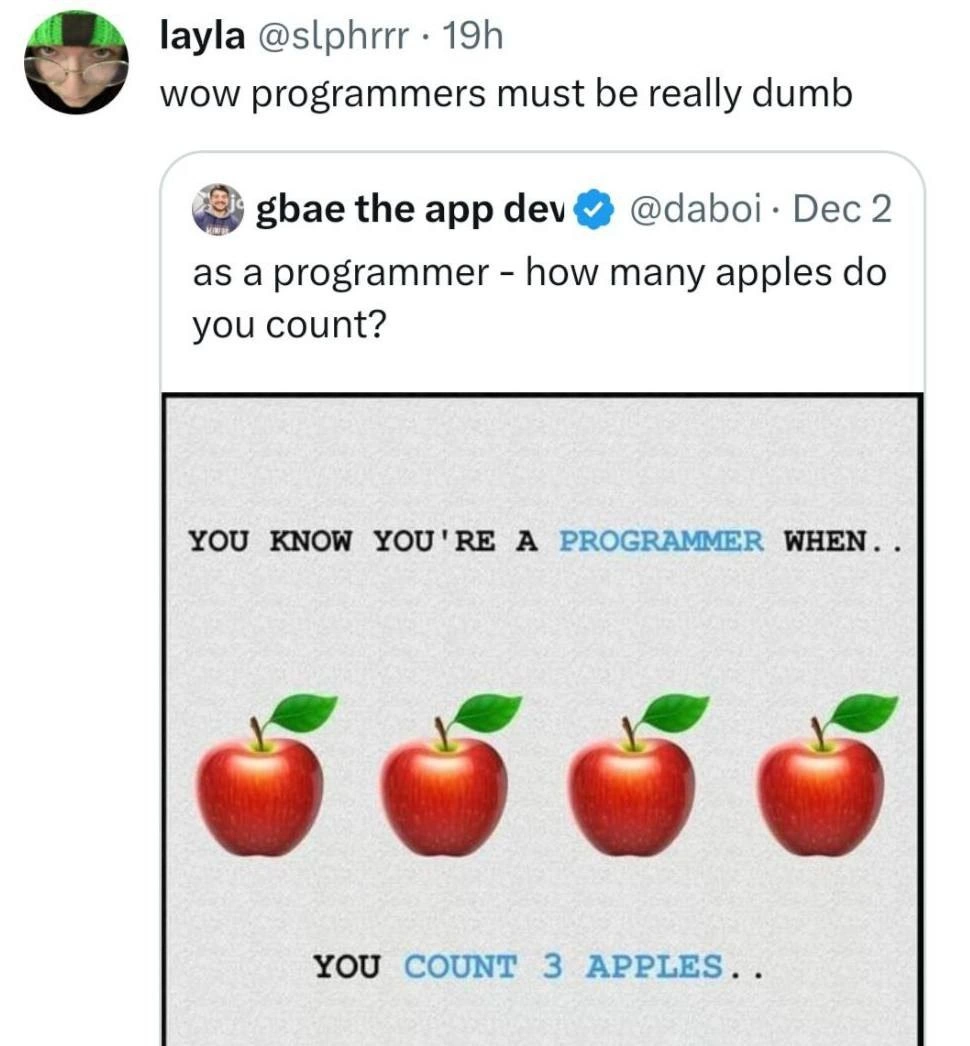
A classic “programmers count 3 apples” meme shows four fruit; the quote-tweet calls programmers dumb. The dive separates zero-based indexes (0–3) from count (4) and maps that to off-by-one errors in loops and pagination.
Level 1: Labels And Lunch
Imagine four lunch boxes sitting on a table, and someone puts stickers on them: 0, 1, 2, and 3. If a friend asks how many lunch boxes there are, the answer is still four. Saying “three” because the last sticker says 3 is the silly mistake. That is why the meme is funny: programmers spend so much time using weird labels that sometimes the joke pretends they forgot how to count normal things.
Level 2: The Last Apple
An array is a list of values in a program. Many languages number array positions from zero. For example, if apples = ["red", "red", "red", "red"], then apples[0] means the first apple and apples[3] means the fourth apple. The number inside the brackets is a position label, not the total number of items.
That distinction matters because code often uses both ideas at once:
const apples = ["apple", "apple", "apple", "apple"];

console.log(apples.length); // 4 apples total
console.log(apples[3]);     // the fourth apple
New developers hit this early when writing loops. If a list has length 4, the valid indexes are 0 through 3, so a loop usually runs while i < apples.length, not while i <= apples.length. The meme is built around that beginner lesson, but the top tweet turns it around: knowing indexes start at zero does not mean you should forget how ordinary counting works.
Level 3: Indexes Are Not Counts
The visible joke has two layers fighting each other. The quoted tweet asks:
as a programmer - how many apples do you count?
and the embedded old meme says:
YOU KNOW YOU'RE A PROGRAMMER WHEN.. YOU COUNT 3 APPLES..
But the image plainly shows four apples. The top tweet, “wow programmers must be really dumb,” is funny because it punctures a very old programmer in-joke: developers often work with zero-based indexing, where the first item in an array is at index 0, the second is at index 1, the third is at index 2, and the fourth is at index 3. That means the last apple’s index is 3, but the number of apples is still 4. Confusing those two is not advanced computer science; it is the kind of bug that ships right before someone adds a boundary test with a sigh.
This is the heart of the off-by-one error. In real systems, the difference between “last valid index” and “total count” causes broken pagination, missing final records, buffer mistakes in lower-level code, loops that skip data, and UI labels that say “showing 1-10 of 9” like a tiny confession. Senior developers recognize the pattern because it is not about apples; it is about every place where human counting, mathematical intervals, and programming conventions collide.
The post message says Layla is right, and she is. The classic meme tries to celebrate programmer thinking, but it accidentally celebrates a category error. A programmer should be able to say: “There are four apples; their indexes are 0, 1, 2, and 3.” The joke survives because the mistake is also familiar. Everyone who has written i <= array.length in the wrong language has briefly been the person counting four apples and proudly returning three.


Counting from zero is fine; returning the last index as the aggregate is how you get promoted directly to incident commander.
I think some programming languages don't start indexing from 0
But the count is 4
App development doesn't require 1st grade math knowledge, noted
I can only see 100 apples...
One apple and 3 references.
i see 1 tex and 4 render targets
Only one
So 4 is objectively correct, and 3 is just dumb, there's really not a way to justify 3
It's -1 anyway
one apple class and 4 instances
bruh, the count is 4, but the index of the last element is 3. It's a big difference. Leyla is actually right
Indexing and counting is different story
I can see 10 G for those laptops
The index of the last one is 3 but the count is 4.
0 1 2 3