
Java this Keyword Abuse Meme Explained
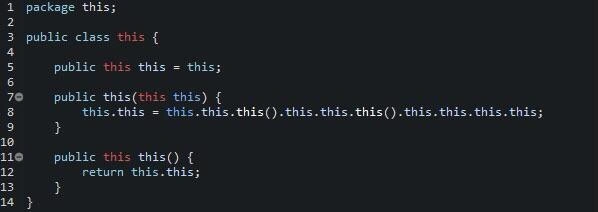
The screenshot shows Java-like code where almost every identifier is this—package, class, field, constructor, and method. The deep dive explains why this is a reserved keyword, how lexers reject it as a name, and why unreadable naming fails humans even when a grammar might allow it.
Level 1: Same Name For Everything
This is like labeling every person, room, door, and key in a building “this,” then asking someone to explain where “this” is and which “this” opens “this.” The joke is funny because the word that should help identify one thing is used for everything, so the whole program becomes nonsense.
Level 2: This Means This
In many object-oriented languages, this refers to the current object. If you have an object representing a user, this.email means “the email field on this user object.” It is useful when a local variable has the same name as a field, or when a method needs to pass the current object somewhere else.
The code in the image abuses that idea by trying to make this the package, class, type, field, constructor parameter, method name, and value. That is why it looks ridiculous. Instead of one clear keyword pointing to the current object, the entire file becomes the same word repeated in every possible role.
For newer developers, the practical lesson is that naming is not decoration. Names are how other people understand your code. Even if the computer could theoretically follow a confusing program, your teammates still have to debug it, review it, extend it, and trust it in production. Code that looks clever for ten seconds can become a maintenance tax for years.
Level 3: Existential Complexity
The image is funny because it weaponizes a keyword that is supposed to clarify ownership. In object-oriented programming, this normally means “the current object.” It lets a method distinguish an instance field from a local variable, as in this.name = name;. Here, every visible meaningful word is this, so the keyword stops being a pointer to context and becomes the entire context. It is code as a hall of mirrors.
The screenshot also mocks a real maintainability problem: names are part of the program's design. A compiler may care about tokens and scopes, but humans care about intent. Good names compress meaning: customer, invoiceTotal, retryCount, parseConfig, connectionPool. Bad names force the reader to simulate the code manually. This meme takes that failure to its logical endpoint: a program whose cyclomatic complexity might be low, but whose existential complexity is absolutely through the floor.
There is an extra joke in the syntax highlighting. The editor dutifully colors every this like it is helping, but highlighting cannot rescue a program that has erased its own vocabulary. Tooling can flag style issues, autocomplete identifiers, and navigate definitions, yet it cannot make this.this().this.this a humane thing to review. Somewhere a senior engineer is asking for “just one small rename” and the author is preparing a philosophical defense.
The code is also a neat reminder that language rules and readability rules are separate. If this were strict Java, several lines are invalid because this cannot be used as those identifiers. But even in a hypothetical language that accepted it, the result would still be hostile. A program can satisfy a grammar and still fail the more important test: can another person understand what it is trying to say before lunch?
Level 4: Lexer Says No
The visible code begins with:
package this;

public class this {
and keeps escalating into public this this = this;, public this(this this), and a chain like this.this = this.this.this().this.this.this().this.this.this.this;. The compiler joke starts before object-oriented semantics even get a chance to be confused. In Java, this is a reserved keyword, not a legal identifier, so a real Java compiler's lexer classifies it as a special token rather than a package name, class name, field name, method name, or parameter name.
That distinction is a compiler front-end issue. Source text is first tokenized: character sequences become tokens such as identifiers, keywords, punctuation, literals, and operators. The parser then tries to match those tokens against the language grammar and build an abstract syntax tree. A declaration expects an identifier in positions like class Identifier or Type Identifier; this image feeds it a keyword token instead. The AST never becomes the beautiful monument to self-reference promised by the screenshot. It dies at the velvet rope because this is on the reserved list.
If a language allowed this as a contextual keyword or identifier in some positions, then name resolution would become the next layer of comedy. The compiler would need to decide whether each occurrence means the current object reference, a type named this, a field named this, a method named this, or a parameter named this. That is why the code feels cursed: it deliberately collapses the human-readable namespace separation that makes object-oriented code navigable.


The cyclomatic complexity is low, but the existential complexity is O(this).
Why black
This
Wait, is this Java?
Fuck this
this was never an option
Long live Belarus
мда
а нахуя?
Does it even work?
this
And protests are much smaller!
But saw how many yellow vests died?
They are fully supporting opposition
That's why they lost their accreditation btw
No difference at all. They only pretending to be peacefull
You can check their main media source, if you knows Russian
Nexta
Are you sure? Their movement coordinated by nexta. Check what he writes
They only peaceful for European camera