
JUnit @Test Comment Bug Meme Explained
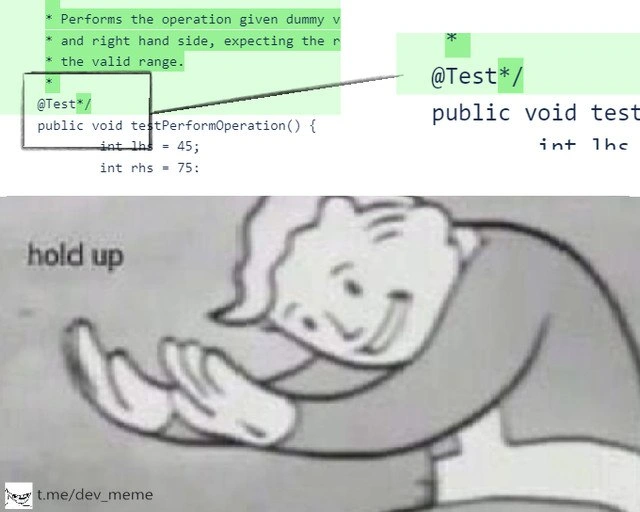
A zoom callout shows @Test*/ above a test method, then Fallout’s “hold up.” The dive explains how a closing block comment can hide the JUnit annotation so the runner never discovers the test.
Level 1: The Missing Label
Imagine a teacher has a box labeled "homework to grade," but someone accidentally covers the label with a sticky note. The papers are still in the room, and they still look like homework, but the teacher does not know to check them. The meme is funny because the programmer suddenly notices that one tiny mark may have hidden the test from the computer.
Level 2: The Comment Trap
@Test is an annotation used by JUnit, a popular Java unit testing framework. It marks a method so the framework knows to run it during tests. A block comment starts with /* and ends with */; everything inside is ignored by the compiler as explanatory text.
The joke is that the image shows @Test*/ right above public void testPerformOperation(). That makes the annotation look entangled with a comment ending. For a junior developer, this is the kind of mistake that feels unfair because the code still looks "near" correct. The method has a test-like name, has example inputs, and sits in a test-looking file, but the one symbol that actually registers it as a test may be broken or hidden.
This connects to early testing pain: you change documentation, run the suite, and everything seems fine. Later, someone notices that a test never ran, or coverage dropped, or a bug escaped because the safety net had a hole cut in it with punctuation.
Level 3: Annotation Autopsy
The tiny visual payload is the zoomed-in line @Test*/. That is doing almost all the damage. In Java, @Test is the JUnit marker that tells the test runner, "this method is a test case; execute it." The trailing */ is the end of a block comment, so the meme is pointing at a suspicious boundary where documentation and executable test metadata have collided.
The top half shows a code editor with green comment text above public void testPerformOperation(), with sample values like int lhs = 45; and int rhs = 75;. The bottom half says:
hold up
That reaction works because experienced developers immediately see the contradiction: the commit message can honestly sound like "fixed tests, added documentation," while the actual edit may have turned the test annotation into part of a comment cleanup crime scene. Depending on the exact surrounding syntax, this could fail compilation loudly, or worse, make the test runner stop discovering a method that everybody assumes is still covered. Silent test disappearance is the deluxe package: no red build, no obvious stack trace, just a coverage report looking mildly haunted.
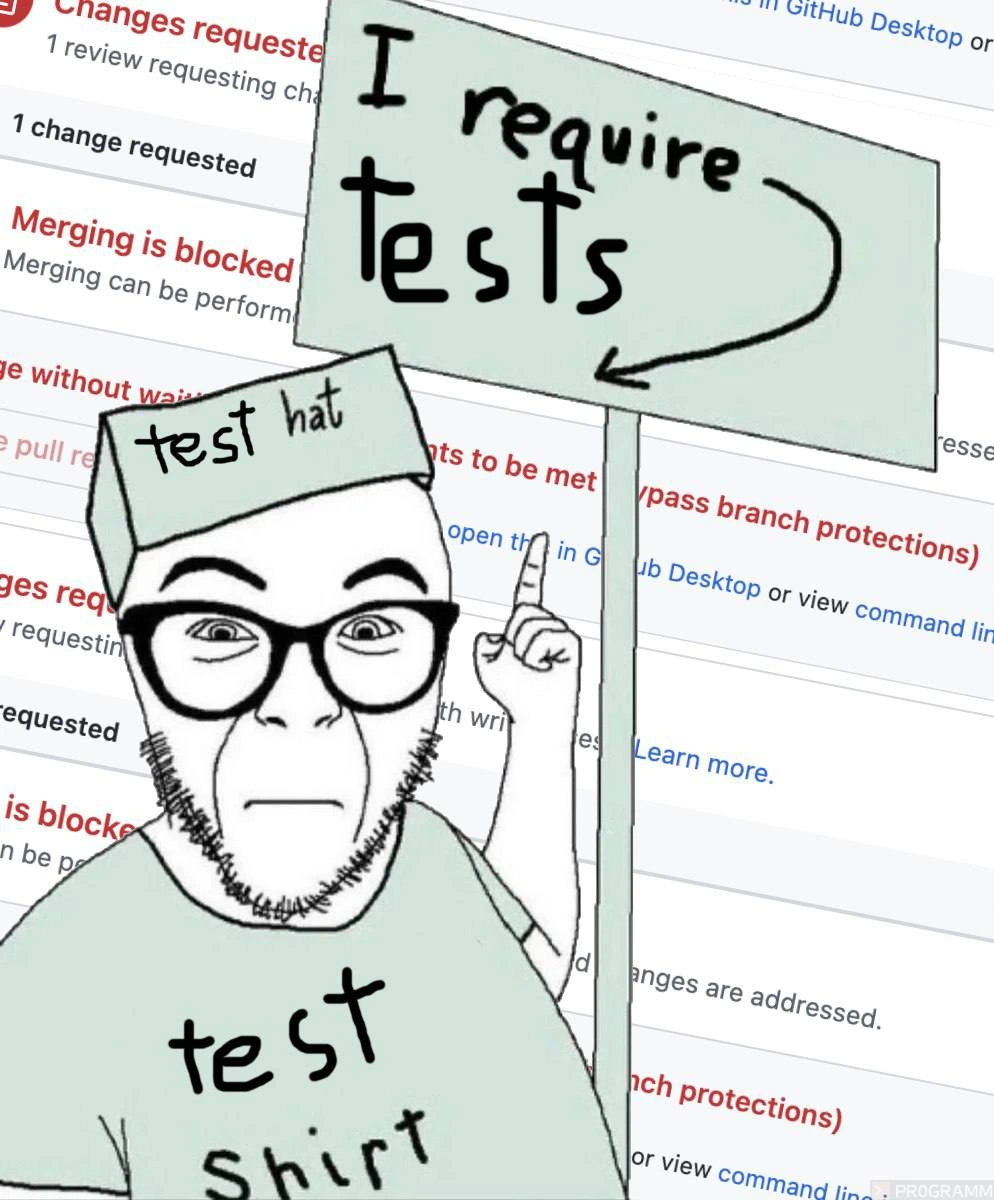
This is a testing and code quality joke because comments are supposed to be harmless documentation, but misplaced delimiters can change what the compiler and test framework see. A reviewer may scan the prose and miss that the executable contract moved by two characters. Static analysis, formatter behavior, coverage thresholds, and CI discovery rules are the things that usually save you here, assuming they were configured before the team decided "we will tighten that later" was a strategy.
Coverage did not drop because the test failed; it dropped because the comment system achieved feature parity with the test runner.