
Practice Over Talent Coding Meme Explained
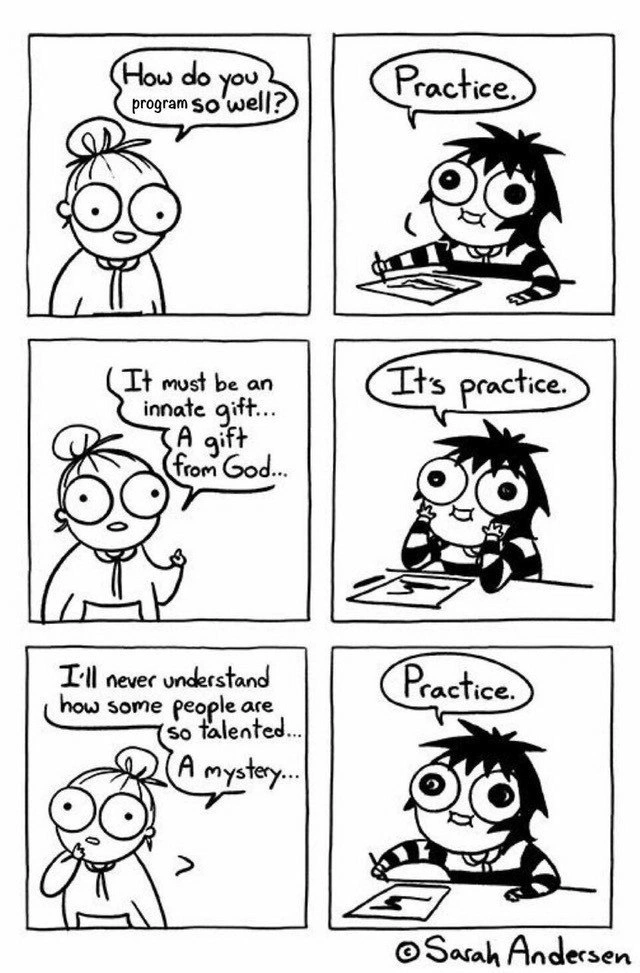
A six-panel comic pits a wide-eyed admirer against a coder who answers every “how do you program so well?” with “Practice.” The dive debunks the innate-gift myth and frames mastery as continuous, deliberate effort.
Level 1: Try, Try Again
Imagine you see your friend effortlessly riding a bike, doing neat tricks or zooming around without ever falling. You might think, “Wow, they must have been born to ride bikes!” But the truth is, they probably wobbled with training wheels and took a few tumbles when they first started. They got really good by getting on that bike every day and trying over and over. In other words, they practiced a lot. This meme is joking about the same idea, but with coding. One character is amazed at how well the other can program and is looking for some big magical reason – like maybe the person was given a special gift or super talent. But the only answer they get, again and again, is “Practice.” It’s like asking a pianist, “How do you play so beautifully? Is it a magic piano?” and the pianist just keeps saying, “No, I simply practiced.” The funny part is the first character just doesn’t seem to get it and keeps calling it a “mystery.” We, the audience, find it amusing because we know there’s no mystery at all – just like with riding a bike or playing a video game, you get good by trying, messing up, and trying again. The experienced coder shouting “Practice” is basically saying: anyone can do what I do, you just have to keep at it! That’s the heart of the joke and the lesson: there’s no magic or secret sauce, just keep practicing and you’ll get better at whatever it is – coding, biking, or anything else.
Level 2: Climbing the Learning Curve
For those newer to programming, let’s break down what this meme is saying. The question “How do you program so well?” is something many beginners wonder when they see an experienced developer easily writing code that might take a newbie days to figure out. It can feel almost magical or like those experts have some innate gift. In the comic, the wide-eyed character keeps guessing that the other person’s ability is due to a special talent or a gift from God. This reflects a common junior perspective: assuming coding success is pre-destined or that some people are just born to be developers.
The spiky-haired coder’s response every time is a very down-to-earth “Practice.” This single word is repeated in three panels, which is exactly the meme’s joke: the answer isn’t a fancy secret at all! It’s just repeated effort. When we say practice in a coding context, we mean writing code regularly, building small projects, experimenting with examples, and even making lots of mistakes and debugging them. Every bug you encounter and fix is practice. Every time you struggle with a new concept—be it learning how a for loop works or figuring out a tricky error message—and eventually solve it, you’re practicing and improving. This ongoing process is often called Continuous Learning. Developers constantly have to learn new languages, libraries, or technologies, so the learning never really stops.
The term LearningCurve often comes up here: programming has a “steep learning curve,” which means it’s challenging at first and there’s a lot to absorb. But as you put in more hours, things that once seemed baffling (like pointers, recursion, or that weird NullPointerException) start to make sense. It’s just like leveling up in a game or mastering a new skill: the more you do it, the easier and more natural it becomes. When the experienced dev in the comic says “Practice” while drawing on paper, it suggests they likely learned by writing things out and solving many problems over time. Maybe they started with a simple “Hello World” program and kept building from there. Over years, those small lessons accumulate into serious skill. That journey from beginner to proficient coder is what we tag as the LearningToCodeJourney or DeveloperGrowth. No one pops out of a computer science class writing flawless code on day one; it’s a learning curve we all climb.
The humor also touches on ImposterSyndrome, which many new developers experience. That’s the feeling when you think “I’m a fraud, everyone else here is so naturally good at this, and I’m struggling.” The comic counters this by implying those “naturally good” people got that way through repetition, not because they magically understood everything from the start. It’s encouraging juniors to adopt a skill_building_mindset: the belief that abilities in coding grow with effort and time, rather than a fixed innate ability. In practical terms, this means if you’re a beginner, you should know that the gurus you admire likely spent nights and weekends hacking on code, encountering the same frustrations you face now. They perhaps built lots of little apps, broke things, fixed them, and asked questions on Stack Overflow (another form of practice!). Over time, their code got cleaner and their debugging got faster. That’s DeveloperProductivity earned through experience.
So, when the comic’s mentor figure shouts “Practice.” for the third time, it’s a funny exaggeration of a real mentorship moment. Mentors often do emphasize practicing coding problems, contributing to open source, or repetition_makes_master techniques like coding katas (little coding exercises) to improve. There’s no shame in starting simple and repeating tasks—like writing multiple versions of a to-do list app or coding the same algorithm in different languages. Each repetition builds confidence. This is the essential message in those tags like practice_over_talent and ContinuousLearning: you improve by doing. The comic is a lighthearted reminder that even the best programmers were once beginners who just kept coding. Or as an old proverb goes (very relevant here): “Practice makes perfect.” Maybe not perfect—everyone still makes mistakes—but definitely practice makes you better. And that’s the real secret to great code: lots of not-so-great code written along the way!
Level 3: No God Mode in Code
In the senior developer realm, this comic hits on the innate_gift_myth head-on. It humorously debunks the idea that programming prowess is a gift from God or some magical talent reserved for a chosen few. Seasoned engineers recognize this scenario: a junior dev or outsider asks “How do you program so well?” expecting a mystical answer, some secret algorithm or a silver bullet. The experienced coder simply answers “Practice.” and keeps repeating it. This repetition is a classic comedic device (the rule of three) but also painfully true. We often see novices attributing expert skill to innate genius or assuming there’s a hidden trick (like entering God Mode in a video game). The comic exaggerates this by having the questioner increasingly insist it must be a “gift from God… a mystery”, while the spiky-haired coder grows more emphatic: “It’s practice. Practice. PRACTICE!”. This evokes knowing laughs from senior devs because we’ve all been there—either as the perplexed newbie idolizing gurus, or as the mentor feeling like a broken record.
From a veteran perspective, the humor taps into the practice_over_talent truth. Writing great code isn’t about typing some arcane incantation or being born with a CPU in your brain; it’s about deliberate practice. This mirrors the real LearningToCodeJourney: initial confusion, repeated effort, gradual improvement. The comic’s Sarah Andersen-like style (big round eyes and simple line art) underscores the stark simplicity of the message. There’s irony in how the wide-eyed junior in the left panels just can’t accept the straightforward answer. It’s a satire of the innate gift mindset vs. the skill_building_mindset. In reality, every “10x engineer” or “coding wizard” has spent uncountable hours debugging, reading documentation, failing and trying again. As a senior dev might quip, “There’s no sudo apt-get install genius in programming.” You cannot import talent as a library; you upload it into your brain through continuous effort. The repetition of “Practice” in the meme beautifully captures that aha! moment in developer culture: the real secret to great code isn’t a secret at all.
We also sense an undercurrent of ImposterSyndrome being addressed. Newcomers often feel “I’ll never understand how some people are so talented… A mystery…” and conclude they themselves must lack some natural gift. This comic is the senior engineer yelling the truth from the rooftops: everyone starts clueless, and those “talented” devs simply slogged through the LearningCurve over and over. The broad grin on the coder’s face and their pencil and paper imply they’ve sketched countless solutions and learned from each. As any mentor will tell you, practice isn’t just one big project, but dozens of little lessons. ContinuousLearning is the norm in software development—frameworks evolve, bugs surprise us, new languages emerge—so the only way to stay skilled is constant practice and DeveloperGrowth. The meme thus resonates widely because it flips the narrative: instead of pedestalizing “gifted” programmers, it reassures us that DeveloperProductivity and expertise come from persistence. The real DeveloperHumor here is that the “mystery” behind great code is hilariously mundane: type, test, break things, fix things, repeat ad infinitum. Senior devs chuckle because they know the hard truth that you earn your “rockstar coder” status by grinding away at code, not by divine intervention. In summary, the comic delivers a powerful industry lesson with a laugh: coding well isn’t about being a born genius, it’s about repetition_makes_master – a message every seasoned coder wishes more juniors would truly hear (ideally by the second panel, not the sixth!).
// Pseudocode of the "secret" to coding well:
for (int hour = 0; hour < 10000; ++hour) {
    practice();  // Deliberate coding & debugging, hour after hour
}
// Eventually...
bool writesGreatCode = true;

Some believe great programmers are born with a gift. The rest of us know it's just a decade of Stockholm syndrome with a compiler
“Innate gift” is just what juniors call the muscle memory you acquire after enough 3 a.m. rollbacks that your fingers can SSH, git cherry-pick, and kubectl apply before your brain finishes swearing
Same energy as explaining to the board why the legacy system rewrite will take 18 months when "it's just moving some data around" and watching them conclude you're sandbagging because the vendor said their AI can do it in 3 weeks
Senior engineers know the secret: that 'rockstar 10x developer' everyone mythologizes? They're just someone who debugged the same class of error 10,000 times. The real divine intervention is having the discipline to practice when Stack Overflow is down
People think it’s a gift; it’s just practice - rollbacks, logs until they confess, and deleting yesterday’s clever abstraction before it ossifies into an API
Talent is just a well-tuned L2 cache of past production outages, warmed by years of practice
Practice: politely admitting you've debugged more race conditions than juniors have written 'Hello World'
... a gift from God ... Atheistic programmers: ...
✅
Some people cannot into abstract thinking and breaking the jail of walls formed by the wrong interpretation of poorly chosen words
So yeah. It's a talent, and practice is just a booster for it
You know, fisherman who can fish with a carpenter tools is an awesome master that can handle any tool. But if fisherman makes money daily from fishing with a carpenter tools then it's an idiot with a lot of practice in fishing using carpetner tools. A lot of practice.
Only capability of abstract thinking can give you an ability to evolve and if you have enough agility of your mind and stamina to practice new ways. That's more of the talent than practice. You can be master in COBOL or other obsolete tech. It won't make you more productive or less error prone. C'est la vie mon ami.
A rare talent nowadays.
Keep arguing this is fun
And yeah I agree u can keep practising it wrong which is worse than never practising it