
Windows LinkedIn Hotkey Chord Meme Explained
The meme wishes Windows had a universal LinkedIn hotkey, then presents an absurd four-modifier chord as if it were a sacred ability. The dive explains global hotkeys versus app shortcuts, Microsoft platform placement, and why overloaded OS keybinds annoy power users.
Level 1: Too Many Keys
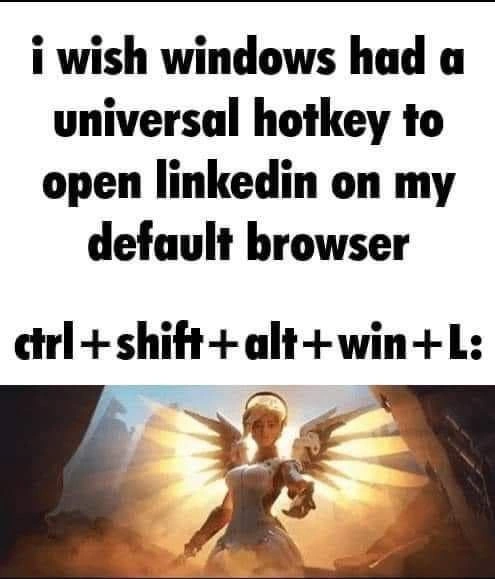
It is like needing to press five secret buttons on a remote control just to open a magazine nobody asked for. The big glowing hero picture makes the button combo look powerful, but the result is just LinkedIn. That mismatch is why it is funny: the shortcut acts like a magic spell for something very ordinary.
Level 2: Hotkeys With Motives
A keyboard shortcut is a key combination that triggers an action. Some shortcuts belong to one app, like Ctrl+S saving a file in an editor. Others are global hotkeys, meaning the operating system or a background service can respond no matter which app is active.
The meme is about the difference between useful global shortcuts and strange product shortcuts. A useful one might lock the screen, switch windows, open search, or take a screenshot. Those actions are part of controlling the computer. Opening LinkedIn is different: it is a specific website owned by Microsoft, not a basic operating-system action.
The visible chord is funny because it is so overloaded:
Ctrlis already a common command modifier.Shiftoften changes direction or selection behavior.Altis used for menus and alternate commands.Winis reserved for operating-system shortcuts.Lusually has strong associations with lock, login, link, or launcher actions depending on context.
Stacking them together makes the shortcut look important. The punchline is that the important-looking command opens a professional social network. For developers, this is familiar UX irony: the more complicated the shortcut, the more it feels like it should do something critical. Instead, it routes you to the place where recruiters, brand posts, and "thought leadership" live.
The original post message asks whether it is even worth it, which fits the visible joke. If a shortcut is harder to remember than typing the destination into a browser, its convenience is mostly theoretical. A shortcut can be technically available and still fail as interface design.
Level 3: Enterprise Summoning Ritual
The meme's visible text says:
i wish windows had a universal hotkey to open linkedin on my default browser
ctrl +shift+alt+-win +L:
Under that, an angelic game character with glowing wings points forward like someone has just triggered an ultimate ability. The contrast is the joke: the key chord looks like a sacred productivity spell, but the destination is LinkedIn. Not a debugger. Not a terminal. Not password manager unlock. LinkedIn.
The technical detail being mocked is a real class of Windows shortcut weirdness: global hotkeys that operate above the active application and launch vendor-preferred destinations. Ctrl+Shift+Alt+Win is infamous because it effectively behaves like a modifier stack for Microsoft Office-key shortcuts. Once a hardware or OS-level modifier exists, product teams can bind it to apps, services, and web properties. In theory, this is convenience. In practice, it can feel like the operating system is one accidental hand cramp away from opening a professional networking feed.
That is why the word universal matters. A universal hotkey competes with every app, game, IDE, terminal, accessibility tool, and power-user workflow on the machine. Developers are protective of keyboard shortcuts because good shortcuts become muscle memory, and bad global shortcuts become workflow landmines. When a chord with four modifiers plus a letter opens a social platform, it feels less like user-centered design and more like a corporate org chart escaped into the input subsystem.
There is also Microsoft product history under the surface. Windows is not just an operating system; it is a distribution channel for Microsoft services. Office, Teams, OneDrive, Edge, Bing, Copilot, and LinkedIn can all become "one shortcut away" because platform ownership makes placement easy. The meme exaggerates the user's desire for that placement, but the sarcasm is obvious: nobody was sitting in front of Visual Studio thinking, "My compile failed, better emergency-open LinkedIn."
The glowing game image makes the shortcut look overpowered, which is exactly the right visual metaphor. The chord has boss-fight energy. It asks for both hands, a calm mind, and possibly a keyboard with emotional support. Then it launches the website where people write posts about being humbled to announce they optimized a Jira filter.
Nothing says productivity like hiding LinkedIn behind a modifier stack that looks one key away from rebooting the shell.
It really works
There's also ctrl+shift+alt+win+W for Word, which seems more useful
trl+Shift+Alt+Win — Office UWP app from MS Store Ctrl+Shift+Alt+Win+W — Word Ctrl+Shift+Alt+Win+P — PowerPoint Ctrl+Shift+Alt+Win+X — Excel Ctrl+Shift+Alt+Win+O — Outlook Ctrl+Shift+Alt+Win+T — Teams Ctrl+Shift+Alt+Win+D — OneDrive Ctrl+Shift+Alt+Win+N — OneNote Ctrl+Shift+Alt+Win+L — LinkedIn Ctrl+Shift+Alt+Win+Y — Yammer
useless shit btw
Don't forget about Win+Ctrl+Shift+B
They were aded for a MS keyboard with dedicated buttons for these actions.
Ring finger on ctrl, middle finger on windows key and shift, index finger on alt. Press letters with right hand.
clean your keyboard
posting from a nuclear ground zero
finally an explanation for the radioactive fallout caused by my farts
Dude
…no. no, not at all
people with 4 key rollover:
https://invent.kde.org/plasma/plasma-desktop/-/merge_requests/1731