
Algorithmic Feed Shift Meme Explained
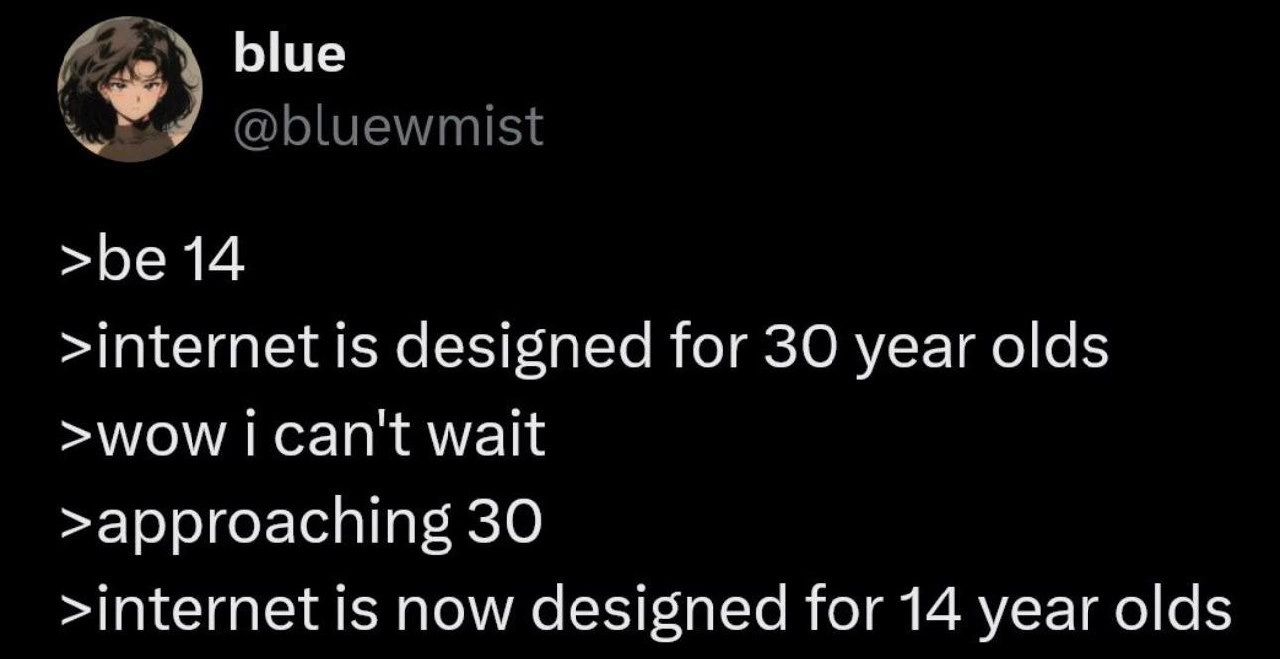
A greentext tweet mourns waiting to inherit an adult internet only to find it redesigned for 14-year-olds. The dive ties the joke to engagement metrics, recommender feeds, and the forum-to-short-form product shift many developers helped ship one A/B test at a time.
Level 1: The Restaurant That Changed Its Menu
Imagine being a kid pressed against the window of a fancy restaurant where all the grown-ups eat, thinking: "I can't wait until I'm old enough to eat there." You wait fifteen years, you finally walk in wearing your nice clothes — and the restaurant has turned into a candy stand with flashing lights, built entirely for kids the age you used to be. You never got your turn. The joke is that sad-funny feeling of waiting your whole childhood for a door to open, and discovering the room behind it was redecorated for someone else just as you arrived.
Level 2: Feeds, Forums, and Format Wars
Two terms unlock this one. Greentext is a storytelling format from imageboards where each line starts with > and the story is told in terse, first-person fragments (">be me..."); it traditionally renders green, hence the name, and it's the old internet's native short story form. An algorithmic feed is what replaced the old chronological web: instead of you choosing pages to visit or people to follow in time order, a recommendation system predicts what will keep you scrolling and assembles your experience automatically.
The "internet designed for 30 year olds" the author remembers was the forum era: discussion boards, personal blogs, RSS readers, long comment threads — a web you navigated deliberately, where status came from knowing things. The "internet designed for 14 year olds" is the short-form video era: TikTok-style clips, Stories, Reels, Shorts, trends, and humor that mutates weekly. Neither is objectively better, but the transition explains a lot of what early-career developers inherit: why every product meeting mentions "engagement," why every app sprouts a vertical video tab regardless of its purpose, and why "time spent" appears on dashboards as a success metric rather than, occasionally, a confession. If you've ever wondered why a documentation site has autoplaying video — this tweet is the answer compressed to five lines.
Level 3: The Demographic Doppler Shift
The tweet by blue (@bluewmist) deploys the imageboard greentext format — each line prefixed with >, the four-line tragedy structure 4chan perfected — inside a Twitter/X screenshot, which is itself a neat archaeological layering: an old-web narrative form preserved in amber on a platform that helped kill the old web. The text:
>be 14 >internet is designed for 30 year olds >wow i can't wait >approaching 30 >internet is now designed for 14 year olds
The joke is a moving-target problem, and the target moved for structural reasons worth excavating. The web a millennial 14-year-old grew up on — forums, blogs, IRC, long technical flame wars, Slashdot, early Wikipedia — felt designed for 30-year-olds because it largely was: built by adult engineers and academics, for users self-selected by the patience to configure things. Text-heavy, pseudonymous, chronological, and gloriously indifferent to engagement metrics. The implicit promise to that teenager was inheritance: hold on, and one day this adult kingdom of knowledge is yours.
Then the business model changed underneath them. The shift from destination sites to algorithmic feeds, and from subscription/ownership to ad-funded attention markets, redefined the optimization objective: not "serve the user's intent" but "maximize time-on-app." And in an attention auction, the winning content profile skews young — short-form vertical video, frictionless infinite scroll, trends with a half-life of days. Product decisions followed the metric: density of information gave way to density of stimulus. The 14-year-old wasn't courted out of malice; they're simply the marginal unit of watch-time. Meanwhile the systems got engineered to extraordinary sophistication — recommender models, autoplay pipelines, CDN-scale video — meaning the industry's adults now do their most serious engineering in service of the least adult possible feed. That inversion is the tweet's quiet sting for developers: many of them built this, one well-reasoned A/B test at a time.
The greentext's classic arc — naive hope, time skip, ironic reversal — also encodes the part nobody says out loud: the 30-year-olds didn't lose the internet to teenagers. They lost it to a metric. The teenagers are just better adapted to the habitat the metric produced.



We waited twenty years to inherit the internet, and the handoff doc was a 15-second vertical video
The internet's age gate is implemented as currentUser.age !== targetDemographic.
for 14yos to become mentally challenged, I'd even say
Lucky me for not developing into a proper adult with duties and instead sitting at home for years 24/7 pressing buttons and getting money for that somehow 🙄 😨
> politicians ban children <18 from the Internet one country after another.
make your way to the IRC that’s where all the fossils are
Why do you think the internet is designed for people with no education?