
Domain Renewal Side Project Meme Explained
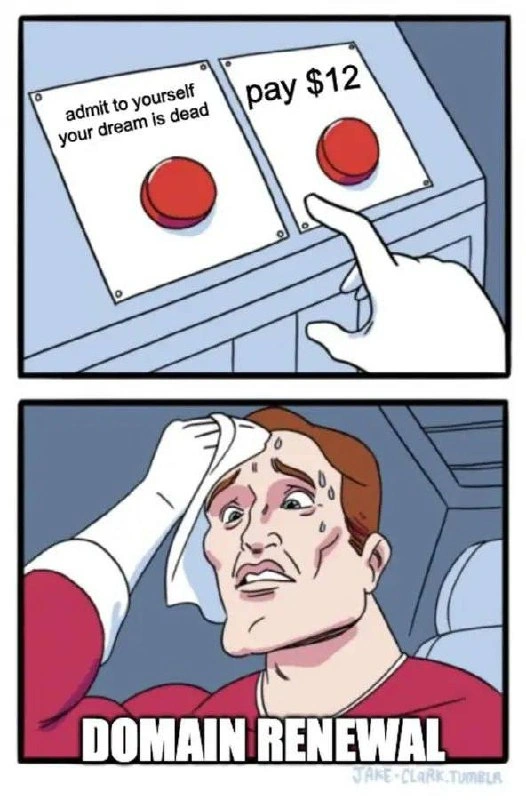
A two-button dilemma pits “admit your dream is dead” against “pay $12” under the caption domain renewal. The dive unpacks why developers keep dormant names alive as cheap infrastructure for unfinished side projects.
Level 1: Another Year of Hope
Imagine you have a toy or a project you haven’t touched in a long time, but you’re not ready to throw it away. Every so often, you pay a little bit of money to keep it stored safely, just in case one day you’ll use it. It’s like paying for a gym membership even though you never go, simply because you keep telling yourself “maybe next month I’ll start.” This meme is funny because it shows a person sweating over two choices that seem silly: either give up on your dream (let the toy or idea go) or pay a small fee to keep the dream alive a little longer. Most people find themselves choosing to pay that small fee – it’s a way of holding onto hope. In the picture, the poor superhero is panicking because choosing the hopeful option (spending $12 for the year) is so tempting, even if deep down he knows he hasn’t used that thing all year. We laugh because we recognize ourselves in that situation – it’s a goofy way to show how hard it is to let go of a dream, even when it costs us a little money every year to keep pretending we’ll make it happen.
Level 2: Annual Renewal Ritual
Let’s break down the joke in simpler terms. In web development, a “domain name” is basically the website address you buy (like mygreatidea.com). You register it through a domain registrar (companies like GoDaddy or Namecheap) and pay a yearly fee (often around $12 for a standard .com domain) to keep ownership. This fee and process is what we call domain renewal. If you don’t renew, the name can expire and even be taken by someone else. Now, many developers have side projects – fun app or website ideas they tinker with outside of work. It’s super common to get excited about an idea, grab a cool domain name for it… and then life happens. The code might never get finished or the project never quite launches publicly. But a year later, the developer gets an email: “Your domain is about to expire. Renew now!” Here comes the decision_fatigue: do they let it expire (essentially admitting the project is going nowhere), or do they pay that relatively small ~$12 to hold onto the name for another year “just in case”?
This meme uses the famous “sweating two-buttons” format to visualize that dilemma. In the top panel, you see a control board with two red buttons labeled with the choices: one says “admit to yourself your dream is dead” and the other says “pay $12”. The white-gloved hand hovering uncertainly between them represents the developer struggling to decide. In the bottom panel, the cartoon superhero (from the original meme template) is wiping sweat from his forehead, looking extremely anxious, and below him the caption reads “DOMAIN RENEWAL”. The joke is that domain renewal – ordinarily a mundane part of DNS management – has become an epic, anxiety-inducing choice. The humor comes from exaggerating how painful it feels to either give up on a beloved idea or keep pouring a little money into it. It highlights a very real developer habit: instead of shutting down an unfinished project, we often just renew the domain for another year. After all, twelve dollars feels like a small price to postpone saying goodbye. In simple tech terms, it’s poking fun at how we maintain a piece of infrastructure (the domain name and its DNS entry) for a website that doesn’t actually exist yet, purely out of hope and stubbornness.
Level 3: Domain of Denial
The meme hits a nerve in the WebDev community by dramatizing a painfully familiar scenario. Every experienced developer has that one side project (or ten) with a catchy domain name they snagged in a burst of inspiration. Fast-forward a year: the project’s repository hasn’t seen a commit in months, the brilliant idea is collecting digital dust, and along comes the domain renewal notice. The classic two-button format perfectly captures this decision fatigue. On one side: admit the dream is dead – let the domain expire and finally acknowledge that your grand idea never left the planning stage. On the other: pay $12 to renew the domain for another year – essentially buying yourself a little more hope, or perhaps renting space in the land of denial. The sweating superhero with his hand hovering anxiously between choices? That’s every developer who’s emotionally invested in a dormant project, unwilling to pull the plug. 🥵
From a senior developer’s perspective, the humor cuts deep because it’s rooted in shared experience. We’ve all justified “it’s just twelve bucks” as a reasonable investment for our side_project_dreams. Twelve dollars is trivial in tech (where a cloud instance might cost more in a day), yet it symbolizes something much bigger: our infrastructure of optimism. This annual ritual is practically a part of DNS management folklore. Sure, we quip that “It’s always DNS” when diagnosing outages, but in this case DNS isn’t breaking anything – instead, it’s facilitating our procrastination. The Domain Name System dutifully holds onto that clever-project-name.com for us, year after year, no questions asked. The industry even has a term for these never-launched sites: domain graveyards – except we keep DomainRegistration on life support, because killing the domain feels like killing the dream. It’s a gentle self-deception shared across dev culture: as long as that URL still points somewhere (even if it’s an empty page or a parking server), the project isn’t completely dead. This meme is funny (and a little tragic) because it exposes that collective habit of techies: preferring a small recurring domain_registrar_cost over confronting our sunk-cost fallacy. In the end, renewing a domain for a defunct project is almost a rite of passage in WebDevelopment – a tongue-in-cheek reminder that in our hearts, hope springs eternal at about $12 a year.
My domains are like Schrödinger's startups: as long as I pay the renewal fee, they are simultaneously alive and dead
The only piece of that “weekend MVP” still in prod is the domain - apparently my denial TTL outlives every DNS record
The real tragedy isn't the $12 annual fee - it's explaining to your accountant why you're writing off 47 domain renewals as 'R&D expenses' while your GitHub shows the last commit was 'initial commit' from 2019
Every senior engineer has a portfolio of domains that serve as a monument to optimism and a testament to the gap between 'I'll build this next weekend' and 'it's been three years.' That $12 annual renewal isn't just a fee - it's the subscription cost for maintaining plausible deniability that you haven't given up on your revolutionary idea. The real engineering challenge isn't the tech stack; it's architecting a rationalization framework robust enough to justify another year of DNS records pointing to a 'Coming Soon' page that's been coming soon since 2019
Paying $12 to give the project another 365-day TTL is the cheapest SRE practice I’ve ever approved
Side projects obey CAP: can't have dream consistency and partition tolerance without paying the $12 availability tax
Domain renewal: $12/year to refresh the TTL on my side‑project delusion for another 365d
I just had this issue a few weeks ago
I had to admit one project is dead💀
This is funny but sad
How many domains (projects) do you have?
beebyte + vmp + control flow flattening + rsa xor mt64 traffic + shuffling protobuf + shuffling cmdids + encrypted metadata + inlined decrypt constants in accessors + kernel anticheat
android has shitty tencent anticheat, no