
Hello Triangle Graphics Meme Explained
A party-scene meme blames career ruin on the classic RGB-interpolated triangle. The deep dive covers Hello Triangle as the graphics Hello World, barycentric interpolation on the GPU, and the brutal OpenGL-to-Vulkan learning curve that follows one bright first pixel.
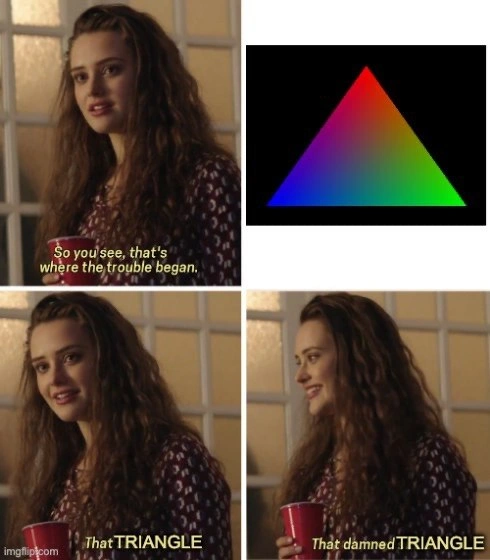
Level 1: The First Puzzle Piece
It's like someone telling the story of how they got hopelessly hooked on jigsaw puzzles: "It all started so innocently... someone handed me one piece. Just one pretty, colorful piece." The colorful triangle is the very first thing anyone learning computer graphics makes — simple, bright, and satisfying. But behind that one piece is a ten-thousand-piece puzzle that takes over your desk, your weekends, and your life. The girl at the party isn't telling a story about a triangle. She's telling the story of the moment a tiny taste of success tricked her into a lifetime of beautiful suffering — and anyone who's ever said "just one more level" of anything knows exactly how that feels.
Level 2: Hello, Triangle
What you're actually looking at in panel two:
- The RGB triangle: The standard first exercise in graphics APIs like OpenGL or Vulkan. You define three corner points (vertices), give each a color — pure red, green, blue — and the GPU fills in the middle by blending. It's the graphics equivalent of
print("Hello, world"). - Vertex: A point in space with attached data (position, color). Three vertices = one triangle, the basic building block of all 3D graphics. Every game character you've ever seen is thousands of these.
- Interpolation: The automatic blending you see in the gradient — the GPU smoothly transitions values between vertices. It's why the triangle's center is a muddy mix of all three colors.
- Shader: A small program you write that runs on the GPU and decides where vertices go and what color each pixel gets. Even the humble triangle requires two of them.
The relatable junior moment: you follow the tutorial, the triangle appears, and you feel like a wizard. Then you try to load a 3D model, get a black screen, and spend three days learning that graphics code doesn't crash — it just silently renders nothing.
Level 3: 1,200 Lines Before the First Pixel
The meme's 13 Reasons Why party-scene format — curly-haired narrator, red Solo cup, the rueful "So you see, that's where the trouble began" — is built for origin stories of ruin, and graphics programmers instantly recognize theirs: panel two's RGB-interpolated triangle on a black void, the "Hello, Triangle" that opens every OpenGL and Vulkan tutorial ever written. "That TRIANGLE. That damned TRIANGLE."
The joke's precision lies in what that first triangle actually costs and what it actually promises. In legacy OpenGL you could get it in thirty lines; in Vulkan, the famously explicit modern API, the canonical hello-triangle runs north of a thousand lines — instance creation, physical device selection, logical devices, queues, swapchains, image views, render passes, pipeline layouts, shader modules, command buffers, and synchronization primitives — all to paint one gradient triangle. The tutorial euphoria of seeing it appear is the industry's most effective recruitment scam: the dopamine hit arrives precisely once, after which the learner discovers that everything beyond the triangle (lighting, shadows, transparency sorting, frustum culling, the entire shader zoo) scales in difficulty exponentially while the visible payoff scales linearly.
Hence the "trouble began" framing. The triangle is the gateway drug of graphics programming and game development: it convinces you the field is approachable, then introduces you to NaN-colored geometry, black screens with zero error messages, driver-specific behavior, and debugging by changing the clear color to magenta and praying. The character recounting it at a party like a traumatic backstory is every graphics dev explaining how a single tutorial in their teens led, fifteen years later, to them knowing what a swapchain recreation bug feels like at 2 AM before a milestone build.
Level 4: Barycentric Confessions
The gradient inside that triangle isn't decoration — it's a live demonstration of the mathematics every GPU executes billions of times per frame. The three vertices are assigned pure red, green, and blue, and the rasterizer fills every interior pixel using barycentric coordinates: each point $P$ inside a triangle can be written uniquely as $P = \alpha A + \beta B + \gamma C$ with $\alpha + \beta + \gamma = 1$, and those same weights linearly blend the vertex attributes. The smooth wash of color you see is the hardware whispering, "I interpolate everything this way" — colors today, texture coordinates and normals tomorrow.
It goes deeper. In a real 3D scene, naive linear interpolation in screen space is wrong after perspective projection — attributes must be divided by depth, interpolated, then un-divided (perspective-correct interpolation), a hyperbolic correction baked into silicon since the late 1990s precisely because early hardware that skipped it produced warping textures. And the reason everything is triangles at all is mathematically load-bearing: three points are always coplanar, always convex, and barycentric weights are unique — properties that quads and arbitrary polygons can't guarantee. The triangle isn't a tutorial simplification; it's the irreducible primitive the entire raster pipeline is built on. Her trouble began with the one shape that cannot be decomposed further.

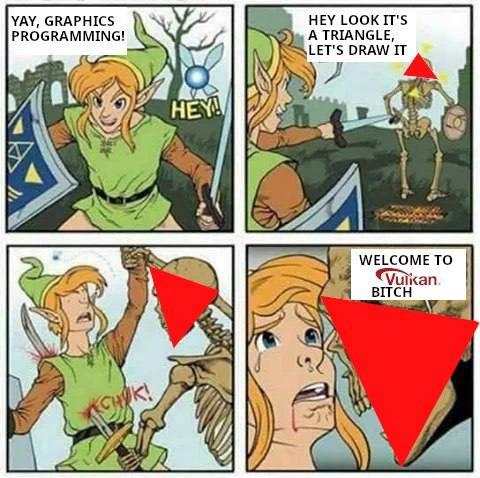
1,200 lines of Vulkan boilerplate later, you too can render the triangle that ruined her life
Three vertices in, five years later you have a custom allocator and no game.
Instead of opening Pandora's box, they OpenGL
speedrunning Raylib
a black-red triangle?
Should have used
No color spaces in this space please.
This is an English only chat, please adhere to the rules
I was wondering, where the f my photo went 😅
You're not getting the joke
Not only is xy diagram the worst thing to judge color gamut (mostly ergonomic improvement on the original rg diagram), but the whole idea of representing volumetric information in a planar view, even with more advanced u'v' or a*b*. 🧐
Its a middle slice where most colors are perceived, 50% lightness (in hsl terms or smth.) or smth. Because with more light it all goes to white, colors are lost. The same with less light - all goes to black, also no colors. Talking about other shortcomings - well , thats our eyes, dread it, run from it, destiny still arrives.