
JSX as SQL Query DSL Meme Explained
A TypeScript snippet wraps a SELECT/WHERE/LIMIT query in JSX tags like UI components. The dive explains why SQL’s relational model fights React-shaped trees, and how JavaScript’s habit of absorbing every domain creates cursed abstractions.
Level 1: Soup In A Cake Pan
This is like trying to cook soup by putting all the ingredients into a cake pan because cake pans are your favorite kitchen tool. You might still end up with food, but everyone watching wonders why soup had to become cake-shaped. The meme is funny because programmers sometimes force every problem to look like the tool they already like.
Level 2: Tags For Queries
SQL is the common language used to ask relational databases for data. A normal query might say, “Find rows where status is paid and name is bob, then return at most five results.” An ORM, or object-relational mapper, is a library that lets developers work with database records through programming-language objects instead of writing raw SQL every time.
JSX is syntax used heavily with React. It lets developers write markup-like tags inside JavaScript:
<Button disabled={isSaving}>Save</Button>
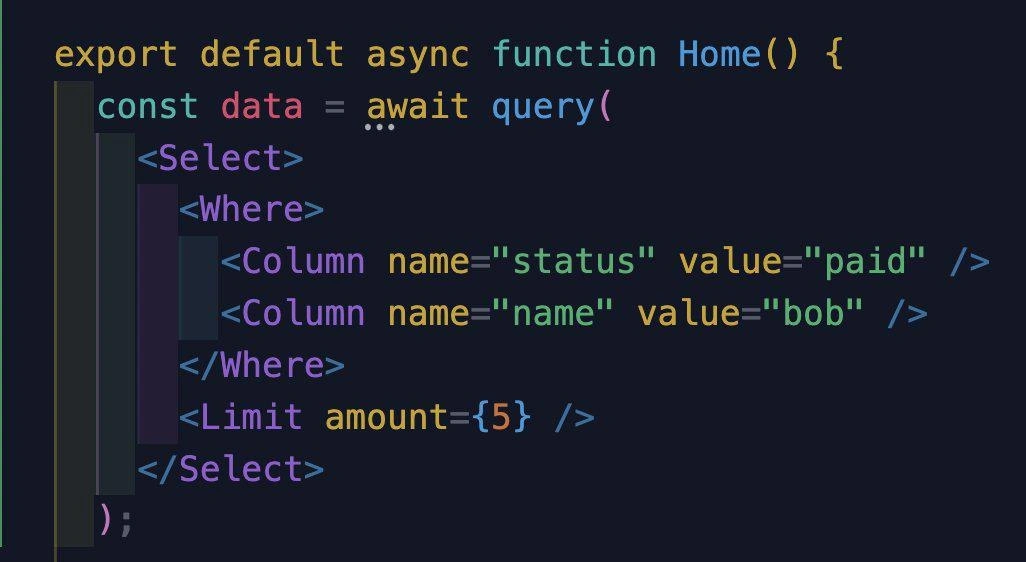
The image combines those worlds. It uses JSX tags to describe a SQL-like query. That feels funny because <Select> and <Where> look like UI components, but they are being used to talk to a database. For a beginner, this might even look readable at first. The trouble starts when the query becomes more complicated than two filters and a limit.
This is why developers argue about DSLs, or domain-specific languages. A DSL can make one kind of task pleasant, but if it copies the wrong shape from another domain, it becomes confusing. SQL already has a compact way to express database logic. JSX already has a compact way to express UI trees. Smashing them together creates something that is clever enough to be dangerous.
Level 3: Hydrate The Database
The screenshot shows a dark code editor with a JavaScript or TypeScript function:
export default async function Home() {
  const data = await query(
    <Select>
      <Where>
        <Column name="status" value="paid" />
        <Column name="name" value="bob" />
      </Where>
      <Limit amount={5} />
    </Select>
  );
The post message says, “We’re so cursed,” and the image earns it. The joke is that a database query has been expressed as a React-style component tree. Instead of SQL like SELECT ... WHERE status = 'paid' AND name = 'bob' LIMIT 5, or a normal ORM query builder, the code uses JSX tags such as <Select>, <Where>, <Column>, and <Limit>. It looks like the frontend ecosystem stared at a database long enough to ask whether it needed components.
Senior developers wince because this is not just weird syntax; it is a familiar abstraction temptation. JSX is good at describing nested UI structure because UI is naturally tree-shaped. SQL is declarative too, but a query is not a DOM subtree. It has relational semantics: projection, filtering, joining, grouping, ordering, cardinality, indexes, query planning, parameterization, and transaction context. Turning it into tags can make the simplest case look cute while making the real cases deeply awkward. What does <Join> look like? How do you express OR, subqueries, window functions, common table expressions, null handling, or parameter binding? Somewhere in the distance, a query optimizer starts updating its resume.
The satire hits the JavaScript ecosystem specifically because JavaScript has a habit of absorbing every domain into its dominant idioms. Configuration becomes JavaScript. Styling becomes JavaScript. Server rendering becomes JavaScript. Database access becomes JavaScript. Now SQL, an already successful domain-specific language, is being dressed in JSX because the toolchain can parse it and the demo looks memorable. That is the cursed part: it is technically possible, and technical possibility has never been a sufficient design review.
There is a real trade-off buried under the joke. A JSX query DSL could offer type checking, composability, editor autocomplete, and safe parameter construction. Those are legitimate goals. But the abstraction must pay rent. If it makes simple filters look friendly while hiding the actual database model, it risks teaching developers a toy version of querying and then abandoning them when production asks for EXPLAIN ANALYZE.


When your ORM has a render tree, the database starts asking whether it needs hydration too.
JESUS
I do not understand the Joke edit: wait wtf
EWWWW is this sql in xml
WHY WHY WHY WHY
NOOOOOOOOOOOOOOOO
finally sqxml
WHYYYY
SQML
this is SQL-in-JS
I just installed ms sql server manager, don't make me uninstall it
wow, my coworker once created a json to sql converter so frontend developers could write queries directly for db This is so much worse
ok ok ok but what if const data = await query({ select: { where: [ { column: "status", value: "paid" }, { column: "name", value: "bob" } ], limit: 5 } });
Wow
But, I mean, why not?
mfw I saw this
Is it fake?
lol… am I the only one thinking where’s the FROM?
const data = await.db .from("programming_languages") .select({ name: true, }) .where({ skill: "lower", }) .orderBy({ dev_count: "ASC" }) .limit(3) .execute(); Better?
Wtf is this?