
AI Leaderboard Distillation Meme Explained
The meme jokes that a top Code Arena score means Chinese labs distilled models that do not exist yet. The dive separates legitimate distillation, preference rankings, and what a frontend leaderboard snapshot actually measures.
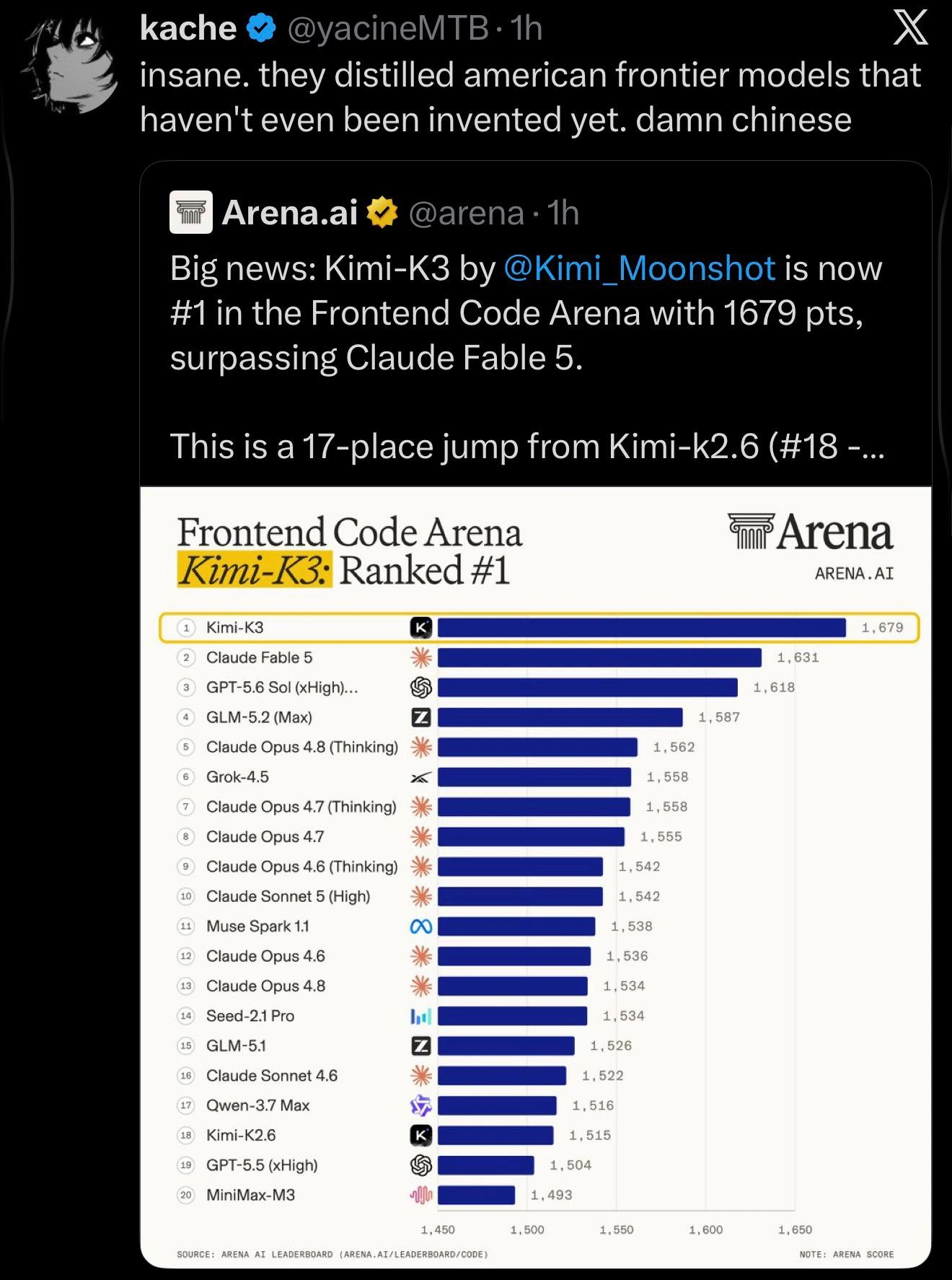
Level 1: Copying Tomorrow's Homework
It is like a student winning today’s drawing contest and someone joking that they must have copied next year’s winning picture before it was painted. Winning shows that the drawing impressed the judges; it does not show where the student learned to draw.
Level 2: Teachers, Votes, and Bars
In distillation, a powerful teacher model produces examples that help train a student model. Imagine asking an expert thousands of questions and using the answers as study material. The student can become smaller, cheaper, more specialized, or simply better at the targeted tasks. Seeing two models answer similarly does not reveal whether distillation occurred; establishing provenance requires evidence about data collection and training, not a leaderboard position.
A frontend coding benchmark evaluates work that users see and interact with in a web application. Arena lets models build outputs and asks people to compare them. Those votes become relative ratings, so Kimi-K3: Ranked #1 means first on this particular leaderboard snapshot. It does not mean flawless code, universal intelligence, or permanent first place.
The graphic makes the result feel categorical. Kimi-K3 is boxed in yellow, placed above a long column of famous model names, and given the longest blue bar. Reading it carefully produces a more useful statement: Kimi-K3 led this measured frontend contest at that moment. The outer post then leaps from “won this contest” to “must have copied tomorrow,” which is the absurd inferential jump that makes the meme work.
Level 3: Causality Lost the Benchmark
insane. they distilled american frontier models that haven't even been invented yet. damn chinese
The joke begins with a real industry controversy and deliberately breaks chronology. Anthropic had alleged that Moonshot used more than 3.4 million Claude exchanges in a coordinated effort to extract capabilities such as coding, tool use, and agentic reasoning. The chart then shows Kimi-K3 ahead of newer systems including Claude Fable 5 and GPT-5.6 Sol. If Kimi’s only route to competence were copying those particular later models, its result would require training data from the future. Causality has apparently lost its head-to-head battle.
That conclusion is funny precisely because the leaderboard cannot establish it. Model distillation is a training technique in which a student model learns from outputs or probability distributions produced by a teacher model. It can transfer behavior without copying the teacher’s weights. It is a legitimate technique when the provider owns or is authorized to use the teacher and data; the dispute arises when outputs are collected through prohibited access or used without permission. Anthropic’s account is an allegation attributed to Anthropic, not something proven by this screenshot, and a similar benchmark score would not independently prove shared training data.
The visible 1,679 is an Arena score, not a percentage of correct programs or a count of tests passed. Code Arena collects pairwise human judgments of generated applications and aggregates those preferences with a Bradley-Terry ranking model. For frontend work, voters can respond to functionality, usability, fidelity, design, and the overall result. The score therefore answers a scoped question: under Arena’s prompts, execution environment, model configuration, and voter population, which output did people prefer?
| The snapshot supports | The snapshot does not support |
|---|---|
| Kimi-K3 had the highest displayed Frontend Code Arena score | Kimi-K3 was the best model for every task |
| Its displayed score exceeded Fable 5 by 48 points | It was 48 percent more capable |
| Voters preferred its frontend outputs in the Arena setup | Its training data came from any named model |
| K3 ranked far above the displayed Kimi-K2.6 entry | One controlled change caused the entire jump |
Uncertainty matters. The underlying leaderboard marked Kimi-K3’s result preliminary and reported a confidence interval, while the promotional chart presents one clean integer per model. A live preference leaderboard can move as more votes arrive, and overlapping intervals can make rank order less decisive than the numbered list appears. The horizontal scale also begins at 1,450 rather than zero, visually magnifying differences among scores clustered within a much narrower range. The labels provide the actual values, but the bars deliver the drama.
The 17-place jump is still interesting. It may reflect better pretraining data, post-training, architecture, inference-time reasoning, coding tools, a stronger harness, explicit specialization for web generation, or several of those together. It does not identify which cause dominated. Nor does frontend preference guarantee secure backend behavior, maintainable architecture, factual reliability, or low operating cost. A polished interface can win a vote while quietly carrying enough technical debt to qualify as a second framework.
The final phrase generalizes from a disputed company-level practice to Chinese people as a group. Its provocation is part of the post’s voice and of the geopolitical narrative around Chinese and American AI labs, but neither the Arena result nor Anthropic’s allegation supports that national generalization. The technically defensible punchline is narrower: Kimi-K3 performed strongly enough against later frontier models that the old “it only copied the current leader” story becomes comically insufficient.
Their training cutoff is apparently next quarter; causality is just another benchmark to beat.