
Small Changes Huge PR Meme Explained
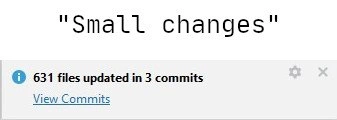
The screenshot quotes Small changes above a GitHub-style banner reporting 631 files updated in 3 commits. The deep dive explains why that mismatch wrecks code review, how formatters and lockfiles inflate diffs, and why teams split large work into focused pull requests.
Level 1: Tiny Label, Giant Box
This is funny because someone says they made a tiny change, but the evidence shows a huge pile of things moved around. It is like telling a friend you only cleaned one drawer, then they walk in and see every room in the house emptied onto the floor. Maybe there was a good reason, but nobody is having a relaxing weekend now.
Level 2: The Diff Avalanche
In version control, a commit is a saved set of changes, and a pull request is a request for other developers to review and merge those changes into the shared codebase. The banner in the image says 631 files updated in 3 commits, which means the proposed change affects a very large number of files even though the caption calls it "Small changes".
For a junior developer, this is a common surprise. You might change one setting, run a formatter, regenerate files, update a dependency, or rename something used across the project. Suddenly the tool says hundreds of files changed. The computer is not judging you, but your teammates might.
The problem is not that large changes are always bad. Sometimes they are necessary, especially in large codebases. The problem is that code review depends on attention. Reviewers need to understand what changed, why it changed, and what might break. A huge diff makes that harder because the reviewer must separate meaningful logic from noise.
Good teams often split this kind of work into smaller pull requests: one for formatting, one for generated files, one for the actual feature, and one for cleanup. That makes review less like searching a warehouse for one misplaced screw.
Level 3: Review Scope Detonation
"Small changes"
631 files updated in 3 commits
The screenshot works because it captures one of the most reliable ways to make a code reviewer age visibly: describing a change as small while the repository banner reports 631 updated files. That is not a diff; that is a weather system.
In a healthy Git and GitHub workflow, a small pull request usually means a narrow behavioral change, a focused set of files, and commits that tell a story the reviewer can replay mentally. This image shows the opposite tension. Three commits can be perfectly legitimate, but when they touch hundreds of files, the reviewer has to ask whether this is really one change or several unrelated operations wearing one trench coat: feature work, formatting, generated artifacts, dependency lockfile churn, snapshots, renamed paths, and maybe a little "while I was here" maintenance sprinkled on top.
That mismatch is why the meme belongs so naturally to VersionControl, CodeReviews, CodeQuality, and TechDebt. Large diffs destroy the signal reviewers need. A reviewer cannot easily tell whether a changed line is intentional product behavior, a mechanical refactor, a formatter pass, or an accidental edit from a local script. Even when most of the 631 files are harmless, the important question becomes expensive: where is the actual risk hiding?
The post text says Have a nice weekend!, which sharpens the joke. Anyone who has been handed a giant pull request late in the week knows the social ritual: the author says it is small, the tooling says otherwise, and the reviewer starts calculating how much trust they have in CI, tests, ownership boundaries, and the author's definition of "small." The "View Commits" link is almost cruelly polite; sure, click it, maybe the second commit is only 428 files.

Nothing says "small change" like invalidating every reviewer cache line in one diff.
When u don't gitignore node_modules
oh, 8= , here we go again..
It might be a rename in core lib though
1+1+629