
Scope Creep Meme Explained: Client Cool Ideas
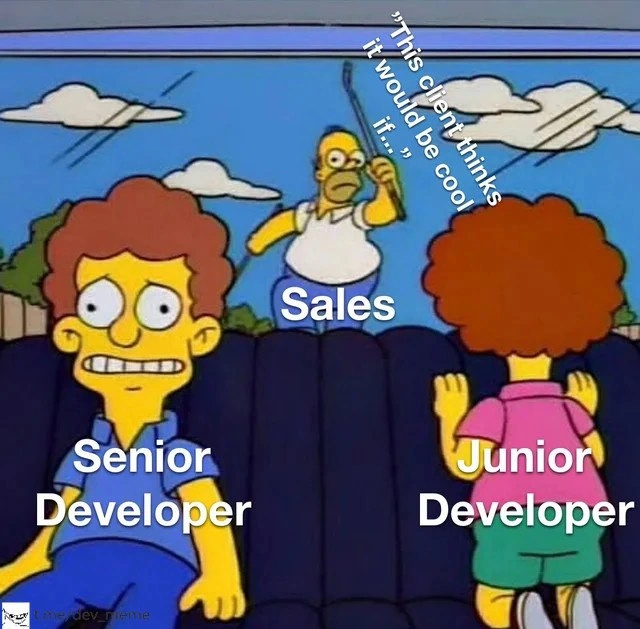
A Simpsons-style scene shows Sales dangling a vague client request over the fence while a junior leans in and a senior recoils. The deep dive unpacks how “would be cool if” often signals scope creep, missing requirements, and misaligned sales-engineering incentives.
Level 1: The Shiny Trap
This is like an adult offering a kid candy over a fence while another kid knows it probably means trouble. The junior developer thinks the new idea sounds fun, but the senior developer knows it may turn into a huge mess. The funny part is watching experience recognize the danger before innocence does.
Level 2: Requirements Bait
In software work, requirements are the agreed details of what a feature should do. Good requirements answer questions like who uses it, what problem it solves, what counts as done, and what should happen in weird cases. Scope creep is what happens when extra work quietly sneaks into a project after the team has already planned the time and cost.
That is why the fishing setup works so well. The bait is not a worm; it is a vague client request. A junior developer may hear it as "fun new feature." A senior developer hears "we need product clarification, design review, database changes, QA coverage, rollout strategy, and probably a rollback plan." The post message about a project manager driving faster fits the same pressure: move quickly, promise confidently, and let engineering discover the missing details later.
The joke also captures a common early-career lesson: not every request should go directly from stakeholder excitement into code. Sometimes the best engineering move is to ask boring questions first. Boring questions are how teams avoid exciting outages.
Level 3: Cool Means Expensive
The trap in this meme is the phrase dangling from the fishing line: This client thinks it would be cool if... That sentence looks harmless to the Junior Developer, but the Senior Developer already sees the incident report forming in real time. The word cool is doing spectacularly unpaid labor here. It can hide unclear requirements, missing budget, a product direction nobody approved, and an integration with a system last documented by someone who now raises goats in the mountains.
The image labels make the power dynamic blunt: Sales is behind the fence, Junior Developer is curious, and Senior Developer is visibly alarmed. Sales is not necessarily malicious; the problem is incentive alignment. Sales is rewarded for saying yes, clients are rewarded for asking ambitiously, and engineering is left translating enthusiasm into schemas, deadlines, edge cases, support load, and awkward meetings about why "just a button" became a quarter-long roadmap item.
The senior's fear is not the feature itself. Experienced developers have learned that scope creep often arrives as a vibe before it becomes a ticket. "Would be cool if" usually means there is no acceptance criteria, no owner for trade-offs, and no agreement about what happens when the cool thing collides with performance, privacy, billing rules, localization, permissions, or the existing architecture. The junior sees a chance to impress. The senior sees the words quick win sharpening a knife.
The senior is not afraid of the feature; they are afraid of the three unmodeled domains hiding behind the word "cool."