
RAG vs Pure Attention Meme Explained
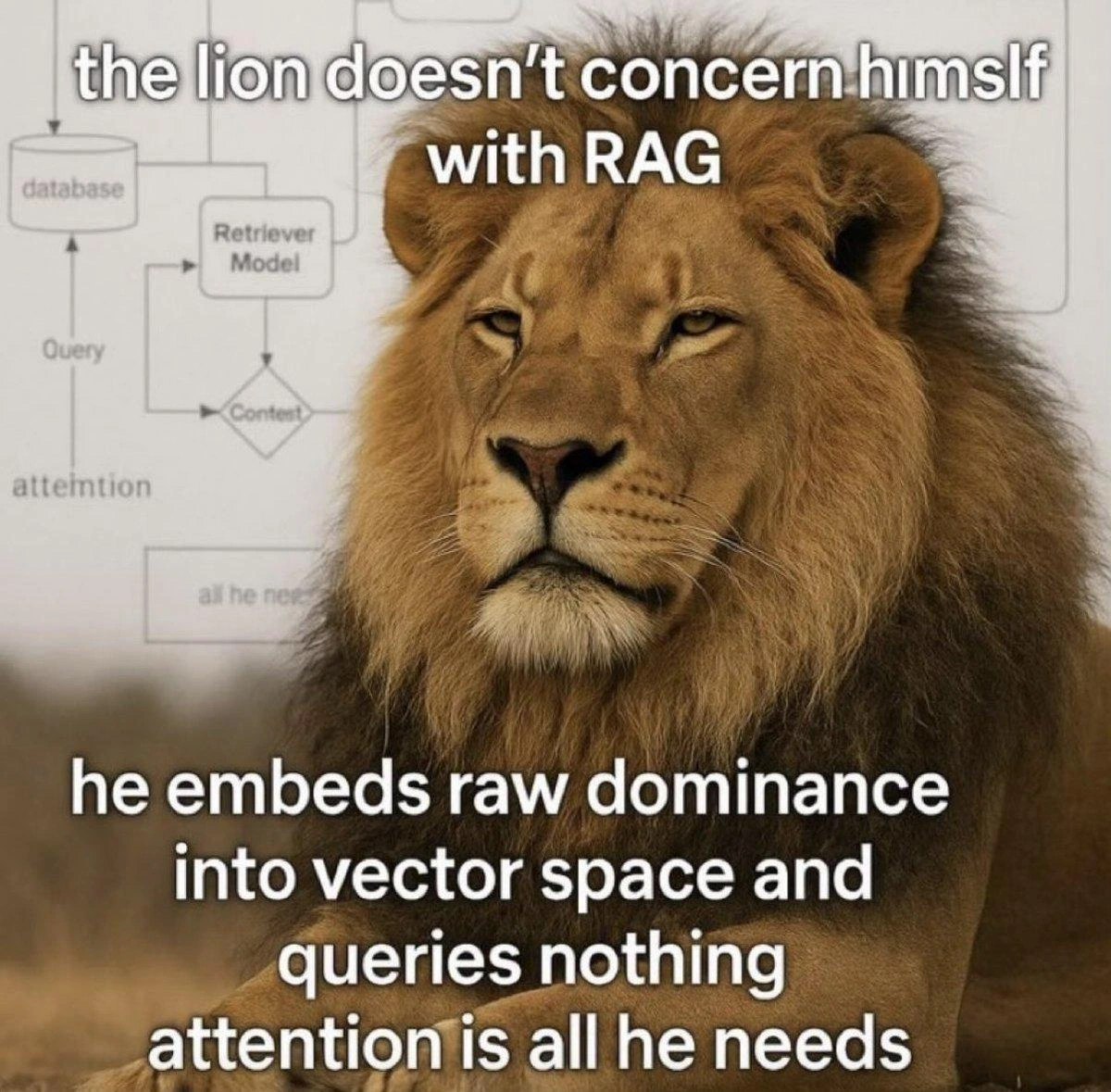
A stern lion meme rejects RAG, claiming attention is all he needs. The dive explains retrieval-augmented generation, embeddings, vector search, and why attention alone cannot replace external knowledge.
Level 1: The Lion Skips the Library
It is like a lion being asked a history question and refusing to look in a book because he feels powerful enough to know everything already. His strong stare may impress the room, but confidence cannot put missing facts into his head. The joke dresses that simple mistake in grand AI vocabulary, as though “raw dominance” were a substitute for checking the library.
Level 2: What the Lion Refuses
An embedding is a list of numbers representing features learned from data. Texts with related meanings can receive vectors that are close under measures such as cosine similarity. A simplified illustration might be:
"reset my password"  -> [ 0.18, -0.42, 0.73, ...]
"change login code" -> [ 0.21, -0.39, 0.69, ...]
The numbers are not human-readable definitions. Their geometry helps software compare the two phrases even though they use different words.
A vector database stores these representations and searches for nearby vectors. When a user asks a question, the system embeds the question, retrieves the most similar document chunks, and places those chunks in the model’s prompt. This is the retrieval part of RAG.
Attention is a mechanism inside a transformer model. Each token produces:
- A query, describing what information that token seeks.
- A key, describing what information that token can match.
- A value, containing information that may be combined into the output.
Similarity between queries and keys determines how strongly values contribute. Multiple attention heads can learn different relationships, such as connecting a pronoun with a noun or a function call with an earlier definition.
The two uses of “query” are related ideas but not identical operations. A retrieval query searches an external collection for passages. An attention query participates in matrix operations over representations already inside a model layer. The meme pretends the second makes the first unnecessary because both sound powerful.
RAG has ordinary failure modes a junior engineer eventually meets:
| Stage | Failure | Result |
|---|---|---|
| Chunking | Relevant facts are split badly | No retrieved passage contains the complete answer |
| Embedding | Query and document phrasing map poorly | Useful material ranks too low |
| Retrieval | Too few or irrelevant chunks return | The model receives weak evidence |
| Context assembly | Too much text is inserted | Important evidence is diluted or truncated |
| Generation | The model ignores or distorts evidence | A fluent answer is still wrong |
The background diagram hints at this real pipeline; the lion covers most of it and declares the whole thing beneath him. That contrast is the emotional core of technical satire: a complicated system full of failure points is “solved” by somebody announcing confidence louder than the architecture.
Level 3: Semantic Apex Predator
The meme gives an alpha-lion slogan an AI architecture review:
the lion doesn’t concern himslf with RAG
he embeds raw dominance into vector space and queries nothing attention is all he needs
The visible misspelling of himslf is preserved, which makes the absolute technical confidence even better. A stern lion occupies most of the frame and physically obscures a pale retrieval flowchart. Around him, fragments such as database, Retriever Model, Query, Context, and attention remain visible. He is not merely rejecting the architecture; his head has become the undocumented component blocking it.
Retrieval-augmented generation, or RAG, combines two kinds of memory. The language model’s learned weights act as parametric memory: patterns and facts compressed during training. A searchable document collection acts as non-parametric memory: information that can be added, removed, inspected, and updated without retraining the model. A typical request flows roughly like this:
user question
  -> query embedding
  -> similarity search
  -> top matching passages
  -> passages inserted into context
  -> language model generates an answer
The lion’s boast deliberately deletes the middle. “He embeds raw dominance into vector space” sounds mathematically formidable, but an embedding is useful only in relation to some task or comparison. A text encoder maps a query and documents to numerical vectors so that semantically related items can be placed near one another under a chosen similarity measure. If the lion queries nothing, no retrieval system compares his magnificent dominance vector with stored document vectors. He has built a coordinate and refused to ask where it is.
The last line twists the title of the 2017 transformer paper “Attention Is All You Need.” That title did not claim that attention eliminates databases, search, external knowledge, or every other system component. It meant that the proposed Transformer could perform sequence transduction without the recurrent and convolutional layers dominant in earlier architectures. In scaled dot-product attention, token-derived queries compare with keys, and the resulting weights mix values:
$$ \operatorname{Attention}(Q,K,V)
\operatorname{softmax}\left(\frac{QK^\top}{\sqrt{d_k}}\right)V $$
This lets each token selectively incorporate information from other positions in the model’s current sequence. It does not let the model attend to a private handbook, yesterday’s deployment notes, or a newly changed price unless that information enters the context or was somehow represented in the trained parameters. Attention chooses among information available to it; retrieval expands what is available.
That distinction is why the jargon forms a coherent technical joke instead of random AI word salad:
- Embedding without querying creates a representation that retrieves nothing.
- Attention without relevant context can reason over the wrong or incomplete evidence very elegantly.
- Parametric knowledge without retrieval may be stale, imprecise, or unable to expose provenance.
- RAG without good retrieval can inject irrelevant passages and make generation worse.
The lion’s approach is therefore not an advanced replacement for RAG. It is the confidence of a model answering from internal weights alone, recast as animal dominance. If the result is wrong, the lion will not concern himself with evaluation metrics either.
There is a fair criticism beneath the parody. Teams sometimes add a vector database because every contemporary architecture diagram appears to contain one. RAG introduces chunking policy, embedding-model choice, index maintenance, access control, approximate-nearest-neighbor tuning, reranking, context budgeting, latency, and observability. It is not automatically needed for questions the model already handles reliably or for applications that do not depend on external knowledge. “Do we need retrieval?” is a legitimate design question.
But swagger is not a design criterion. The answer depends on freshness, domain specificity, auditability, privacy, acceptable error, and operational cost. A system that must answer from current internal documents has a strong reason to retrieve them. A creative rewriting tool may not. The meme satirizes AI hype by replacing that trade-off analysis with a lion’s facial expression and three adjacent technical phrases. This is, to be fair, only marginally less rigorous than some vendor decks.
Cosine similarity is trivial when every vector points toward apex predator.