
Real Coders Use Java Meme Explained
A SpongeBob Patrick meme answers “No Patrick—real coders still use Java a lot.” The dive covers language wars, No True Scotsman gatekeeping, and why Java’s ecosystem, stability, and talent pool keep it dominant in production despite trendier rivals.
Level 1: If It Ain’t Broke…
Imagine a kid who thinks that professional builders must use those fancy electric nail guns for everything now, and that nobody serious would bother with an old-fashioned hammer. The child asks, “Real builders don’t still use hammers, right?” The builder smiles and replies, “Of course we do – we use hammers all the time because they’re reliable and get the job done.” The child is a bit surprised, but it makes sense: sometimes the old, trusty tools are still the best. This meme is funny for the same reason. It’s taking someone who doesn’t know better (Patrick, like that child) and humorously correcting them: yes, the “old” tool (Java, like the hammer) is still used by real professionals a lot! The joke clicks because it shows that new and shiny isn’t always what experts rely on – often they stick with what works.
Level 2: The "Real Coder" Debate
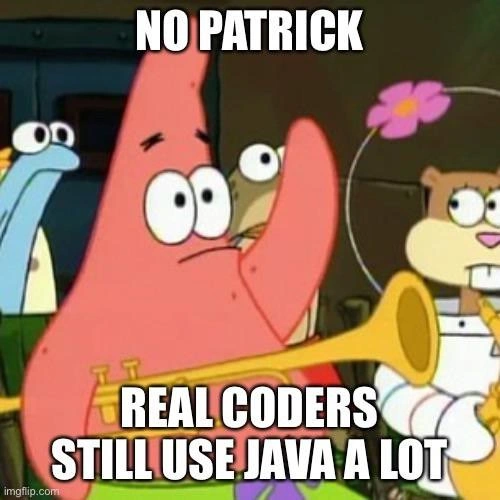
This meme uses a scene from the cartoon SpongeBob SquarePants to make a point about programming languages. In the image, the character Patrick Star (the pink starfish) is holding a trumpet with a perplexed look on his face. This comes from a famous SpongeBob episode where Patrick asks a very silly question (“Is mayonnaise an instrument?”) during band practice. In the show, he's immediately corrected by Squidward with a firm, “No, Patrick, mayonnaise is not an instrument.” Meme creators love this cartoon quote format – bold white text in all-caps at the top and bottom of an image – to humorously reframe Patrick’s clueless question and the curt response for other situations.
In our developer version of the meme, Patrick is essentially asking something naïve about programming, and the answer becomes: “No Patrick, real coders still use Java a lot.” The top caption “NO PATRICK” mimics the stern tone of correcting a misconception. The bottom caption delivers the punchline, swapping out the mayonnaise joke for a coding twist. Patrick’s confused expression, paired with that confident text, makes developers laugh because it feels like a senior engineer schooling a junior developer in a very straightforward way.
Now, let’s break down the tech meaning. Java is a very popular programming language that’s been around since the mid-1990s. It's known for its “write once, run anywhere” design (meaning a Java program can run on different computers without modification, thanks to the Java Virtual Machine). Java is heavily used in large companies for building backend systems – the behind-the-scenes software that powers websites, business applications, and Android apps. Because it’s been around for decades, some might casually label Java a “legacy” language (meaning it’s older and established). But legacy doesn’t mean “dead” or “bad” – it just means it has a long history. In fact, many programmers have a lot of respect for Java’s staying power (a bit of legacy language love 😀). It’s proven itself reliable over time. So when the meme says “real coders still use Java a lot,” it’s highlighting that Java is still extremely common in professional software development. Despite any rumors that it’s old-fashioned, Java is far from obsolete – it’s actively used in countless projects and industries every day.
The phrase “real coders” here means “serious, professional programmers” in a tongue-in-cheek way. People in the developer community sometimes joke or argue about what real programmers do – it’s a form of techie gatekeeping. This falls into the long-running programming language wars, which are basically friendly (and sometimes not-so-friendly) debates over which programming language is the best. Imagine one group of developers saying “Our language is the coolest and anyone not using it is behind the times,” and another group defending their favorite tool just as passionately. For example, a JavaScript fan might tease a Java developer about Java being verbose, or a C++ guru might claim that real programmers manage memory manually instead of relying on Java’s garbage collector. These debates can be intense, but often they’re done with a sense of humor and community rivalry, like fans of different sports teams ribbing each other.
This meme plays on that dynamic. Patrick (the clueless question-asker) could represent someone who believes that real modern developers have all moved on to newer languages and that Java is something only outdated or non-serious coders use. It’s like he’s asking, “Don’t real expert developers use the new cool languages instead of Java?” The meme’s answer is a firm “No.” It asserts that real, professional developers do indeed use Java — and use it a lot. This is a playful smackdown to the idea that Java is no longer relevant. In reality, many experienced engineers spend their days writing Java code because that’s what their systems and teams use to solve real-world problems.
This ties into language evangelism, where developers become cheerleaders for their favorite programming language. Sometimes enthusiasts exaggerate, saying things like “No serious programmer uses X anymore” or “If you’re a real coder, you only use Y.” Here the meme humorously flips that idea by implying the real coders are actually using good old Java. It’s poking fun at the notion that only new or fancy tools make you a “real” programmer. By using Patrick’s famously clueless persona, the meme exaggerates how absurd it sounds to claim real coders wouldn’t use a well-established language like Java.
So, what’s the takeaway for someone new to coding? The meme is basically a friendly reality check: Java is still very relevant and widely used by experienced developers. Yes, new languages and frameworks pop up all the time and generate buzz. It’s fun to explore them, but that doesn’t mean the older languages disappear or become “not real programming.” Think of Java as a trusty family car that’s still on the road while new sports cars come and go. A lot of big, important software (banking systems, online stores, Android phone apps) runs on Java. Developers with years of experience often continue to use Java because it’s reliable, they know it well, and it has a huge ecosystem of tools and libraries that get the job done.
The humor in the meme comes from the blunt, almost parental tone of the correction (“No, Patrick…”). Patrick is the perfect character for this joke because he often represents the well-meaning but uninformed viewpoint. The image of him holding a trumpet – as if he’s about to ask a completely off-the-mark question – sets up the punchline. When the text declares, “real coders still use Java a lot,” it’s like an expert gently but firmly correcting a novice’s misunderstanding. It’s funny because it reveals the gap between what someone thinks is true (“Java is old and no serious programmer uses it”) and what is actually true (“Java is everywhere and lots of programmers use it every day”).
In simple terms, the meme is saying: Don’t be silly – just because Java has been around a long time doesn’t mean real programmers have stopped using it! The SpongeBob scene makes the lesson light-hearted. It’s as if Patrick (the newbie) just learned in comedic fashion that his assumption was as goofy as thinking a jar of mayonnaise could be played like a trumpet. The joke resonates with developers because it highlights a common scenario in tech humor: new folks or outsiders underestimate an older technology, and insiders set the record straight with a laugh. Java isn’t gone at all – real coders are indeed tapping away in Java, and that’s perfectly normal in the programming world.
Level 3: Jar Wars: Hype vs Reality
The meme’s caption “No Patrick, real coders still use Java a lot” drops us right into the crossfire of the perennial language wars. It's a sarcastic, battle-hardened rebuttal in an ongoing culture clash within dev communities about programming stacks. Seasoned engineers immediately recognize this bit of developer humor — a tongue-in-cheek Java defense amid endless language evangelism and hype cycles. We’ve seen waves of new languages touted as Java killers, yet Java still stands tall, quietly running mission-critical backends while flashier tools come and go.
In developer communities, calling someone a "real coder" for using a specific language is a classic form of gatekeeping (and a logical fallacy known as the No True Scotsman argument). Decades ago, an infamous joke essay titled “Real Programmers Don’t Use Pascal” poked fun at this exact attitude. Today’s meme riffs on that tradition: it places a naïve Patrick (representing an inexperienced dev or pundit) in the hot seat and corrects him with a dose of reality. The bold Impact font caption format mimics an authoritative smackdown, as if refuting a wildly misguided question. The humor works because it flips the usual script. Typically, tech evangelists brag that only cutting-edge or “hardcore” languages count. Here, the punchline is that an established language is what serious developers rely on. It’s a cheeky reversal that makes seasoned devs smirk.
Why is this funny to a senior developer? Because it rings true. After surviving countless “Java is dead” headlines and Reddit flamewars, experienced devs know that Java’s ecosystem is a juggernaut. Sure, we hear the hype — “real devs use Rust,” “nobody uses Java anymore” — especially from enthusiasts chasing the latest trend. But then 3 AM hits, production is on fire, and guess which service is still steadily handling thousands of transactions per second? The boring battle-tested Java server that’s been running for years. Meanwhile, that shiny new microservice someone wrote in the trend-of-the-month language might be struggling with a memory leak or an odd crash. Seasoned engineers have witnessed this pattern enough times to appreciate the meme’s blunt truth: hype is hype, but proven tech endures. The caption isn’t really putting down newer languages; it’s just dryly observing that when the dust settles, Java often ends up carrying the load in critical systems.
There’s history behind this as well. Java emerged in the mid-’90s promising “Write Once, Run Anywhere,” and it largely delivered. Over the decades it amassed a huge ecosystem of libraries (from Apache Commons to Spring) and a reputation for reliability at scale. Many enterprise architectures were built on Java, resulting in millions of lines of code that won’t magically evaporate just because a new language is trending on Hacker News. Every few years, a new contender – be it Ruby, Node.js, Go, or Kotlin – is proclaimed the future, and bold predictions of Java’s demise resurface. Yet time and again, Java adapts (improving performance with the HotSpot JVM, adding modern features like lambdas, embracing open-source tooling) and keeps chugging along in production. The meme is nodding at this predictable narrative twist: after all the flashy new languages have had their buzz, Java is still there quietly running the show at the end of the day.
In practice, real coders use whatever language gets the job done – and very often, that language is Java because of hard realities like these:
- Legacy code and stability: Huge codebases already exist in Java (some call it legacy language love)*. Companies aren’t going to rewrite a stable, million-line system in the latest fad language just to appear trendy. Real engineers know stability and maintainability often trump trendiness.
- Ecosystem and support: Java has a mature ecosystem and decades of accumulated knowledge in its developer community. Need a library for something? There’s probably a rock-solid Java library for it. Newer languages are exciting, but Java’s extensive tooling and support give it an edge for serious projects.
- Performance at scale: The Java Virtual Machine has been highly optimized over years. With just-in-time compilation and efficient garbage collection, Java applications can handle enormous scale. Many high-throughput systems (financial trading platforms, large e-commerce sites) rely on Java because it delivers reliable performance under heavy loads.
- Talent and skills availability: There are millions of Java developers out there. It’s easier for teams to hire and for organizations to find expertise for an established language like Java. When you have 50 developers who know Java in your company, choosing Java for the next service is a practical decision.
All these factors mean that Java remains one of the most popular programming languages in real-world use, even if it’s not always the trendiest topic on Twitter. The meme captures that reality with a laugh. Patrick – a character who literally lives under a rock in the cartoon – is clueless about Java’s continued prominence, making him the perfect avatar for someone oblivious to industry realities. The caption’s firm tone sets him (and by extension, anyone who thinks “no real coder uses Java anymore”) straight. It’s the same energy as a veteran developer saying, “Listen up, kid: that old Java system isn’t going anywhere. We rely on it every day.”
For battle-scarred developers, this meme elicits a knowing chuckle of recognition. It satirizes the endless language popularity battles and reminds us that despite all the evangelists shouting about the Next Big Language, a lot of serious software is powered by tried-and-true tech. It’s funny because it’s true: the backbone of many critical applications isn’t the latest hip tool, but the reliable one that’s been there all along. Java, love it or hate it, fits that description – and that’s exactly why this meme lands so well among experienced coders.


Claiming Java is dead is a classic junior move. Seniors know that legacy enterprise systems running on Java 8 will outlive us all, guarded by the ghosts of ten thousand AbstractFactory patterns
Sure, the new hires push Rust and serverless, but every quarter-close reminds them: nothing says “enterprise-grade” like a 300 MB Java WAR quietly running payroll since 2006
Patrick's right though - while we're all debating Rust vs Go in our side projects, half the Fortune 500 is still running on Spring Boot apps maintained by teams who've perfected the art of AbstractFactoryFactoryBean configuration
Java has been declared dead annually since 1999, yet it still processes your paycheck, your flight booking, and the Kafka cluster that lost neither
The irony here is that Patrick is actually correct - despite the constant 'Java is dead' proclamations from HN and Reddit, TIOBE consistently shows Java in the top 3, and if you've ever tried to hire for a Fortune 500 backend position, you know the JVM ecosystem isn't going anywhere. The real joke is that while everyone's chasing the new hotness, there are literally millions of production Java applications quietly running the world's financial systems, e-commerce platforms, and Android devices. Patrick's megaphone is just drowning out the sound of Spring Boot applications starting up in every data center on Earth
Java: Biennially declared dead since '96, yet still the unseen JVM monolith powering 70% of Fortune 500 backends
Every roadmapping meeting ends the same: someone suggests Rust, the CAB estimates the blast radius, and we ship another Spring Boot jar because -Xmx40G costs less than a compliance audit
Everyone dunks on Java until your throughput SLA has commas - then suddenly you’re fluent in GC pause times, JIT warm-up, and which Spring Boot actuator you forgot to lock down
Sad
But true
Just use Kotlin...
No Patrick, OOP is actually very useful and a lot of developers use it
kids in r/programminghumor be like
No new memes?