
Java by Committee Meme Explained
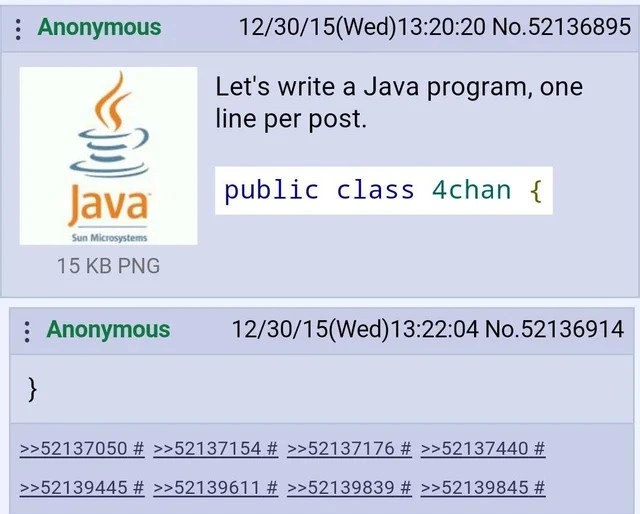
A 4chan-style thread tries to write Java one line per post: an invalid class name, then a lone closing brace. The deep dive explains why that fails to compile, what empty classes mean, and why anonymous collaboration often ends in trolling.
Level 1: The Empty Group Project
This is like a group project where the first person writes "Chapter 1" but spells the title wrong, and the second person immediately writes "The End." Everyone technically added something, but nothing useful was made, and the mistake at the beginning means the teacher will not accept it anyway.
Level 2: Braces Before Features
In Java, a simple class often looks like this:
public class Example {
    public static void main(String[] args) {
        System.out.println("Hello");
    }
}
The braces { and } mark the beginning and end of a block. The meme starts a class block, and the reply immediately ends it. That creates an empty class, which can be legal in Java if the class name is valid. Here it is not valid, because 4chan begins with 4. Java class names must be identifiers, and identifiers can include digits but cannot begin with them.
For a newer developer, this is a compact tour of early programming pain:
- Syntax errors happen when the code does not follow the language grammar.
- Compiler errors appear before the program runs, because Java checks the source first.
- Language gotchas include rules like "a digit is allowed inside a name, but not at the start."
- Bad practices include letting random people add production code one line at a time with no review, unless the goal is performance art.
The reply containing only } is funny because it looks like cooperation while ending the effort instantly. It is the code-review equivalent of approving a ticket by deleting the feature.
Level 3: Committee Compilation
The visible thread proposes:
Let's write a Java program, one line per post.
The first contribution is:
public class 4chan {
and the entire next contribution is:
}
That is the perfect two-post summary of software design by anonymous committee: an ambitious kickoff, followed immediately by someone closing the scope before anything useful can happen. The result is not a program so much as an empty container for disappointment. Even better, the first line is already broken because 4chan is not a valid Java class identifier. Java identifiers cannot start with a digit, so the compiler does not get to the philosophical question of whether the project needs requirements, tests, or a product owner. It fails at the door.
The humor lands on multiple layers. As developer community comedy, it captures how public collaboration can turn into sabotage or minimal-effort trolling. As compiler error comedy, it shows that the project is syntactically doomed before the second post contributes its aggressively unhelpful closing brace. As code quality satire, it compresses a whole failed project into two lines: invalid naming, no behavior, no main method, no purpose, and probably a meeting scheduled to discuss why velocity is down.
The class being named 4chan matters because the image is styled like an anonymous imageboard post. The environment itself is the punchline. Asking a crowd of anonymous posters to cooperatively write Java one line at a time is not pair programming; it is distributed chaos with semicolons. The second poster understands the assignment in the most hostile possible way: technically contributing a valid line while ensuring the program remains useless.

The first design review found two blockers: distributed authorship and a class name that fails before the JVM even gets invited.
Teg-class
lets do this here public class dev_meme {
Convert this shit to Kotlin😂😂
Let's try that again. public class dev_meme {
True, true
So much time spent in Scala...
this is the best constructor in existence
ok, so far we have public class dev_meme{ int angle_of_attack; public dev_meme(){ while(true){ break; } System.out.println("Hello World!");
it does compile fyi
more challenges to lucky guys
edited