
Open Source Diversity Meme Explained
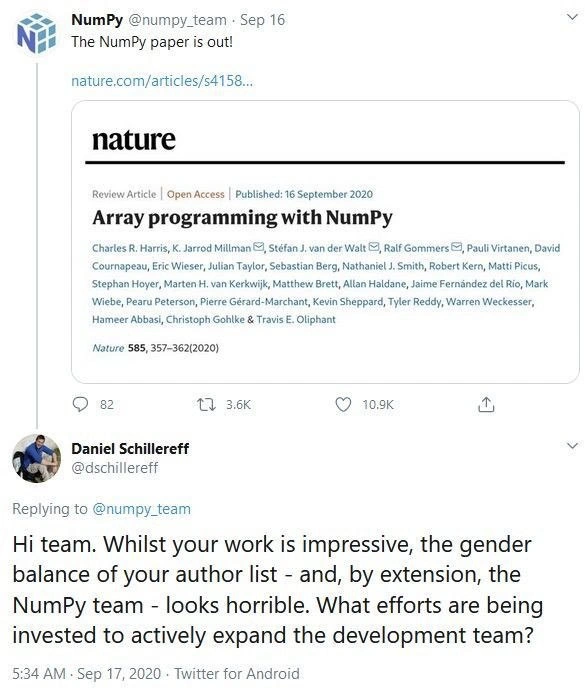
NumPy announces a Nature paper on array programming, then a reply critiques the author list’s gender balance and asks about team expansion. The dive frames the tonal whiplash as classic open-source governance tension.
Level 1: The Party Comment
It is like someone proudly showing a big school project to the whole class, and the first response is, "Great work, but why did only one kind of person get to help make it?" The funny part is the sudden change in mood: celebration turns into a serious fairness question before anyone has even finished clapping.
Level 2: More Than Code
NumPy is a Python library for arrays, numerical computing, and scientific programming. When people analyze data, train models, process images, run simulations, or use libraries built on scientific Python, NumPy is often part of the stack underneath.
The screenshot shows a tweet from the NumPy account announcing a paper, with engagement counts underneath and a public reply below it. The visible reply is not about an API bug or performance benchmark. It asks about the gender balance of the author list and what the team is doing to expand the development team.
That connects to OpenSource, DeveloperCommunity, and CommunityDynamics because open-source software is created by people, not just repositories. A project can have excellent code and still need to think about who can join, who feels welcome, who has time to contribute, who gets reviewed kindly, and who receives public credit.
For newer developers, this is a useful reminder that software communities have social architecture. Governance, documentation, mentoring, code review tone, funding, and contributor recognition all shape the project just as surely as function signatures do.
Level 3: Peer Review Escalated
The screenshot is funny in the uncomfortable way open source is often funny: a technical victory immediately becomes a community governance conversation. NumPy posts:
The NumPy paper is out!
The embedded article card reads:
Array programming with NumPy
Then the reply shifts the whole scene from celebration to accountability:
Hi team. Whilst your work is impressive, the gender balance of your author list - and, by extension, the NumPy team - looks horrible. What efforts are being invested to actively expand the development team?
That tonal whiplash is the meme. NumPy is not a trendy side project; it is foundational Python and DataScience infrastructure. A Nature review article is a rare mainstream academic recognition for software that many scientists use every day without thinking about the maintainers behind it. The reply treats the author list as evidence of a deeper OpenSourceCulture issue: who gets to build, maintain, be credited for, and eventually lead the tools everyone depends on.
The senior-developer read is that both things can be true at once. The work can be technically impressive, historically important, and deserving of celebration. The visible author list can also raise fair questions about representation, onboarding, credit, mentorship, and contributor pathways. Mature open-source projects are not only codebases; they are institutions with governance, norms, maintainership bottlenecks, and reputational gravity.
The joke is not "someone asked about diversity." The joke is the extremely open-source timing: the project finally gets a high-status publication, and the replies immediately become the issue tracker for community structure. Somewhere, a maintainer saw 10.9K likes and still thought, "Please, just one clean release announcement. One."

Open source finally gets cited in Nature, and the first peer review arrives as a governance issue in the replies.