
Date Format Localization Meme Explained
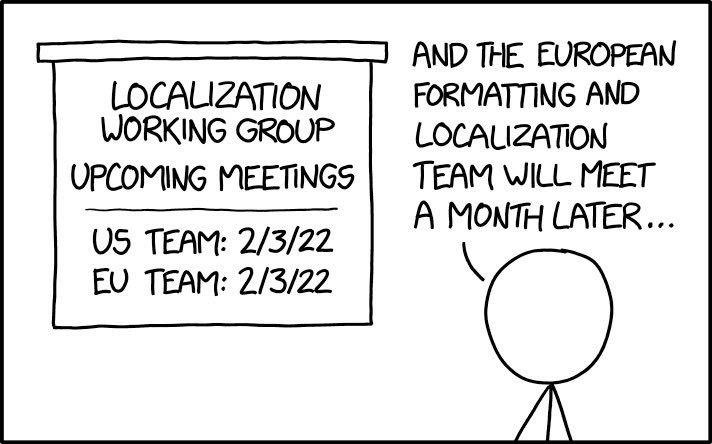
A flip chart for a localization working group lists US and EU meetings as 2/3/22, while a stick figure notes Europe meets a month later. The dive covers month/day vs day/month parsing, internationalization, and unambiguous date data.
Level 1: Two Calendars
Imagine two children get the same note: 2/3. One child was taught that the first number is the month, so they show up on February 3. The other was taught that the first number is the day, so they show up on March 2. The funny part is that the people in charge of making messages clear for different places wrote the kind of message that makes everyone confused.
Level 2: Parsing the Punchline
Internationalization, often shortened to i18n, means designing software so it can work across languages, regions, calendars, currencies, writing directions, and user expectations. Localization is the part where the product is adapted for a specific audience. Dates are one of the classic traps because many formats look familiar while meaning different things.
The sign shows two teams with the same meeting date:
US TEAM: 2/3/22
EU TEAM: 2/3/22
To a US reader, that usually means month/day/year. To many European readers, it usually means day/month/year. The stick figure's line says the European team will meet a month later because 2/3/22 can be parsed as either February 3 or March 2. Early-career developers often discover this when a form works locally, then a user in another country reports that birthdays, invoices, trial expirations, or appointment reminders are off. The fix is not "tell users to be less confusing"; the fix is to make the interface and data model explicit.
This is also why TechnicalCommunicationSkills matter in engineering. A requirement like "show the meeting date as 2/3/22" is incomplete unless it says whose locale, what timezone if time is involved, whether the value is a calendar date or an exact instant, and how it should be validated. The original post's phrase 2nd attempt to meet today adds a nice little twist: even the retry can depend on which calendar convention you thought the first attempt used.
Level 3: Calendar Shrapnel
LOCALIZATION WORKING GROUP
UPCOMING MEETINGS
US TEAM: 2/3/22
EU TEAM: 2/3/22AND THE EUROPEAN FORMATTING AND LOCALIZATION TEAM WILL MEET A MONTH LATER...
The joke works because the sign commits the exact sin a localization working group exists to prevent: it publishes a date as an ambiguous string and lets each audience bring its own parser. In common US usage, 2/3/22 reads as February 3, 2022. In much of Europe, the same characters read as 2 March 2022. Nothing on the sign says which convention is authoritative, so both readings are plausible, and the speaker's "a month later" is not a misunderstanding so much as a predictable production incident with better handwriting.
This is a DataFormats problem wearing a meeting-room badge. A date shown to humans is not the same thing as a date stored in a system. Teams get into trouble when they reuse one representation for both jobs: a compact display string for people, a durable value for APIs, validation, logs, scheduling, reminders, and emails. MomentJSDateHandling, DateFNS, native Date, and backend serializers can all behave "correctly" inside their configured assumptions while the business outcome is still wrong. That is the special cruelty of localization bugs: the code may pass tests because the tests were written by people with the same cultural defaults as the code.
The visual simplicity makes the anti-pattern sharper. The board says LOCALIZATION WORKING GROUP, then immediately demonstrates Miscommunication, RequirementsAmbiguity, and weak DataValidation in four lines. A safer system would store an unambiguous date value, display it in each user's locale, and avoid naked numeric dates in cross-regional coordination. 2022-03-02, 3 February 2022, and 2 March 2022 are not equally pretty, but prettiness has never joined the incident call and apologized.
ISO 8601 exists because `2/3/22` is a distributed-systems bug wearing a calendar costume.
ffs
Oh, I think they are too busy right now for this
The best time format is 2022 3. 4. 14:41 (YYYY MM DD hh:mm)
Idk why US citizens use even for thier dates little endian
Also idk why germans write 137 but pronounce it as "100, 7 and 30"
1387465 is pronounced as: 1000000, 300, 7 and 80000, 400, 5 and 60
Hungarian it is: 1 egy 2 kettő 3 három 4 négy 5 öt 6 hat 7 hét 8 nyolc 9 kilenc 10 tíz 11 tizenegy 12 tizenkettő 13 tizenhárom 19 tizenkilenc 20 húsz 21 huszonegy 24 huszonnégy 30 harminc 31 harmincegy 40 negyven 41 negyvenegy 50 ötven 60 hatvan 70 hetven 80 nyolzvan 90 kilencven 100 száz 101 százegy 200 kettőszáz 200 kétszáz 202 kettőszázkettő 202 kétszázkettő
Also look what happens to the marking in tíz húsz etc
Probably because you cant say the full numbers in one tact😂😂😂
I mean you can
But it's not sounding good/understandable
Btw: cs dz dzs gy ly ny sz ty are one sound and are also defined as 1 letter
You also can never split them
If you want to double them, then you only double the first one (dzs can't be doubled and there are literally 2 words that use it) Like double sz would be ssz
L sounds just like the L in hello. But LY sound like Y in you. The J sound exactly the same. This is the only thing in Hungarian writing that has no true rule. Because it doesn't matter which one you use while writing. In spoken language its the same
write 100 + 20 + 3 in flie names: 123 for everyday stuff: 321