
Software Bug Hunting Meme Explained
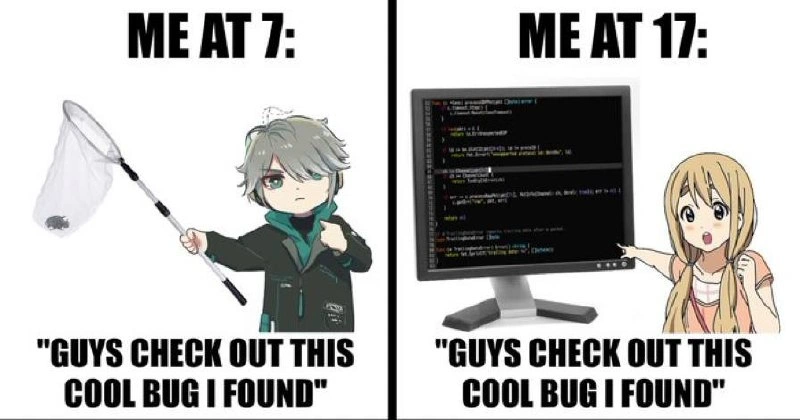
A two-panel meme shows a kid with a net and a teen pointing at IDE code, both saying "guys check out this cool bug I found." The dive links childhood bug collecting to software debugging, from Grace Hopper's moth to Jira backlogs and the pride of finally trapping a glitch.
Level 1: Look What I Found!
Remember how excited you felt as a little kid when you discovered something weird or cool, like a shiny bug in the backyard? You couldn’t wait to show it off to your friends or family, right? Now imagine a similar feeling, but instead of a real bug, it’s a mistake in a computer program. When people write code (the instructions that tell a computer what to do), sometimes things go wrong – kind of like building a LEGO tower and finding one piece is out of place. Finding that little mistake can be just as satisfying as finding a ladybug under a rock. This meme is saying that as we grow up, our toys and tools change (butterfly nets turn into computers!), yet we can still feel that same excitement. A 7-year-old shows off a cool insect they caught, and a 17-year-old shows off a tricky computer bug they figured out. It’s funny and sweet because it shows that deep down, we’re all curious kids when we discover something new. Whether it’s a creepy-crawly in a jar or a glitch on a screen, we love to say, “Hey, look what I found!”
Level 2: Bug Hunting 101
In software development, a bug is just a nickname for a mistake in the code. It could be a typo, a logic error, or anything that makes the program act funny or crash. When programmers talk about debugging, they mean the process of finding and fixing these mistakes (literally "taking the bugs out" of the code). It’s a bit like being a detective: you see clues (error messages, weird behavior), and you investigate to find what's causing the problem. The meme compares this to a kid catching insects. At 7 years old, "look at this cool bug" means a cool insect – maybe a ladybug or a butterfly caught with a net. At 17, if you’re into coding, "look at this cool bug" means a software bug – like a glitch in your program that you’ve tracked down.
The left panel with the child and net is symbolic: that net is a tool to catch bugs. On the right, the teenager pointing at the monitor is using their own tools: a computer with a code editor or an IDE (Integrated Development Environment). The screen is dark with syntax-highlighted code (different colored text that helps programmers read code more easily). Maybe there’s an error message or a highlighted line on that screen – that’s the “bug” they found in the program. An IDE log or console is where the program might print out an error message, kind of like the bug’s hiding spot. For example, if a program crashes and prints NullReferenceException at line 42, that’s a clue a bug lives at line 42 of the code. Finding that is exciting when you’re new to coding because it means you can fix it and make your program work.
This meme is relatable for many developers because discovering your first few software bugs is oddly thrilling. It’s a big part of the learning curve in programming. In the beginning, you might even be proud of finding a bug because it means you’re learning how the code works. You might call your friends over or post in a chat: “Guys, check out this weird bug I found!” just to share the crazy thing that happened. It’s half frustration, half pride – frustration that the bug gave you trouble, but pride that you caught it. Just like a kid might carefully keep a captured firefly to show others, a young coder might save a screenshot of a funky glitch or a particularly tricky bug as a memory. Over time, you learn that debugging is an everyday part of coding. Not every bug feels “cool” when you’re on a deadline (some are debugging nightmares that make you tear your hair out), but the meme highlights the positive, curious mindset: treating a bug as something cool to investigate rather than just a headache. And indeed, many programmers stay curious like that kid with the bug jar – always ready to chase down the next bug hiding in their code.
Level 3: Jar to Jira
At age 7, a kid might keep an actual insect bug in a jar as a prized find. Fast forward to 17, and that same excitement shifts to software: finding a sneaky error in code. The meme cleverly equates collecting insects with collecting software bugs. In programming, a "bug" is a flaw or error that makes the software behave in unexpected ways. And just like showing off a rare beetle, developers sometimes proudly show off an elusive code bug they’ve finally captured (or figured out) in their program. It’s a rite of passage in debugging: you spend hours chasing a weird glitch, and when you finally trap it, you can’t help but share the victory.
This dual-panel joke hits on a bit of tech lore, too. The term debugging literally comes from removing an actual bug: early computer pioneer Grace Hopper documented a case in 1947 where a moth was found stuck in a relay of a Mark II computer, causing an error. They taped the moth into the logbook and wrote "First actual case of bug being found." So in one panel we have a child with a net and a jar (classic bug hunting kit), and in the other panel a teen has an IDE on-screen with code — the modern "jar" is maybe an IDE log or a bug tracker like Jira. We’ve evolved from pinning moths to logging exceptions. Instead of a butterfly collection, a developer might accumulate a bug backlog in Jira (each ticket a specimen of something gone wrong).
For seasoned engineers, the humor cuts both ways. On one hand, we still call errors “bugs” and talk about bug hunting as if we’re entomologists of software. On the other hand, what a 17-year-old dev calls a “cool bug” might make a senior dev groan — because behind every cool bug is often hours of lost sanity. Yet, there’s a shared understanding: whether it’s a bizarre memory leak or a UI glitch that only happens on Tuesdays, discovering the root cause can feel like capturing a rare creature. It’s a moment of triumphant curiosity. The meme nails this relatable dev experience: the youthful enthusiasm of “Guys, check out this cool bug I found!” is something many of us have felt, especially early in our coding journey, even if later we learn to say it with more sarcasm. The joke is that deep down, even the grizzled coder inside us remembers that first thrill of debugging—finding a bug can be oddly satisfying, just as catching an interesting insect was in childhood.



The thrill of finding a cool bug is timeless. The only difference is that at 17, you can't just put it in a jar and forget about it; you have to write a regression test
Seven-year-old me: beetle in a glass jar. Thirty-seven-year-old me: zombie thread in a Kubernetes pod - turns out we never outgrow bug collecting, we just pay for more expensive containers
The only profession where finding bugs after 10 years of experience still makes you excited enough to show everyone - though now it's because you finally found the root cause of that intermittent production issue that's been haunting your on-call rotation for months, not because it has pretty wings
The real character development arc isn't going from junior to senior - it's realizing that at 17 YoE you're still just as excited about finding bugs, except now they're race conditions in production instead of ladybugs in the garden. The butterfly net gets replaced with gdb, but the dopamine hit of 'I found it!' remains unchanged. Senior engineers don't lose their enthusiasm; they just redirect it toward increasingly esoteric edge cases that make their teammates question their sanity
Childhood bugs were finite and catchable; now they're recursive heisenbugs that vanish under observation
From butterfly net to Jira: the cool bug I found now only reproduces at p99 during cross‑region failover when retries ignore backoff; turn on debug and it vanishes - classic Heisenbug
At 7 a bug earned me a jar; at 17 it earns me a Jira, a SEV‑2, and permanent ownership of the module I didn’t know existed
Me at 27: "Guys i fixed this bug i found 10 years ago"
Boy became a femboy
why did I read "me at" as "meat"? now I cannot un-see it
https://www.quora.com/Can-my-gender-pronouns-be-he-her
MEAT 7
Are we going to talk about how he turned to a femboy?
man i sure do love the rule that every programming related community sooner or later devolves into trans dispute is there an objective reason for that?