
DNS Failures Meme Explained
The meme captures the ops denial arc from "it's not DNS" to "it was DNS." The dive explains why name resolution hides behind app failures: wrong records, caches, TTLs, split-horizon setups, and public domains returning private IPs.
Level 1: The Wrong Address Book
DNS is like an address book for the internet. You ask it, “Where does this place live?” and it gives you an address. The joke is that people often insist the address book cannot be the problem, then after checking everything else, they find out the address book had the wrong address all along. It is funny because the simplest hidden thing can waste the most time.
Level 2: Names Need Answers
DNS, the Domain Name System, is the internet’s naming system. Humans use names like example.com; computers need addresses like IPv4 or IPv6 values. DNS connects those two worlds. An A record maps a name to an IPv4 address. A DNS server answers questions about names, and a DNS cache stores answers for a while so the same lookup does not have to be repeated constantly.
The meme is funny because DNS sits underneath almost everything. If DNS gives the wrong answer, your application may look broken even when the application code is fine. A web request can fail before it reaches your server. A database connection can point at the wrong host. A certificate can appear mismatched. A load balancer can look unhealthy. The error message often does not say, “Hello, I am DNS, the ancient tax you forgot to pay.”
DNS propagation is the everyday name for waiting while updated records stop being stale across caches. If a bad record was cached for an hour, fixing the source record does not instantly fix every resolver that already copied the old answer. That is why operations teams ask which resolver you used, where you tested from, whether VPN was on, and what dig or nslookup returned. They are not being pedantic. They are mapping where the lie still lives.
Level 3: The Root Of Denial
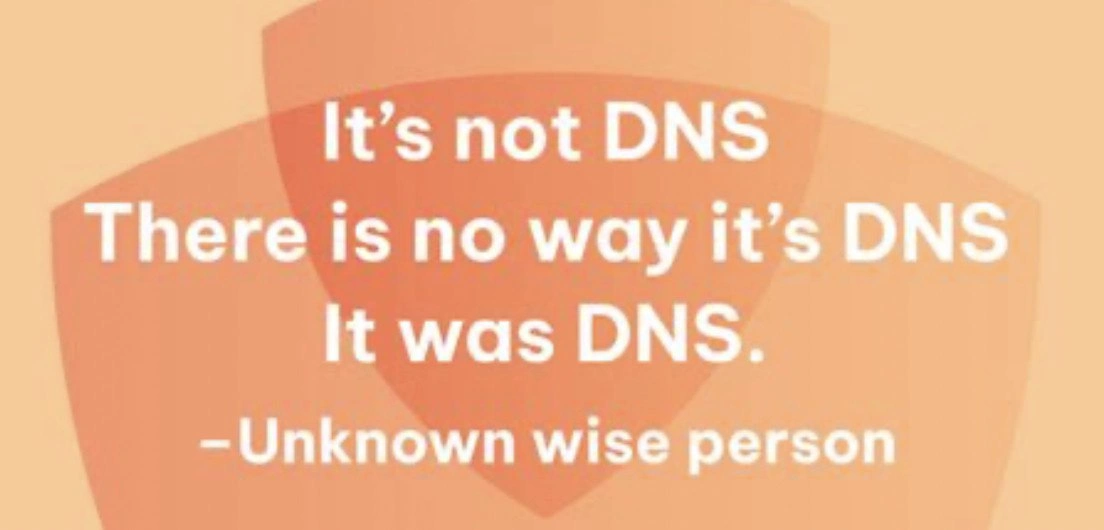
The image is pure operations folklore in four lines:
It's not DNS There is no way it's DNS It was DNS. -Unknown wise person
The joke works because every experienced developer, sysadmin, SRE, or network engineer has lived this exact emotional arc. A service fails, the app logs look suspicious, someone blames the deploy, another person restarts a pod, a third person opens a dashboard with great confidence, and eventually the boring answer crawls out from under the floorboards: DNS. Name resolution is so foundational that people forget it exists until it stops resolving reality correctly.
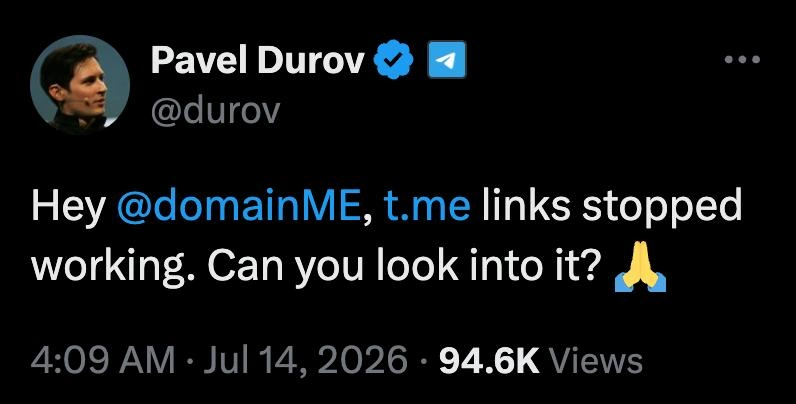
The associated post adds a specific kind of DNS nightmare: records for a major domain reportedly included private 192.168.1.0 and 192.168.1.1 addresses. Those are addresses from a private IPv4 range commonly used inside home and office networks, not public internet destinations. If a public domain returns private LAN-looking addresses, weird things can happen depending on resolvers, rebinding protections, local network setup, browser behavior, and cache state. Some systems may reject the answer. Others may try to connect somewhere local. Many will simply make the incident look like five different unrelated failures because DNS enjoys wearing disguises.
The deeper pain is that DNS failures are rarely binary. A bad DNS record might be fixed at the authoritative nameserver while recursive resolvers continue serving cached answers until their TTL expires. Split-horizon DNS can return one answer inside a network and another outside. Corporate VPNs can override resolvers. Local hosts files can lie. Container runtimes can add their own resolver layer. Browsers and operating systems can cache differently. That is why “it works for me” is practically a DNS diagnostic smell, not reassurance.
This is also why debugging DNS feels insulting. The mechanism is conceptually simple: turn a name into an address. The operational reality is a distributed, cached, delegated system where stale state can persist in many places. Smart engineers skip DNS because the application failure looks too specific, too high-level, too obviously caused by the new release. Then dig ruins everyone’s afternoon. Again.


DNS is the distributed system everyone debugs last and unknowingly depends on first.
What?
Eat some shit, MS
wtf?
Fuckers
What the actual fuck?
it is real?
I mean I have a subdomain that points to one of my local devices IPs but what is that? Like does anybody know a reasoning behind what ms did?
So you don’t know why and what this causes but it’s because Microsoft is shit?
Good for you ig
they did revert this
Can anybody explain what it means for someone not so close to the internals of the Internet?
In Armenia there's a thing with some taxes related government service, it has 2 A-records. The 1st one points to a local IP in the dev team network, the 2nd to an actual public backend. So you either have to hardcode the public one in your hosts file locally or just spam refreshes until you get lucky and round-robin hits the public IP.
The bundled ms-office online and for Android is so buggy, I switched back to cryptpad
Alright, that's why i use other subnet. Suck ms