
DNS Domain Hold Outage Meme Explained
Pavel Durov publicly asks DomainME to fix t.me while prayer hands do severity-one duty. The dive explains serverHold, DNS dependency risk, and why Telegram can be up while short links vanish from the map.
Level 1: The Missing Street Sign
Imagine a huge shop that is still open, staffed, and full of products, but the city suddenly removes its street name from every map. Customers cannot find the door, and the owner has to stand in another company’s town square shouting, “Hey, map office, can you look into it?” The machinery inside the shop may be fine; the ridiculous crisis is that one missing name can make the whole place seem gone.
Level 2: DNS Pulls the Plug
The Domain Name System, or DNS, translates names such as t.me into records that direct software toward servers. The .me portion is a country-code top-level domain. Its registry maintains the authoritative database for names under that suffix, while a registrar normally provides the customer-facing registration service. Those roles are related but not interchangeable.
EPP is a protocol registries and registrars use to manage domain objects. serverHold is a registry-set status telling the DNS publication system not to include the domain. It is different from an expired certificate, a crashed web server, or a bad application deployment: clients fail before they can reach Telegram’s HTTP service. Existing DNS caches may answer temporarily until their time to live expires, so users can observe a staggered failure even though one registry action caused it.
The visible view count and verified profile make the communication breakdown especially absurd. This is not an engineer pasting diagnostics into a private incident channel; it is a founder asking for help in public while tens of thousands watch. Public escalation may create fast pressure, but it also signals that the normal support relationship did not produce a quieter, faster resolution before the outage became content.
Level 3: Escalation by Mention
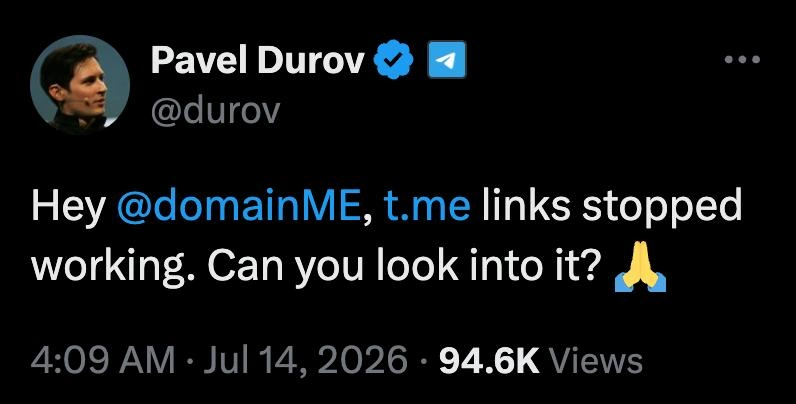
“Hey @domainME,
t.melinks stopped working. Can you look into it? 🙏”
The screenshot compresses a global production incident into the tone of asking a neighbor to check the fuse box. Pavel Durov, Telegram’s founder, is publicly contacting the operator of the .me registry on X because Telegram’s short-link domain no longer resolves. The funny part is not merely that a CEO posted during an outage; it is that an @-mention on a competing social platform appears to be the visible escalation path for infrastructure supporting an enormous link namespace.
The failure occurred at a layer below Telegram’s web application. The registry placed t.me in the EPP status serverHold, which means the domain is not published in the .me DNS zone. As cached records expired, recursive resolvers could no longer obtain the records needed to turn t.me into a destination. Telegram’s servers could be healthy and its messaging application could remain usable while browsers still failed to open channel, profile, and invitation links. “The service is up” becomes a wonderfully useless comfort when users cannot resolve the name by which they reach it.
The July 14, 2026 timing is integral to the joke because this post was part of the incident itself, not a retrospective parody. DomainME later attributed the hold to OFAC compliance: a sanctioned service’s listed infrastructure included a Telegram channel path beneath t.me. That exposed a brutal mismatch between policy granularity and network architecture. DNS delegates hostnames; it does not understand an HTTP path identifying one channel. A registry-level hold therefore acts on the entire domain rather than one piece of content. The control available at that layer was a sledgehammer with excellent global propagation.
This is also a clean example of operational risk hidden in a tiny dependency. A short domain looks like branding, but it becomes infrastructure once applications, websites, QR codes, documentation, and users rely on it. The registry, registrar, DNS operators, legal-compliance process, and Telegram’s own response organization all sit in the dependency chain. Redundancy inside Telegram’s data centers cannot cancel an administrative state applied by the authoritative registry.
Mature incident handling would therefore include monitoring authoritative DNS and registration status, documented registry contacts, an out-of-band escalation channel, and tested alternative entry points. Each mitigation has limits: already distributed links cannot be rewritten, switching domains can resemble phishing, and DNS caches do not all refresh simultaneously. The screenshot satirizes the gap between that sober runbook and the observable procedure:
- Notice that the public namespace vanished.
- Open X.
- Tag the registry.
- Add prayer hands—the universal severity-one escalation token.


Nothing says mature incident response like discovering your DNS escalation policy is an @-mention.