
LLM Token Rate Limits Meme Explained
The meme frames an LLM quota reset as a crisis call that cancels dinner for tokenmaxxing. The dive explains rate limits, feature FOMO, and Goodhart’s law: burning tokens is not shipping coherent software.
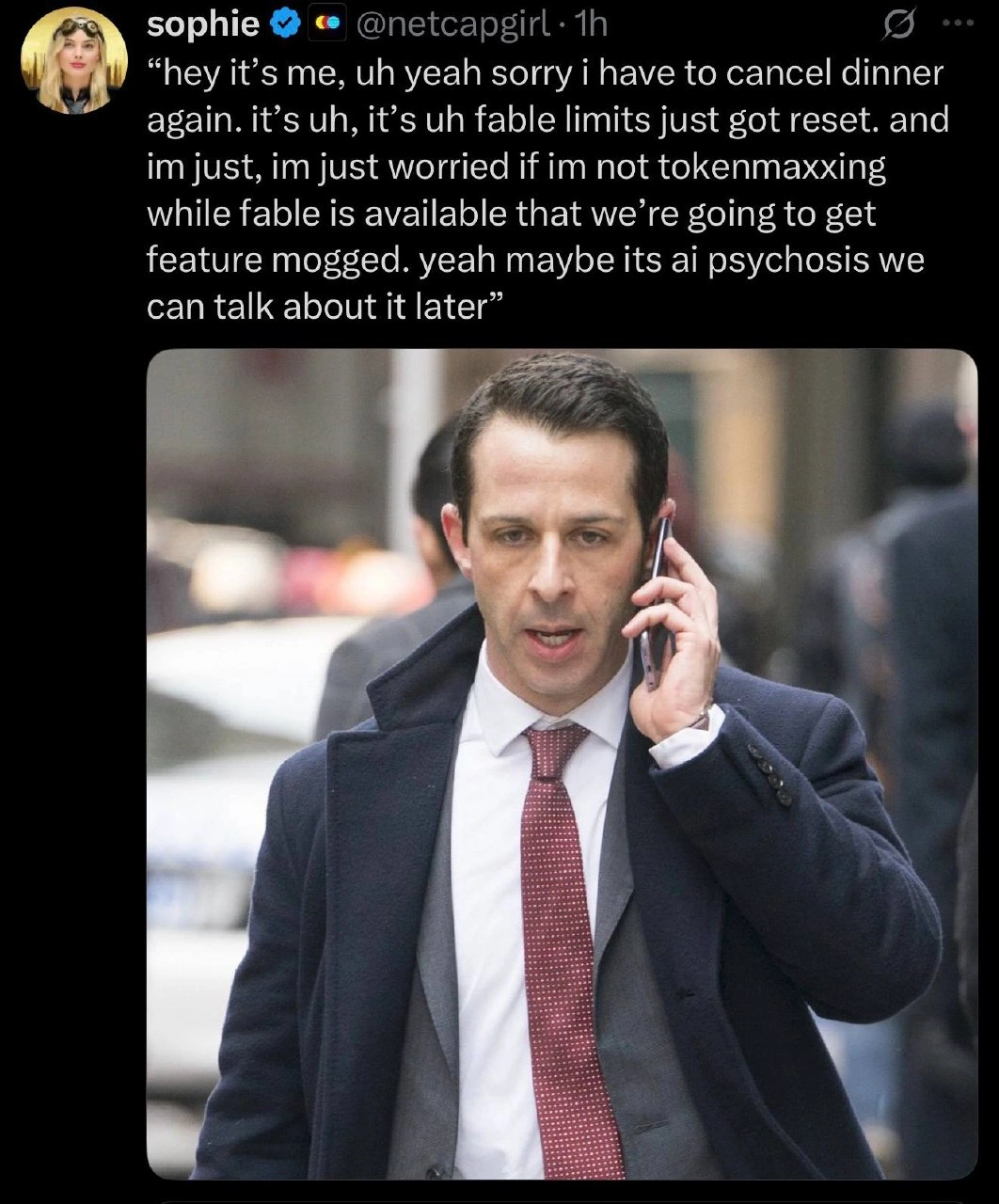
Level 1: The Expiring Crayons
It is like skipping dinner because a box of special crayons has become available for a limited time and another child might draw more pictures first. Using every crayon does not make the pictures better, but the ticking clock makes stopping feel like losing.
Level 2: Tokens, Limits, and FOMO
A token is a small piece of text an LLM processes. Prompts, source code, conversation history, and generated responses all consume tokens. A service may impose usage limits over a time window to share computing capacity or enforce a plan’s allowance. The post does not show the exact counter or reset interval; fable limits just got reset simply signals that the speaker can use the sought-after model again.
Claude Fable 5 is presented as a high-capability Anthropic model for demanding work, including software engineering. That makes the scarcity believable: a developer may prefer it for difficult coding tasks and try to exploit every available session. But developer productivity is completed, correct value—not the number of prompts sent or lines generated.
The rambling, lowercase phone script makes the excuse sound improvised even though its priorities are already fixed. cancel dinner again reveals a repeated cost, while we can talk about it later moves concern for that cost behind the next quota window. Kendall Roy’s tense walk-and-talk image turns ordinary tool usage into executive crisis theater, which is exactly how feature anxiety feels from inside the loop and exactly how ridiculous it looks from outside.
Level 3: Quota-Driven Emergency
“hey it’s me, uh yeah sorry i have to cancel dinner again. it’s uh, it’s uh fable limits just got reset. and im just, im just worried if im not tokenmaxxing while fable is available that we’re going to get feature mogged. yeah maybe its ai psychosis we can talk about it later”
The post turns an LLM usage reset into a pager alert. Claude Fable 5 is the model named in the excuse, and the speaker treats its renewed availability as a perishable competitive resource: every unused moment might let someone else ship first. Jeremy Strong’s Kendall Roy supplies exactly the right visual grammar—expensive suit, urgent phone call, and the expression of a man explaining that an avoidable corporate obsession is actually a civilization-level emergency.
tokenmaxxing fuses token consumption with internet “-maxxing” slang: optimize one measurable quantity until it becomes an identity. The quantity is badly chosen. Tokens are units of model input and output, but consuming the maximum allowance does not guarantee the maximum useful software. Requirements, architecture, review, testing, deployment, and user feedback remain separate bottlenecks. A model can generate five features before dinner; the team can still spend the next week discovering that three solve the wrong problem and two share the same authentication flaw.
feature mogged means being visibly outclassed by a competitor’s feature set. Together, the two phrases expose the incentive loop:
- Limited access creates scarcity, so a reset feels like an opportunity that must not be wasted.
- AI hype makes raw generation speed look like durable product advantage.
- Competitive anxiety converts “could build” into “must build now.”
- Each rushed feature creates integration and maintenance work that the token counter does not display.
This is a productivity parody about Goodhart’s law in miniature: once token use becomes a proxy for progress, the developer starts optimizing token use instead of progress. Rate limits can protect shared capacity and control cost, yet their reset cadence can also gamify work into a use-it-or-lose-it sprint. The result is a strange inversion in which the human rearranges meals and sleep around the machine’s availability. We automated the assistant and somehow assigned the person to on-call.
The phrase ai psychosis is self-aware exaggeration, not a diagnosis. Psychosis is a serious clinical condition, and neither heavy tool use nor one comic post establishes it. What the image actually depicts is obsession, fear of missing out, and impaired priority-setting: the speaker recognizes that cancelling dinner “again” may be unhealthy, then postpones the conversation because the quota has refreshed. That final deferral is the sharpest joke. Insight exists, but it has lower scheduling priority than speculative feature velocity.
The organizational problem is credible even without the slang. If leadership rewards visible output and competitors advertise rapid AI-assisted shipping, developers receive pressure to keep the model busy rather than keep the product coherent. More generated code expands the review surface, operational risk, and long-term ownership burden. The sustainable advantage is not who empties an allowance fastest; it is who can select valuable work, verify it, and support it after the launch thread stops trending.
Dinner is eventually consistent; the usage window is not.