
Mozilla Google Search Deal Meme Explained
A four-panel anime reaction walks from cheer to horror as Google’s monopoly case threatens default-search cash. The deep dive explains how search deals fund Firefox and why 81% of Mozilla’s revenue hangs on one partner.
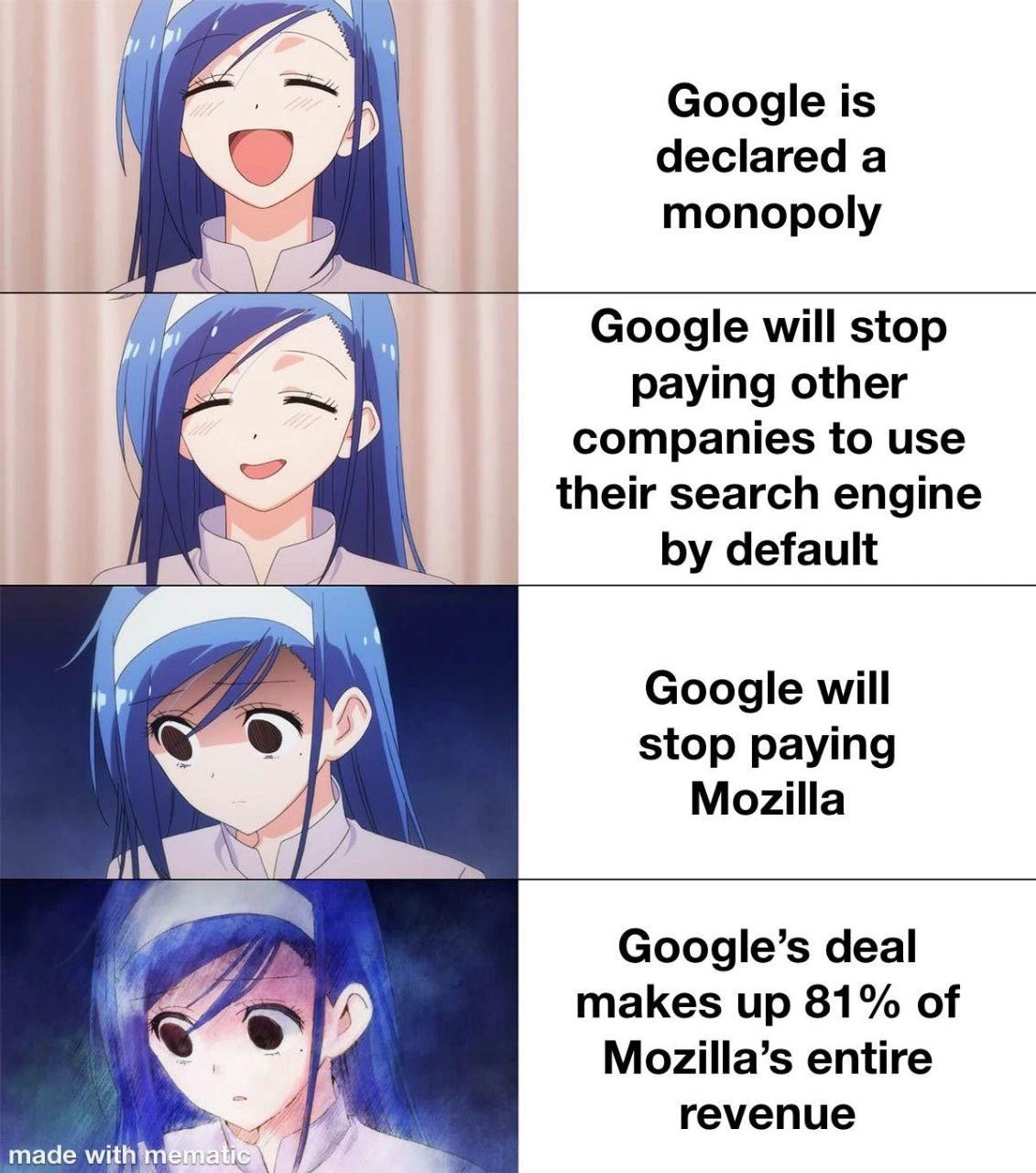
Level 1: Losing Your Allowance
Imagine you have a friend who always gives you a big bag of candy every week – most of the candy you ever get, actually. You love candy, so this makes you really happy! Now suppose the teacher at school says, “It’s not fair for one kid to be giving out so much candy. That has to stop.” At first, you think, “Okay, the teacher is making sure things are fair.” But then it hits you: that rule means your friend can’t give you candy anymore. Suddenly, you realize you’re not getting those sweets you relied on. You’d feel shocked and scared, right? You might be like the girl in the meme: first smiling, then slowly understanding, then eyes wide, and finally looking horrified when you understand what it really means. In this story, Mozilla Firefox is like the kid who loves candy, and Google is the generous friend giving out the candy (money in real life). The teacher’s rule is like the monopoly decision telling Google to stop giving out that money candy. It’s funny in a “uh-oh” way because Firefox was happy to see Google get in trouble for being too powerful, until Firefox realized that punishment also means losing its main allowance. The meme makes us laugh because we see the cartoon girl’s face go from excited to terrified – just like anyone would feel if they suddenly lost something that paid for almost all of their treats.
Level 2: Follow the Money
For newer developers or those less familiar with browser business models, let’s break down why Mozilla’s reaction in the meme goes from happy to horrified. Mozilla is the organization behind the Firefox web browser – a browser that’s free to download and open source (meaning its code is public and community-driven). Now, if Firefox is free, how does Mozilla pay its engineers and keep the lights on? The answer: search engine deals. By default, when you install Firefox and type a query into its address bar, it searches the web with Google. That’s not a coincidence – Google pays Mozilla a hefty sum to be the default search engine in Firefox. This kind of arrangement is common in the tech industry and part of everyday CorporateCulture deals: one company pays another for prime placement, ensuring its product is the one users see first. In Firefox’s case, Google has been the default for most regions for years (with a brief switch to Yahoo in the US a while back). In return, Mozilla gets a share of the ad revenue Google earns from Firefox users’ searches. It’s essentially Google saying, “We’ll give you money so that when people use your browser, they use our search and we both benefit.”
Now, the meme references a monopoly ruling against Google. Monopoly in this context means regulators (like government authorities) decided Google has too much power in the search engine market – so much that it can stifle competition. Antitrust_action is what governments take to limit or break up monopolies. One possible action here is telling Google, “Hey, you can’t keep paying everyone to favor your search engine by default. That’s unfair to other search providers.” It’s a bit like a sports league banning a top team from buying up all the best players from smaller teams – the idea is to keep the playing field fair.
So what happens if Google is forced to stop paying other companies to use their search engine by default? Those “other companies” include browser makers like Apple (Safari browser on iPhones) and Mozilla (Firefox). Apple and Mozilla have been receiving huge payments from Google basically for pointing users to Google Search right out of the box. The second panel of the meme shows the blue-haired character looking neutral, which mirrors a moment of realization: “Oh, Google will stop these payments. That’s interesting… companies won’t get that extra cash anymore.” It sounds like Google simply saving some money or other search engines maybe getting a chance.
The real punch comes in panel 3 and 4. Panel 3’s text, “Google will stop paying Mozilla,” connects the dots explicitly. Mozilla stands to lose its golden goose. The girl’s eyes widen – this is a big “uh-oh” moment. Why? Because Mozilla isn’t a tech giant with many revenue streams; it’s more like a specialized shop with one main customer. Panel 4 drops the bombshell: “Google’s deal makes up 81% of Mozilla’s entire revenue.” In plain terms, over three-quarters of Mozilla’s money comes from Google’s default search deal alone. That number – 81% – is enormous. Picture your own finances: if 81% of your income disappeared overnight, you’d be in serious trouble, right? That’s why in the final panel the character looks utterly horrified, as if the world is ending (the background even turns dark and spooky). The meme exaggerates the facial reaction for comedic effect, but it’s not far from how Mozilla’s leadership and Firefox fans might feel reading that news. It’s a mix of TechHumor and genuine concern.
To put it another way, Mozilla has a revenue dependence on Google that’s almost like a life support. This is ironic because Mozilla’s Firefox is supposed to be an alternative to Google’s Chrome in the BrowserWars, championing openness and user privacy. Yet, financially, Mozilla has been relying on the very company it’s competing with. The Follow the money lesson here is something even junior devs quickly learn about the tech industry: if you want to understand why decisions are made, look at where the money comes from. Mozilla kept Google as the default search not just because Google is popular, but because Google paid them to, and that funding enabled Mozilla to keep improving Firefox for users. It’s a classic case of an OpenSource project needing corporate cash to survive. There’s nothing inherently nefarious in that – many open-source initiatives get sponsorships or donations – but the scale (81% of revenue from one partner) is what makes this situation so precarious.
Now, with an antitrust action looming, Mozilla faces a potential firefox_financial_crisis. If Google truly pulls out (or is barred from these deals), Mozilla would suddenly lose the majority of its income. They’d have to scramble: maybe cutting costs, seeking donations or new partnerships (Microsoft’s Bing might step in as a default search partner, but likely not at the same dollar amount Google provided). The meme’s humor has a dark edge: it’s essentially saying “We wanted Google to be punished for monopoly behavior – but not like this!” It highlights an unexpected consequence: curbing Google’s monopoly might accidentally hurt one of Google’s few competitors in the browser space. In tech, this kind of twist isn’t unheard of. Remember, for example, when Microsoft was ruled a monopoly in the 90s and had to stop some practices, it indirectly changed how other companies behaved or survived too. Here, Mozilla is caught in the crossfire of google_monopoly_concerns: they benefited from Google’s dominance (through cash), and now they risk collateral damage from Google’s monopoly being challenged.
Finally, let’s talk about the anime_reaction_format of the meme. This format is popular in online forums and developer chat groups. It uses a sequence of anime screenshots with a character’s expression changing dramatically, paired with text to convey a story. In this case, the blue-haired girl’s happy-to-horrified transformation perfectly mirrors Mozilla’s emotional journey upon hearing this news: starting with joy at Big Tech getting its comeuppance, then a neutral “wait, what does that entail?”, then shock, then existential dread. It’s funny to us because it’s an exaggeration of reality – of course, Mozilla isn’t a literal anime girl, but the feels are real. Developers share this meme because they grasp both the technical context (monopoly rulings, default search deals) and the absurdity that Firefox’s financial stability is so tightly bound to Google’s actions. It’s a cautionary tale wrapped in humor: even in tech, if you follow the money, you might be surprised (and amused, or dismayed) by what you find.
Level 3: Single Point of Failure
The meme spotlights a monopoly plot twist hidden in plain sight of the browser world. At first glance, an antitrust victory over Google looks like cause for celebration: regulators finally declared Google’s search business a monopoly, aiming to curb its power. For veteran developers and tech industry watchers, this triggers memories of past antitrust showdowns – think Microsoft in the late ’90s when IE had to be unbundled from Windows. Here, history seems to rhyme: Google’s dominance in search (around ~90% market share) is under scrutiny, and one remedy floated is to stop Google from paying other companies to set Google Search as the default search engine. No more lavish default-search deals means Google can’t throw its weight (and wallet) around to secure exclusive spots in browsers. In theory, this should level the playing field for search competitors like Bing or DuckDuckGo.
But then comes the unintended side effect – the reason this meme hits home for so many in the industry. It turns out Mozilla Firefox, the beloved open-source browser, has been living off a massive yearly check from Google for that default search slot. We’re talking on the order of hundreds of millions of dollars. In fact, as the meme’s final panel spells out in cosmic-horror font, that Google deal makes up 81% of Mozilla’s entire revenue. That’s a staggeringly high dependency ratio – essentially a single point of failure in Mozilla’s funding model. In engineering terms, Mozilla’s revenue pipeline has a bus factor of 1: if Google steps away, the budget bus runs over Firefox. Those of us who’ve been around the block can’t help but smirk darkly here. We’ve always known that behind Firefox’s open source idealism was a very real, very large Google paycheck. The figure has hovered around 80-90% for years; it’s the industry’s open secret. Google giveth and Google taketh away – a cynical twist on corporate dependency.
Why is this such a big deal? Imagine structuring a critical system with a single dependency – any CorporateCulture veteran will tell you that’s a recipe for sleepless nights. Mozilla’s reliance on Google search revenue is like a cloud service built on a lone server: fine when it’s up, catastrophic when it goes down. Here the “server” is Google’s goodwill (or rather, Google’s strategic interest in Firefox’s user base). This default search deal has been essentially Mozilla’s lifeline since Firefox’s rise in the mid-2000s. Back then, after the BrowserWars of the 90s (Netscape vs. Internet Explorer), the newly formed Mozilla Foundation had to find a sustainable funding model for a free browser. The solution was search engine partnerships – Firefox would direct users’ searches to a provider and get a revenue cut from the search ads. Google quickly became the prime partner, because they simply had the deepest pockets and the most popular search. Over time, as Firefox’s own user share fluctuated (and as Google launched Chrome, ironically becoming Firefox’s chief competitor), the default_search_engine_deals only grew more lucrative. Google wasn’t being altruistic; these deals ensured Firefox didn’t defect to, say, Microsoft’s Bing, and they kept Google’s search traffic share high. It’s a classic big-tech IndustryTrends move: pay the smaller players to maintain the status quo – and incidentally, keep them alive as token competition. Some grizzled observers even suggest Google keeps Firefox around (via cash infusions) to avoid being a lone giant, to dodge even harsher monopoly accusations. Talk about a strategic frenemy relationship!
Now, the humor (tinged with anxiety) in this meme comes from the oh-no realization of that relationship’s fragility. The four-panel anime_reaction_format nails the emotional trajectory. Panel 1: a cheerful acknowledgment that Google is finally called out as a monopoly – the tech world’s David-vs-Goliath moment, embodied by a smiling blue-haired character. Panel 2: a mild concern as she learns Google will stop paying companies to be the default search – eyebrows furrow slightly. That’s a broad industry consequence: no more easy money for anyone setting Google as the preset. Panel 3: wide-eyed shock when it sinks in that Mozilla is one of those companies. Firefox, champion of OpenSource ideals, has been effectively on Google’s payroll. And panel 4: absolute horror – the background darkens to a blue haze – on learning that 81% of Mozilla’s revenue comes from that very arrangement. It’s the final puzzle piece that turns a generic antitrust story into an existential crisis for Firefox. Developers with a sense of tech history see the dark irony: an anti-monopoly action might kneecap the underdog it’s meant to help. It’s like déjà vu from the Browser Wars: back then, Microsoft’s monopoly tactics crushed Netscape, which led to Mozilla’s birth; now Google’s monopoly being checked could inadvertently crush Mozilla’s finances. This meme’s punchline lands with senior devs because it underscores a painful truth about the modern web ecosystem – even open source projects often survive on behind-the-scenes corporate deals, a Faustian bargain that can unravel when the regulatory winds shift. The next time someone naively asks, “Why can’t Mozilla just be independent?”, the answer is in this very meme: independence is hard when 81% of your funding comes from the very giant you’re fighting.

Mozilla spent a decade eliminating use-after-free bugs, only to discover its revenue pointer was still pointing to google.com
Mozilla discovering their entire business model is being Google's controlled opposition is like finding out your microservices architecture is actually just one monolith paying rent to different AWS availability zones
When your entire business model is essentially a single database foreign key constraint with ON DELETE CASCADE pointing to Google's payments table, and the DBA just announced they're dropping the relationship. Mozilla's architecture review suddenly revealed they've been running in production without a backup revenue stream - turns out 81% coupling isn't just a code smell, it's an existential threat. Time to refactor the funding pipeline before the garbage collector claims Firefox as unreachable memory
We preach “eliminate SPOFs,” yet Firefox’s revenue topology is a single upstream: Google.defaultSearch(); antitrust just flipped the circuit breaker
Mozilla's revenue model: ultimate single point of failure, making even your legacy monolith look resilient
Architects hate SPOFs; Mozilla put theirs in the revenue path. Antitrust toggles the “DefaultSearch=Google” flag and the P&L returns 503
OH NO, MY FAVORITE FURRY BROWSER!!!
That's why I switched from chrome to FF. This monopoly will not lead to something good. And all taking into the account google's changes related to the manifest v3
Anyway I want to stay away from direct supporting google's domination. I understand, that this will not change anything, but at least I doing something😁
soon...
btw
inferior, u say...
Maybe this will make firefox great again They've been so comfy with this money that they use it to finance political projects
They don't sell your data It's more profitable to keep it to themselves
I'm not even lol. I'm pointing out how fucking ridiculous it is to take mozilla's side in this
I've been using Internet Explorer 6 for years. I never had a problem. I might switch when I have more time after the election.
Time to switch
Well, why did Mozilla decide it was a good idea to get most of its funding from its main competitor to begin with. Now it's not the time to act all surprised Pikachu.
All firefox users now: "let's use modern private browser, how it names?.. oh, 😀😀🚶"
reject browsers, run npm scripts to access websites