
PHP Cloud Functions iPhone Art Meme Explained
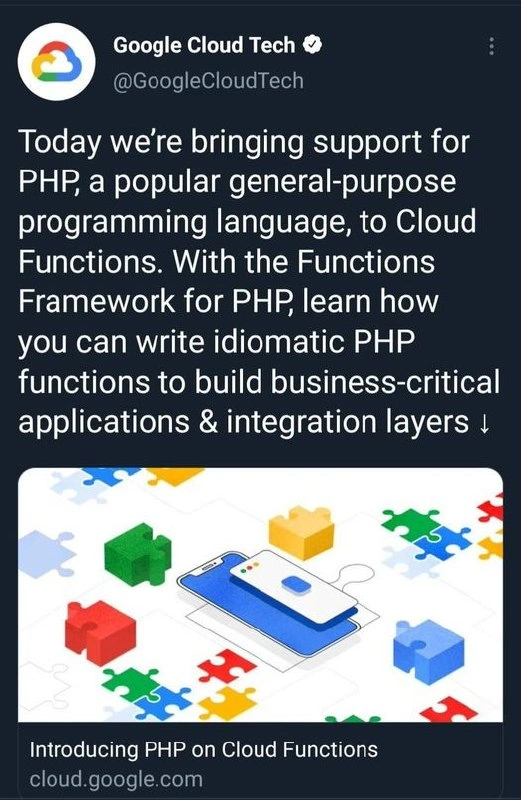
Google Cloud announces PHP support for Cloud Functions while the preview art shows a phone-like device and puzzle pieces. The dive explains serverless functions, the Functions Framework, and the funny gap between backend work and marketing imagery.
Level 1: Fancy Box, Wrong Picture
Imagine a store announces, "We now fix kitchen sinks," but the poster shows a shiny phone surrounded by toy blocks. The words make sense, and the service might be useful, but the picture feels oddly unrelated. This meme is funny because Google is talking about serious cloud programming work while the image looks like someone grabbed a generic tech drawing and hoped nobody would ask why the server code looks like an iPhone.
Level 2: Serverless Puzzle Pieces
PHP is a long-running, widely used programming language, especially common in web backends, WordPress, Laravel apps, internal tools, and the kind of business workflows companies keep because they work and because replacing them would require three budget cycles.
Google Cloud Functions is a serverless product. "Serverless" does not mean there are no servers; it means the cloud provider hides the server management from you. A developer writes a small function, deploys it, and the platform runs it when something happens. For example, a function might resize an uploaded image, process a payment webhook, or move data from one system into another.
The phrase Functions Framework for PHP points to the tooling that helps PHP code run in that function-shaped cloud environment. It gives developers a standard way to write functions locally and deploy them to the cloud runtime.
The visual elements map loosely to that story:
- The puzzle pieces suggest integration: different software systems being connected.
- The Google Cloud Tech account and cloud preview make it a platform announcement.
- The phone-like sketch is the odd part, because this is backend infrastructure, not an iPhone feature.
- The line
Introducing PHP on Cloud Functionsmakes the subject explicit: PHP can now be used for this Google Cloud serverless workflow.
For a junior developer, the humor is a gentle lesson in how often backend work gets represented by unrelated app imagery. You may be wiring event triggers, IAM permissions, environment variables, and deployment configs, but the announcement art will still show a clean little gadget and some optimistic puzzle pieces.
Level 3: Cupertino Cloud Function
The joke lives in the collision between enterprise cloud seriousness and visual-brand confusion. The tweet says:
Today we're bringing support for PHP, a popular general-purpose programming language, to Cloud Functions. With the Functions Framework for PHP, learn how you can write idiomatic PHP functions to build business-critical applications & integration layers ↓
That is a very Google Cloud sentence: serverless, business-critical applications, integration layers, and just enough "idiomatic" to imply that someone had a standards meeting. Then the preview image shows a phone-like slab with rounded corners, a small earpiece-like detail, colored dots, and a blue case-looking shape sitting among puzzle pieces. The post message asks the obvious thing: why does a PHP-on-Cloud-Functions announcement look like it wandered out of a mobile hardware mockup?
The technical irony is that Cloud Functions are supposed to erase the machine. You write a function, wire it to an HTTP request, Pub/Sub event, storage trigger, or some other cloud event source, and let the platform handle provisioning, scaling, routing, and runtime lifecycle. PHP support means teams with existing backend code, CMS integrations, webhooks, and legacy business logic can deploy smaller event-driven pieces without managing servers. None of that has anything to do with a handheld device.
The puzzle pieces do make sense as marketing shorthand for APIs, integration pain, and "your systems fitting together." The phone-like centerpiece is where the image becomes funny: it suggests either a generic "app" icon got reused, or the cloud platform announcement was fed through the universal tech-marketing blender where every abstract backend feature must be represented by floating isometric objects. Somewhere, a service that runs PHP functions in Google's infrastructure got illustrated as "what if iPhone, but business-critical."
This is also why developers enjoy the screenshot. It captures a familiar gap between the actual engineering work and the way platforms are sold. The engineering story is runtime support, deployment packaging, request handling, and integration glue. The marketing story is cheerful shapes, a pristine device, and puzzle pieces that have never seen a production incident.


Nothing says idiomatic PHP in Cloud Functions like a promo image that accidentally deploys to Cupertino.
how tf is php general purpose
If it were php, none of those jigsaw pieces would fit together
This is the definition of degradation
bruh
its pocophone f1
👀
id say
like if it was general purpose it would be regularly used for a lot of other things