
Chat App File Size Limits Meme Explained
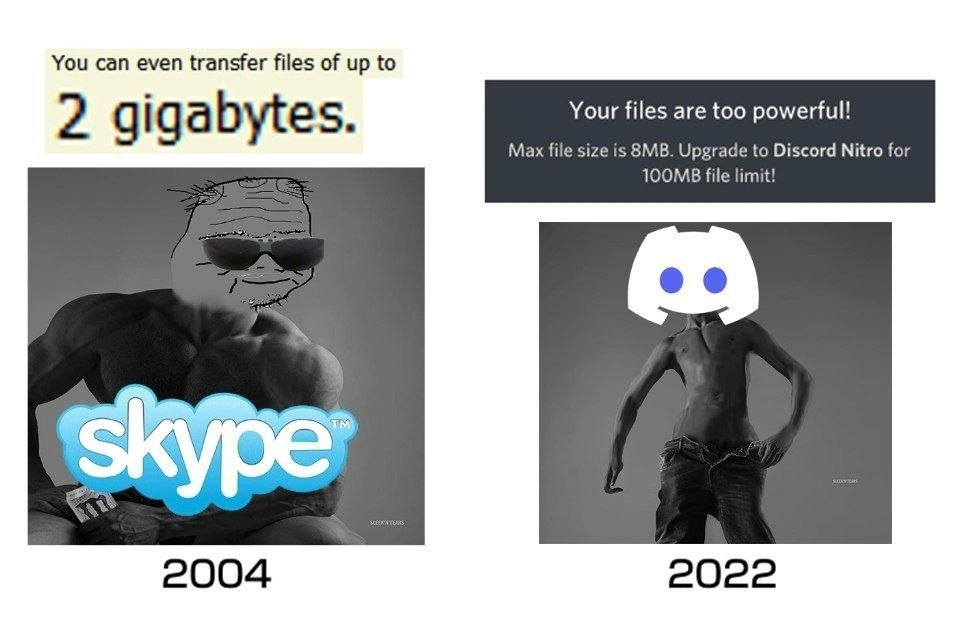
Buff Skype flexes 2 GB P2P transfers in 2004; scrawny Discord free users hit an 8 MB wall unless they buy Nitro. The dive explains peer-to-peer versus cloud storage costs and why newer tools can feel like feature regression.
Level 1: Candy Size Surprise
Imagine you have two friends who want to share treats with you. Your 2004 friend is super strong and generous – he comes up with a huge chocolate bar and says, “Here, you can have the whole thing!” No fuss, he just gives you this giant treat for free. Now your 2022 friend comes along, and he’s a bit scrawny. He only offers you a tiny piece of candy and then goes, “Sorry, that’s all you get for free. If you want a bigger piece, you’ll have to pay for the premium pack.” It’s funny because you’d expect the newer friend (with all the modern stuff) to give at least as much as the old friend did – but nope! The old friend from 2004 shared a huge treat easily, while the new friend in 2022 is stingy unless you give him money. This silly comparison makes us laugh and shake our heads, because it shows in a simple way how sometimes old things could do more and new things put limits on, all for the sake of a few bucks. It’s like the strong buddy from the past is bragging, “Back in my day, I gave out big goodies,” while the modern buddy shrugs weakly and blames your “too big” candy for his own limits. That little twist – expecting more from the new but getting less – is exactly why this feels both funny and a bit true.
Level 2: Freemium File Frustration
Let’s break down the joke for a newer developer (or anyone unfamiliar with these apps). Skype is an older communication app (founded in 2003) that was super popular for voice/video calls and chatting. Back in its prime (around 2004), Skype’s software allowed file sharing up to 2 GB in size. 2 GB (gigabytes) is 2,000 MB (megabytes) – roughly the size of an entire movie or a large database dump – massive especially for that era. Skype could do this because it used peer-to-peer (P2P) technology: your file would be sent directly from your computer to your friend’s computer over the internet, rather than going through Skype’s servers. This peer networking meant Skype didn’t have to store everyone’s big files on a central system; it just helped establish the connection and then let your computers do the heavy lifting.
Now fast-forward to 2022 and look at Discord – a modern chat app wildly popular among gamers, open-source communities, and remote dev teams. Discord is more of a cloud service: when you send a file in a Discord channel, that file gets uploaded to Discord’s servers (so others in the chat can download or view it even if you go offline). Here’s the catch: on the free tier, Discord pops up a message saying, “Your files are too powerful! Max file size is 8 MB.” Essentially, any file over 8 MB won’t send. 8 MB is pretty small – think a couple of high-quality images or a very short video clip. A typical smartphone photo these days can be 5 MB or more, and any decent-length screencast or log file can easily exceed 8 MB. So, for free users, Discord imposes this strict limit. Why? Two reasons: technical constraints and business strategy. Technically, hosting and transferring files costs bandwidth and storage on the servers. If everyone dumped huge files for free, it would burden Discord’s infrastructure. On the business side, Discord uses a freemium model: the app is free to use, but they offer a paid subscription called Discord Nitro. Upgrading to Nitro raises the file upload limit to 100 MB (and comes with other perks like higher quality streaming, custom emojis, etc.). Nitro is how Discord earns money since most people never pay a dime. So the meme’s right panel highlights this with a scrawny figure (Discord’s logo as a weak-looking character) and a banner essentially saying “Pay for Nitro to send big files.” This feels like software regression to many developers – a step backward – because an older app (Skype) had a feature that let you send huge files freely, whereas a newer app (Discord) restricts you unless you open your wallet.
For a junior dev or someone new to these platforms, imagine you’re working on a RemoteWork project and want to share a large log file or a demo video with your team via Discord. You drag the file into the chat, and bam – you see that “Your files are too powerful!” error for anything above 8 MB. It’s frustrating (CommunicationBreakdown in the workflow) because now you must find a workaround: maybe compress the file into pieces, use a different FileSharing service (like Google Drive or Dropbox link), or ask someone with Nitro to upload it. In contrast, if this were 2004 and you were using Skype (which some teams did use back in the day for collaboration), you could just send that file directly through Skype without such a low cap – no extra payment needed. The left panel’s buff Wojak with a Skype logo is basically flexing, saying “Ha! In my day we sent multi-gigabyte files no problem,” while the right panel’s skinny Discord character admits “I can’t handle that file unless you pay me.” This resonates as TechHumor because it underscores how newer, fancier tools sometimes make us jump through more hoops. We also learn some terminology: “freemium” means the product is free but with limited features (like that 8 MB cap) and you pay for premium features (Discord Nitro being the premium here). Developer Experience (DX) is all about how tools affect our day-to-day workflow – and having to stop and deal with file size limits is definitely a DX hiccup. In summary, the meme uses a funny then-vs-now comparison (2004 vs 2022) to highlight how feature degradation and monetization can turn something as simple as sending a file into a point of friction. It’s a lighthearted jab at our modern CollaborationTools – pointing out that newer isn’t always better, especially when it comes to unrestricted communication features.
Level 3: P2P Power Flex vs Nitro Nudge
Back in 2004, Skype was essentially the buff Wojak of file sharing because it used a peer-to-peer architecture that let users send files directly to each other. This design meant Skype could brag “go ahead, send up to 2 gigabytes” without breaking a sweat – the data would just flow between your machine and your friend’s, no massive central server needed. In contrast, Discord (circa 2022) is the scrawny Discord-logo-headed figure because it’s a modern cloud-based SaaS platform. Every image or log file you upload to Discord has to be stored and relayed by Discord’s servers, which cost real money to operate at scale. So Discord imposes an 8 MB file size limit on free users and then dangles Discord Nitro (a paid tier raising the cap to 100 MB) as a “power-up”. This is a classic freemium monetization move – intentionally restrict a basic feature to nudge users toward paying. Seasoned developers recognize the humor (and pain) here: technological progress isn’t always linear. Feature regression is real when business models change. In 2004, a 2 GB file was enormous – a true flex – yet Skype’s P2P approach made it feasible. Now in 2022, with gigabit fiber internet and cloud infrastructure, one would expect file sharing to be even more limitless. Instead, we get “Your files are too powerful!” errors for anything bigger than a high-res screenshot, unless we whip out the credit card. The meme brilliantly contrasts the “good old days” of generous feature sets against today’s product-led growth tactics. It’s poking fun at how a once-mighty Communication tool (Skype) from two decades ago out-muscles a modern collaboration titan (Discord) in this specific area. Experienced devs chuckle (perhaps a bit bitterly) because we’ve all encountered that moment in a RemoteWork session where a teammate says, “Hang on, Discord won’t let me upload this log file, it’s too big.” We remember a time when software proudly touted such capabilities instead of paywalls. In essence, the meme hits on the DeveloperExperience_DX gap: when design decisions driven by cost and monetization make the developer’s life just a tad more frustrating. The buff vs. weak imagery exaggerates the point: older tech wasn’t always weaker, and sometimes our modern cloud-based CollaborationTools are the ones skipping leg day. It’s an ironic reminder that the muscle behind seamless file sharing can shrink when companies prioritize upsells over user convenience.



Modern software engineering: invent a dozen new frameworks to build a chat app that's 100x slower and 250x less capable at transferring a file than a VoIP client from 2004
2004 Skype’s supernodes would happily shove a 2 GB ISO through DSL; 2022 Discord calls a 9 MB crash log “too powerful” unless I buy Nitro - turns out bandwidth doubles every 18 months, then product managers halve it for ARPU
Remember when we thought Moore's Law applied to file upload limits? Turns out it's actually an inverse relationship with subscription revenue models - the more powerful our infrastructure becomes, the smaller the free tier gets
Ah yes, the march of progress: from Skype's generous 2GB P2P transfers in 2004 to Discord's 8MB ceiling in 2022 - because nothing says 'modern cloud infrastructure' like artificially crippling file transfers to upsell Nitro subscriptions. At least Skype understood that when you're debugging production at 2 AM, you need to send that 500MB heap dump without converting it to a torrent file first
2004 Skype: NAT traversal and supernodes; 2022 Discord: 8MB unless you subscribe - UDP hole punching replaced by wallet punching
2004 Skype: 2GB over P2P supernodes. 2022 Discord: “8MB, upgrade.” Translation: your file isn’t too powerful - our egress bill is
Skype 2004 devoured your monorepo zips; Discord Nitro chokes on a single Docker layer. Progress in DX, amirite?
Skype files are p2p, Discord stores them on their servers.
Future has come
telegram allows 2GB and stores this on server. (With Premium - 4GB)
Don't worry, they need them to datamine you, so that's ok.
laughs in magic-wormhole
zachem vi vse na angliiskom govorite?
I heard of some people randomly loosing all content saved messages
I hate English