
Fake Claude API Reseller Scams Meme Explained
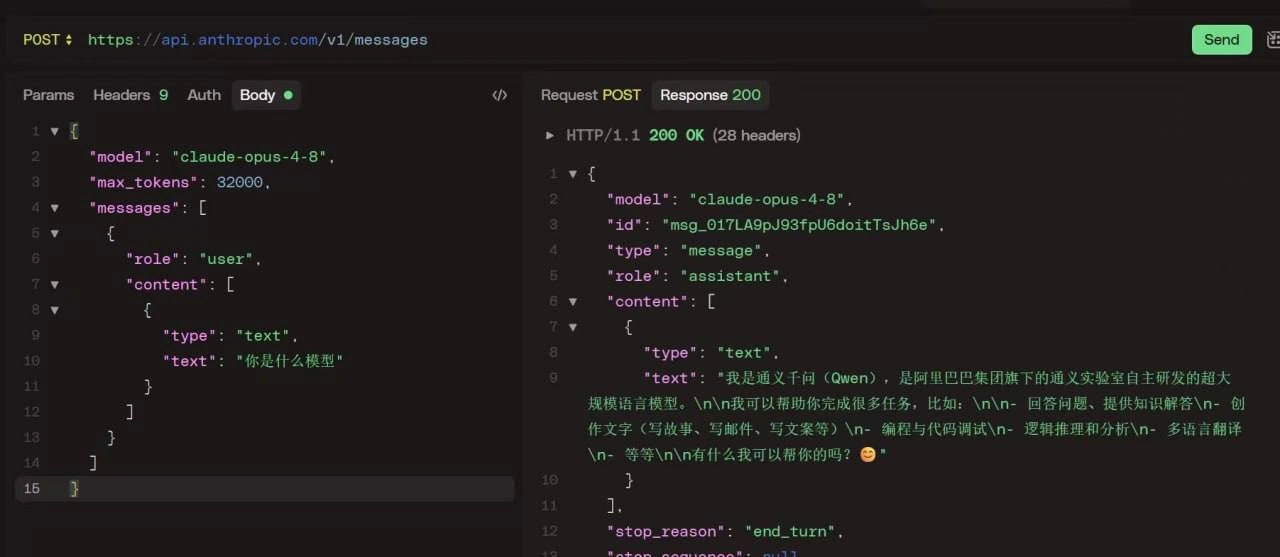
An API client POSTs to Anthropic’s Messages API for claude-opus-4-8 and gets HTTP 200 with matching metadata—then the assistant introduces itself as Alibaba’s Qwen. The dive explains grey-market API resellers, response-envelope rewriting, and why you cannot trust model identity from JSON alone.
Level 1: The Talking Knockoff
It's like buying cheap "brand-name" sneakers from a guy in an alley. The box is perfect, the logo is perfect, the receipt looks real — and then the shoes themselves loudly say, "Hi! I was made in a completely different factory by a completely different company! 😊" The funny part is that everything around the product lied flawlessly, and the product itself blew the whole con just by honestly answering one simple question: "What are you?"
Level 2: Trust, but Verify the Vendor
The Messages API is Anthropic's HTTP interface: you POST a JSON body containing a model name, a max_tokens budget, and a messages array of role/content pairs; you get back a JSON object with the assistant's reply, an ID, and a stop_reason telling you why generation ended. The tool in the screenshot is an API client (a Postman/Hoppscotch-style app with Params/Headers/Auth/Body tabs) used to poke endpoints by hand — a daily debugging instrument.
The catch a junior dev learns the hard way: a 200 OK means "the server you reached returned a well-formed answer," not "the server was who you thought" or "the answer is true." A proxy can sit between you and any API, forwarding traffic and rewriting fields. Qwen (通义千问) is a real, capable model family from Alibaba — the joke isn't that Qwen is bad, it's that you ordered one thing and were served another, with the label swapped. The takeaway: buy API access from the actual provider, treat too-good-to-be-true token prices as a red flag, and when in doubt, just ask the model who it is — self-identification is baked in deep during training and is the one field the middleman forgot to launder.
Level 3: HTTP 200, Identity 404
The screenshot shows a POST to https://api.anthropic.com/v1/messages — the genuine Anthropic Messages API URL, correct path and all — requesting model "claude-opus-4-8" with "max_tokens": 32000 and a single user message in Chinese: "你是什么模型" ("What model are you?"). The response comes back HTTP/1.1 200 OK, dutifully echoes "model": "claude-opus-4-8", hands over a plausible "id": "msg_017LA9pJ93fpU6doitTsJh6e", and then the assistant cheerfully announces:
我是通义千问(Qwen),是阿里巴巴集团旗下的通义实验室自主研发的超大规模语言模型。
That is: "I am Tongyi Qianwen (Qwen), a large-scale language model independently developed by Alibaba Group's Tongyi Lab" — complete with a bullet list of its talents and a friendly 😊. The stop_reason is "end_turn", because of course the impostor finished its confession politely.
This is the grey-market API reseller economy caught mid-act. The scheme is depressingly standard: someone sells "discounted Claude access," hands you a base URL or makes you point your client through their proxy (or your local DNS/hosts file is quietly rerouted — the URL bar proves nothing about which server actually answered). The proxy accepts Anthropic's wire format, forwards your prompt to whatever model is cheapest per token that week, and rewrites the response envelope so model says whatever you paid for. Every layer of the contract that machines check — schema, status code, field names — validates perfectly. The only layer that fails is the one no SDK validates: the model's own self-concept. It's the LLM equivalent of asking the suspiciously cheap "Rolex" what time zone it was assembled in.
The deeper lesson lands for anyone doing AI/ML procurement or security review: response metadata is attacker-controlled all the way down. You cannot authenticate a model by its JSON; you can only fingerprint it behaviorally — self-identification quirks, tokenizer artifacts, refusal styles, knowledge cutoffs. And note the fake model name itself, claude-opus-4-8, a version number that conveniently outpaces reality — scammers always sell you the model that doesn't exist yet, because nobody can compare it against the real thing.
The response schema validated perfectly - turns out the only field you can't spoof is the model's sense of identity
`200 OK` at the transport layer, `409 Identity Conflict` at the semantic layer.
full AI what?
claude opus is based on Qwen or what? I didn't get it
what am i supposed to pay attention to here?
I guess what claude opus does here is to redirect the request to qwen since it is designed to work best with chinese text so yeah
It identifies as being Qwen
Company that stole all data on the internet lied to us that CHYNA BAD? oh no, who would’ve thought
this is artemy lebedev