
Ethernet vs Gaming Router Meme Explained
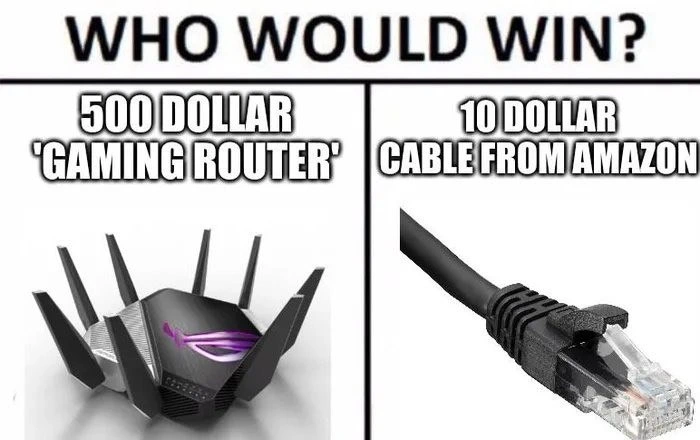
A “who would win” meme pits a flashy gaming router against a $10 Ethernet cable. The dive explains Wi-Fi contention, wired full-duplex stability, and why boring copper often wins on latency for games and reliable networking.
Level 1: The Plain Shortcut
It is like choosing between a fancy walkie-talkie and a simple string telephone that goes straight across the room. The fancy one has lights and features, but the string has less to go wrong. The joke is that the cheap cable can beat the expensive gadget because it takes the simpler path.
Level 2: Wires Are Steady
Ethernet is a wired networking technology. You connect a computer, console, or other device to a router or switch with a cable. Wi-Fi is wireless networking. It sends data through radio signals instead of a physical cable.
Wi-Fi is convenient because you can move around without plugging in. The tradeoff is that radio signals can be weakened or disrupted by distance, walls, other devices, and nearby networks. That can create lag spikes or unstable performance, especially in games or video calls.
The router in the meme looks powerful and expensive, but if your device is still using Wi-Fi, it may still deal with wireless problems. The Ethernet cable looks cheap and boring, but it gives the device a more direct and stable connection. That is why many gamers and developers prefer a wired connection when reliability matters.
Level 3: Marketing Meets Copper
The humor comes from the lopsided comparison: on one side, a dramatic “gaming router” with plastic fins, antenna spikes, and premium branding; on the other, a cheap black Ethernet cable. The meme says the cable wins because experienced developers, gamers, and infrastructure people know that performance problems are often solved by removing complexity rather than buying a more theatrical box.
Consumer networking marketing tends to emphasize big numbers: maximum wireless throughput, number of antennas, gaming modes, RGB styling, and aggressive industrial design. Those features may matter in some homes, but they do not guarantee the thing a player actually feels: stable low-latency communication between their machine and the game server. If local Wi-Fi adds jitter, packet loss, or random stalls, the game feels worse even if the router package screams about speed.
Ethernet is satisfying because it is unglamorous and brutally practical. Plug in the cable and many variables disappear: signal strength drama, roaming behavior, channel congestion, driver weirdness, and whether a wall contains whatever material was chosen by a contractor with a personal grudge against radio waves. The meme’s “10 dollar” cable is funny because it makes the expensive gear look like a premium solution to a problem the cable simply sidesteps.
There is also a broader engineering lesson here: performance tradeoffs live in the whole system, not in the most expensive component. A router cannot fix a congested ISP route, a bad modem, overloaded DNS, server tick rate, or a game backend having a rough night. But for the local network segment, wired Ethernet is one of the rare upgrades that is cheap, measurable, and boring in the best possible way.
Level 4: Medium Access Reality
The image asks:
WHO WOULD WIN?
On the left is a black angular router with many antennas and gamer-style lighting labeled:
500 DOLLAR 'GAMING ROUTER'
On the right is a plain Ethernet plug labeled:
10 DOLLAR CABLE FROM AMAZON
The technical reason the cheap cable often wins is not brand cynicism; it is physics plus link-layer behavior. Wired Ethernet gives the endpoint a dedicated physical path to a switch port. Modern switched Ethernet is typically full-duplex, so each side can transmit and receive without sharing airtime with every other nearby device. The cable is boring because the medium is controlled: copper conductors, known signaling, bounded distance, predictable interference characteristics, and no neighbor streaming video through the same air.
Wi-Fi is a shared radio medium. Devices contend for airtime, avoid collisions, adapt modulation rates, retransmit lost frames, and deal with walls, reflections, distance, microwave ovens, neighboring networks, Bluetooth noise, and the thrilling architectural decision to put the router behind a television. Even when throughput is high, latency and jitter can fluctuate because the station has to wait for access to the channel and may retry frames. Online games care deeply about latency consistency, not just maximum bandwidth on the box.
A high-end gaming router can still be useful. Better radios, antennas, firmware, queue management, and band steering can improve a bad wireless setup. Quality of Service can prioritize traffic in some bottleneck scenarios. But it cannot repeal the fact that Wi-Fi is negotiating with the environment while Ethernet is mostly just carrying frames over a cable. The meme is really a physical layer and MAC layer joke wearing a consumer electronics hat.
This is why network engineers tend to distrust flashy performance claims that skip the path. The expensive router might optimize routing, wireless scheduling, or buffer behavior, but the cable removes an entire class of uncertainty. The fastest packet is often the one that does not need to win airtime, survive multipath distortion, or argue with three apartments of overlapping SSIDs before leaving the room.


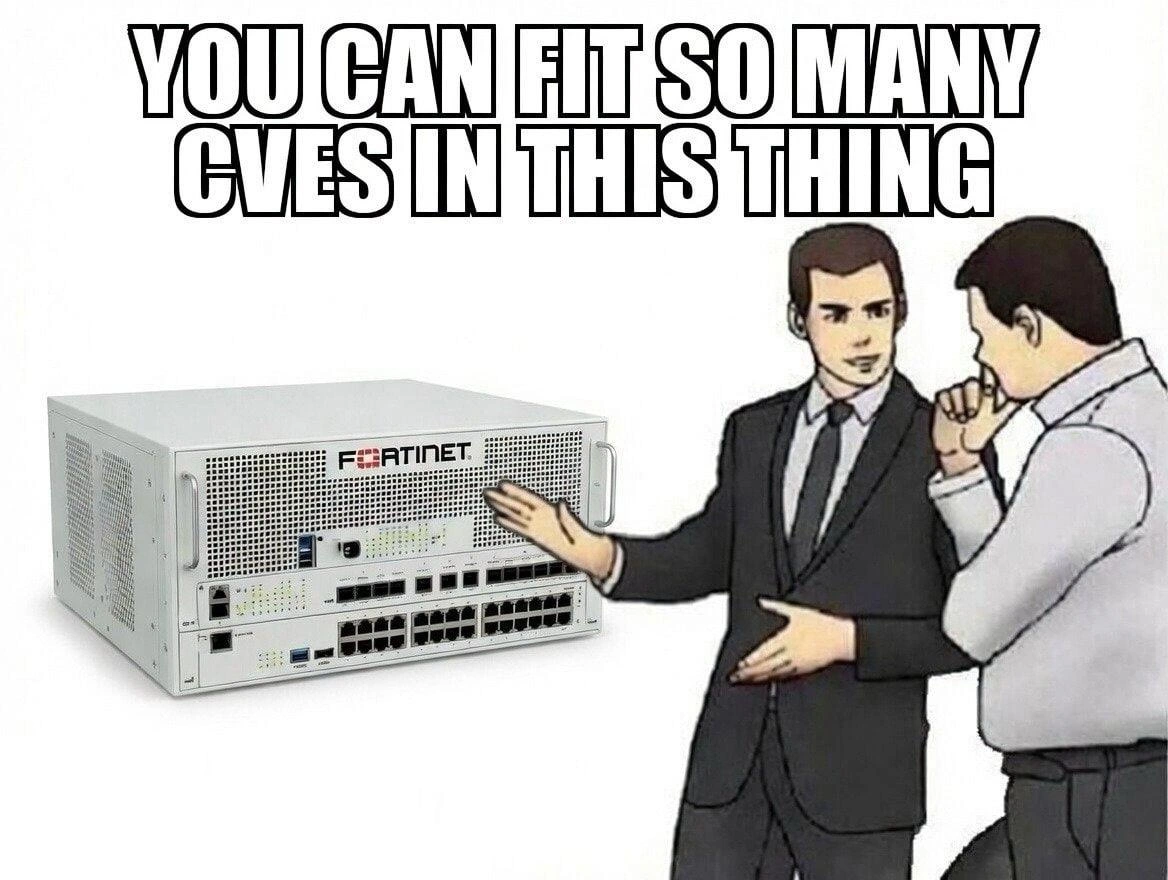
The fastest QoS policy is still "plug in the cable and stop negotiating with drywall."
yes, $10
Amazon Basics?
I mean the router will win in flexibility of usage
And also you will need a router anyway
What you gonna connect the lan cable to
Sure but watching YouTube on your phone doesn’t need a $500 router
ROG Strix/Zephyrus, for example Zephyrus S GX502LXS-HF082T 2 kilos (exactly like MacBook Pro) RTX2080 Super Max-Q Width - 18.9mm
The real question is - does the cable have RGB?
I didn't see any data center rigs that's runs on wifi so...
I mean if u need 10gbit + bandwidth it's bad idea trying get it on wifi