
Technical Debt Fix-It-Later Meme Explained
A custom Slack reaction—a clown named for the calculated decision to make tech debt and fix it later—skewers strategic-sounding shortcuts. The dive explains when technical debt is rational, how interest appears as friction, and what a real repayment plan needs.
Level 1: The Clown-Shaped IOU
It is like stuffing everything into a closet before guests arrive and promising to organize it tomorrow. Doing that once can be a smart way to meet a real deadline. The funny clown appears because everyone knows tomorrow will bring more guests, more things will be thrown into the closet, and nobody wrote down when cleaning must happen. Calling the mess a “calculated decision” does not make the plan less silly if the calculation never included cleanup.
Level 2: Shortcut Versus Strategy
Technical debt means choosing an easier implementation now that is expected to make future changes more expensive. It is different from an ordinary bug: the code may work exactly as required today. It is also different from merely old code; stable old software that remains easy to operate is not automatically debt.
Suppose a team must import customer data by Friday. The durable design supports several formats with validation and clear error reporting. The quick version supports one exact CSV layout with assumptions embedded directly in the parser. Shipping the quick version could be sensible if only one customer exists. It becomes debt because adding the second format will require untangling those assumptions.
The responsible version of that choice might include:
- Tests that lock down the first customer’s behavior.
- A small interface around the temporary parser.
- A note describing the shortcut and its risks.
- A rule that the parser must be redesigned before onboarding a second format.
- Time on the roadmap when that trigger becomes likely.
The irresponsible version says, “We will clean it up later,” then schedules only new features. That is why the clown face fits. Everyone recognizes that the future team will inherit both the messy parser and a backlog item with no urgency.
Code maintenance and refactoring are how teams keep such costs under control. Maintenance includes fixing defects, updating dependencies, improving tests, and adapting software as needs change. Refactoring changes internal structure without intentionally changing external behavior. Neither is cosmetic housekeeping; both preserve the team’s ability to deliver future work without each change becoming slower and riskier.
Level 3: Interest Compounds in Slack
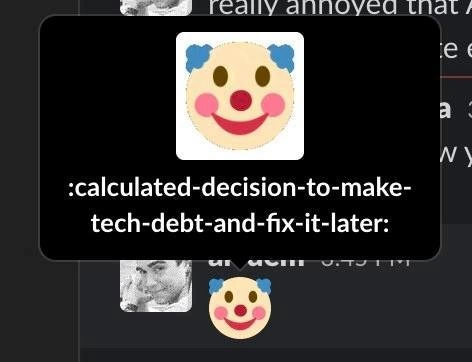
The entire engineering postmortem is compressed into one custom reaction: a smiling clown labeled :calculated-decision-to-make-tech-debt-and-fix-it-later:. The alias carefully preserves every respectable phrase used in the meeting—calculated, decision, technical debt, fix it later—while the picture supplies the team’s actual confidence in that plan. It is not mocking every shortcut. It is mocking the ritual in which a shortcut becomes “strategic” merely because everyone says the repayment sentence out loud.
Technical debt is a useful economic metaphor when a team knowingly accepts a future maintenance cost to obtain value now. Shipping a narrow implementation before a deadline, supporting one customer’s format with a temporary adapter, or duplicating a small component while the correct abstraction is still unclear can all be rational. Like financial debt, the trade can work when there is a reason to borrow, a known cost, and a credible repayment mechanism. The clown appears when only the borrowing is concrete.
The “interest” is paid through engineering friction:
- Every new feature must work around the shortcut.
- Tests become harder to write because boundaries are unclear.
- Engineers carry more exceptions in their heads.
- Incidents take longer to diagnose because the system no longer behaves uniformly.
- The original author leaves, taking the unwritten repayment plan with them.
None of those costs arrives as a tidy invoice named TECH_DEBT. They appear as slower estimates, regressions, onboarding difficulty, and mysterious production behavior. That invisibility creates the organizational anti-pattern behind the emoji: feature delivery is measured immediately, while maintainability pays off gradually and often benefits some future team. Under deadline pressure, the next visible feature repeatedly defeats the old invisible promise. “Later” is the most scalable backlog state ever invented.
A genuinely calculated decision would record more than good intentions. It would identify the compromised boundary, document why the shortcut is safe enough, contain it behind an interface or feature flag, add tests around the accepted behavior, assign an owner, and specify a repayment trigger. That trigger might be a date, traffic threshold, second customer, next major release, or measured rise in failure rate. Without such a condition, “we made a ticket” often means “we gave forgetting a database row.”
The best repayment is frequently incremental refactoring, not a heroic rewrite. Engineers can replace the compromised component behind stable tests, remove duplicated paths as nearby features are changed, or reserve regular capacity for high-interest debt. A full rewrite carries its own risk: old systems contain years of undocumented edge cases, and the new system can spend months rediscovering them with fresher branding. The clown has attended that kickoff too.
The chat interface matters. A custom emoji reaction is lightweight organizational memory: one click lets a teammate challenge a familiar rationalization without reopening the architecture debate in every thread. The absurdly long name makes the reaction searchable and painfully explicit, while the smaller clown visible beneath the popover shows it being used in conversation. The obscured background does not reveal the underlying dispute, so the screenshot stays universal; practically every development team can supply its own example.
There is also a communication trade-off. The reaction can be healthy shorthand among colleagues who share trust, or it can become a way to ridicule someone facing a real delivery constraint. The useful follow-up is not “never take debt.” It is: what are we buying, what interest do we expect, and what event forces repayment? If the group cannot answer those questions, the emoji has probably completed the design review.
The ':fix-it-later:' Jira ticket has been in the backlog so long it's now classified as a legacy system
The decision was calculated, but the repayment date evaluated to NaN.